月氏 Yuèzhī, literal “Clanul Lunii”/ joi 20 iunie 2019, 4.45 a.m.

June 20, 2019

Atentie!                                                                                                                                                                  Aceasta postare nu este o o descifrare sau citire a unui presupus continut scris real. Avand in vedere ca semnele nu apartin unui unic sistem de scris ci mai multora, pagina are un caracter pur didactic. Are rolul de a incerca si testa diferite scrieri in idea ca pe tablite s-ar fi folosit unul din ele. Semnele de pe tablite apartin mai multor sisteme de scrisi dintr-larg interval de timp si care au folosite in diferite arii geografice. In niciuna din incercari semnele nu s-au incadrat intr-un singur tip de scriere, totdeauna au ramas semne care au provenit din alte scrieri (sau din necunoscut). Cele mai multe semne provin din cele sumeriene proto-cuneiforme.Apoi privind asemanarea, in ordine descrescatoare este aceea cu semnele Linear A/B si cele Anatoliene. Semnele din jumatatea superioara a tablitei rotunde par a proveni din scrierea arhaica greceasca.Cel mai degraba aceasta “adunatura” de semne pare a fi rodul imaginatiei bogate a cuiva.Dupa cum au constatat A.Falkenstein si A.A.Vaiman, (aceasta fiind si parerea mea ferma) autorul nu a fost un scrib, avea doar vagi notiuni privind scrisul in general si nu se stie ce a urmarit. Exista multe elemente de neconcordanta precum si altele care scot tablitele din tiparele si normele uzuale ale  logicii, scrisului si intentiilor oneste. 

======                                                                                                                                                            月氏 Yuèzhī, literal “Clanul Lunii”/ joi 20 iunie 2019, 4.45 a.m. https://wordpress.com/post/tartariatablets.com/2161

**************   ATENTIE !   ****************                                                                                  UN CITITOR NEINITIAT IN PRIVINTA EVOLUTIEI SCRISULUI IN LUME AR PUTEA AVEA DIFICULTATI IN PRIVINTA BAGAJULUI FOARTE BOGAT SI DIVERSIFICAT DE SEMNE. CU RESPECT, SUGEREZ O TRECERE INITIALA IN REVISTA A LOR PE OMNIGLOT.COM                  *********************************************                                                                     PREZENTUL ARTICOL ESTE O IPOTEZA DE LUCRU, SI ARE LA BAZA O SUMA DE ELEMENTE FAPTICE DAR SI OBSERVATII SI ” STRANII? COINCIDENTE”, intamplatoare sau nu, urmeaza sa vedem.

  • Tablitele prezinta un grup aparent eterogen de semne folosite pe o lunga perioada de timp si pe largi arii culturale, din Orientul Apropiat pana in Europa.Cea mai buna caracterizare pe care o pot da este accea de COLECTIE DE SEMNE. Spre exemplu unele semne par a apartine perioadei arhaice grecesti.                                              
  • Inscriptia gasita la Sannicolau-Mare are litere grecesti, desi este facuta de o populatie asiatica de factura turcica=altaica. Se presupune ca ultimul val al unei asemenea populatii au fost avarii. Daca tablitele de la  Tartaria au fost inscriptionate de aceeasi populatie ca cea de la Sannicolaul-Mare, autoare a “BUYLA INSCRIPTION” !?
  • Sumerienii, dupa o ipoteza au origine asiatica, altaica:
                                                                                                                                                             Din pdfs.semanticscholar.org › …                                                                                                  Yet Another Suggestion about the Origins of the Sumerian …
    by I Kenanidis –

    << the Sumerian is not a language isolate, as it is regarded so far, but that it may be classified as an rAltaic language of the Bolgar branch.>>                                                          

  • Legatura geto-dacilor cu scitii, saka si KUSAN (Da yuezhi).                                                                                                                                                                                             Din https://www.romanianhistoryandculture.com/getaewhatsinaname.htm            <<  It is, therefore, not rare to read in Indian scriptures about the Sakas, Kushans (Da Yuezhi), and even the Hunas (White Huns or Ephthalites) being considered as Mlecchas (foreigners, outcastes), Asuras (demons), etc. (Dhillon 1994, 15). Similar perspectives are alluded to in Persian or Chinese texts.                                                       …..  Da (Greater) Yuezhi or in the earlier pronunciation d’ad-ngiwat-tieg, has been seen to equate with the Massagetae who occupied the oases and steppelands of West Central Asia in the time of Herodotus; here Massa renders an Iranian word for “Great,” hence “Great Getae.” … Others have seen in this word an attempt to capture in Chinese the name of a tribe that is rendered in Greek as the Iatioi who are recorded in Ptolemy’s geography. The original pronunciation has been reconstructed as gwat-ti or got-ti or gut-si, which opens up distant lexical similarities with the Goths (the German tribes of northern and eastern Europe), the Getae (the Dacian, i.e., Balkan, tribes northwest of the Black Sea), the Guti (a people on the borderlands of Mesopotamia), the Kusha (our Kushans), the Gushi (a people mentioned in Han texts and regarded as brigands along with the peoples of Kroran), or a combination of some but not all of the above (Mallory and Mair 2000, 98-99).

    This comparison of like-sounding tribal names, although merely a paragraph in length, could potentially generate volumes of discussion and can help us understand more definitively the nature of the barbarian invasions in ancient Rome, the powerful Kushan Empire in India, the possible origins of the Guti people, the Guti kings of Mesopotamia, and the similarity between the Goths, Getae, and the Yuezhi. Moreover, this opens up the possibility that at least some of the people termed “Scythians” were a single tribe — the Getae. So could there have been a nation of nomads who knew themselves as Gets, Gats, Guts, or Yuts?                                 ==============================                                                                                         Dupa mine tablitele nu sant nici pe departe atat de vechi pe cat s-a apreciat, in special in urma cu ani de zile.Situl de la Tartaria-Lunca se prezinta ca sediul mai multor culturi succesive.Una din cele mai recente este o fortificatie dupa cat se pare a tatarilor. 
  •   Din TĂRTĂRIA-GURA LUNCII. FORTIFICAȚIA MEDIEVALĂ TIMPURIE CARE TAIE TELLUL PREISTORIC Zeno-Karl Pinter
  •                                                                                                                                                             << În momentul de faţă, raportat la actualul stadiu al cercetării, suntem nevoiţi să avem în vedere două ipoteze de lucru privitoare la originea şi funcţionalitatea puternicei fortificaţii (Fig. 15 –conturarea tellului și fortificației) de la Tărtăria-Gura Luncii:
      1. O fortificaţie a tătarilor, un loc de adunare a cetelor tătărăşti înainte de atacul asupra centrului de

      putere de la Alba-Iulia.

    1. O fortificaţie a populaţiei din zonă, un punct de apărare şi în acelaşi timp de control al Văii

    Mureşului, în punctul cel mai bine plasat strategic, punct de control folosit încă în perioada hallstatiană şi apoi în secolele VIII-IX, aşa cum demonstrează descoperirile mai vechi, dar extrem de relevante, de la Blandiana şi Tărtăria.Pentru această ipoteză avem şi susţinerea singurului izvor scris: Carmen Miserabile în care clericul Roger (Rogerius) relatează în capitolul XL (40) despre existenţa unei populaţii numeroase în Transilvania, populaţie ce a ridicat numeroase fortificaţii după prima trecere a tătarilor spre vest, fortificaţii distruse însă, în cea mai mare parte de tătari, la întoarcerea lor spre Asia „…                                                                       ….. Dacă fortificaţia de la Tărtăria face parte dintre cele multe ridicate: „castra plurima preparata”, atunci este foarte probabil că este şi dintre puţinele nepustiite: „exceptis castris quibustam”, deoarece urme ale unei incendieri sau ale unui conflict armat nu au fost surprinse arheologic. Aceasta ar fi putut, de asemenea, să fie rezultatul „cruţării” fortificaţiei de la Tărtăria, în scopul folosirii ei drept loc de reşedinţă, drept centru de putere al noii forţe militare ce se impune, pentru foarte scurt timp în Transilvania, într-un loc apropiat de centrul ecleziastic şi politic de la Alba Iulia, un loc dominant şi un excelent punct de observaţie şi control.>>

  • ===============================================
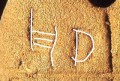
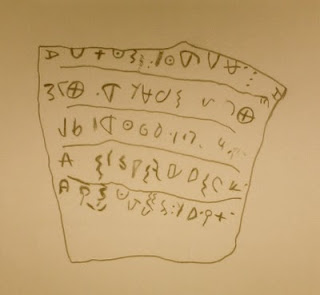
  • Foarte multi cercetatori nu au stiut ce interpretare sa dea semnului/semnelor “D” din tablita rotunda de la Tartaria.                                                                            Imaginea, http://aplaceofbrightness.blogspot.com/2008/11/moonlight-in-romania-tartaria-tablets_21.html
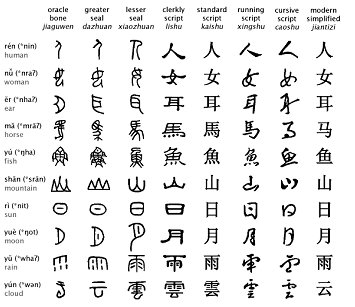
  • Unii au afirmat ca reprezinta Luna. Dar langa el, in tablita rotunda sfertul stg-sus avem acel semn care culmea, in scrierea veche chineza reprezenta in diferite perioade soarele sau luna.                                                                                                                     Din http://www.sunnyokanagan.com/joshua/Rabbit.html
  • M-am gandit ca poate avem Soarele si Luna !? Nota. Culmea este ca acest semn “H” in greaca este Heta/Eta si ma asteptam sa fie monograma lui Helios/ Elios, dar nu am gasit deloc asa ceva !

…..daca articolul postat in urma cu numai 2 zile l-am intitulat “Divertisment curios-dubios” acum zau ca nu mai stiu ce titlu sa dau articolului.                                            Acolo faceam referire la o inscriptie gasita in Romania la Sannicolau-Mare, care are semne asemanatoare celor de pe tablitelor de la Tartaria (cel putin in ceea ce o priveste pe cea rotunda).Articolul acesta se refera tot la o inscriptie gasita la Sannicolau-Mare. Harta, http://www.maplandia.com/romania/timis/timisoara/accommodation/sannicolau-mare/                                                                                                                                                       De fapt la Sannicolau-Mare sau descoperit mai multe inscriptii aflate pe mai multe artefacte.Pentru acestea exista lucrarile unui grup de cercetatori, ca de exemplu: VEKONY, András; Róna-Tas /Ungaria,                                                                                          Eugene HELIMSKY/ Hamburg si                                                                                                    José Andrés ALONSO DE LA FUENTE (Vitoria/Barcelona)                                                             

ACUM ESTE VORBA DE INSCRIPTIA BUYLA                                                                                                                                                                                                                                                           On probable Tungus-Manchurian origin of the Buyla inscription from Nagy-Szentmiklós (preliminary communication) Eugene Helimski (Hamburg) Studia Etymologica Cracoviensia 5 (2000) Kraków 2000 http://www.kroraina.com/hungar/helimski.htm

1.1. The famous treasure of Nagy-Szentmiklós was found exactly two hundred years ago, in 1799. It consists of 23 gold bowls, dishes, jars, and cups, and belongs now to the exposition of the Kunsthistorisches Museum in Vienna. It was found in Banat, near the village of Nagy-Szentmiklós (today Sînnicolau Mare, to the north-west of Temesvár-Timişoara). The detailed description of the treasure and the history of studies is given in László, Rácz 1983; see also an ample bibliography compiled by Mária Ivanics (in Göbl, Róna-Tas 1995: 59-77).

There are no direct indications for dating and attribution of the objects. Most estimates place them in the period between the 5th and the 10th centuries, the first half of the 9thcentury being the most wide-spread (and still, rather likely then proven) dating, see Róna-Tas 1990: 9; in his more recent publication András Róna-Tas (1997: 110) gives however preference to the second half of the 8th century . Therefore the treasure is usually referred to as “Avar” or “Late Avar”, sometimes also as “Protobulgarian” (e.g. Mavrodinov 1943 as well as later literature from Bulgaria). This, however, does not necessarily characterise its provenance: as far as analogues to goldsmiths’ work, vessel forms, pictorial representations, and ornamental motives are concerned, references has been made to the Carpathian basin and to the entire Eurasian steppe zone, to Byzantium and to Southern Europe, to the Caucasus and to Iran.

1.2. The objects belonging to this treasure have inscriptions of three kinds which received recently a detailed palaeographic analysis in Göbl, Róna-Tas 1995. An inscription in Greek (the reading of which remains non-unproblematic, see Vékony 1973) is repeated twice on two paired bowls. The famous “Buyla inscription” (Inscr. 17 on buckled bowl [Schnallenschale] XXI) is written also with Greek letters, but in a non-Greek language.13 objects have short inscriptions written with an unknown script of the “runiform” type.

It has been confirmed many times and by various study methods that the Nagy-Szentmiklós inscriptions differ not only in language and script, but also were not made by the same hand and therefore may originate from different (geographically as well as chronologically) artisan shops – as well as the gold objects themselves. “ ……………………………………………………………………….

However, this circumstance could not be taken into consideration in the numerous attempts to decipher the text: the Turkic languages do not know an ending like –Vgi in systematic grammatical use.

It is Tungus-Manchurian that fits this demand: here one of the most frequent, wide-spread and archaic verbal forms of 3Sg. is reconstructed as *-ra-gī (with harmonic variants like *-re-gī and with variants determined partly by the assimilation of the initial consonants and partly by the conjugation class like *da-gī,                               …………………………………

3. It is almost universally assumed that the engraver – poor devil! – knew neither the Turkic language nor the Greek script, and that nobody possessing this knowledge cared to control his work. The entire philological experience proves, however, that assumptions of that kind (and they occur, regretfully, too frequently) signalise only the inadequacy of interpretations – not of the texts in question. ============================                                                                                                  Desi am citit cel putin unul din studiile care se refera la aceasta inscriptie, acum cativa ani, doar ieri “mi-a picat fisa”, respectiv mi-au atras atentia cateva lucruri, ca de exemplu acestea doua:                                                                                                                                        Primul :     avem in inscriptia de la Sannicolau-Mare cuvantul:                                                 “4.3.3. ΗΤΖΙΓΗ.

The participial aorist of TM *iče– ‘to see, to observe’ should be probably reconstructed as *eregī or (if the stem belonged to the conjugation classes II or III, see Benzing 1955: 123-128) resp. *ičesegī or *ičedegī. However, the consonantal stem in Even – and Orok it-, as well as the variation of vowels in the second syllable in the derivatives of other TM languages (cf. Evenki ulī– ‘to check, to investigate’, Nanai uči– ‘to show’, Solon isȫ– ‘to appear’, see TMS 2: 334-335)/”

Acest ΗΤΖΙΓΗ mi-a sunat al dracului de asemanator cu IZIGI, ICIGI, YAZIGI !                                  Al 2-lea:

Am gasit in alta lucrare referitoare la aceasta inscriptie, ca in familia limbilor altaice, mai precis in subfamilia limbilor tungusice, in limba OROK, exista o structura gramaticala (sufix) -DDoo. Adica exact cum avem pe tablita rotunda de la Tartaria !          De data asta avem DDoo numai daca folosim literele grecesti

Din  https://www.jstage.jst.go.jp/article/gengo1939/1956/30/1956_30_77/_pdf                            by J IKEGAMI

INFLECTION OF OROK  The substantive endings are as follows.
-ba•san object which is subjected to motion .•t
-la•sa place, with some extension in space or time, where motion
occurs or a state exists.•t
-ndoo•sa co-agent.•t
-ddoo•s’as (something) designated for someone.’•t                                                                    …
the simple designative case-ending -ddoo can appear as a word. 

Din https://www.academia.edu/16685926/Manchu_Etymological_Dictionary_-_HANDOUT    urchen dedu-           to sleep

Daca folosim alfabetul khazar, avem DDoo=”jjmb”? “jjmm=iimm“?

Din khazarian culture and its inheritors – Jstor   https://www.jstor.org/stable/10.2307/23682777  by A ZAJĄCZKOWSKI –

“umma (iimm‘at) “congrégation, corn munity of  .

ATENTIE,                                                                                                                                     TEORETIC SI PRACTIC, TABLITA SE POATE CITI FOLOSIND ALFABETUL KHAZAR SAU ALFABETUL GREC, ORI ARHAIC GREC, ASA CUM ACESTA DIN URMA S-A FOLOSIT CU PRECADERE PE INSCRIPTIILE DE LA SANNICOLAU-MARE.     

Din https://www.omniglot.com/writing/khazarianrovas.htm

INSA CRED CA ORICINE REALIZEAZA SI ESTE O CHESTIUNE DE LOGICA SI BUN-SIMT CA NU SE POT FOLOSI AMBELE SIMULTAN !                                                                                                     ======================

In postarea trecuta, am identificat in semnele  folosind alfabetul runic khazar, literele CS(Ci) respectiv J(i).In acest caz am putea avea,citind de la dreapta la stanga ICsI (ICI) si de la stg. la dreapta “CsI ” .(Vezi mai sus in Even,   , iar in TM(tarim-manciurian?) *iče :”a vedea, observa“)                                                                                       Nota.                                                                                                                                                        Nu este momentul sa ma grabesc afirmand cu certitudine ca aceasta portiune are scrisul de la dreapta la stanga, ori invers, atata timp cat rezultatul este asemanator (ICI visa Ci), nici in privinta citirii ; In fond nu ma fugareste nimeni!

Din lucrarea de mai jos,

 José Andrés ALONSO DE LA FUENTE (Vitoria/Barcelona)

TUNGUSIC HISTORICAL LINGUISTICS ANDTHE BUYLA (A.K.A. NAGYSZENTMIKLÓS) INSCRIPTION*

                                                                                                                                                                << VIIicigi(ī-,y-,ī)icigii icä-rä.gii-Ø{see-PRT.AOR-3SG}iči-y.i < *iči-g-i{drink-DER-3SG.POSS}[izafet construction? >>

chiar componenta denominarii triburilor  ičigi=  ICIGI, IZIGI, YAZIGI.

Din https://dictionary.hantrainerpro.com/chinese-english/translation-zhi_classifier.htm      English translations : classifier, single, alone, odd number

之 (of) , 支 (to support) ,  (branch) 汁 (juice) , 知 (to know) , 织 (to weave)

Din (PDF) Origin of Yuezhi Tribe | Adesh Gurjar – Academia.edu   https://www.academia.edu/31033336/Origin_of_Yuezhi_Tribe                                               ” In Chinese , Tocharians were mentioned are Yuechi, which means Moon –Tribe

Din https://en.wiktionary.org/wiki/Yuezhi                                                                 ” Etymology From Mandarin 月氏 (Yuèzhī, literally Moon Clan) or 月支 (Yuèzhī, literally Moon Branch).                                                                                                         Yuezhi pl (plural only)                                                                                                                        1.An ancient Indo-European people who originally settled in the arid grasslands of the eastern Tarim Basin area, in what is today Xinjiang and western Gansu, in China, before migrating to TransoxianaBactria and then northern South Asia, where one branch of the Yuezhi founded the Kushan Empire.                                                            Synonyms Rouzhi ”

Din https://alchetron.com/Yuezhi

————————————————————

Apoi mai ramane de vazut ce rol are, cum se interpreteaza acea structura -DDoo.           

Din http://aplaceofbrightness.blogspot.com/2008/11/moonlight-in-romania-tartaria-tablets_21.html

                                                                                                                             Din lucrarea de mai jos,                                                                                                                   <<Language   Ending      Description                    Reference                                                                      Orok     ddoo–    + POSS.REF.Partitive    Petrova (1967: 51–52) >>

 José Andrés ALONSO DE LA FUENTE (Vitoria/Barcelona)

TUNGUSIC HISTORICAL LINGUISTICS ANDTHE BUYLA (A.K.A. NAGYSZENTMIKLÓS) INSCRIPTION* https://www.academia.edu/14286788/Tungusic_Historical_Linguistics_and_the_Buyla_a.k.a._Nagyszentmikl%C3%B3s_Inscription

                                                                                                                                                                  “1. Introductory remarks
In a series of articles, the late Eugene Helimski (2000a, 2000b, 2003, 2004)argued that an aberrant form of Tungusic could have entered the Carpathian basin during the Avar period,the only evidence of which is preserved in the Buyla(or Boyla/Boila) inscription and a handful of words found in the classical sources on the Avars. Moreover, it is possible to infer from the wording of the author that the Avar confederation could have been constituted, among many other un-known nations, by a small contingent of Tungusic individuals (Helimski 2000b:
53 fn. 12). It was the Tungusic reading of the Buyla inscription that led him to
this conclusion.Tungusic is one of the many indigenous ethnolinguistic groups of the Asian continent, its current habitat covering most of Eastern Siberia and Manchuria.Speakers of the Northern Tungusic languages can be found in Central and Northeastern China, whereas the bulk of the Southern Tungusic speakers concentrates in the Amurian region and the Northernmost part of the Sakhalin Island.
Manchuric speakers aside, about which we know a great deal thanks to Chinese
sources, the Siberian Tungusic were first reported at the very beginning of the17
th century. The time depth of the Tungusic language family is very shallow,
with Manchuric being the most aberrant group (specialists consider this condition

to be the result of Mongolic and Chinese influence)

The Avar-Tungusic theory is indeed a bold proposal. If it turns out that
Helimski is right, then the Buyla inscription would instantly become the oldest linguistic monument in any Tungusic language, washing away even the earliest Jurchen records. In spite of the apparent relevance of such a statement, Helimski’s proposal was passed over in silence in the Tungusic specialist literature. No less surprising is to nd out that critics from other areas disregard the Tungusic na-ture of the Buyla inscription without discussing its substance. They are usually
Turcologists believing that the only possible reading of the inscription has to be
Turkic. The most explicit statement was made by Erdal: “[…] the hypothesis is,
however, arrived at by some arbitrary stretching of Tungus data, [it] is far-fetched
 by itself and is therefore rather unlikely” (2007: 79).Erdal did not go into great
detail in order to explain the reader what the “stretch of the Tungus data” involved.Therefore, the general opinion is that the Tungusic reading of the Buyla inscription is wrong,but no one can explain why that is so.
The main goal of this paper is to provide the reader with an evaluation of
Helimski’s hypothesis based on the Tungusic data. Neither the geopolitical scenario
set up by Helimski (or by any other author for that mater) nor the paleographicalanalysis of the inscription shall be discussed at large in the present contribution.The former issue seemingly depends in its entirety on the linguistic hypothesis thateach of the author endorses.As for the latter, the topic has been approached by specialists much more qualied than the present author (see
i.a. Róna-Tas 2001)

                                                                1.

From the viewpoint of European history, the so-called Asian Avars are traditionally identified as the Ruanruan (402–555). The term Avars refers to the European Avars (567–822), i.e. the Asian Avars that entered Europe in 555 AD (see i.a. Pohl 2002).
The Nagyszentmiklós treasure to which the Buyla inscription belongs (see §2 below)
is associated with the last remnants of the European Avar culture, i.e. the one whichspread over the Carpathian basin during the 8th –9th centuries.                    Good summaries withadditional literature of the two major competing interpretations regarding the ethno-linguistic afinities of the Ruanruan can be found in Golden (1992: 76–79), who presents the traditional position that the Ruanruan were actually a Mongolic language population, and Janhunen (1996: 190), who believes that the linguistic core of the Ruanruan was Turkic. Beckwith (2009: 390–391) points out that “[c]areful study of
the Jou-jan [= Ruanruan] names in the Chinese sources could shed light on the eth-nolinguistic afinities of the Jou-jan; until that is done, speculation on the subject is
 premature.” In the same vein, see Vovin’s remarks (2007: 180, 184–185). Incidentally,
the hypothetical connection between the ethnonyms ruanruan and ju()cen ‘Jurchen
echoed by Helimski (2000b: 137) is most likely false and should be abandoned (for the
etymological intricacies of the term ju()cen, see Janhunen 2004).
 As is custom in recent specialist literature on Tungusic linguistics and in agree-
ment with some of the ideas by Janhunen on phonological transcription (1987, 1996:
xiii–xiv), Helimski’s ‹e› has been replaced with ‹ä›, ‹j› with ‹y›, ‹ʒ & ǯ› and ‹c & č›
merged in ‹j› and ‹c›, respectively, vowel length is written with double-vowels. Other
conventions: Northern Tungusic (= Northwestern: Ewenki, Ewen, Solon, Negidal,
Arman, Udihe), Southern Tungusic (= Amurian Tungusic: Oroch, Nanay, Kilen, Kili,
Ulcha, Orok), with Udihe and Oroch serving as a bridge between one branch and the
other, Manchuric (Early and Late Jurchen, Written Manchu [= WM], Spoken Manchu
and Sibe), Common Tungusic [= CT] (all languages but Manchuric, i.e. NorthernTungusic + Southern Tungusic), and Proto-Tungusic (= Pan-Tungusic = CommonTungusic + Manchuric). “Lit.” stands for “Literary”, and ‹-n› for (lightly) nasalized
nal vowel. The difference between Proto-Tungusic and Pan-Tungusic is that the latter
does not make any claims regarding the (genealogical) inheritance of a given word,
i.e. it may refer to both inherited and borrowed terms (see for instance the presence of

English loanwords across entire linguistic families: they are common, pan-elements, but not proto-elements; the former emphasizes the synchronic distribution, the latter its diachronic depth).It may be worth noting that the Middle Amur region is commonly identified as the most likely Urheimat for the parental language from which all the Tungusic languages descend (see general discussion in Janhunen 1996: 167–172, and also Janhunen 1985, 2012,2013: 27–28; for further details on the Northern Tungusic expansion, see Atknine 1997and, for the larger Altaistic perspective, see Miller 1994).       4 Berta/Róna-Tas (2011: 1163) claim that both Helimski’s hypothesis and Futaky’s Hungaro-Tungusica (see Excursus below) have been refuted somewhere else (Kara 2002 and Róna-Tas 2003). Unfortunately, the references provided by the authors concerns only Futaky’s work, with no mention whatsoever to the work of Helimski on the Buyla inscription. As shall be shown, Helimski’s and Futaky’s works require the adoption of different approaches, put another way, the conclusions of criticizing one, while having an impact to certain degree, cannot be uncritically applied to the other. This opinion is echoed in one of the obituaries about Helimski (Janhunen 2009:368–369, see also Janhunen 2013: 55 and Szalontai/Károly 2013: 367). Stachowski (2004) has spoken in support of Helimski’s hypothesis, at least as far as the possibility of identifying a Tungusic substratum in Europe is concerned, and made what seems best use of it by proposing a new etymology of English sabre (← French ←German ← Hungarian ← Avar? ← Manchu seleme ‘a dagger carried at the belt’ and other Tungusic related terms). However, there is no harm whatsoever in removing the Tungusic substratum element of the equation. This etymology can be judged in its own merits assuming, for instance, that sabre is a Kulturwort/Wanderwort. There is a causal relationship between linguistics and geopolitics. This fact apparently renders them incompatible with each other: if one claims that the Buyla inscription reflects a Turkic language, then it cannot be argued that the Tungusic were to be counted among the (Asian) Avars, and vice versa. But since the Avars were a multiethnic state, the idea that both Turkic and Tungusic populations may have been a part of it cannot be rejected out of hand. Be that as it may, it is necessary to highlight that Helimski’s hypothesis is coherent from the geopolitical, historical and linguistic viewpoints: it is theoretically plausible that (1) a fraction of the original Ruanruan population was Tungusic, (2) that fraction might have fled westwards to Europe after the attack of the Turkic-Chinese alliance in 552, (3) a linguistic substratum may have survived in the languages of the Carpathian basin region. The plausibility of this scenario set up by Helimski is what makes it unique: although everything sounds perfectly logical, it is totally indemonstrable unless very convincing linguistic evidence is presented. In the discussion below, it will be shown that the linguistic evidence actually does not stand up to serious scrutiny.                                        ~~~~~~~~~~~~~~~~~~~~~~~~~~~~~~~~~~~~~~~~~~~~~~~~~

ACUMA SE PARE CA CEATA GROASA CARE INVALUIA TABLITELE DE LA TARTARIA INCEPE SA SE RISIPEASCA                                                                                                                                                                                                                                                                                     O SERIE DE ASPECTE NEELUCIDATE SI PARTICULARITATI ALE SCRISULUI SE LAMURESC                                                                                                                                                                                                                                                                                                    ASUPRA PROBITATII DESCOPERITORULUI N.VLASSA NU A FOST NICI-O INDOIALA, TOTUSI TABLITELE AU PARUT A PROVENI DIN NEANT.
ORIGINEA SI PROVENIENTA LOR NU A PUTUT FI NICI PE DEPARTE LAMURITA                       ~~~~~~~~~~~~~~~~~~~~~~~~~~~~~~~~
1, Tablitele sant autentice si gasite de Vlassa cu echipa.                                                                 Este firesc sa fi fost derutat in privinta scrisului, nefiind specialist in epigrafie.                       Ce sa mai zic de altii; puteti constata cum specialisti de varf (asirologi si specialisti in proto-scriere s-au incurcat in hatisurile propriei lor specialitati)                                                                                                                                                                                                                     2. Nu sant nici pe departe atat de vechi.  Sant departe de orice estimare de vechime.          Par a fi opera unui membru al valurilor de popoare migratoare de factura altaic-mongolica.                                                                                                                                                                                                                                                                                                        3.Scriitorul nu stapanea prea bine scrisul.                                                                                           ” It is almost universally assumed that the engraver – poor devil! – knew neither the Turkic language nor the Greek script, and that nobody possessing this knowledge cared to control his work.”                                                                                                                           In acest moment inca nu pot afirma daca este vorba de litere provenind din alfabetul arhaic grecesc ori din alfabetul khazar.                                                                                          “may originate from different (geographically as well as chronologically) artisan shops -”   Oricum nu facea parte din popoarele cu mare si indelungata traditie de scris, altfel traditia culturala este o cu totul alta chestiune.
4. Fiind relativ noi si provenind de la populatii care au “maturat” o arie extrem de larga, se explica “achizitia” atator semne provenind din diferite locuri si timpuri.                     Cercetatori de marca (A.Falkenstein, Aisic Abramovici, Rumen Kolev si altii) s-au incurcat si pacalit incercand sa faca citiri folosind semnele sumeriene proto-cuneiforme.
5.Intamplarea face ca este vorba chiar de populatiile unde s-a inventat samanismul
6. Cred ca realizati ca exista o legatura (asa cum de zeci de ani au supozitionat cercetatorii) intre populatiile Kushan/ Samara/SAKAYUE-ZI (citeste yue-tchi=yue-ci), YAZIGI si DACI !                                                                                                                                Ca sa nu mai spunem ca pecenegii,bulgarii,cumanii, avarii erau diferite ramuri si populatii care secole la rand au venit din Asia in Europa.

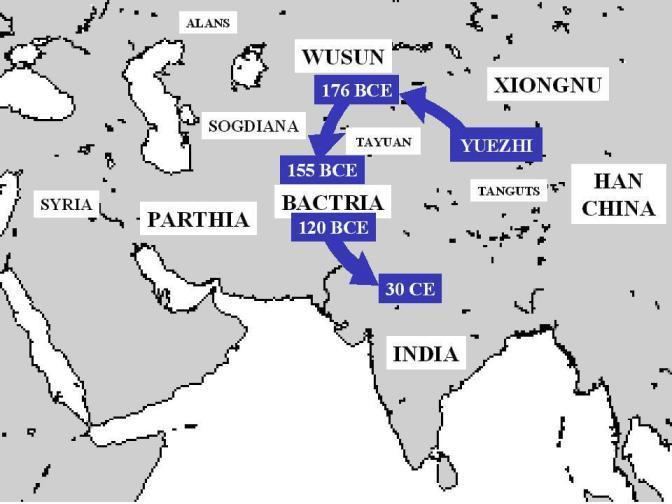
https://en.wikipedia.org/wiki/YuezhiThe Yuezhi (Chinese月氏pinyinYuèzhīWade–GilesYüeh4-chih1[ɥê ʈʂɻ̩́]) were an ancient Indo-European[5][6][7][8] people first described in Chinese histories as nomadic pastoralists living in an arid grassland area in the western part of the modern Chinese province of Gansu, during the 1st millennium BC. After a major defeat by the Xiongnu in 176 BC, the Yuezhi split into two groups migrating in different directions: the Greater Yuezhi (Dà Yuèzhī 大月氏) and Lesser Yuezhi (Xiǎo Yuèzhī 小月氏).

The Greater Yuezhi initially migrated northwest into the Ili Valley (on the modern borders of China and Kazakhstan), where they reportedly displaced elements of the Sakas. They were driven from the Ili Valley by the Wusun and migrated southward to Sogdiaand later settled in Bactria, where they then defeated the Greco-Bactrian Kingdom. The Greater Yuezhi have consequently often been identified with Bactrian peoples mentioned in classical European sources, like the Tókharioi (Greek Τοχάριοι; Sanskrit Tukhāra) and Asii (or Asioi). During the 1st century BC, one of the five major Greater Yuezhi tribes in Bactria, the Kushanas(Chinese貴霜pinyinGuìshuāng), began to subsume the other tribes and neighbouring peoples.

7. Altfel daca este vorba de influenta Mongola si chineza:”

“The time depth of the Tungusic language family is very shallow,
with Manchuric being the most aberrant group (specialists consider this condition
to be the result of Mongolic and Chinese influence)”,                                                               am putea lua in considerare si ipoteza ca semnele
 au reprezentat la Chinezi stralucire/ soarele (Ri) si Luna (Yue)
O alta ipoteza:                                                                                                                                 Daca secventa HD se citeste ICI, *iče :”a vedea, observa“, ar fi oarecum la indemana sau comod ca in jumatatea de sus a tablitei rotunde sa avem in stanga “a vedea, observa iar in dreapta sa avem, de ce nu, fazele lunii !
===========================================
DOCUMENTARE

Далай-лама: Монгольским племенам нужно развивать в себе дух …

savetibet.ru/2008/05/28/mongolia.html

https://en.wiktionary.org/wiki/%C3%B6r%C3%B6k                                                     EtymologyProbably from a Turkic language before the times of the Hungarian conquest of the Carpathian Basin (at the turn of the 9th and 10th centuries).                                        Adjective örök (not comparable) 1.eternal

Yuezhi 月氏, Tokharians                                         http://www.chinaknowledge.de/History/Altera/yuezhi.html

########################################

Acum, desi demonstratia de mai sus poate fi tentanta, atractiva si eventual convingatoare, totusi dupa mine raman doua ipoteze  privind originea tablitelor, amandoua aproape egal de valabile,fiecare cu cate un set de argumente pro si contra.

IPOTEZA MIGRATIEI DIN ASIA

PLUSURI:                                                                                                                                                  – migratiile au existat in realitate si au lasat urme in Romania                                               – se imbina cu originea dacilor prezumata cu zeci de ani in urma de oamenii de stiinta    – daca ar avea legatura cu populatia Kushan, populatia rezulta a fi Indo-Europeana            – nu se mai pune problema cum au aparut sau cine le-a adus                                                 – sau mai gasit la noi inscrptii asemanatoare e adevarat putine dar exista.Dispare problema unicatului.                                                                                                                          – o serie de aspecte si inadvertente se lamuresc cu aceasta ipoteza (saman, cum putea cineva sa cunoasca atat de multe semne din trecut si aproape de prezent)                             –explica prezenta semnelor D, chiar in portiunea suspicionata ca ar contine un mesaj scris concret.

MINUSURI:                                                                                                                                               – rezulta o vechime foarte mica a tablitelor                                                                                   – artefactele gasite in apropiere par a indica o alta origine, Egeeana/Cicladica?                  – daca populatia are legatura cu avarii,tungusii si te miri care, acea populatie nu afost Indo-Europeana                                                                                                                                     – daca ar avea legatura cu populatia Kushan, aceea folosea alt tip de scris!                            – asemanare maxima (per global) a semnelor cu cele sumeriene proto-cuneiforme, asemanare urmata de cele anatoliene(cariene) si scrierile Cretane.                                          – semnele D nu apar decat dupa 1800 B.C. in scrierile veche canaanita si greaca arhaica.

IPOTEZA UNEI ORIGINI MAI APROPIATE, EUROPENE                                                                                                                                                                                                                     PLUSURI                                                                                                                                                    – varsta posibil mult mai mare                                                                                                          – artefactele din apropiere sant similare celor Cicladice -; pot fi la o adica chiar si cariene                                                                                                                                                     – exista sanse pentru o transmisie a semnelor dinspre Sumer via Siria, aria Egeeana si in consecinta, posibil  varsta inca mult mai mare                                                                          – asemanare maxima a semnelor (in ordine) cu cele: Sumeriene, Anatoliene/Egeene

MINUSURI                                                                                                                                               – deplasari de populatie dinspre zona Egeeana inspre nord improbabile, mai probabile invers                                                                                                                                                       – ramane mica problema unde au fost inscriptionate tablitele ori cine le-a adus               (ramane ipoteza calatorului/ comerciantului “ratacit” )                                                                 – nu mai exista ceva asemanator pe la noi sant unicat                                                                – nu s-au folosit semnele D in proto-scrierea sumeriana nici in cele Egeene, ci doar in cele vechi-canaanite si arhaice grecesti.

DOCUMENTATIE ADITIONALA

1. AMULETS.                                                                                                                              Among the Tungus groups and Manchus there is a belief that there are various things which may bring luck in different branches of human activity. Such things are usually incidentally found in the form of natural abnormalities, monstrosities, rare unknown things, etc. If the Tungus happen to learn something new along this line they include it into their complex without any hesitation. Owing to this there now is in vogue a belief into the possibility of finding treasures, ever-lasting food, etc., borrowed from the Chinese, Mongols and even Russians. The function of the amulets in Tungus life is not great, but they never refuse to collect them and keep, for nobody exactly knows what is true and what is not, but to keep these things is not difficult. Yet one likes to have a hope of finding a fortune, or luck. The coincidence of «luck» with finding or using amulets often brings confirmation of the supposedly existing correlation between amulets and luck. Owing to the character of this hypothesis of the amulets and particular hypotheses regarding relationship between particular amulets and particular forms (cases) of luck are subject to great variations, not only among the ethnical groups but also in the life of generations and individuals. I will here give a list of amulets which, as a matter of fact, may be extended by more detailed investigation of the groups and even individuals. Naturally the amulets are much more fashionable among the Tungus who are in close contact with the other ethnical groups, and especially among those who are under the Chinese influence.

The amulets are called among the Manchus and Tungus groups influenced by them, — bobai, [cf. Dahur baobai (Poppe), – «precious», «precious thing»; Manchu baobai (Zaxarov), – id. from Chinese bao-bei] while among the reindeer Tungus of Manchuria and those of the Amur Government it is called ajeya. Amulets may be carried on the cradles, with the tobacco bag, attached to the spirits. Many amulets have been formed from the placings for spirits and special things used for protection. Therefore to establish the line of demarcation between an amulet and former placing for spirits or protector against them, is impossible. Such is also the Tungus attitude in this matter. If such an amulet is found and if it is followed by luck in hunting there must be given sacrifice to the local spirits or to the spirit which is held responsible for the success.                                                                           Once I met with the hypothesis that all amulets are produced by the spirits and therefore one must consider any amulet as indicative of future luck to be produced by the spirits, — the spirits therefore must have regular sacrifices from those who carry the amulets, and if the sacrifice is not given it will be very bad for those who carry the amulets.                                                                                                            Indeed, this idea puts a certain limitation upon the collecting of amulets. However, this is not a general belief.

Here are a few examples of articles used for amulets: ……………………………”

Din [PDF] S. Starostin. Tungus- Manchu etymology                                   https://www.bulgari-istoria-2010.com/Rechnici/TMS.pdf

Proto-Tungus-Manchu: *epu

Altaic etymology: Altaic etymology
Meaning: 1 elder sister’s husband 2 grandfather, elder relative 3 bear 4 father’s elder brother
Russian meaning: 1 муж старшей сестры 2 дед, старший родственник 3 медведь 4 старший брат отца
Negidal: epo, epa 4
Spoken Manchu: efū 1 (905)
Literary Manchu: efu 1
Orok: ēpi2, epeke 2, 3
Proto-Tungus-Manchu: *sebe-
Altaic etymology: Altaic etymology
Meaning: 1 ghost (shaman’s aid) 2 idol 3 God                                                                 (eugenrau:Tartaria tablet                                                                                                                     Se                                                                                                                                                              D b o o )
Din https://www.bulgari-istoria-2010.com/Rechnici/TMS.pdf
Proto-Tungus-Manchu: *dēdu Altaic etymology:
Meaning: to care, like, love
Russian meaning: любить, оберегать, уважать
Negidal: dēdeluUlcha: dēdu(n)
Nanai: dēdu
Oroch: deduli
Letters on tablet: D D o u >reading> DeDou= Dedu
Proto-Tungus-Manchu: *pedēAltaic etymology:
Meaning: to ford, cross over
Russian meaning: переехать, переправиться
413
Evenki: hedē
Proto-Tungus-Manchu: *ēdeAltaic etymology:
Meaning: 1 silly 2 defect, shortcoming
Russian meaning: 1 глупый 2 недостаток, увечье
Literary Manchu: eden 2
Ulcha: ede(n) 1
Nanai: ēdẽ 1
Oroch: ede 1
Udighe: ēde 1
Proto-Tungus-Manchu: *arAltaic etymology:
Meaning: 1 to make, work, construct 2 to come to one’s senses 3 to cause fear (оf an evil ghost), to appear in one’s imagination 4 shape, form 5 evil spirit
Proto-Tungus-Manchu: *erü-n
Altaic etymology:
Meaning: time
Russian meaning: время
Even: eri
Negidal: ejun
Spoken Manchu: erin (2648)
Literary Manchu: erin
Jurchen: erin (89)
Ulcha: eru(n)
Orok: eru
(n) / eri(n)
Proto-Tungus-Manchu: *eriAltaic etymology:
Meaning: 1 to breathe 2 breath 3 soul
Russian meaning: 1 дышать 2 дыхание 3 душа
Evenki: erī- 1, erīn 2, 3
Even: eri- 1, erin 2
Negidal: ejī- 1, ejgen 2, 3
Spoken Manchu: erǝxǝn ‘breath, life’ (39, 693, 2965)
Literary Manchu: erge- ‘to rest’, ergen 2, 3
Jurchen: erin-he ( = erhen) (517)
Ulcha: ersi- 1, erge(n) 2
Orok: er(i)- 1
http://starling.rinet.ru/cgi-bin/response.cgi?root=config&morpho=0&basename=%5Cdata%5Calt%5Caltet&first=461
Proto-Altaic: *ĕ̀r a
Nostratic: Nostratic
Meaning: to be
Russian meaning: быть
Turkic: *er-

Mongolian: *ere-

==============================================================
Din http://www.jstage.jst.go.jp › article › gengo1939 › _pdf                                                                      1. In Orok (Orokko), a dialect of Tungus,(1) substantives are …
https://www.jstage.jst.go.jp/by J IKEGAMI – ‎1956 
                                                                                                                                                                   [ In Orok (Orokko), a dialect of Tungus,(1) substantives endings:                                                                       –ddoo    <”as. (something) designated for someone’> ]

Din

Tungus etymology :

http://starling.rinet.ru/cgi-bin/response.cgi?root=config&morpho=0&basename=dataalttunget&first=1581

OROK , ER:”suflet”
OROK  sufix –DDOO “pentru
ER-DDOO = PENTRU SUFLET (al cuiva)
Proto-Tungus-Manchu: *irg[ü]

Altaic etymology: Altaic etymology

Meaning: 1 brain 2 head
Russian meaning: 1 мозг 2 голова
Evenki: irge 1
Even: irgъ 1
Negidal: igge / ijge 1
Spoken Manchu: uǯu 2 (1)
Literary Manchu: uǯu 2
Jurchen: (h)u(i)ǯew (492) 2
Ulcha: iǯe 1
Orok:īde1
Nanai: īge 1
Oroch: igge 1
Udighe: igi 1
Solon: igge, irge 
IDE-DDOO = “destinat/pentru MINTE” 
Proto-Tungus-Manchu: *sē

Altaic etymology: Altaic etymology

Meaning:year, age
Russian meaning: год, возраст
Spoken Manchu:  (2725)
Literary Manchu: se
Jurchen: sejŋ-ŋer (82)
Ulcha: 
Nanai: 
Oroch: 
Udighe: se
           SE                                      AN/VARSTA
IDE-DDOO = CAP/MINTEdestinat/pentru   , (? in plus.  +++++ reprez.50 ani. ?)
             SE                     VARSTA
ER DDOO = SUFLET(ului)DESTINAT
(in greaca +++ Xi, Xe  ; Xero~SERo)
~~~~~~~~~~~~~~~~~~~~~~~~~~~~~~~~~~~~~~~~~~~~~~~~~~~~~~~~~~~~~~
sau       <<Language   Ending      Description                    Reference                                                                      Orok     ddoo–    + POSS.REF.Partitive    Petrova (1967: 51–52) >
                                                                                                                                                                 ER –DDOO :” AL SUFLETULUI”

Divertisment curios-dubios

June 12, 2019

Atentie!                                                                                                                                                       Aceasta postare nu este o o descifrare sau citire a unui presupus continut scris real. Avand in vedere ca semnele nu apartin unui unic sistem de scris ci mai multora, pagina are un caracter pur didactic. Are rolul de a incerca si testa diferite scrieri in idea ca pe tablite s-ar fi folosit unul din ele. Semnele de pe tablite apartin mai multor sisteme de scrisi dintr-larg interval de timp si care au folosite in diferite arii geografice. In niciuna din incercari semnele nu s-au incadrat intr-un singur tip de scriere, totdeauna au ramas semne care au provenit din alte scrieri (sau din necunoscut). Cele mai multe semne provin din cele sumeriene proto-cuneiforme.Apoi privind asemanarea, in ordine descrescatoare este aceea cu semnele Linear A/B si cele Anatoliene. Semnele din jumatatea superioara a tablitei rotunde par a proveni din scrierea arhaica greceasca.Cel mai degraba aceasta “adunatura” de semne pare a fi rodul imaginatiei bogate a cuiva.Dupa cum au constatat A.Falkenstein si A.A.Vaiman, (aceasta fiind si parerea mea ferma) autorul nu a fost un scrib, avea doar vagi notiuni privind scrisul in general si nu se stie ce a urmarit. Exista multe elemente de neconcordanta precum si altele care scot tablitele din tiparele si normele uzuale ale  logicii, scrisului si intentiilor oneste.

======                                                                                                                                                           Divertisment curios-dubios, sau loc de dat cu capul. Din Alsószentmihály inscription (INSCRIPTIA DE LA SANNICOLAU-MARE) https://en.wikipedia.org/wiki/Als%C3%B3szentmih%C3%A1ly_inscription
The relic


The photo of the Alsószentmihály inscription

The stone was an ancient Roman building stone—proved by the leaf-symbol, a frequently applied ornamental element of ancient Roman inscriptions—reused in the 10th century. Alsószentmihály located on the territory of the late Province Dacia existed up to the middle of the 3rd century. Dénes showed that the Khavars (Khazar rebels joined the Hungarians in the 9th century[1]) probably settled in this region (that time Transylvania).[2] In some parts of Hungary, there are data of the Khavars even from the 13th century Script used for the Alsószentmihály inscription

Some quotations from historian Gábor Vékony about the identification of the script in this inscription:

  • Vékony wrote in page 218: “Since the Alsószentmihály inscription was found not in the geographical area of the Old Hungarian script, and in the first line, only vowels could be read based on the Szekely alphabet, we can state surely that the possible transcription of the inscription is surely out of the Szekely script”.
  • Vékony wrote in page 230: “To summarize, we can state that the Alsószentmihály Village inscription is the relic of the Khavars settled into Transylvania, which is naturally written in Khazar with Khazarian script.”
  • Vékony wrote in page 280: Similar symbol occurs in other Khazarian runic inscriptions as well.
  • Vékony wrote in page 109:” “In Transylvania, the inscription of the reused stone built into the wall of the church of the Alsószentmihály Village is unambiguously written with Khazarian runic alphabet.”

Based on the quotations above examples, it can be stated that Vékony identified the script of the Alsószentmihály relic as a Khazarian script. According to Vékony, another relic, namely the Homokmégy-Halom inscription contains Khazarian text as well.
The meaning of the inscription

The Alsószentmihály inscription was deciphered by archaeologist Gábor Vékony.

The transcription of Vékony (it uses IPA symbols):[9]

  First Row Second Row
Inscription Alsoszentmihaly Khazarian Rovas inscription row 1 Alsoszentmihaly Khazarian Rovas inscription row 2
Transcription (using IPA) ɛbi atlïɣ jyedi • kyr qereji
Translating from Common Turkic,[10][11] His mansion is famous. Jüedi Kür Karaite. or Jüedi Kür (the) Kerei.

According to Vékony, the inscription was made by a Khavar leader, whose religion was Karaite.[12] The first symbol of the first row is a ligature, its transcription: atlïɣ.[13] The first symbol (from left) in the second row is a Khazarian word separator.

In the inscription, the third symbol of the first row (from left), and the symbol in the second and last place can be considered as the descendants of the Turkic ideograms. Nevertheless, their relation needs more evidence.
Critics, alternative theories

There are several critics of Vékony’s theories and translations, most notably the Hungarian linguist and historian, András Róna-Tas. The debates were summarized[how?] by István Riba in 1999 and 2000. =============================================== Noi avem la Tartaria: Poza din http://aplaceofbrightness.blogspot.com/2008/11/moonlight-in-romania-tartaria-tablets_21.html

Vekony zis-a ca primul semn este separator de cuvinte iar al doilea ar fi “J” =========================

Altfel avem dupa/din: Khazarian Rovas https://www.omniglot.com/writing/khazarianrovas.htm
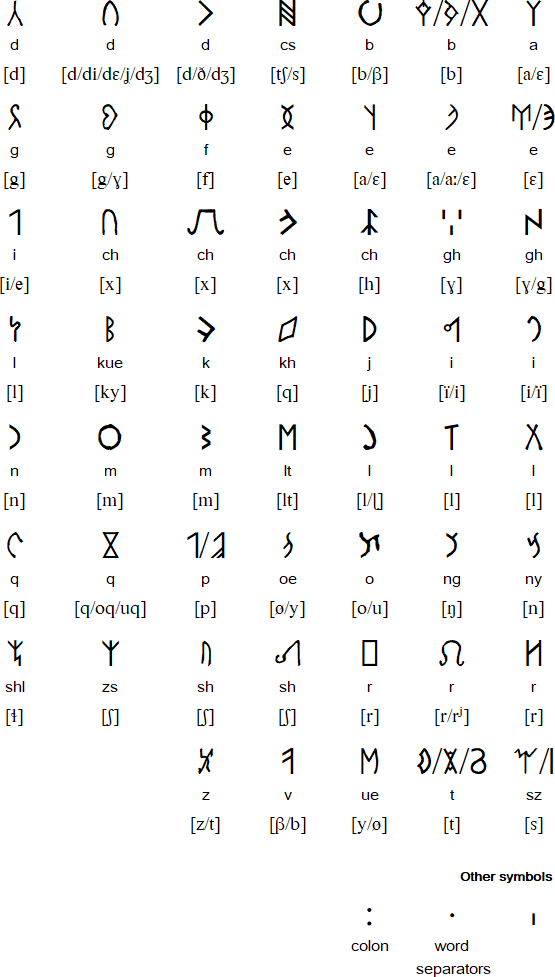
SEMNELE H D = CS J Ce inseamna ? numa’ Istenu stie ! ======================================

Apoi semnele din partea dreapta, “D D o c”


ar putea fi:
J(L?) J M Q

Ce inseamna? Vre-un mesaj extraterestru. ~~~~~~~~~~~~~~~~~~~~~~~~~~~~~~~~~~~~~~~~~~
Din Listă de invazii https://ro.wikipedia.org/wiki/List%C4%83_de_invazii
….. Alte popoare migratoare
Khazarii, popor turcic de origine mongolă, era originar din Asia centrală și Siberia de sud. Ei au migrat în Europa alături de maghiari și alte popoare turcice. In secolul VII d.Hr își constituie un Hanat în nordul Mării Negre. In anul 890 o parte din ei migrează alături de Arpad și ceilalți maghiari în Panonia. Khazarii au fost singurul popor din istorie care s-a convertit la iudaism. Hanatul khazar era in sfera de influenta a Bizantului. În anul 969 el a fost distrus de cneazul rus Sviatoslav al Kievului. Ultimele sale rămășițe au fost înlăturate de o expeditie militară bizantină (1016). Khazarii se retrag în Caucazia și de acolo urmele lor se pierd în negura istoriei.
Pecenegii erau un popor din Turkestan și o ramură a turcilor. In secolul X d.Hr, sub presiunea triburilor selgiucide, turcii s-au islamizat. Turcii pecenegi au migrat însă in zona Volgăi, neacceptand Islamul. În 895, în același timp cu khazarii, unguri (cumanii apar ulterior) au migrat în Europa, stabilindu-se parțial în Muntenia și sudul Moldovei, unde cu timpul s-au integrat populației valahe autohtone. Acolo ei întemeiază mai tîrziu, temporar, un hanat alături de cumani, popor turcic. În 1091 pecenegii se infiltrează, la sud de Dunăre, în Balcani. Împăratul Constantinopolului, Alexios Comnen îi înfrânge și pecenegii vor dispare militar din istorie, după o ultimă confruntare cu Bizanțul în 1122.

Cumanii erau si ei popor turco-mongol ca pecenegii. Erau originari tot din Asia centrala si Turkestan. Hanii cumani au migrat in Europa cu pecenegii, ungurii si khazarii. Dupa caderea hanatului peceneg, cumanii le-au luat locul in Dacia. Atacau si jefuiau periodic cnezatele ruse si Ungaria. Cneazul Sviatoslav al Rusiei il infrange pe hanul cuman Kobiak. Apoi cumanii hanului Gza sufera o infrangere cand asediaza Novgorodul. Cneazul rus Igor este infrant de hanul Konkeak. In anul 1227 cumanii sunt infranti de mongoli si dispar din istorie. ============================== Vezi http://unicode.org/wg2/docs/n4080.pdf Universal Multiple-Octet Coded Character Set
International Organization for Standardization
Organisation Internationale de Normalisation
Международная организация по стандартизации
Doc Type: Working Group Document
Title: Issues of encoding the Rovas scripts
Source: Gábor Hosszú (Hungarian National Body)
Status: National Body Contribution
Action: For consideration by WG2
Date: 2011-05-25
This document compares the static and dynamic models of the development of the Rovas /rovaːʃ/ scripts.
Please send any response regarding to this document to Gábor Hosszú (email: hosszu@eet.bme.hu).
In this document, the IPA (International Phonetic Alphabet) symbols are applied for representing phonemes
extending with the symbols for the undetermined back /A/ and front /B/ vowels.
Contents
1. Latest proposals of the Hungarian National Body …………………………………………………………………………………1
2. Position of the Hungarian National Body…………………………………………………………………………………………….2
2.1. Purpose of encoding…………………………………………………………………………………………………………………………………….. 2
2.2. Name of encoded scripts………………………………………………………………………………………………………………………………. 2
2.3. Present-day Hungarian orthographies …………………………………………………………………………………………………………….. 2
2.4. The family of the Rovas scripts …………………………………………………………………………………………………………………….. 2

Figure 5: The Alsószentmihály inscription (920-952)
Written with Khazarian Rovas font First row: Í ¬B
Second row: C jZaq ZK ìIuj
IPA phonetic transcription First row: ɛ
bi a
tlï
ɣ
Second row: jyedi • kyr qara
j
Translation from Common Turkic (Khazar) First row: ‘His mansion is famous.’
Second row: ‘Jüedi Kür (the) Karaite.’
Table 3: Transcription of the Alsószentmihály inscription
The word /ɛb/ was used for larger buildings in the Khazar building inscriptions;38 therefore, its meaning is
‘mansion’. The word /jye
di/ meant Jewish in Khazar language, in this case it could have used as a personal
name. The /kyr/ means ‘courageous’ and ‘fearless’ in Turkic, such personal names are typical in Turkic
languages. Therefore, the second row or at least the first two words (Jüedi Kür) formed the name of a Khavar
leader. The word Karaite also could have been a personal name. The Karaite Judaism is a branch of the Jewish
religion accepting the five books of Moses but not the Talmud, oppositely to the Rabbinic Judaism. The symbol
in the third row could have been a tamgha.39
In this relic, the KR q K /q/ is the ancestor of the SHR k K /k/, the KR Z R /r/ is the ancestor of the SHR
r R /r/. The KR u UE /y/ is ancestor of the SHR v V /y/v/ (see Subch. 4.7 in this document). The KR j J /j/ is
identical to the CBR j J /j/; the KR K KUE /ky/ is identical to the CBR ç KUE /ky/, the KR ì ANGLED I /i/ and
the a A /a/ are also common character with the CBR but not in the SHR.
The following Khazarian Rovas characters cannot be found in other Rovas scripts: B RAISED B /b/,
d ARCHED D /b/. The d ARCHED D is in a systematic KR ligature, the I DI /de/di/ed/. The symbol Í is the
ligature of T ANGLED T /t/ + l SIMPLE L /l/ + G GH /ɣ/.40
The punctuation symbol C KHAZARIAN ROVAS SEPARATOR LARGE is specific for the Khazarian Rovas
and it cannot be found in other Rovas scripts. The diacritic mark á SEPARATOR DOT ABOVE is also specific
for the Khazarian Rovas; however, it is descendant of the á COMBINING STOP ABOVE in the Inscriptional
Pahlavi script. It is used in the first row of this inscription.

Phoenician H HET /ħ/
> Early Aramaic H HETH /ħ/
> Imperial Aramaic À HETH /ħ/
> Parthian h HETH /ɣ/x/h/
> *Early Steppean *Q /ɣ/
> *Proto-Rovas *Q /ɣ/
> CBR (7th c.) Q, µ GH /ɣ/ > (21
st c.) Q GH /øː/
> SHR (*9th c., 12th c.) U GH /ɣ/
>SHR (15th c.) w, ¹ OPEN UE /ø/øː/y/yː/
> SHR (17th c.)¾ OPEN UEE /ø/øː/y/yː/ > (21st c.) /yː/
> SHR (20th c.) w OPEN UE /y/
> CBR (21
st c.) ¹ OE /ø/
> KR (8th c.) G, £, ù, ¥ GH /ɣ/, in Alan: /g/
> *Early Steppean *ó /y/ø/
> KR (8th-9th c.) ó UE /y/*ø/
> KR (9th-10th c.) u UE /y/ø/
> SHR (*9th c., 12th c.) v V /y/u/uː/
> SHR (14th-15th c.) u U /y/u/uː/
> SHR (16th c.) U UU /u/uː/ > (20th c.) /uː/
> SHR (17th c.) y UU /u/uː/
> SHR (15th c.) v V /v/
> SHR (20th c.) ® W /v/
> SHR (20th c.) ê W /v/
> SHR (21st c.) [ W /v/
> Old Turkic (Orkhon) M OE /ø/y/w/
> Inscriptional Pahlavi H HET /h/x/
> KR (8th c.) H ARCHED CH /x/
> Hebrew ח HET /ħ/x/
> Nabataean µ, h, H HETH /ħ/
> KR (8th c.) µ ANGLED CH /x/

××××××××××××××××××

Deci ne aflam in situatia mai mult decat rizibila sa fim nevoiti sa atribuim o data pentru tablitele de la Tartaria situata in intervalul 5.300 B.C.(Marco Merlini) si 900 A.D. (?Vekony) deci un interval total de cca. 6.200 ani ! Felicitari dragilor coledzi cercetatori !

Ceea ce este tolerabil unor amatori este intolerabil unor profesionisti

June 7, 2019

Atentie!                                                                                                                                                          Aceasta postare nu este o o descifrare sau citire a unui presupus continut scris real. Avand in vedere ca semnele nu apartin unui unic sistem de scris ci mai multora, pagina are un caracter pur didactic. Are rolul de a incerca si testa diferite scrieri in idea ca pe tablite s-ar fi folosit unul din ele. Semnele de pe tablite apartin mai multor sisteme de scrisi dintr-larg interval de timp si care au folosite in diferite arii geografice. In niciuna din incercari semnele nu s-au incadrat intr-un singur tip de scriere, totdeauna au ramas semne care au provenit din alte scrieri (sau din necunoscut). Cele mai multe semne provin din cele sumeriene proto-cuneiforme.Apoi privind asemanarea, in ordine descrescatoare este aceea cu semnele Linear A/B si cele Anatoliene. Semnele din jumatatea superioara a tablitei rotunde par a proveni din scrierea arhaica greceasca.Cel mai degraba aceasta “adunatura” de semne pare a fi rodul imaginatiei bogate a cuiva.Dupa cum au constatat A.Falkenstein si A.A.Vaiman, (aceasta fiind si parerea mea ferma) autorul nu a fost un scrib, avea doar vagi notiuni privind scrisul in general si nu se stie ce a urmarit. Exista multe elemente de neconcordanta precum si altele care scot tablitele din tiparele si normele uzuale ale  logicii, scrisului si intentiilor oneste.

=======                                                                                                                                                       Ca sa incepem cu inceputul,                                                                                                                  A – Imediat dupa descoperirea tablitelor de catre arheologul N.Vlassa, chiar acesta a creat o turbulenta initiala in comunitatea stiintifica prin atribuirea tablitelor  unei varste de aprox. 2700 B.C.                                                                                               Eu nu pun la indoiala onestitatea acestuia. In mod hotarat nu este participant la nici un gen de fals sau inselatorie. Activitatea dansului a fost prea bogata si lucrarile absolut serioase si remarcabile. Ca atare nu putea sa-si expuna propria persoana unui oprobiu general si nici activitatea precedenta unui asemenea risc major. Dar in schimb putea fi antrenat fara voia sa in expunerea unor artefacte care nu sant exact ce par si nici ceea ce credea dansul. Nefiind specialist in epigrafie si necunoscand lungul parcurs al aparitiei si evolutiei scrisului in lume, a atribuit tablitelor o varsta aflata oricum la o limita de timp extrema si implicit riscanta.Are in schimb meritul de a fi primul care a sesizat similaritatile cu inceputurile scrierii sumeriene.                                                                                  TOLERABIL !                                                                                                                                    ———————————————————-                                                                                        B – Apoi nu a fost destul, prin contributia cercetatorului italian Marco Merlini, a fost avansata o varsta si mai inaintata, cca. 5.300 B.C. Nici acesta nu a avut o imagine clara asupra parcursului scrierii in lume. Desi a sesizat similaritati mai mult ale semnelor cu cele prezente in alte scrieri nu a depasit deloc aceasta faza, neavand capacitatea unei analize de asemenea complexitate.                                       Dar inca si mai curios, nu gasesc o explicatie satisfacatoare pentru faptul ca a convins un arheolog absolut de marca ( Dl. Prof. Lazarovici), poate printre primii 5 cei mai mari din Romania, asupra unei varste atat de inaintate. Probabil ca cei doi au ramas cam singurii cercetatori din lume care au ales o asemenea optiune in privinta varstei. Parca l-a vrajit pe Dl. Profesor, pentru ca altfel i-mi scapa complet intelegerii.        Aceasta in conditiile in care toti arheologii, din tara si strainatate au luat la cunostinta de anumite aspecte si inadvertente:                                                                      – situl aflat pe un mal al Muresului a fost expus in mod constant erodarii si surparilor                                                                                                                                       – situl in sine prezinta un conglomerat de artefacte apartinand mai multor culturi                                                                                                                                               – chiar artefactele aparent gasite in imediata vecinatate a tablitelor fac apropierea de alte culturi decat cea neolitica Vinca-Turdas.                                            INTOLERABIL !                                                                                                                        Mai ales atribuirea direct a aceleiasi varste cu a  oaselor (5.300 B.C.) pentru tablite !    —————————————————–

C – Cercetatorii straini , desi multi dintre ei specialisti de marca in cele mai vechi forme de scriere, nu au avut suficient timp si nu au alocat suficient efort pentru evidentierea tuturor particularitatilor tablitelor. Avand la baza in principal, cu precadere analiza semnelor acestia au afirmat cu tarie ca nu sant sumeriene, nici scris sumerian autentic si nici mai vechi ca primele tablite sumeriene (3.000-3.200 B.C.).           Deci din start este exclusa o varsta mai mare de 3.000 B.C. Multi dintre ei au afirmat ca varsta maxima limita (dupa mine si aceasta exagerata) ar fi 2.700 B.C. (exact cum afirmase N.Vlassa!).Desi toate semnele pot fi asimilate celor proto-cuneiforme sumeriene, nu sant sumeriene ci “asemanatoare/ca si/- cele sumeriene” Ei nu dau nici-o explicatie plauzibila finala pentru acest fapt. Nici nu pot spune cu siguranta unde este locul unde au fost inscriptionate nici de cine (carei populatii ii apartinea scribul).       Si dupa mine, semnele prezinta similaritati maxime cu semnele proto-cuneiforme sumeriene.(~95% !) Faptul ca seamana cu scriere sumeriana nu se datoreaza unei asemenea origini ori contact direct, ci faptului ca filiatia scrierilor Europene are ca origine ultima scrierea sumeriana. (Acest fapt a fost remarcat si de  cercetatorii E.Papakitsos si I.Kenanidis in ceea ce privesc strict scrierile Egeene).                                                         Alti cercetatori nu au remarcat, sau cel putin nu au facut vorbire ca urmatoarele scrieri (pe locurile 2 – 3) in ceea ce priveste asemanarile, ar fi scrierile Anatoliene (cariana, ~70%)) si cele Egeene (Hieroglifica Cretana, Linear A,B ~70%). Cercetatorii straini in special cei specialisti in scrisurile cele mai vechi nu s-au implicat in controverse legate de varsta si au incercat pe cat posibil sa se faca ca nu observa si sa tolereze o varsta cat mai veche. Aceasta probabil pentru a nu deranja sensibilitati si orgolii nationale !                                                                                                                       TOLERABIL                                                                                                                                  Inafara de tablita pictografica, care prin natura sa poate fi usor interpretabila, niciuna din celelalte doua nu poate fi citita folosind exclusiv si integralfolosind un singur sistem de scriere concret (din cele existente cunoscute: proto-cuneiform, silabar sau alfabet.).      Am incercat pe rand testarea prin folosirea mai multora, pe rand si astfel am constatat acest lucru.                                                                                                                                               ————————————————————-
D – Mult timp Dl. Marco Merlini nu a realizat ca civilizatia Vinca-Turdas desi a facut progrese remarcabile,nu a atins faza scrisului.De altfel nici-un cercetator nu a facut dovada cu vre-un artefact ca ar fi atins pe deplin faza proto-scrierii.                            Ulterior Dl. Merlini pare a-si fi revizuit putin parerile, fara a afirma aceasta cu tarie.                   Desi unii cercetatori au observat ceva de genul unui amestec de semne, nu au acordat suficienta importanta acestui fapt. Semnele par a fi trasate de cineva care pe o cale sau alta a luat cunostinta de existenta unor semne folosite anterior pe o arie foarte larga si un larg interval temporal. Ele sant oarecum mai mult decat o colectie de semne, fara ca sa fiu malitios ar fi mai degraba o adunatura, gramada (scuze, ghiveci de semne).     Altii nu au observat sau sustinut ca semnele de pe cele trei tablite reprezinta (aproximativ 3) faze evolutive ale scrisului, aceste faze fiind distantate in timp ! Apartinatorul unei civilizatii nu ar fi facut in mod normal asta, decat eventual sa arate cuiva principiile si evolutia scrisului. Este greu, ba chiar imposibil de demonstrat vre-o posibila legatura d.p.d.v. al mesajului intre cele 3 tablite. Majoritatea cercetatorilor sant de acord iar eu subscriu ca “scribul” evea vagi, mai exact incomplete cunostinte necesare scrisului, daca nu era cumva absolut iliterat.                                                           De asemenea, un aspect care in mod normal sare in ochi adica iese in mod pregnant in evidenta, este acela ca jumatatea de sus contine scris adevarat, apropiat de timpurile noastre (ex. scris arhaic grec sau roman; ~99%). Eu am demonstrat acest lucru, iar de ale altora din cat am cautat amanuntit stiu ca nu exista. Acesta incaodata reflecta carente, imperfectiune, are un caracter ezitant si schiopatat, al unei persoane care nu stapanea in masura suficienta nu limba ci scrisul.                                                                                       INTOLERABIL !                                                                                                                                    —————————————————————–
E – Pentru ca scrisul din jumatatea de sus a tablitei rotunde pare a proveni dintr-o faza incipienta (epichorica) a scrisului alfabetic inainte de a fi standardizat. In diferite locuri foloseau alfabete asemanatoare dar usor diferite. Unul si acelasi sunet era reprezentat de forme ale literelor diferite. Ex, intr-o parte forma D era pentru sunetul D, iar in alta forma D pentru sunetul R. (Acest fapt conduce de la un numar oarecare de citiri posibile, la marirea si mai mult a acestui numar). Din pacate alti cercetatori nu s-au aplecat cu suficienta atentie pentru a remarca acest fapt (desi Domnului Merlini i-a atras atentia ca aceasta portiune avea un caracter secret si era gandita sa fie ascunsa privirii directe). Dar atat si nimic mai mult.                                             INTOLERABIL !                                                                         ======================================                                                                   PENTRU VERIFICARE SI COMPARATIE, URMATOARELE SISTEME DE SCRIERE:

PROTO-CUNEIFORME SUMERIENE                                                                                                proto-cuneiform signs   https://cdli.ucla.edu/tools/SignLists/protocuneiform/archsigns.html

“kaga, un important cuvant dacic”…? OARE !?… sa vedem.

May 22, 2019

Incep aicici prin a ma refero la lucrarea lingvistului specializat in tracologie, Sorin Olteanu, in engleza :                                                                                                                                          κάγα: an important Dacian word in Tomitan inscriptions1 https://web.archive.org/web/20150222020903/ http://soltdm.com/sources/inscr/kaga/kaga_e.htm                                                                           In romana:                                                                                                                                         κάγα: un important cuvânt dacic    http://soltdm.com/sources/inscr/kaga/kaga_r.htm                                                                                     Este vorba de o inscriptie din Tomis:

Heroi sacrum
Ti(berius) Claudius Mu-
casius v(otum) s(olvit) l(ibens) m(erito)
Ηερώϊι (sic!) ΚΑΤΑ Τι(βέριος)
Κλαύδιος Μου-
κάσιος εὐξάμ[ε-
νος καθιέρωσε[ν

IN ROMANA:                                                                                                                                         “Pasajul latin, uşor de citit la descoperirea pietrei însă aproape ilizibil astăzi din pricina condiţiilor precare de depozitare, nu ridică nici o problemă de interpretare: ” Ofrandă lui Heros. Tiberius Claudius Mucasius şi-a îndeplinit juruinţa, cu dragă inimă şi pe bună dreptate “. Formula de încheiere, abrevierea V•S•L•M bine cunoscută epigrafiştilor, indică limpede o inscripţie votivă. Iată însă ce spune acelaşi Tiberius Claudius, de data aceasta în greceşte:                                                                                                                        ” Lui Ērōs KATA. Tiberios Claudios Mukasios a consacrat (după cum) a promis “.                     Dacă, aşa cum am văzut, varianta latină este limpede, în cea greacă apare în schimb acest KATA, neexplicat satisfăcător de nici unul din editorii inscripţiei. Primul dintre ei, Gr. Tocilescu, încercând, la 1895, să-i dea totuşi un înţeles plauzibil, îl consideră pe KATA un adjectiv al lui Ērōi şi propune – de aceea – interpretarea lui drept o prescurtare a unui κατα(χθόνιος) subpământean”, un epitet ori o ipostază a zeului. În lipsa unei alte explicaţii mai consistente propunerea a fost acceptată de toţi editorii ulteriori – şi admisă în literatura de specialitate. Ea are însă cel puţin două mari neajunsuri care atrag atenţia:                                                                                                              1. mai întâi ar presupune o diferenţă considerabilă între variantele latină şi greacă ale dedicaţiei, căci kata(chthōnios) “subpământean” lipseşte din textul latin, în timp ce acesta conţine pe sacrum “jertfă“, inexistent în versiunea greacă.                                             2. abrevierea kata pentru katachthōnios ar reprezenta un “dublu unicat”:                             pe de o parte ar fi singura oară când acest cuvânt s-ar prescurta astfel în inscripţiile greceşti,                                                                                                                                                 pe de alta acesta ar fi singurul loc în care zeul epihoric Hērōs ar fi numit “subpământean”. Toate aceste dificultăţi ar fi putut fi evitate dacă atât Tocilescu, cât mai ales editorii de mai târziu, ar fi privit cu mai multă atenţie piatra pe care, aşa cum se poate vedea în fig.1 şi 2, lapicidul a scris nu ΚΑΤΑ , ci ΚΑΓΑ !”                                                 E adevărat că această nouă lectură nu ar fi lămurit de la sine şi de îndată sensul inscripţiei dar, oricum, nu ar mai fi prilejuit lansarea în circulaţie a inexistentului κατα(χθόνιος), epitet pe care Hērōs, bineīnţeles, nu l-a purtat niciodată. Lăsând deocamdată de o parte apartenenţa lingvistică a termenului, vom observa că dacă îl considerăm pe kaga nu un adjectiv al lui Hērōs ci un echivalent al latinescului sacrum , neconcordanţele dintre cele două variante ale textului dispar: “sacrum (=ofrandă) lui Heros. Tiberius Claudius Mucasius şi-a îndeplinit promisiunea (votum), cu dragă inimă şi pe merit ” din textul latin, ar avea aproape acelaşi înţeles cu “kaga (=ofrandă) lui Heros. Tiberios Claudios Mukasios a consacrat(-o) după cum a făgăduit ” din textul grec . Este o interpretare fără îndoială mai plauzibilă decât kata(chthōnios), dar insolitul cuvântului şi prudenţa deontologică ne-ar obliga să admitem şi posibilitatea unei greşeli a pietrarului şi să considerăm termenul, în consecinţă, drept dubios. Din fericire însă, o a doua inscripţie, şi ea de la Tomis, vine să îi confirme validitatea.   ”                                                                                                                     ENGLISH                                                                                                                                                         ” The first lines of the text, those in Latin, easy to read at the discovery of the stone but almost illisible today because of the poor conditions it was preserved, raise no problem of interpretation:                                                                                                                                  “Sacrum to Heros. Tiberius Claudius Mucasius respected his vote, gladly and on merit”. Let us see what the Greek part says: “To Heros KATA. Tiberios Claudios Mukasios consacrated as promised.” If, as we saw, the Latin variant is fairly clear, in the Greek one we find instead this KATA, unsatisfactory explained by any of its succesive editors. The first of them, Grigore Tocilescu, who also discovered the monument in 1895, trying to find a plausible meaning for the sequence KATA, took it as an adjective of Heros and interpreted it as an abbreviation of κατα(χθόνιος) which he considered to be an attribute or a hypostasis of the Thracian god. The lack of any other more consistent explanation of this word made his interpretation finally accepted in the litterature.

.Inscr. ISM II (Tomis), n.128-Drawing

It has nevertheless at least two weak points which draw our attention: 1. it supposes a considerable and unexpected difference between the Latin and the Greek variants of the text and 2. it proposes an attribute twice unique (and I insist to enounce here an important principle, which I should formulate as Always beware of hapax!): it would be the only time that καταχθόνιος would be abbreviated κατα and the only time that the epichoric god Hērōs would be called “of the underworld”. All these difficulties could have been avoided if both Tocilescu, but especially the later editors, would have taken a closer look at the stone, where – as you can see by yourself in the images below – the lapicida wrote not ΚΑΤΑ , but ΚΑΓΑ!                           =================================================

CUVINTE, TERMINOLOGIE:

Din https://en.wikipedia.org/wiki/Sacred

Something that is sacred is dedicated or set apart for the service or worship of a deity[1] or considered worthy of spiritual respect or devotion; or inspiring awe or reverence among believers. The property is often ascribed to objects (a “sacred artifact” that is venerated and blessed), or places (“sacred ground“).  …………Although there are similarities between the terms “sacred” and “holy” and they are sometimes used interchangeably, there are subtle differences.                                                                                                                                                                                                            “Holiness” is generally the term used in relation to persons and relationship, while “sacredness” is used in relation to objects, places, or happenings.                                                                                                                                                                                                       SFINTENIA ESTE LEGATA DE PERSOANE SI INTER-RELATIONARE IAR SACRALITATEA ESTE LEGATA DE OBIECTE,LOCURI SI EVENIMENTE                                                                                                                                                                                                                                   Thus a saint may be considered as holy, but would not be viewed as sacred.   ………..                                                                                Etymology.                                                                                                                                                The word “sacred” descends from the Latin sacer, that is consecrated, or purified dedicated  to the gods or anything in their power, and to sacerdos and sanctum, set apart.  ……………..                                                                                                                   (Greek; ιερος, hieros, “sacred” or “holy”

Din https://en.wiktionary.org/wiki/sacer

sacer (feminine sacraneuter sacrum); 

  1. sacredholy, dedicated (to a divinity), consecrated, hallowed (translating Greek ἱερός) quotations ▼
  2. devoted (to a divinity for sacrifice), fated (to destruction), forfeitedaccursed quotations ▼
  3. divinecelestial
  4. Number Singular Plural
    Case / Gender Masculine Feminine Neuter Masculine Feminine Neuter
    Nominative sacer sacra sacrum sacrī sacrae sacra
    Genitive sacrī sacrae sacrī sacrōrum sacrārum sacrōrum
    Dative sacrō sacrae sacrō sacrīs sacrīs sacrīs
    Accusative sacrum sacram sacrum sacrōs sacrās sacra
    Ablative sacrō sacrā sacrō sacrīs sacrīs sacrīs
    Vocative sacer sacra sacrum sacrī sacrae sacra

Din https://en.wikipedia.org/w/index.php?search=%E1%BC%B1%CE%B5%CF%81%CF%8C%CE%BD&title=Special%3ASearch&go=Go&ns0=1

 Lat sacrum = gr. ἱερόν,  ( ἱερόν, lit. “holy place“)

Din https://en.wikipedia.org/wiki/Sacrum

Din https://it.wikipedia.org/wiki/Sacro                                                                                           Romana :”SACRU”                                                                                                                         Nota:                                                                                                                                                     In varianta in romana tampitii il identifica ca SFINTENIE                                                                                                                                                                                                                         Varianta engleza:                                                                                                                  <<Something that is sacred is dedicated or set apart for the service or worship of a deity[1] or considered worthy of spiritual respect or devotion; or inspiring awe or reverence among believers. The property is often ascribed to objects (a “sacred artifact” that is venerated and blessed), or places (“sacred ground”).  >>                                                                                                                                                                                   << Storia e origine del termine                                                                                                             Il termine italiano “sacro” deriva dal termine latino arcaico sakros, rinvenuto sul Lapis Niger, sito archeologico romano risalente al VI secolo a.C.[3] e, in un significato successivo, indica anche ciò che è dedicato ad una divinità, ed al suo relativo culto; infatti, tale termine lo si trova, con medesimo significato, anche in altre lingue antiche come, ad esempio, l’ittita saklai e il gotico sakan.

La radice di sakros è, a sua volta, il radicale indoeuropeo *sak, *sag, col significato di avvincere (a fascina) aderire, o sac-ate, col significato di seguire,(a urma)sap-ati, col significato di onorare, sempre sottintendendo una divinità, a tal punto che negli antichi testi Ṛgveda può anche diventare sinonimo di adorare >>

===================================

latina: Heroi sacrum :eroului sacrificiu,consacrat, dedicat”                                                                         greaca: Ηερώϊι ΚΑΤΑ :                                                                                               S.Olteanu:  “Lui Ērōs KATA“= sacrum(=ofrandă,jertfa) lui Heros ”                                                   E.Rau:eroului de jos/sub pamant“,kata{chtonios}” sau mai exact:                              “eroului DEPUS, in sensul de ofranda si doar asa apropierea de lat. sacrum

De fapt greseala D-lui Olteanu nu este totala ci consta in faptul ca KAGA nu are sensul de SACRU (opus profanului, un gen de sfintenie care nu se suprapune totusi acesteia) ci are sensul de “DEPUNERE,OFRANDA” Greseala consta in a nu gasi originea corecta si mai putin sensul gasit corect, acela de “OFRANDA” , dar numai provenind pe linia “DEPUNERE”.                                                                                                                                                DV. AVETI DEMONSTRATIA ORIGINII CORECTE PENTRU KAGA=DEPUNERE>si astfel=”OFRANDA” si numai astfel echivalent cumva cu SACRUM                                                       ===================================                                                                               Nota                                                                                                                                                          1-Este posibil ca cel care a scris sa nu faca deosebirea intre ieros, hieros (templu,sacru,sfant) si heros (semizeu, erou) ?In loc sa scrie  Hierôi (dativul lui hieros)   a scris Ηερώϊι.  Ηερωιs ! 

https://en.wiktionary.org/wiki/%E1%BC%A1%CF%81%CF%89%CE%AF%CF%82#Ancient_Greek                                                                                    ἡρωῐς  (hērōísf (genitive ἡρωῐ́δος); third declension

  1. heroine quotations ▼
  2. deceased woman 

                                                                                                                                    ( https://biblehub.com/greek/2413.htm hieros: “sacred, a sacred thing, a temple” )                 2-este posibil un ritual de “eroizare” si eroul sa fie chiar numitul  Mucasios ?                 Din traducere reiese ca nu.                                                                                                                 3- altfel litera Image result for greek upper case gamma (gamma), si dupa mine, parca seamana cu o idee mai mult cu un G dacat cu T

~~~~~~~~~~~~~~~~~~~~~~~~~~~~~~~~~~~~~~~~~~~~                                                                  DAR CU KAGA=”SACRU” AVEM O ENORMA PROBLEMA !                                                                                                                                                                                                                                    Din SORIN OLTEANU:  List of reconstructed Dacian words – …
https://en.m.wikipedia.org › wiki › List_…
This article contains a list of reconstructed words of the ancient Dacian language. ….. kaga, sacred, holy, kaga, *kʷog(h)- (< *kʷeg( h)-), Old Slav. kazat′, skazat′ (“to tell                                                                                                                                                                                       Existau 2 posibilitati de alegere pentru Dl. S.Olteanu:                                                                      – sa considere KATA sau                                                                                                                         – sa considere KAGA, caz in care trebuia sa se concentreze maxim asupra semnificatiei. Este adevarat ca la o inscriptie bilingva, oricine (si eu) se asteapta ca semnificatiile cuvintelor sa fie corespondente. Cel mai comod pentru Dl. Olteanu a fost sa atribuie o semnificatie identica lui KAGA.                                                                                           Aici a gresit Dl. Olteanu, prezumand gresit originea <kaga, sacred, holy, kaga, *kʷog(h)- (< *kʷeg( h)-), Old Slav. kazat′, skazat′ (“to tell > dintr-o radacina doar presupusa si deloc studiata si demonstrata.                                                                                                         In cazul de fata se pare ca varianta greceasca nu o reproduce “mot-a-mot” pe cea latina.

       In nici-o limba indo-europeana nu avem nici pe departe vre-un cuvant gen KAGA a carui sens  macar sa se apropie cat de departe de sensul SACRU (sacru, opus profanului)!                                                                                                                                                                 Eventual,(sa verific despre ce cuvant exact este vorba!):                                                              Din A Greek and English lexicon
https://books.google.ro › books
John Jones · <<Kaga, (indeclinable as used by Homer, but by later writers x262, as, o, or xzén, “s) head, top, summit, zaga  >>                                                                                                                                                                                                                                                                                                    
La sfarsitul postarii o sa pun o lista cu sensurile cuvantului kaga incepand cu nostratica, continuand cu familia limbilor Indo-Europene, si terminand pe cat se poate din aceasta familie I.E. cu limbi de aici de pe langa noi.                              ~~~~~~~~~~~~~~~~~~~~~~~~~~~~~~~~~~~~

In schimb am gasit:

Origins of European Peoples: Part One: Ancient History
https://books.google.ro › books
Mario Mosetto · 2018 · History
… “Kaga” low, analogous to the Greek Katà; the Italic connected word (cagare – to shit) is obscene and we don’t need to mention it, but

A Grammar of Modern Indo-European, Second Edition (part 2) (2.9K views)
https://www.scribd.com › doc › A-Gram…
It contains a comprehensive description of Proto-Indo-European grammar and offers an analysis of the … kaga ‘dens‘ (in romana, tot dens)

Profilo linguistico della Romània pre-romana – The Paleolithic Continuity … PDF http://www.continuitas.org › texts › alinei_ben… Oct 8, 2009                                                           sima corrispondenza fra i tre nomi kač, kağà/kažà, kağa- ….. [1992], The Problem of Dating in Historical Linguistics, SLE ...(il latte) caglio:”kaga”

<< 3.1. La prima riguarda l’etimologia di caseus ‘cacio, formaggio’, che già in precedenza avevamo interpretato come allotropo dialettale lombardo-emiliano, tipo cač, del sostantivo coagulum ‘caglio’ [Alinei 1996-2000: 961-2]. Che ilio formaggio  sia una semplice trasformazione del latte cagliato lo sanno tutti. Che la scoperta del caglio e l’inizio della produzione del formaggio risalgano al tardo Neolitico è, invece, una cosa che sanno solo gli archeologi. Per cui, che lat. caseus sia una semplice trasformazione dialettale, più precisamente lombardo-emiliana, di data tardo-neolitica, del lat. coagulum, nessuno poteva pensarlo, al di fuori del quadro della latinità pre-romana, mentre ora è dimostrato dall’imponente documentazione dialettale riprodotta nella tabella. Anzitutto, il confronto delle tre carte dell’AIS che riguardano il ‘caglio‘ – cioè 1212 ‘caglio‘, 1214 ‘il latte caglia‘, 1215 ‘latte cagliato’ – con le due che riguardano più da vicino la tecnica produttiva del formaggio, cioè 1209 ‘caciare’ (fare il formaggio) e 1198 ‘caciaio’, dimostra che in quasi tutta l’area caratterizzata da kač c’è una notevolissima corrispondenza fra i tre nomi kač, kağà/kažà, kağada/kažada, cioè del caglio, del cagliare, e della cagliata da una parte, e quello del verbo caciare dall’altro. Inoltre, in un punto

dell’Emilia (436) e tre della Lombardia (229, 236, 254), questa corrispondenza si spinge ad includere anche il nome del ‘caciaio’.

punto1212’caglio’1214′(il latte)caglia‘1215’latte cagliato’1209’caciare’1198’caciaio’

227 kač (al vé la)kažada kažada Kažà Kaśér                                                                               229 kač kaža kažada Kažà Kašer
236 kač kaža kažada Kažà Kažér
237 kač kaža kažada Kažà Kaśér
238 kač  kažada kağada Kažà Kaśér
244 kač kağa kažada kažà Altro Tipo (= AT)
245 kač kažat kağà
247 kač kağa kažada kağà Kaśér
254 kač kaža ? – Kažér
299 kač – kağada kažàr Kaśér
412 kač kağa kağà Kaśér
413 kač kağa kağà Kaśér
424 kač kağeda Kaśér
427 AT kağa kağà +
436 kač  kageda kağeda     Kažér
443 kač kağa kağada            Kaśär
444 kač-          kağeda           Kaśér                                                                                                                   ATnell’AIS,ma i dizz.dialettali emiliani danno ovunque anche
cagiar cagèr

Questo è dunque il focolaio da cui, in epoca tardo-neolitica, il continuatore lombardo-emiliano di coagulum si sarà diffuso in Europa centro-occidentale, come nome del formaggio. A Sud, la conferma più importante di questo scenario vie-
ne da un’area immediatamente contigua a quella emiliana: quella tosco-emiliana – Lunigiana, Garfagnana, alta Versilia e Appennino tosco-emiliano. Come mostra la cartina, tratta dal-l’Atlante Lessicale Toscano, in Lunigiana, ai confini con l’Emi-
lia, il caglio si chiama cagio o cažo, ovvia variante di derivazione emiliana, con restituzione della vocale finale. >>

Vezi exemple care conțin traducerea cheag
Substantiv – Neutru
(59 exemple cu termeni corespondenți)

” href=”https://context.reverso.net/traducere/romana-italiana/cheag&#8221; data-pos=”[nn]” data-inflected=”cheagului}–{cheagul” data-pos-index=”0″ data-posgroup=”0″ data-freq=”59″>cheag

Vezi exemple care conțin închegarea laptelui
(4 exemple cu termeni corespondenți)

” data-posgroup=”10″ data-freq=”4″>închegarea laptelui

Vezi exemple care conțin închegare
(4 exemple cu termeni corespondenți)

” data-posgroup=”10″ data-freq=”4″>închegare

coagulul

Deci acel KAGA nici pe departe nu poate fi nici sacru nici altceva pe aproape ci ceva in categoria semantica :

dens, inchegat, ?depus (jos)?”                                        ============================================

Deci entschuldigung Herr lingvist & tracolog!  Sorin Olteanu, intelesul poate fi in greaca :   greaca: Ηερώϊι ΚΑΤΑ :”eroului de jos/sub pamant“,kata{chtonios} , sau tot intr-un gen de greaca,

“eroului dens/?intarit/?mort   inchegat,intocmit      depunere     ………..alegeti ce doriti, propuneti ca toate merg cumva in jos.                                                                                              Deci nu, domnule S.Olteanu, daca unui amator (inginer) i se pot tolera inadvertente unui lingvist de marca si in plus tracolog, nu !                                                                                  DECI NU Sorin Olteanu:                                                                                                                 Din Palaeolexicon – The Thracian word ziu / zia   https://www.palaeolexicon.com/Word/Show/18824   kaga ‘sacred, holy …                                    SI NU Sorin Olteanu:                                                                                                                  radacina *kʷog(h)- (< *kʷeg( h)-); nici-o legatura cu Sl. kazat,skazat   “a spune”,                                                                                                                                                                                     ci radacina IE KEG (hitt. “teapa”) respectiv                                                                                     IE **KoGo “dinte” (hit. kaga, “dinte” ; vezi in documentare kaga/gaga : “cioc” ; kaga :”cioara,corb” )                                                                                                                                      si radacina “dense“(romana tot “dens“)                                                                                                                                                                                                                                                        Legatura nu este aceea a lui sakros/sacros SAK, si nici aceea presupusa de Dv.  cu skazat/”spune” ci mai degraba cu kaga, kaza, koza (v. M.Alinei) capra si branza !                                   “ingrosare?stiintific “densificare”, dens, dinte, depunere, coagulare”

Acum va intreb:                                                                                                                                      – Cand cineva vorbeste intr-o limba si strecoara un singur cuvant in alta limba, in ce limba vorbeste de fapt?                                                                                                                        – Daca a existat limba daca de ce nu scria cuvintele din limba daca?                                      – Atata timp cat a existat KATA in greaca, dar se pare ca si KAGA, cu acelasi sens, KAGA este cuvant dac ?                                                                                                                            Nota-bene, oricum nu avem sacru din greaca care este hieros/ieros.

ATENTIE MARE !

DACA SAKROS (rad, SAK) CA SI HIEROS INSEAMNA NUMAI “SACRU” (tampitii au tradus in romana pe wiki SFINTENIE),                                                                                                           – in latina, SACROS SI SACRUM INSEAMNA ATAT “SACRU” CAT SI “OFRANDA”,                        – IN SCHIMB KAGA, PRIN ORIGINEA LUI NU ARE NICI-O TANGENTA NICI CU SACRU SI CU ATAT MAI PUTIN CU SFANT ORI SFINTENIE,                                                                               – CI  PRIN ORIGINEA SA, NUMAI  SENSUL “DEPUNERE” SI DOAR ASTFEL I SE POATE ATRIBUI  SENSUL DE OFRANDA !

ESTE CLAR ? a lua notita eventual si popii; lamuriri eugenrau@gmail.com

?????????????         https://lrc.la.utexas.edu/lex/master/0338              ??????????????

CUM SE FACE CA UNELE ATRIBUTE ALE ENTITATII DACO-TRACICE (remarcate & notate de antici) TRANSPAR DIN ACEASTA RADACINA “DENS” !?

Pokorny Etymon1. dens-   ‘to learn; mental power’  Semantic Field(s): to Learn

Indo-European Reflexes:

Family/Language Reflex(es) PoS/Gram. Gloss Source(s)
English
English: autodidact n self-taught person AHD/W7
didactic adj fitted/intended to teach AHD/W7
Hellenic
Homeric Greek: δήνεα n.neut.pl counsels, plans RPN
Greek: autodidaktos adj self-taught W7
δαΐ-φρων adj wise of mind, prudent RPN
didaktikos adj didactic W7
didaktos adj taught W7
didaskein vb to teach W7
Iranian
Avestan: dąh- vb to be wise/mighty RPN
dąhah- n.neut mastery RPN
dąhišta- adj.sup wisest RPN
Indic
Sanskrit: dáṁsas- n.neut wondrous deed/power RPN


Din https://lrc.la.utexas.edu/lex/master/0339

Pokorny Etymon2. dens-   ‘dense‘                  Semantic Field(s): Thick (in Density)

Indo-European Reflexes:

Family/Language Reflex(es) PoS/Gram. Gloss Source(s)
English
Middle English: condensen vb to condense W7
English: condense vb to make denser/more compact AHD/W7
dense adj marked by compactness/crowding together of parts AHD/W7
West Germanic
German: kondensieren vb to condense LRC
Italic
Latin: condensocondensāre vb to make dense W7
dēnseōdēnsēre vb to make thick, press (together) RPN
dēnsōdēnsāre vb to make thick, press (together) W7
dēnsus adj dense, thick, close RPN
Middle French: condenser vb to make dense W7
Hellenic
Greek: δασύς adj hairy, shaggy, rough RPN
Anatolian
Hittite: daššuš adj mighty, massive RPN

Eugen Rau: Apropos de “dens”=dens<> dinte,

Din Thracian Glossary – The Indo-European Database   https://tied.verbix.com/project/glossary/thra.html                                                                       … dentu– ‘clan, tribe‘ [Latv. gens ‘clan, tribe’].

eu: Clanul, tribul este de fapt o coagulare, densificare a oamenilor. ++++++++++++++++++++++++++++++                                                                                  DOCUMENTARE ADITIONALA

Din Alexei Kassian (RSUH) Anatolian lexical isolates
and their external Nostratic cognates  http://starling.rinet.ru/Texts/anatnost.pdf                  44. kaga- c. ‘tooth’. From MS on.
IE **KoGo– (~ ­a­).
≠ Probably cognate is IE *kgo­, known from Germ. *xak-ōn ‘hook; bolt’,
*xōka-z ‘hook; angle’ (Orel HGE: 154).18 Both directions of the assumed meaning shift are possible: ‘hook’ > ‘fang’ > ‘tooth’ / ‘hook’
> ‘bolt’ > ‘tooth’ or, vice versa, ‘tooth’ > ‘hook’. For general reasons
the Hitt. anatomic meaning should be accepted as primary

Din Swadesh-Liste – A possible Homeland of the Indo-European Languages http://www.hjholm.de/Universal%20concept%20list%20for%2017%20Indo-European%20l&#8230;


Din COMPARATIVE LINGUISTICS INDO-EUROPEAN AND … – CiteSeerX PDFciteseerx.ist.psu.edu › viewdoc › download by GJK Campbell-Dunn · Cited by 3 · Related articles In Homeric Greek and Vedic Sanskrit the augment is optional, rather like an adverb …… kan.kata “a comb”, kan.kala “skeleton”, kaga “ a lotus”, kata “a mat”, kati:raka “loin

Din Turkic – Indian Lexical Parallels in the Framework of the Nostratic … – waset
PDFhttps://waset.org › publications › turkic-i…
Nostratic ancestor language was carried out by V. M. Illich -. Svitych [2]. According to ….. kag, kaga ‘raven, crow‘ karga ‘crow’ taral

Din (PDF) What language did the Pharaohs speak? Kheli kheli kheli keli. | flavio …
https://www.academia.edu › What_langu…
Significantly in Ancient Indoeuropean Greece the “black” (krsna) “crow” (krsna, nava, kaga) “ bird” (khaga, vaca, “sun”) was the “sacred

Din The Nostratic Macrofamily: A Study in Distant Linguistic Relationship
https://books.google.ro › books
Allan R. Bomhard, John C. Kerns · 2011 · Language Arts & Disciplines
… to sound’: A. Proto—Indo—European * klhian— ‘to sing, to sound’: Greek kotvotxt’t ‘ sharp … Proto—Uralic *kaga- ‘to call’

Din http://starling.rinet.ru/cgi-bin/etymology.cgi?single=1&basename=%2Fdata%2Falt%2Fturcet&text_number=+981&root=config

Proto-Mongolian: *kaka- / *kaga– Altaic etymology: Altaic etymology Meaning: to break, tear off

Din https://educalingo.com/ro/dic-tr/kagan                                                                         <<Kagan este unul dintre titlurile folosite de conducătorii din statele mongole și turce și este relativ mai vechi. Din vremea lui Avar, cultura statului turc a conținut cuvântul “kagan”. În acest context, “kagan” este un cuvânt turc precum Tanhu, Hakan, Bey, Toktamıș, Giray și constituie o caracteristică distinctivă pentru statele turcești. Cuvintele Kagan; marele, hanul mare este derivat din kaga khan sau kagan khanim.>>

Din Questioning the Origin of Indo-European: A Comparative Evolutionary … https://pdfs.semanticscholar.org/4314/02bdff552724c38644b8b03ffdb29d39b006.pdf

baseless “verdict” that “there is no evidence that IndoHittite is related to any …… Watkins adds that, if the Hittite kaga– ‘tooth‘ is ‘cognates with English ‘hook’, we 

κἀγώ | billmounce.com
and I, I also, but I, a crasis of και and ἐγώ, dat., κἀμοι, acc., κἀμέ
billmounce.com


Sanse mari, mari de a fi oarecum dat de capat tablitelor de la Tartaria.

May 16, 2019

Atentie!                                                                                                                                                   Aceasta postare nu este o o descifrare sau citire a unui presupus continut scris real. Avand in vedere ca semnele nu apartin unui unic sistem de scris ci mai multora, pagina are un caracter pur didactic. Are rolul de a incerca si testa diferite scrieri in idea ca pe tablite s-ar fi folosit unul din ele. Semnele de pe tablite apartin mai multor sisteme de scrisi dintr-larg interval de timp si care au folosite in diferite arii geografice. In niciuna din incercari semnele nu s-au incadrat intr-un singur tip de scriere, totdeauna au ramas semne care au provenit din alte scrieri (sau din necunoscut). Cele mai multe semne provin din cele sumeriene proto-cuneiforme.Apoi privind asemanarea, in ordine descrescatoare este aceea cu semnele Linear A/B si cele Anatoliene. Semnele din jumatatea superioara a tablitei rotunde par a proveni din scrierea arhaica greceasca.Cel mai degraba aceasta “adunatura” de semne pare a fi rodul imaginatiei bogate a cuiva.Dupa cum au constatat A.Falkenstein si A.A.Vaiman, (aceasta fiind si parerea mea ferma) autorul nu a fost un scrib, avea doar vagi notiuni privind scrisul in general si nu se stie ce a urmarit. Exista multe elemente de neconcordanta precum si altele care scot tablitele din tiparele si normele uzuale ale  logicii, scrisului si intentiilor oneste.

========                                                                                                                                                    In delungul timpului, foarte multi cercetatori s-au aplecat asupra acestor tablite de la Tartaria. Am observat ca a fi arheolog nu include neaparat specializarea in semiologie si epigrafie. Din pacate nici inalta calificare in scrieri vechi si proto-scriere nu constituie o garantie totala pentru clarificarea si obtinerea unui verdict final.                      Cu toate acestea, acestia din urma, cu inalta specializare in proto-scriere, au reusit cea mai mare apropiere de natura intrinseca a inscrisurilor.                                                          Practic, fiecare din acestia au extras cate un set propriu de  concluzii preliminare. ADUNATE, ACESTE CONCLUZII PARTIALE FORMEAZA UN TOT CARE SE SUPRAPUNE QUASI-INTEGRAL PESTE CONCLUZIILE MELE.                                                                               Cu * am marcat concluziile care-mi apartin exclusiv:                                                                    – Tablitele reflecta semne care au fost folosite pe o lunga si mare departare in timp, si o larga extensie geografica, (din Orientul Apropiat pana in zona Egeeana)                        – Prezinta similaritati cu scrierea proto-cuneiforma sumeriana, (folosita in perioada 3.200-2.800 B.C.)                                                                                                                                         – Cu toate acestea, nu este scriere sumeriana proto-cuneiforma nativa/propriu-zisa     – Semnele ca un ansamblu, nu apartin complet niciunui sistem de scriere concret   *     – Am putut prezenta cele mai multe abordari a diferitor sisteme de scriere.                   Abordarile au rolul de testare, sondare si incercare ( a vedea in ce masura  semnele ar putea fi imbracate de un anume sistem de scriere concret).                                                      In multe cazuri, este posibil sa fi depasit intrucatva nivelul atins de alti cercetatori.             In plus am articole cu caracter critic si corectiv al acestora.*                                          – Semnele per total, sant mai degraba o “colectie de semne” In plus, anafara practicii uzuale a scrisului, avem categorii/tipuri diferite de scriere, pictografica visa ideografica si chiar alfabetica *                                                                                                         – Aceasta colectie provine din ariile si scrierile sumeriana, Anatoliana si Egeeana (Lin.A,B)*                                                                                                                                                   – Nu-mi este foarte clar ce a urmarit de fapt “scribul”/”scriitorul” , dar se pare ca nu stapanea bine scrisul.                                                                                                                             Semnele din jumatatea de sus ies in evidenta prin asemanarea lor izbitoare cu litere     – Se poate face o legatura intre intentia vadita de ascunderea a acestora si constituirea lor intr-un scris adevarat                                                                                                 – Aceste semne din jumatatea de sus a tablitei rotunde se regasesc ca litere in faza initiala a scrisului alfabetic in aria Egeeana (Ciclade,Chalkis. Creta, cu difuzie si prezenta in pen. Italica) *                                                                                                                         – “scriitorul” putea apartine oricarei perioada cuprinse intre 2.500 B.C. si zilele noastre, cu sanse cu atat mai mari cu cat ne apropiem de prezent*                                                     – Explicatia faptului ca atat de multe semne se regasesc in atatea sisteme de scriere rezida in faptul ca exista un filum, filiatie pornind de la semnele proto-cuneiforme sumeriene pana la alfabetele de azi*                                                                                              – In final nu-mi pot explica absolut deloc, cine, unde si cand putea avea acces la asemenea semne (multe si vechi !) *                                                                                             – Exista numai doua posibilitati reale, mari si late:                                                                     Scriitorul nu ar putea apartine decat ariei Egeene, sau uneia de undeva mai din nord, (chiar si de la noi~transhumanta?) Sant semne ,sau intuitia i-mi spune ca acea persoana pe de alta parte, pare a fi foarte perspicace/patrunzatoare * 

EU AM REUSIT SA TREC BARIERA APARENT INSURMONTABILA DE LA SITUATIA CA NIMENI NU A DEMONSTRAT CLAR PANA ACUM CA POATE FI VORBA DE SCRIS, LA A DEMONSTRA CA ACEST LUCRU ESTE POSIBIL.                                                                                                    DIFICULTATEA APARUTA REZIDA IN FAPTUL CA PARADOXAL, PUTEM PREZENTA MAI MULTE PROPUNERI DE CITIRI SI CA ATARE ESTE DIFICIL IN A O SELECTA PE CEA “CORECTA, ADEVARATA” *                                                                                     Nota                                                                                                                                                             In realitate, numarul citirilor “posibile” este absolut, covarsitor de mare.             Matematic un numar de combinatii de x cate y.  O selectie obiectiva cu greu ar fi posibila. Unele citiri au urcat subiectiv ( in afectivitatea si intelectul meu) spre pozitii superioare nemeritate.Insa timpul oarecumva a permis un gen de usoara sedimentare spre domeniul de a fi oarecum independente de mine si naturale.

CITIRILE DEMNE DE LUAT IN CONSIDERARE SE GASESC IN ARTICOLUL:              Tartaria,posibil o problema “simpla” !?

Tabletele din Tartaria, posibil o problema simpla !?

May 11, 2019

Atentie!                                                                                                                                                  Aceasta postare nu este o o descifrare sau citire a unui presupus continut scris real. Avand in vedere ca semnele nu apartin unui unic sistem de scris ci mai multora, pagina are un caracter pur didactic. Are rolul de a incerca si testa diferite scrieri in idea ca pe tablite s-ar fi folosit unul din ele. Semnele de pe tablite apartin mai multor sisteme de scrisi dintr-larg interval de timp si care au folosite in diferite arii geografice. In niciuna din incercari semnele nu s-au incadrat intr-un singur tip de scriere, totdeauna au ramas semne care au provenit din alte scrieri (sau din necunoscut). Cele mai multe semne provin din cele sumeriene proto-cuneiforme.Apoi privind asemanarea, in ordine descrescatoare este aceea cu semnele Linear A/B si cele Anatoliene. Semnele din jumatatea superioara a tablitei rotunde par a proveni din scrierea arhaica greceasca.Cel mai degraba aceasta “adunatura” de semne pare a fi rodul imaginatiei bogate a cuiva.Dupa cum au constatat A.Falkenstein si A.A.Vaiman, (aceasta fiind si parerea mea ferma) autorul nu a fost un scrib, avea doar vagi notiuni privind scrisul in general si nu se stie ce a urmarit. Exista multe elemente de neconcordanta precum si altele care scot tablitele din tiparele si normele uzuale ale  logicii, scrisului si intentiilor oneste.

============                                                                                                                                           De ani de zile sustin ca jumatatea de sus a tablitei rotunde iese in evidenta.Contine semne care au fost folosite de greci ca litere. 

Saved from Lino Agudelo del fenicio.-griego-etrusco al romano

                                                          Si nu orice fel de semne=litere, ci unele relativ noi ( folosite la cateva sute de ani Inaintea Erei Noastre).                                                                                                   Semne continute in principal in alfabetul arhaic grecesc.                             ========================                                                                                                                 ! PREZENTA POSTARE  REPREZINTA SI SUSTINE  IPOTEZA CONFORM CAREIA SCRIBUL AVEA O VAGA CUNOSTINTA DE O SUMA DE SEMNE DE ORIGINE SUMERIANA, DAR NU LE STAPANEA INTELESUL SI CA ATARE DOAR LE-A EXPUS.                                          CUNOSTINTELE SALE IN A SCRIE CU ADEVARAT S-AR REZUMA STRICT LA JUMATATEA DE SUS A TABLITEI ROTUNDE !

Din The Lost Civilizations of the Stone Age Richard Rudgley                                                  << the tablets represented a garbled and ‘senseless’ mimicry of Near Eastern writing >>

Din discovery.ucl.ac.uk › Josiffe_10082208_thesis                                                                         an investigation into the origins of writing – UCL Discovery
https://discovery.ucl.ac.uk/PDF by C Josiffe – 
<< Tărtăria tablets has been … He suggested that these scratch marks had been made as mimicry of the signs themselves … >> 
 
Din Acta Terrae Septemcastrensis
<<The hypothesis that the Tartaria tablets represent only a writing-like design was … had a vague idea of Sumerian documents and aped them (Gelb 1967: 489).>>

                                                                                                                                              =================                                                                                                                          Am spus “posibil o problema simpla”. Ar fi fost simpla daca am avea certitudinea ca scrisul continand doua cuvinte am avea siguranta care sant acelea.       Se pare insa ca cel care a scris, in mod voit sau nu a lasat in urma posibilitatea unor citiri multiple.                                         Daca a fost in intentie asta reflecta un nivel intelectual si al cunostintelor destul de ridicat. Asta ar fi cum ar fi. Insa faptul ca cunostea atat de multe semne prezente pe toate tablitele, semne ce apartin in mod normal unei arii temporale si spatiale foarte largi ar trebui cu adevarat sa ne dea de gandit.                                                 Acest lucru este cu atat mai posibil cu cat ne-am apropia de zilele noastre si altfel, nu-mi explic cum putea sa fie posibil intr-un oarecare trecut.                                                                                                                                                               =============   POSIBILE CITIRI   ======================                                                 In stanga avem semnele HD “heta-rho” sau “eta-rho” pentru ca acel semn H initial s-a pronuntat H,He fiind litera Heta si mai apoi survenind schimbari in limba s-a pronuntat “E“. latinii l-au folosit in continuare ca H. De fapt nu santem siguri, avem semnele HP sau HD !?                                                                                                                                                      In dreapta avem semnele grecesti DDoc sau DDou.                                                                 Deocamdata semnul +++++ il lasam in suspensie.                                                                        In varianta ca avem semn D in stanga si semne D in dreapta,                                                             Atunci am avea citirea:                                                                                                            HeDe/EDDi D o u                                                                                                                             (observati ca primul D are inauntru o linie aparent miscata, ar pute fi “i” )

Din ἔδω Ancient Greek Etymology From Proto-Indo-European *h₁ed-.                                ἔδω  (édō) :”(eu) mananc”                                                                                                     Alternative form of ἐσθίω (esthíō

imperative   ἔδε
  1. δίδου https://biblehub.com/greek/didou_1325.htm                                                              in romana :”da”(“da!”)
  2. Luke 11:3 V-PMA-2S
    GRK: τὸν ἐπιούσιον δίδου ἡμῖν τὸ
    NAS: Give us each day
    KJV: Give us day
    INT: daily give us

Deci am avea: MANANCA!+ DA                                                                                                       Am putea avea in vedere un ritual religios legat de cele “de-ale gurii”, de recolta, chiar forma de turta paiinita sugerand aceasta.                                                                                         Nota                                                                                                                                                            Parca am gasit candva in evolutia ulterioara a limbii latine (inspre limbile romanice) o forma gramaticala a acestui verb gen DEDUI ca si rom. DADU si DADUI

Din morphology 1999 – Springer                                       link.springer.com/content/pdf/10.1007%2F978-94-017-3722-7.pdf

. Before examining the sign-like behaviour of Romance derivational affixes in diach- …… again, some scholars imagine an intermediate form *DEDUI, (Tekavcic 1980, vol. 2:.     


Din The Nomads of the Balkans | Greece | English Language – Scribd

give here a brief account of the circumstances under which the dispute arose. …… form of Latin or Romance speech among the Bulgarian troops except by the presence of Vlach …… dapoia, adv., afterwards. dau, V. irreg., give ; dare, dedui.

                                                                                                                                                                   ???!!?? Din Roumanian Stories – Hellenica World

? “Fluxul,convergent, unirea +IUBIRE“?
                                                                                                                                                               ?!?!?                                                                                                                                                            Din File:Nestor Cup Cumae.jpg – Wikimedia …
https://commons.m.wikimedia.org › wiki
Jan 15, 2015 · Νεστορος [ἐρροι] εὐποτ[ον] ποτηριο[ν]: ὁσδα τοδε π[ιεσι] ποτηρι[ο] ηὐτικα κενον: ἱμερ[ος αἱρ]εσει καλλιστε[φα]νο
 
Greek and English Lexicon
https://books.google.ro › books
John Pickering · 1832 · Greek language
Eq. 7, 5. “Epírruas, ov, *, *, belonging to cavalry, Xen. Cyr. viii, 3, 3. “Epirros, ov, 3, sitting on a horse, equestrian, Xen. Cyr. iv, 2, 1 ; Soph                                                                                 Nota                                                                                                                                                   Epirus si tot ceea ce este legat de el, se scrie cu un singur R, iar noi avem “RR”.Posibil sa fi existat o forma ca mai sus cu 2 de R?     
 
The name Epirus is derived from the Greek: Ἤπειρος, romanized: Ḗpeiros (Doric Greek: Ἄπειρος, romanized: Ápeiros), meaning “mainland” or terra firma.[3] It is thought to come from an Indo-European root *apero- ‘coast’,[4] and was originally applied to the mainland opposite Corfu and the Ionian islands.[5] The local name was stamped on the coinage of the unified Epirote commonwealth: “ΑΠΕΙΡΩΤΑΝ” (Ancient Greek: Ἀπειρωτᾶν, romanized: Āpeirōtân, Attic Greek: Ἠπειρωτῶν, romanized: Ēpeirōtôn, i.e. “of the Epirotes”, see image right). The Albanian name for the region, which derives from the Greek, is Epiri.
 
Asa incat, am putea efectiv avea :H,P=epe +iR, R, o, c/ur r o s/                                                
 
EPEIRROS/EPEIRROU                                                                                                                                                                                                                                                                                                Nota                                                                                                                                                 Vedeti ca in interiorul primului semn D=R avem o linie nesigura ce pare a fi un “i
 
https://www.scribd.com › doc › Daci-Ro…
Daci, Romani, Vlahi si Albanezi 1 ….. Populatiile slave le spun vlahi sau vlassi, grecii le spun cuto-vlahi, albanezii le spun tschoban
 
descoperitorul, VLASSA= “vlah,albanez“……….CIUDATA COINCIDENTA !
alb. rrok “quickly seize (something) in a rude or eager way.”
 

  Din Verb ἐρᾰω  (eráō) https://en.wiktionary.org/wiki/%E1%BC%90%CF%81%CE%AC%CF%89#Ancient_Greek

  1. (construed with the genitive of person or with a cognate accusative) love with sexual passion, I am in love with
  2. (without sexual reference) I love warmly (opposed to φιλέω)
  3. (construed with the genitive of thing or with an infinitive) I love or desire passionately (to do [something] – when construed with an infinitive)

Present : ἐρῶἐρῶμαι (Contracted)

“Burebista” si “tarabostes” inseamnau ceva ?

April 30, 2019

Din        Linguistic Map of the Paleo-Balkan Languages, c. 1st century BC Information and map source:       https://twitter.com/arcgreek/status/1072513592195457029


Din A GRAMMAR OF MODERN INDO-EUROPEAN      Carlos Quiles   https://academiaprisca.org/indoeuropean/indoeuropean.htm

C. DACIAN

The Dacian language was an Indo-European language spoken by the ancient people of Dacia. It is often considered to have been anorthern variant of the Thracian language or closely related to it.                                                                                                                           There are almost no written documents in Dacian. Dacian used to be one of the major languages of South-Eastern Europe, stretching from what is now Eastern Hungary to the Black Sea shore. Based on archaeological findings, the origins of the Dacian culture are believed to be in Moldavia, being identified as an evolution of the Iron Age Basarabi culture.                                                                                                                                                   It is unclear exactly when the Dacian language became extinct, or even whether it has a living descendant.                                                                                                               The initial Roman conquest of part of Dacia did not put an end to the language, as Free Dacian tribes such as the Carpi may have continued to speak Dacian in Moldavia and adjacent regions as late as the 6th or 7th century AD, still capable of leaving some influences in the forming Slavic languages.                                                                            According to one hypothesis, a branch of Dacian continued as the Albanian language (Hasdeu, 1901). A refined version of that hypothesis considers Albanian to be a Daco-Moesian Dialect that split off from Dacian before 300 BC and that Dacian itself became extinct.

Harta https://en.wikipedia.org/wiki/Burs_(Dacia)                                                                                400px-roman_empire_map_alexanderfindlay1849                                                             Historical evidence

The Dacian tribe Buredeense / Buri is attested by the ninth tabula of Europe of Ptolemy’s Geography,[2] Cassius Dio[1] and inscriptions.[6]

Before the battle of Tapae (101) (in the first campaign of Trajan) the Dacian tribe, the Buri, sent Trajan a message to the effect that he should withdraw from Dacia and restore peaceful relations. Their message to him was inscribed on the smooth top of a very large mushroom, in Latin,.[3][1] This message was unusual enough to become part of a frieze on Trajan’s column.[3]

In the 6th century a deed issued by Justinian, dated 530 AD, mentions the Burs:[7]

“Insuper constituimus, tibique damus hic descripta armorum insignia: videlicet: scutum in septem partes divisum; in medio eius, scutum aureum, cui inest aquila dupplex, alba et nigra, quae significat Emblema Imperiale, cuius capita coronata sunt purpureo Imperiali diademate, ex parte dextra in prima divisione scutum rubrum, in cuius medio videtur turris, significans utramque Daciam, in secunda divisione scutum coeleste, cum tribus Burris, quarum duae e lateribus albae sunt, media vero aurea, quae indicat Albaniam superiorem; in tertia sectione scutum album cum uno Leone, indicante Epyrum;

Harta, din https://www.kinderweltreise.de/kontinente/europa/rumaenien/daten-fakten/geschichte-politik/

=================================================                                                        In urma cu ceva ani, am facut doua legaturi:          https://en.wikipedia.org/wiki/Burs_(Dacia)                                                                                           – Una legata de limba bascilor<>proto-iberiana>iberiana, gen: BURU-BISTA=BURU-VISTA=cap-vaz, :                                                                                                                    “CAPetenie de vaza”                                                                                                                            Din mi diccionario de euskera – lexicomas https://lexicomas.wordpress.com/2018/…/mi-diccionario-de-euskera…                  Burjes, burgués                                                                            buru : cabeza [PE. *buru]    (rom.”cap“)                                                                                            bista: vista (facultad de ver)  (rom.”vedere“)

Din http://www.logosdictionary.org/index.php?code=6544658&from=PJ

English eye
Aragones bista ; bisión

– alta legata de limba albaneza care pastreaza caracteristici situate la baza trunchiului Indo-European,                                                                                                                            BURE-BISHT= “OM-COADA” !?; o prima asociere conduce la ceva negativ, insa este posibil ca numele adevarat sa fie si sa ramana necunoscut, si aceasta denumire sa reflecte intelegerea contemporanilor sai ca fiind ultimul om adevarat. Nu stiu daca ar putea fi si o legatura cu gr. pistis,pistos:”de incredere” (magh. bistosh:adevarat”, cuvant cu siguranta preluat de la populatia deja existenta in bazinul Panonic). De “comati” (cei cu par in coama, nu poate fi vorba intrucat comati erau patura comuna, de jos,    dac03  Taraboste (Dacian nobleman)                                                                                                                                                                                                                          Din Istoria Dacilor | Victor Chiriac – Academia.edu
https://www.academia.edu › Istoria_Dacilor
I i.e.n. pe teritoriul dac se formeaza, sub conducerea lui Burebista un stat incipient cu centrul … Principalele clase fiind insa nobilii ( pileati) si oamenii liberi de rind (comati),

Burebista nu putea sa fie decat din clasa celor instariti tarabostes (ulterior pileati).Foarte interesant este ca in albaneza bisht mai inseamna si mugur, lastar :                                                                                                                                                                                                     Din  Illyrian and Albanian – a linguistic approach – Eupedia Forum
https://www.eupedia.com › threads › page8
The Slavic pseudo- scientific community privately accepts the Illyrian heritage of Albanians, but …… bisht [m] (tg) ‘tail, brush; stalk, stem‘ Probabil cu intelesul de om de la origine,nativ. Atentie, Kurd. bistî “tulpina,peduncul,vrej

Din Scythian Onomasticon http://www.v-stetsyuk.name/en/Scythian/Onomasticon.html                Βιστησ (biste:s) – Kurd. bistî “stalk” or bista “trusty” or bista “lover”

πιστός – Wiktionary
From πιθ- (pith-) (zero-grade of the root of πείθω (peíthō, “to persuade; to trust”)) +‎ -τος (-tos, verbal adjective suffix).
en.wiktionary.org


Altfel radacinile BUR,BURE si BIST,BISTA m-au condus la:                                                    ==== a se parcurge rapid pana la urmatoarea linie dubla intrerupta ========                                                                                                                                                                     BUR,BURE

(PDF) A Critical Review of Dolgopolsky’s Nostratic Dictionary – ResearchGate
https://www.researchgate.net › publication
Dec 16, 2015 · Was Nostratic a root- isolating or a stem-isolating language? (pp. 44)
…… *buRu (or *buRü) ‘to break’: strong.

(Latin bura f (genitive burae); first declension beam of a plough, genitive burae /rom.:barna plugului)                                                                                                                                Din Latvian Etymology                                                                                                                           Cognate to Lithuanian bùrė (sail). Ultimately perhaps from Proto-Indo-European *bew-*bʰew- (to swell) (whence also bozt) with a suffix -rā- whence Proto-Baltic *burā- whence the Latvian term with the initial meaning of “that which inflates.” It is possible that the Lithuanian term is a borrowing from Latvian (Nieminen, Fraenkel). Of the same origin are the dialectal terms būrabūris (crowd), compare Lithuanian būrỹs (crowd)Sanskrit भूरि (bhū́riplentiful; numerous). [The usual meaning of būris (cage) is unrelated, this is a borrowing from Middle Low German.]                                                                                                                                                   A different opinion (Pokorny, Endzelīns) is that this term is to be linked with Ancient Greek φᾶρος (phâros)φάρος (phárosfabric, canvas) from Proto-Indo-European *bʰer- (to weave) or, according to a different opinion (Mikola, Nieminen, Fraenkel), the term is borrowed from Livonian pūŗaz (< *purri), compare Finnish purje (id.) However, no forms with p-have been recorded in Latvian dialects.                                                                                                                                                                                                                                                                                                               Polish bura inflection of bury:  Etymology Possibly Latin burrus Etymology     From Ancient Greek πυρρός (purrhósflame colored), from πῦρ (pûrfire)burrus (feminine burraneuter burrum); first/second declension red, reddishbrown. genitive burrae                                                                                                                                                                                                                                        Serbo-Croatian From Proto-Slavic *burja, akin to Bulgarian and Russian буря (burja)Slovene burjaSlovak búrka and búrať (to crush). Non-Slavic cognates include Old Norse byrr (fair wind)Latin furō (I rage, rave)Sanskrit भुरति (bhuratito stir, palpitate).                                                                 bora (wind)                                                                                                                                bȕra f (Cyrillic spelling бу̏раbora (wind)                                                                                                                                                                                                                                 Polish bure inflection of burybury brownish dark grey dark grey with spots                                                                                                                                               Serbo-Croatian bȕre n (Cyrillic spelling бу̏реbarrel

Din https://en.wiktionary.org/wiki/b%C3%BAra                                                                      Hungarian Etymology 1 From the bur- stem of burít (to cover), the dialectal variant of borít (to cover). Created during the Hungarian language reform which took place in the 18th–19th centuries. For similar derivations, see csuszainga.                        búra (plural búrák) dome-shaped covering; usually transparent or translucent

Din https://en.wiktionary.org/wiki/bur                                                                                                Istro-Romanian Etymology From Latin bonus, from Old Latin duenos, later duonus, from Proto-Italic *dw-enos, from Proto-Indo-European *dew- (to show favor, revere).      bur m (feminine burĕneuter buro)good                                                                                      Latvian bur from burt  1st conj., presburuburburpast būru                                                   to conjure, to practice magic

Din Dictionary of American Family Names
https://books.google.ro › books
… or from Büren in Westphalia. The last is named with Middle Low German bur ‘dwelling’ , ‘settlement’.

https://en.wiktionary.org/wiki/Reconstruction:Proto-Germanic/buriz                               Proto-Germanic Etymology 1 From Proto-Indo-European *bʰer- (to bear, carry, bring).   *buriz m  male offspringson

Descendants Gothic: 𐌱𐌰𐌿𐍂 (baur)                                                                                                 Etymology 2 From Proto-Indo-European *bʰer- (to bear, carry, bring)*buriz elevationhill                                                                                                          Descendants Old High German: burpurborburī Middle High German: borbüre German: Bor Alemannic: Büri                                                                        Etymology 3 From Proto-Indo-European *bʰer- (to bear, carry, bring).                           *buriz m  favourable wind                                                                                                       Descendants Old Frisian: *bure West Frisian: bur Old Saxon: *buri Middle Low German: bore (in derivative: borelōs)

German Surnames – Behind the Name – Behind the Surname
https://surnames.behindthename.com › g…
Variant of BAYER. BAMBACH German Variant of BAUMBACH. BAUER German From Old High German bur meaning “peasant, farmer”

Concise Anglo-Saxon dictionary for the use of students DOC http://www.s155239215.onlinehome.us › turkic THE first edition of this dictionary having been exhausted, it has been extensively …… [Goth. airus] < ar/er/ir “man, warrior, trooper, husband” …… bur-tSegn, -Sen m. page ..


Genealogy World – Origins and Meanings of Surnames – Genealogy Today
www.genealogytoday.com › enoch › ori…
It was derive from German bauer, from bur = occupant of a small dwelling. …..             It designated a peasant farmer, and was also used as a given name,
Social Theory and Agrarian Practice in Early Medieval England: The Land …
https://www.persee.fr › doc › rbph_0035…
by R Faith · 2012 · Cited by 1 · Related articles
… the geburas, cognate with Old German bur, peasant, farmer, country man,
What does boor mean – Definition of boor – Word finder
https://findwords.info › term › boor
Original meaning was “peasant farmer” ( compare German Bauer, Dutch boer, Danish … bur, defined by the Rambam (Maimonides)

From Proto-Indo-European *bʰuH-.*būraz roomchamber dwellingresidence                                              https://en.wiktionary.org/wiki/Reconstruction:Proto-Germanic/b%C5%ABraz

Proto-Germanic Etymology 1                                                                                                                                         Descendants

  • Old English: būr
  • Old Saxon: *būr
    • Middle Low German: būr
      • → German: -büren (in place names)
  • Old Dutch: *būr
    • Middle Dutch: buur
      • Dutch: -buren (in place names)
  • Old High German: būr
  • Old Norse: búr n
    • Icelandic: búr n
    • Faroese: búr n
    • Old Swedish: būr mn
      • Swedish: bur c
    • Danish: bur n                                                                                                                           Etymology 2*būraz m
      1. dwellerinhabitant

      Descendants

      • Old English: būrgebūr
      • Old Frisian: būr*gebūr
      • Old Saxon: *būrgibūr
        • Middle Low German: būr
      • Old Dutch: *būr
        • Middle Dutch: buur
          • Dutch: buurboer (from eastern dialects)
      • Old High German: būrgibūr
      • Reconstruction:Proto-Slavic/burja – Wiktionary
        en.wiktionary.org


        *burja storm

      • боурꙗ – Wiktionary
        Compare Latin furo (“to rage, be furious”), Sanskrit भुरति (bhuráti, “to stir, quiver”), Old Norse byrr (“fair wind”).
        en.wiktionary.org


        • ————————————————————————
        • BIST, BISTA                                                                                                                                         
        • Universal Annotation of Slavic Verb Forms – Univerzita Karlova
          PDFhttps://ufal.mff.cuni.cz › pbml › art-zeman
          by D Zeman · 2016 · Related articles
          The first work on Slavic-specific issues in UD was Zeman (2015). The present ar- …… bista biste bimъ biste bǫ, bišę. Table 43


      Reconstruction:Proto-Slavic/biti https://en.wiktionary.org/wiki/Reconstruction:Proto-Slavic/biti*bìti impf to beat                  Related terms *bojь(battle, fight)

      Aorist is the old Slavic simple past tense. It is a finite form that marks person
      and number of the subject. It existed in the Old Church Slavonic language and it has survived in several languages until today; however, many languages have replaced it by the l-participle.
    • Imperfect Indicative
      .
      Imperfect is another simple past tense that only survived in a few languages. It does not have any equivalent in English, but there are imperfect tenses in Romance languages.
      Verbs in imperfect describe states or actions that were happening during some
      past moment. They may or may not continue at and after the moment of speaking.Important is the past context and the relation of the action (state) to some other action(state) happening in the past.Despite the name, both imperfective and perfective verbs can be used in the imperfect tense! Perfective verbs in the imperfect tense denote actions that were repeated in
    • Number Person be

      Dual    3     bysta
      OLD CHURCH SLAVONIC
      Table 30.[cu] VerbForm=Fin | Mood=Ind | Tense=Past
      Number Person be
      Dual        2          бꙑста bysta
      —————————————————————————–
      NOTA                                                                                                                                 Foarte interesant istro-romanul bur=”bun” cat si lituanianul būrỹs :”multime” si inca Sanskrit भूरि (bhū́ri“abundent; numeros reflecta doua caracteristici atestate de antici si anume ca erau buni si totodata multi.                                            ==================================                                                                       Avand in vedere ca burii lui Burebista au existat cu putin inaintea Erei Noastre, cu siguranta erau Indo-Europeni. Cat am tot cautat radacini, legaturi si echivalente provenite din lexicul I.-European, in mod constant am fost directionat spre:
                                                                                                                                                      – semnificatia pentru BURE:”vatra, asezare, om nativ, lucrator al pamantului/taran”.                                                                                                        (cu cateva exceptii ex.  Slovak  búrať (“a zdrobi”, leton buru:”a practica magia”).                                                                                                                                   <<bur, buris (boris) ‘man’ [Alb. burrë ‘man’].>>
      – semnificatii pentru BISTA provenite in special din ramura germano-balto-slava, in special ramura germano-slava si mod constant (si numai) legate de verbul BITI: “A FI
      Burebista sau Boerebista sau Buruista.
      Buru-Ista in albaneza :”este barbat”
    • (Gheg) âôâshtâshtôsht                                                                             (Tosk) ësht eshtë                                                                                                    (Çam) ishte  third-person singular present indicative of jam ; in romana “ESTE”
    • vezi si https://en.wiktionary.org/wiki/është
    • Din The ethnic sameness of Illyrians and … PDFialbania.com › ebook The title of the book Epirotes – the Albanians of antiquity is borrowed …… the typical Illyrian suffix -ista, which gave -ishta in. Albanian
      De fapt si in germana am avea:                                                                    ger.BUR,BAUER oland.BOER-BIST, BISTA:”(tu)ESTI  localnic/TARAN”
      << du was often used enclitically in OHG. and MHG. just as it is in the NHG. colloquial language, as OHG. nimis du? became nimistu?= NHG. nimsta?; bisdu? became bistu? = NHG. bista ? This is the origin of the final t in the second pers. sing, of verbs. The t came to be regarded as part of the verb, so that we find already in OHG. forms like nimist du? beside nimistu? NHG. du >>
    • BUREBISTA:” (ai) FOST/DEVENIT al locului, TARAn
    •                                                                                                                                                  Tinand cont de:
    •     Dictionary of American Family Names
      https://books.google.ro › books
      Patrick Hanks · 2003 · Reference
      … or from Büren in Westphalia. The last is named with Middle Low German bur ‘dwelling’ , ‘settlement’.
    •   Genealogy World – Origins and Meanings of Surnames – Genealogy Today
      www.genealogytoday.com › enoch › ori…
      It was derive from German bauer, from bur = occupant of a small dwelling. ….. It designated a peasant farmer, and was also used as a given name,
    • What does boor mean – Definition of boor – Word finder
      https://findwords.info › term › boor
      Original meaning was “peasant farmer” ( compare German Bauer, Dutch boer, Danish … bur, defined by the Rambam (Maimonides)
    •   Genealogy World – Origins and Meanings of Surnames – Genealogy Today
      www.genealogytoday.com › enoch › ori…
      It was derive from German bauer, from bur = occupant of a small dwelling. ….. It designated a peasant farmer, and was also used as a given name,                                               si de:
    • ~Istro-Romanian Edit Etymology Edit From Latin bonus, from Old Latin duenos, later duonus, from Proto-Italic *dw-enos, from Proto-Indo-European *dew- (“to show favor, revere”). Adjective Edit bur m (feminine burĕ, neuter buro) good                                                                                                                                                                                                                                                                           Din List of reconstructed Dacian words – Wikipedia


      BUREBISTA/ger.: “(ai) FOST/DEVENIT al locului, TARAn
      BURUISTA/alb.: “ESTE BARBAT
      BUREBISTA/I.E.,traca = “ fost/ESTE,de credinta<>incredere PUTERNIC,BARBAT(bun)”
      •  ================= V E R I F I C A R E ================
      • Din DUSAN VUKOTIC XURBELAUM                                                                                     Albanian burrë (man)                                          https://vukotic.wordpress.com/2007/11/11/albanian-burre-man-2/

      On July 24. 2007. Abdullah Konushevci wrote:                                                       vie about Alb burrë is:
      *wirH1-os. Alb. burrëruler, warrior, husband, man; distinguished/ 
      brave/courageous person‘        …………. Dacian
      royal name Bure-bista and maybe tribe name Li-burnoi, ………                                If the Albanian burrë is IE word at all it must be related to German Bauer or Serbian <paor> (freeman, peasant). Similar process where B => V change is present in Serbian words like vrlina; vrli, vrlo (virtue, precious) with the close meaning as Latin virilis; or Serbian vredan (worthy) equal to Latin virtus. However, Albanian burrë could be borrowed from Latin puer (boy, young man, slave); Russian boyar (Old Russian boljar); cf. Latin bellare and Russian boljar (a member of the nobility,warrior); also ‘barin’, ‘baron’ and Frankish ‘baro’.

      ~~~~~~~~~~~~~~~~~~~~~~~~~~~~~~~~~~~~~~~~~~~~~~~~~~~~~

      Pentru TARABOSTES:
      Din getica, o protoistorie a daciei – cIMeC PDFwww.cimec.ro › parvan › parvangetica nobililor: tarabostes. Observăm că partea a doua, -bostes, intră și în compoziţia numelui gloriosului rege Burebista, numit la Trogus, Prol
      TARA”                                                                                                                                                                                                                                                                                Din https://www.sgr.fi/sust/sust266/sust266_kroonen.pdf
      PIE *tauro- on the basis
      of e.g. Lat. taurus, Gr. tauros, Lith. taũras, OCS tur, Alb. ter20,                            20. The e-vocalism is due to Umlaut that took place in the Proto-Albanian paradigm *tar, pl. *tarī̆ (Demiraj
      1997: 46).
      Din Indo-European Roots – Sito – Libero
      https://digilander.libero.it › ie-roots
      Indo-European Roots …… Reconstructed from Sanskrit tarati ‘he translates (across the river)’, tara- ‘vigorous’, taranta- ‘sea’, Greek
    • Din mitologia si credintele tracilor.indd – Acte … PDFactesifapte.ro › uploads by S PALIGA · 2013 · Cited by 3 · Related articles SORIN PALIGA. Mitologia tracilor …… sociale, păturii conducătoare reprezentată de tarabostes (tara-bostes „bostes cei tari”)
    • naming the provincial landscape: settlement and toponymy in … – Dialnet
      PDFhttps://dialnet.unirioja.es › articulo
      by LA Curchin ·
      << European settlement in this supposedly non- Indo-European zone. …… Villar more convincingly derives it from IE *tara- “strong” >>
    • nu sant prea convins, de:                                                                                                                                                                                                                                                   Din Zalmoxis – jstor
      https://www.jstor.org › stable
      by M Eliade – ‎
      << aristocratic and military class the tarabostes ( whose name includes the element –bostes, from the Indo-European root *bho-s, “shining >>
      Dar noi nu avem TAR ci TARA:
      English from the Roots Up, Volume I: Help for Reading, Writing, …
      https://books.google.ro › books
      Joegil Lundquist · 2004 · Foreign Language Study
      The Indo-Europeans tacked an ending on ster , making it ster-la, so it’s easy to see how stella … for star is “(s)tara” – not very different
        What does tara mean in sanskrit – aqfrhf.ml – aqfrhf.ml
      https://aqfrhf.ml › world-news-tv › what-…
      The word ‘Tara’ is derived from the Sanskrit root ‘ tṛ’, meaning to cross. that did not … If it is Hindi word Tara (star) then the equivalent Sanskrit word is nakshatra. … (tārā), from Proto-Indo-Iranian * Hstar-, from Proto-Indo-European *h₂stḗr
      Reconstruction:Proto-Indo-​Iranian/Hstā́ – …
      https://en.m.wiktionary.org › wiki › Hstā́
      This Proto-Indo-Iranian entry contains reconstructed words and roots. As such, the … Etymology[edit]. From Proto-Indo-European * h₂stḗr (“star”). … Sanskrit: तारा (tārā
      The Origin of the Indo-European Nominal Stem-Suffixes: Part I – jstor
      https://www.jstor.org › stable
      by W Petersen · 1916 · Cited by 5 · Related articles
      ing of its suffix into that of some similar word or root, and if the suffix ….. Skt. tara ‘ constellation‘: tar-as ‘stars ‘,                                                                                                                                                                                                                                              Din https://en.wiktionary.org/wiki/tara       Dalmatian Alternative forms tiara Etymology From Latinterra. Compare Italian and Portuguese terra, Romansch terratiarateara, Romanian țară, Spanish tierra, French terre.                            taraf “earthground”   
    • Desi am gasit in latina                                                                                            boStes, ae (is), M., a constellation, (??),
                                                                                                                                                  Din Nasal Vowel Evolution in Romance
      https://books.google.ro › books
      Senior Lecturer in Romance Philology Rodney Sampson, Rodney Sampson · 1999 · Language Arts & Disciplines
      Senior Lecturer in Romance Philology Rodney Sampson, Rodney Sampson … VOSTRUM> [‘boste] ‘your (m- sg-)’) for southwestern Gascony, where /o/ was evidently raised

      Din (PDF) Universal Annotation of Slavic Verb Forms – ResearchGate

      https://www.researchgate.net/…/301571434_Universal_Annotation_of_Slavic_Verb_For..                                                                                                                                 “BOSTE:(voi) VETI FI, DEVENI”
    • ———————————————————————–
    • 1.TARABOSTE: “SANT/veti FI,DEVENI PUTERNICI
  • 2. TARA-BOSTE: “veti FI=DEVENI PAMANT/TARA” =(“TARANI”)                                                                                                                                                                           ================= V E R I F I C A R E ================
  • Din DUSAN VUKOTIC XURBELAUM                                                                                     Albanian burrë (man)                                          https://vukotic.wordpress.com/2007/11/11/albanian-burre-man-2/

My vie about Alb burrë is:
*wirH1-os. Alb. burrëruler, warrior, husband, man; distinguished/ 
brave/courageous person

Long-time delayed, Hebrew interpretation.

April 28, 2019


Careful/ Attention !                                                                                                                                             This post is not a decipherment or reading of any actual written content of Tartaria tablets. Given that the signs do not belong to a single writing system but to several, the page has a purely didactic character. It has the role of trying and testing different writings, in the idea that the tablets would have used one of them. The signs on the tablets belong to several writing systems over a long period of time and which have been used in different geographical areas. In none of the trials did the signs fall into a single type of writing, there always remained signs that came from other writings (or as coming from the unknown). Most of the signs come from the Sumerian proto-cuneiform -shaped ones. The signs in the upper half of the round tablet seem to come from archaic Greek writing. This “collection” of signs seems to be the fruit of one’s rich imagination. As A. Falkenstein and A. A. Vaiman found, (this is also my firm opinion) the author was not a scribe, he had only vague notions about writing in general, and it is not known what he intended  or he was after. There are many elements of inconsistency as well as others that take the tablets out of the usual patterns and norms of honest logic, writing and intentions.

==========                                                                                                                                                   …Today when write is 27-th of April 2019 Pass-over evening,…………   

From    Precursor to Paleo-Hebrew Script Discovered in Jerusalem https://www.biblicalarchaeology.org/daily/biblical-artifacts/inscriptions/precursor-to-the-paleo-hebrew-script-discovered-in-jerusalem/

<< During the 2012 excavations at the southern wall of the Temple Mount, archaeologist Eilat Mazar discovered an inscription with the earliest alphabet letters ever found in Jerusalem. The inscription—carved on a storage jar—is written in the Proto-Canaanite script and dates to the 11th or 10th century B.C.E. >>

Quite late for our endeavour related to Tartaria tablets, no !??                                                          =======================================   

Tartaria round tablet picture, from : https://cogniarchae.com/2015/10/29/tartaria-tablets-connection-between-vinca-and-proto-linear-b-script/

                                                                             Some years before, (more than ten), particularly the upper half of the tablet attracted me, cause of the shape of the signs, similar to modern letters. It is about the “H”,”D/P” (on the left) and “D”,”O”-like signs (on the right).                                                                                     ———————————————————————–                                                                               “H”-like sign is allmost identical with old canaanite,phoenician, old hebrew letter  “het”.                                           From The Ancient Hebrew Alphabet
By Jeff A. Benner http://www.ancient-hebrew.org/alphabet_letters_hhet.html

                                                                                                                                                                                                                                     Early hebrew letter Hhet:                                                                                                                                                                                                                                                                   From  Gezer Calendar – Agricultural Almanac http://www.lavia.org/english/archivo/GezerEN.html

                 See at the beginning of every row (reading R>L),  yrh= yarach=”MONTH” 

  From  http://aplaceofbrightness.blogspot.com/2008/11/moonlight-in-romania-tartaria-tablets_21.html                                                                                                                                                                                                                                         HP seem to be paleo-hebrew letters Heth/Chet and Qof  , so H-P=Kh-Q= COKH, kokh (no matter reading L>R or R>L!)                                                                                                          From  https://www.cram.com/flashcards/hebrew-letters-focus-israel-2253556                                                                                      kokh:”loculus, niche”                                                                                                                               Din The Ossuary of James – The Nazarene Way https://www.thenazareneway.com/ossuary_of_james.htm                                       “The ossuary was then placed in a niche (loculi or kokh) area of the burial cave”                  <<If letters Het-Dalet, would be first letters of the word KODESH=”holy” ?                        WORD STUDY – HOLY – Chaim Bentorah http://www.chaimbentorah.com/2013/08/word-study-holy/                I have found a meaning for the word kodesh (holy)>> 
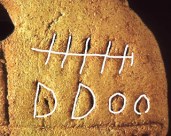
  From  Remains of Ancient Days – LA Times https://www.latimes.com/archives/la-xpm-1997-02-27-ca-33395-story.html                                                                                                                      “Bodies were first placed in a kokh–a deep, narrow cave–or on an … dead were collected and put into an ossuary, a large, usually lidded stone box.”                                 Attention,                                                                                                                                                 At would have an ossuary, as allmost all scientists agree that at Tartaria was an ossuary indeed, related to an “secondary burial” ritual. 

Din https://en.wikipedia.org/wiki/Secondary_burial

<< Artificial mounds and other, clearly visible, above-ground structures have been re-used since the New Stone Age (and even in later times, often by much later cultures) for burials of bodies, bones or cremated remains (in urns). These more recent burials, of whatever form, are referred to by archaeologists as secondary burials. They are found in grave mounds, usually in those areas of the site that could at the same time be extended. In larger dolmenspassage gravesstone cists, etc. the re-use of the interior space available was usually closer in time to the original burial (e.g. by the Globular Amphora culture), if necessary also accompanied by the removal or addition of secondary chambers (as in the Megalithic tombs of Hagestad). The mounds of the megalithic tombs, which were usually covered with earth, were re-used following a similar shape as the original grave mound.   …………..                                                                                                       Some more well-known examples include the megaliths from the late Funnel Beaker culture, the stringent procedures in the single burial graves of the Battle Axe culture, and the uniqueness of the Pitted Ware Culture.[

Din     Jesus and the Ossuaries Craig A. Evans https://docs.google.com/document/d/1-24WMy5xUmJTIhJRbucErA4SETQgoh9Bw2vTS3–kZY/edit

<< The use of ossuaries, or small caskets meant to hold only bones and not the undecomposed corpse itself, is ancient and finds a close parallel in the use of astodans (or “ossuaries”) by the ancient Persians (Yamauchi 1990, 61–63). The evidence for secondary burial in Chalcolithic and Bronze Age Palestine is considerable. …….

ossuaries themselves were then placed in a room, often stacked. They were sometimes placed in the niches themselves or in the central chamber. (In a tomb at Jericho four ossuaries were found in a single niche; cf. Hachlili 1979, 56–57.) There are burial inscriptions in which the word kokh appears: “This kokh [hkwk] was made for the bones of our fathers. Length two cubits. Not to be opened!” (CIJ no. 1300; Fitzmyer and Harrington 1978, 168–69; Meyers 1971, 66). Kokh can also be spelled qwq (qoq), as in this poorly preserved inscription: “This is the kokh [aqwq] of . . . Alas! And his daughter” (CIJ no. 1222; Fitzmyer and Harrington 1978, 182–83).   ……..

In contrast to this custom (i.e. cremation), the Jewish people buried their dead (as did also many Greeks and Romans), later gathering the bones and plac- ing them in containers or a vault set aside for this purpose. The practice of gathering the bones [liqut ‘azamot] of the deceased is called ossilegium, or “secondary burial” (cf. y. Moe‘ed Qatan 1.5, 80c: “At first they would bury them in ditches, and when the flesh had decayed, they would gather the bones [meliqtin et ‘azamot] and bury them in ossuaries”; (Rahmani 1994b, 193–94; for introductory discussion, see Gafni 1981; Silberman 1991; McCane 2000). How far back this practice may be traced and where the practice originated are major questions that lie at the heart of the debate surrounding the significance of the numerous ossuaries found in and around Jerusalem, dating to the Herodian period. …..

Meyers (1970, 12–13) acknowledges that concepts of the ossuary in Palestine may well have been influenced by designs and artwork from the Aegean world that were introduced to the Philistines. But this influence, if any, is quite ancient and in any case coincided with prac- tices to which the inhabitants of Palestine were well accustomed.  ……>>

Apropos de faptul ca la Tartaria este absent craniul:

<<The absence of the skull, which in the possession of Herod’s angry and vengeful wife would surely not have been properly buried and therefore would never have been rejoined to the rest of John’s body, would make resurrection all the more doubtful, at least a resurrection before the time of the general resurrection and judgment.>>

From The Galilean Economy in the Time of Jesus https://books.google.ro/books?isbn=1589837584 David A. Fiensy, ‎Ralph K. Hawkins – 2013 – ‎Religion

 <<on the other side yršlm hq [dsh]).: ‘holy yerusalem”>>

Din https://www.academia.edu/2227970/Ancient_Hebrew_Lexicon_of_the_Bible

B)(HhQQac:Inscribe co:ab:Custom:The appointment of a specific time,function or duty. A custom as something that is appointed.V)(
 Hh-QQ)—  Inscribe:To write a decree or custom. [freq. 19] (vf: Paal,Hophal, Pual, Participle) |kjv:lawgiver, governor, decree, grave, portray, law, printed, set,note, appoint| {str: 2710}Nm)(Hh-QQ) — Custom: [freq. 2] |kjv: thought,decree| {str: 2711}

https://www.biblestudytools.com/lexicons/hebrew/nas/koh.html

KOH                                                                                                                                                       , here, in this manner

  1. thus, so
  2. here, here and there
  3. until now, until now…until then, meanwhile

————————————————                                                                                                         (?? KOKHAION <?>KOGAION =”niche, loculus, pit-grave forever ??) …atention in GAION,HERAION ,AION part is attaching the meaning “forever duration” of a construction so “temple, shrine”, temple, shrine of Ge, temple of Hera. Horos and temenos has also the meanings of a sacred area, domain, precinct  : LOCULUS,PIT/GRAVE- SACRED DOMAIN                                                                                               AION LOCULUS,PIT-GRAVE                                                                                                            ——————————————————————————   

If  the signs  HQ    are read from right to left, we have QACh

 From    https://standingintheeleventhhour.wordpress.com/tag/adam/                        ” Appearing in many forms, qach is used 965 times in the Scriptures “in the widest variety of applications”. “marrying (as in “Avram and Nachor took wives…” Gen 11:29) and even the buying of goods! Common to any use of qach is the act of removing an entity from its original place or owner, such as the taking away sheep from the flock(as Rachael instructed Yaakov, “fetch me from two kids of the goats… Gen 27:9) buying a field or grain from the market (e.g. Proverbs 31:16, Nehemiah 5:3), and even marriage (e.g. as in “Avram and Nachor took wives…” Gen 11:29). In all contexts, qach describes the act of “taking away something to a new owner or new place, as in the context of Gen. 2:15. YHVH Elohim takes Adam away from the place he was formed to the newness of the Garden.”

+++++++++++++++++++++++++++++++++++++++++++++++++++++++++                                                 Until some days bevore, I was convinced that in canaanite, paleo-hebrew writings, there was not used dalet in the modern D shape, only triangle-shaped as Delta is.,                          But recently I’ve found that D-shape was used                                                                       From http://cryptcracker.blogspot.com/2010/03/qeiyafa-ostracon-inscription-this-large.html

QEIYAFA OSTRACON INSCRIPTION ( ~1000 B.C.)

                                                                                  [1] ‘ L T ` Sh  [Q] W? ` B D ‘ [L?] :  Z/T? H/Y?

[2] Sh P Tt . B W ‘ L M  [? ] [Sh] P Tt

[3] G L [Y/W?] [ T?] B ` L  S?  R? H/S? [ ]  Y?

[4] ‘ [ Q] M W N  Q? M Y B/Kh? D M L K .

[5] ‘ Q w/y M ` B D m? sh/m? Y : Ss? D Q T                                                                                  Notice that the direction of writing is from left to right (dextrograde), which is the opposite of the order for Biblical Hebrew, and also for ancient Phoenician, Hebrew, and Moabite inscriptions (right to left, sinistrograde); but there is general agreement that this is the way this text runs. The pattern for this is set in the Izbet Sartah ostracon: it also has 5 lines of text; the fifth has the letters of the script (from ‘Aleph to T) running from left to right, and the other 4 lines are obviously dextrograde also (lines1 to 3 leave a space at the end; 4 runs over into the end-space of 5).
However, Christopher Rollston has said on rollstonepigraphy.com:
Prior to the rise of the Phoenician script, Northwest Semitic inscriptions could be written sinistrograde (right to left), dextrograde (left to right), or boustrophedon (one line left to right, and the next line right to left).  Of course, sometimes NWS inscriptions could even be written vertically.  Many people seem to be reading the Qeiyafa ostracon as dextrograde in its entirety.  ……………………….                                         There is a pantheon leaping out at us in the same way: the storm-god Baal (B`L) in line 3, the mysterious Molek (MLK) in 4, the mother goddess Elat (‘LT) in 1, the chief god El (‘L) or all the gods (‘LM) in line 2 ”    ……………….                                                                            In the Bronze Age the proto-alphabetic sign for Sh was the sun (the disc with a protecting serpent), and the Babylonian sun-god Shamash (the sun being the all-seeing eye, with the stars as the spies by night) was the minister for justice in the celestial government.

From EARLY HEBREW SYLLABARY                                                                                             The Lost Link.The Alphabet in the Hands of the Early Israelites Brian E. Colless Massey University, Palmerston North, New Zealand   http://cryptcracker.blogspot.com/2014/04/                                                                                               This phenomenon could have a connection with the trio of ’Alephforms on the Qeiyafa Ostracon. But my idea goes further than that: in the early “Israelian” Hebrew alphabet each of its twenty-two letters had two additional forms, making a total of sixty-six signs. In fact, the system was not a simple consonantary (which the Phoenician alphabet certainly was, in the Iron Age) but a syllabary.     ………….                                      The first situation seems to fit the case, as the neo-consonantary is attesested around 1500 BCE, and the neo-syllabary appears around 1200 BCE.                                                       Ayin in the Phoenician alphabet, as also on the Zayit Stone, is a circle, but without the centre-dot that is characteristic of the sign in the south in Iron Age I. However, on the Beth-Shemesh Ostracon [7] there is one of each, leading to the suspicion that the empty circle is the syllable ‘I.       …………..                                                                    Then comes ‘Ayin with no dot, so it is ‘I. The Lamed here is not the same as the one further on, and I will not make a decision on their respective sounds; but it might be LI. Hence Shumiba`ili  (“name of Ba`al”) 

  From inscriptions – cryptcracker cryptcracker.blogspot.com/2010/04/timna-inscriptions-copper-mines-at.html                                                                                                                          “The oval on the right has the following signs: `(ayin), Z (properly Dh), … The other oval has the sun symbol at the top (Sh, from shimsh ‘sun‘, …” 

https://sites.google.com/site/collesseum/cuneiformalphabet
o 	s  S(sh+th)  O 	shimsh: sun (but without serpent)

 From syllabary – cryptcracker                                                      cryptcracker.blogspot.com/2007/03/oldest-west-semitic-inscriptions-these.html

Mar 19, 2007 – The circle, for example (an eye with a dot for the pupil, or else the sun) does … stands would represent `U (the consonant being `ayin, and its origin is in the … In the syllabary (by my calculations) the circle is the sun (shimshu, …

 ———————————————————-                                                                                              In the text transcript, I coloured intentionaly Ayin (transcript ` ), Lamed and Dalet.          In  “DDoc” sequence, we could have the signs  o=Aiyn (see folowing alphabet) and c =L (Lamed, Qeiyafa ostracon)                                                                                                                                              Aici se poate vedea mai bine Ayin: Din http://www.abrahamsdescendants.com/hebrew.html

                        ———————————————————                                                                                           But as presented above, the circle possible has the folowing (succeding?) equivalents:    – Ayin                                                                                                                                                         – “SUN” shimsh-logogram                                                                                                                      –syllable ‘I.    =AI                                                                                                                                     – S                                                                                                                                                              So:                                                                                                                                                               D D C = Dalet, Dalet, =Ain=`?/I?/S? /,  Lamed ?                                                                                        D-D-  `/s- L? >> “DoD  `L“, DoD AL:               =          “uncle/BELOVED- AL  ” ; 

                   Attention, in Tartaria, have no  alef-lamed, AL:”EL, god El (‘L) but ayin-lamed, OL=”AL”

From https://www.academia.edu/2227970/Ancient_Hebrew_Lexicon_of_the_Bible             1073)(DDac:Move co:Breasts ab:Passion: The pictograph

 is a picture of the a tent door which hangsdown from the top of the tent entrance.The use of this letter twice indicates “two danglers” representing a womans breasts.The part of the female body invoking heat of passion and love. (eng: udder; dad – asbeloved; teat – a double exchange for a tand d)

A)(DDac:?co:Breasts ab:?m)(DD) — Breast:[freq. 4] |kjv: breast, teat| {str:1717}
                                                                                                                                                           From https://www.academia.edu/2227970/Ancient_Hebrew_Lexicon_of_the_Bible                                                                                                                                                                        A)(AL)ac:?co:Ox ab: Oath: The power of the oxs musclesto perform work.
Nm)(AL) — 
Power:
One who holds authority overothers such as judges, chiefs andgods. In the sense of beingyoked to one another. [freq. 245]|kjv: God, god, power, mighty, goodly, great, idols, strong, unto,with, against, at, into, in, before,to, of, upon, by, toward, hath,for, on, beside, from, where,after, within| {str: 410}

From  Bible Lexicons Old Testament Hebrew Lexical Dictionary https://www.studylight.org/lexicons/hebrew/1730.html                                                                                                                                                                                                                       דֹּד dôd, dôd  Phonetics dode, dode                                                                                                  1.beloved, love, uncle                                                                                                                          1a) loved one, beloved                                                                                                                   1b) uncle                                                                                                                                              1c) love (plural abstract)                                                                                                                                                                                                                                                                      =================   Note   ==================================                                                                                                                                                                                                           – God’s name,EL is written with  Alif-Lamed, transcripted L ; cause alif is not full,proper consonant nor vowel, it is an deaf sound. My question, why written with Alif and not pronounced Al but El , cannot explain myself and found no reason, but a “scientific explanation” of course there is available.                                                       ================================                                                                                   Interpretation would be:                                                                                                                                                                                                                                                                                 NICHE,LOCULUS (SACRED) (…or first letters of the word Cohen=”priest“?) and in                              love, beloved  Al” ; what is  AL for ?, cause normally,                                                   (al) – Means on as in “on top of”. It can also mean “about”

From https://www.biblestudytools.com/lexicons/hebrew/nas/al-3.html                                             AL :”upon, on the ground of, according to, on account of, on behalf of, concerning, beside, in addition to, together with, beyond, above, over, by, on to, towards, to, against ”                                                                                                                                                                      No consisten meaning is emerging. But I put in attention:

Abraham ,Isaac and Jacob never knew God under name Allah. – Ummah …https://www.ummah.com/…/316552-abraham-isaac-and-jacob-never-knew-god-under&#8230;<< The word Allyown is derived from the primary root ALAH as is also the word AL (ayin, lamed) which is also translated as “the Most High” in Hosea 7:16 and 11:7.     As such AL is an exact synonym for the “EL” (aleph, lamed) in “El Shaddai”.                  In fact that “El” should be spelled AL also since Aleph, the first letter of the Hebrew alphabet is equal to our A rather than E. You will notice that when one is careful to pronounce AL slowly and distinctly as the name of the MOST HIGH deserves it becomes phonetically A-L-L-A-H. So everywhere you see Abraham, Isaac, and Jacob use the Hebrew words AL (aleph, lamed) and Al (ayin, lamed) they are using the name ALLAH. >>

From https://mafiadoc.com/strong-hebrew-dictionary-holy-bible-institute_5a1799f81723ddaf7678d011.html                                                                                                                                                                                                                                                      << {409} la” — ‘al, al; (Aramaic) corresponding to 408: — not. click to see {408} {410} lae — ‘el, ale; shortened from 352; strength; as adjective, mighty; especially the Almighty (but used also of any deity): — God (god), X goodly, X great, idol, might(-y one), power, strong. Compare names in “-el.” click to see {352} {411} lae — ‘el, ale; a demonstrative particle (but only in a plural sense) these or those: — these, those. Compare 428. click to see {428} {412} lae — ‘el, ale; (Aramaic) corresponding to 411: — these. click to see >>                                                                                                                                                                                                                                                                                                                          Explanation of Ayin using and not Alef, is due of the fact that for tablet writer the coresponding sounds was of no much concern, nor realised that the sounds are slightly different.  

Brian Coless: “Getting into the mind of a writer of a text is always difficult”

From Hebrew Letter Ayin                                                                          https://www.cartoonhebrew.com/ayin                                                                                        “The letter is pronounced a lot like Alephmeaning that it only has the sound of whatever vowel goes … (al) – Means on as in “on top of”. It can also mean “about.”.

From Does Hebrew have letters that make the same sound? – Quora   https://www.quora.com/Does-Hebrew-have-letters-that-make-the-same-sound               ” Yes, quite a lot actually. * Alef (א) and Ayin (ע)—they mostly merged in the modern language. They were definitely distinct in ancient Hebrew: Alef was a glottal … ===================                                                                                                                        Other interpretations of the signs OC:                                                                                                   SL;”SaL”?                                                                                                                                               ‘IL=”AIL” ?                                                                                                                                                    From https://en.wikipedia.org/wiki/El_(deity)Specific deities known as ʾEl or ʾIl include the supreme god of the ancient Canaanite religion[3] and the supreme god of East Semitic speakers in Mesopotamia’s Early Dynastic Period.[4]

==================================

From  https://en.wikipedia.org/wiki/Names_of_God_in_Judaism”                                            “The name of God most often used in the Hebrew Bible is the Tetragrammaton (YHWH יהוה). It is frequently anglicized as Jehovah and Yahweh.. as “the Lord”  the divine name as too sacred to be uttered.  … Rabbinic Judaism describes seven names which are so holy that, once written, should not be erased: YHWH and six others which can be categorized as titles are El (“God“)…,

THIS COULD BE THE EXPLANATION THAT UPPER HALF OF THE ROUND TABLET, BEING COVERED BY THAT OBLONG-ONE TABLET, THE SIGNS=THE MESSAGE WAS OUT OF SIGHT OF PASSERS-BY, SO INACCESIBLE, INTENTIONALY HIDDEN.                                                                                                                                                                                                        Maybe, by chance or not, this time out of the semitic area, possible kind of 4-letters group, “Tetragrammaton” composed the name of a supreme divinity, possible of the type:                                                                                                                                              “DDou=Dzou, Zou(pelasgian,cretan,thracian), Dibos=Divos (balto-thracian,phrigian,greek), Ddiou,Ddios (neapolitan,sardinian)”?                            ===========================                                                                                                             Proto-Semitic Noun *ʾil–                                                                                                                      1.”deitygod”

=================================================

From THE PHILISTINE SCRIPT AND INSCRIPTIONS (Excerpts from The Celtic Connection Revisited, unpublished material, 2014) By Michel-Gérald Boutet https://mail.google.com/mail/u/0/?zx=5altn8zeq797#inbox?projector=1

Although an early Indo-European presence was felt in the Canaan region after
the second millennium B.C.E, the Philistines along with the other Sea Peoples
make an abrupt entry into the Egyptian records just at around 1200. The
Philistines, purportedly from Bulgaria and Crimea, were of mixed Indo-European
nations mainly of Proto-Celtic Danubian, Aegean and Anatolian descent.These
Danubians, the Dananoi, or Danauoi in Greek, constituted of a number of
undifferentiated Indo-European tribes originally from the Pontic Crimean area of
the Black Sea that had settled on the western Anatolian coast and eventually on
the island of Cyprus. During the Bronze Age, their metallurgical skills gave them
the cutting edge and they were the ones responsible for prompting the Iron Age
in the Mediterranean basin.   ………….                                                                                           The Greeks called them the Pelesetes, the Assyrians, the Palastu or Pilistu, and
the Hebrew the Pelištīm.                                                                                                                   The origin of the name Pelesetes is thought to derive from the Indo-European
root word *pel-, pellis “skin, hide.” A Proto-Celtic root hints at a more plausible
etymology with pell-os/-a/-on, “far away, remote,” thu,s *pelletes, “those from far
away.” ……………..

The Philistine time line                                                                                                                                                    
1550 BCE Start of the Late Bronze Age with the Egyptian
conquest of the Canaanite coastline at the start of
the Eighteenth dynasty. The Mycenaean peoples
export their metallurgical skills and initiate local
production and trade.

1200 BCE The Sea Peoples invade Canaan and Egypt. The
Philistines take foot on the coast between Phoenicia and Egypt and put an end to the Late
Bronze Age.

1175 BCE Ramses III defeats the Sea Peoples including
Philistines and settles for an alliance with the
Philistines who accept to be confined to the coastal
plain of southern Canaan as a client nation.

1150 BCE Under Ramses III, the destruction of the city of
Lachish marks the final Egyptian withdrawal from
southern Canaan.

10th–7th centuries BCE The Philistines lose their military grip over the
surrounding peoples and their distinctive culture is
eclipsed by the surrounding kingdoms of Judea,
Israel and Phoenicia.

7 th-6th centuries BCE The Philistine city states suffer loss of population,
the seat of power and population is concentrated in
Ekron, an important political, agricultural and
commercial center.

After 600 BCE Total collapse of Philistine civilization and the
citadel of Ekron are left abandoned. The city did
not resist at the time of the Assyrian-Egyptian war
in 605 BCE and was destroyed.

586 BCE What is left of the remaining local Philistine
population is assimilated into the Judean and
Phoenician cultures. Jerusalem is destroyed by the
Babylonian king Nebuchadnezzar II and the local
elite and leaders are deported to Babylonia.
During their exile, the remaining Philistines, under
the protection of the Assyrians, occupy the Judean
border town of Beit Shemesh. They are finally
released under the Achaemenid Empire.
 c. 330 BCE Alexander the Great conquers Palestine Syria.

The Philistine Alphabet    ………….. It seems more likely,
however, that the script was the creation of Semitic Canaanites under the
influence of mixed Indo-European agents. ………….                                                                       Ba’al, “master, owner, lord,” theonym, the Canaanite and Phoenician
god Baal.
G’T < Gat or Gath, a Philistine place name. …………                                                                           Khyan (kōhēn, “priest”) and Apophis, betray a Semitic origin. ………….                                     So, at the end of the second millennium, the peoples of the Levant came into contact with the Anatolians and later on, with the Mycenaeans and Aegeans. The alphabet was just one of these innovations that would structure and consolidate this mobile and volatile society.  ……                                                                                                                             ….!must see! Table of Compared Indo-European and Semitic Proto-Scripts

!!!!!!!Tartaria!!!!!!????Turda?????????? :

“These same ethnic groups will later appear in
continental Europe as the co-founders of the Proto-Celtic, Proto-Italic, Proto-Illyric
and Proto-Germanic ethnic groups. It now appears, judging from inscribed tablets
found in Israeli archaeological sites that the Philistine, as the Denen, were
originally Danubian Proto-Celts.
The Greek name Ταρτησσός, Tartessos, was coined from the Iberian place
name Turtha (from PIE root, *tur- < *tu̯er-, “to twirl, turn to grab, hold;” *tur-da,
“artificial mound, hill fort, oppidum,” and punning with torta, “wet, damp, place”).
It is of the same etymology as the Irish toponym Tara (from tura > turra > torra,
“knoll, hill, mound, earth heap”). The root element turd- is also found in the
names of surrounding Celtic Iberian ethnic groups such as the Turduli and
Turdetani. Judging from what wrote Strabo, Tartessos was called turdetania in
their language.
Strabo, in Geographica, Book III:
“From this river the country has received the name of Bætica; it is called
Turdetania by the inhabitants, who are themselves denominated Turdetani, and
Turduli. Some think these two names refer to one nation, while others believe
that they designate two distinct people. Of this latter opinion is Polybius, who
imagines that the Turduli dwell more to the north than the Turdetani. At the
present day however there does not appear to be any distinction between them.
These people are esteemed to be the most intelligent of all the Iberians; they
have an alphabet, and possess ancient writings, poems, and metrical laws six
thousand years old, as they say. The other Iberians are likewise furnished with an alphabet, although not of the same form, nor do they speak the same
language.”

Numai interpretarea ebraica mai lipsea…

April 26, 2019

.

Atentie!                                                                                                                                                                  Aceasta postare nu este o o descifrare sau citire a unui presupus continut scris real. Avand in vedere ca semnele nu apartin unui unic sistem de scris ci mai multora, pagina are un caracter pur didactic. Are rolul de a incerca si testa diferite scrieri in idea ca pe tablite s-ar fi folosit unul din ele. Semnele de pe tablite apartin mai multor sisteme de scrisi dintr-larg interval de timp si care au folosite in diferite arii geografice. In niciuna din incercari semnele nu s-au incadrat intr-un singur tip de scriere, totdeauna au ramas semne care au provenit din alte scrieri (sau din necunoscut). Cele mai multe semne provin din cele sumeriene proto-cuneiforme.Apoi privind asemanarea, in ordine descrescatoare este aceea cu semnele Linear A/B si cele Anatoliene. Semnele din jumatatea superioara a tablitei rotunde par a proveni din scrierea arhaica greceasca.Cel mai degraba aceasta “adunatura” de semne pare a fi rodul imaginatiei bogate a cuiva.Dupa cum au constatat A.Falkenstein si A.A.Vaiman, (aceasta fiind si parerea mea ferma) autorul nu a fost un scrib, avea doar vagi notiuni privind scrisul in general si nu se stie ce a urmarit. Exista multe elemente de neconcordanta precum si altele care scot tablitele din tiparele si normele uzuale ale  logicii, scrisului si intentiilor oneste.

.===================                                                                                                                          .Intamplarea face ca azi este sambata, 27 Aprilie 2019, ajunul Pastilor………….    Tablita rotunda de la Tartaria:  https://neptest1.files.wordpress.com/2015/03/imagine-mare.jpg?w=465&h=310

                                                   In urma cu mai multi ani, m-a atras in mod special, si ca atare am inceput sa ma ocup prioritar de citirea jumatatii de sus, fiind atras de asemanarea  semnelor cu litere (relativ moderne).                                                                                                                           M-au preocupat semnele “H” ; “D/P” din stanga se cele D si O din dreapta.  ———————————————————————–                                                                                                         Daca semnul “H” este identic cu litera veche ebraica “het”.                                             Din The Ancient Hebrew Alphabet
By Jeff A. Benner http://www.ancient-hebrew.org/alphabet_letters_hhet.html

                                                                                                                                                                                                                                     Early hebrew letter Hhet:                                                                                                                                                                                                                                                                   Din  Gezer Calendar – Agricultural Almanachttp://www.lavia.org/english/archivo/GezerEN.html                 Vedeti in fiecare rand, (citire dr>stg.),la inceput yrh= yarach=”LUNA” 

  Din http://aplaceofbrightness.blogspot.com/2008/11/moonlight-in-romania-tartaria-tablets_21.html                                                                                                                                                                                                                                         HP par a fi literele vechi ebraice Heth/Chet si Qof  , deci H-P=Kh-Q= COKH, kokh (indiferent daca citim de la stg.>dr. sau de la Dr>Stg!)                                                            Din  https://www.cram.com/flashcards/hebrew-letters-focus-israel-2253556                                                                                      kokh:”nisa,locsor”                                                                                                                               Din The Ossuary of James – The Nazarene Way https://www.thenazareneway.com/ossuary_of_james.htm                                       “The ossuary was then placed in a niche (loculi or kokh) area of the burial cave”                  <<daca ar fi literele Het-Dalet, ar putea fi primele litere ale cuvantului KODESH=”sfant”      WORD STUDY – HOLY – Chaim Bentorah http://www.chaimbentorah.com/2013/08/word-study-holy/                                                  Aug 13, 2013 – I have found a meaning for the word kodesh (holy)>> 

    Remains of Ancient Days – LA Times https://www.latimes.com/archives/la-xpm-1997-02-27-ca-33395-story.html                                                                                                                      “Bodies were first placed in a kokh–a deep, narrow cave–or on an … dead were collected and put into an ossuary, a large, usually lidded stone box.” 

  Din Ancient Jewish Epitaphs: An Introductory Survey of a Millennium of …https://books.google.ro/books?isbn=9024233070                                                                     Pieter Willem van der Horst, ‎Pw van der Horst – 1991 – ‎Religion

The Hebrew word kokh, here Aramaic kokhah, actually means cavity or cave, but it has developed the special meaning “burial chamber (in a rock).

                             Atentie,                                                                                                                                                 la Tartaria avem de-a face cu osuar, oase care prezinta caracteristicile unui ritual de ingropare secundara a lor (“secondary burial”)                                                                           ————————————————                                                                                                         (?? KOKHAION <?>KOGAION =”nisa,locsorul,mormantul Vesnic??)                                       ——————————————————————————                                                                 Pana mai ieri, aveam convingerea ca in scrierile canaanita si ebraica nu s-a folosit deloc semnul D ci numai sub forma triunghiulara, gen delta.                                               Ca relativ recent sa aflu ca s-a folosit forma “D                                                                      Din http://cryptcracker.blogspot.com/2010/03/qeiyafa-ostracon-inscription-this-large.html

QEIYAFA OSTRACON INSCRIPTION (cca. 1000 B.C.)

                                                                                  [1] ‘ L T ` Sh  [Q] W? ` B D ‘ [L?] :  Z/T? H/Y?

[2] Sh P Tt . B W ‘ L M  [? ] [Sh] P Tt

[3] G L [Y/W?] [ T?] B ` L  S?  R? H/S? [ ]  Y?

[4] ‘ [ Q] M W N  Q? M Y B/Kh? D M L K .

[5] ‘ Q w/y M ` B D m? sh/m? Y : Ss? D Q T                                                                                  Notice that the direction of writing is from left to right (dextrograde), which is the opposite of the order for Biblical Hebrew, and also for ancient Phoenician, Hebrew, and Moabite inscriptions (right to left, sinistrograde); but there is general agreement that this is the way this text runs. The pattern for this is set in the Izbet Sartah ostracon: it also has 5 lines of text; the fifth has the letters of the script (from ‘Aleph to T) running from left to right, and the other 4 lines are obviously dextrograde also (lines1 to 3 leave a space at the end; 4 runs over into the end-space of 5).
However, Christopher Rollston has said on rollstonepigraphy.com:
Prior to the rise of the Phoenician script, Northwest Semitic inscriptions could be written sinistrograde (right to left), dextrograde (left to right), or boustrophedon (one line left to right, and the next line right to left).  Of course, sometimes NWS inscriptions could even be written vertically.  Many people seem to be reading the Qeiyafa ostracon as dextrograde in its entirety.  ……………………….                                         There is a pantheon leaping out at us in the same way: the storm-god Baal (B`L) in line 3, the mysterious Molek (MLK) in 4, the mother goddess Elat (‘LT) in 1, the chief god El (‘L) or all the gods (‘LM) in line 2 ”                                                                                                       ———————————————————-                                                                                              In transcriptia textului, intentionat am colorat literele Ayin (ranscris cu accent grav ` ), Lamed si Dalet.                                                                                                                                       In secventa “DDoc” am putea avea semnele o=Aiyn (vezi alfabetul) si c =L (Lamed, Qeiyafa ostracon)                                                                                                                                  Aici se poate vedea mai bine Ayin: Din http://www.abrahamsdescendants.com/hebrew.html

                        ———————————————————                                                                                           D D C = Dalet, Dalet, =Ain?/s?,  Lamed ?                                                                                        D-D-  `/s- L? >> “DoD  `L“, DoD AL:               =          “uncle/BELOVED- AL  ” ;                      Atentie, in Tartaria, nu avem alef-lamed, AL:”EL, god El (‘L) ci ayin-lamed, OL=”AL”  

Transliteration dôd, dôd  Phonetics dode, dode                                                             1.beloved, love, uncle                                                                                                                          1a) loved one, beloved                                                                                                                   1b) uncle                                                                                                                                              1c) love (plural abstract)

Din https://mafiadoc.com/strong-hebrew-dictionary-holy-bible-institute_5a1799f81723ddaf7678d011.html                                                                                                                                                                                                                                                       dowd, dode; or dDo (shortened) dod, dode; from an unused root meaning properly, to boil, i.e. (figuratively) to love; by implication, a love- token, lover, friend; specifically an uncle: — (well-) beloved, father’s brother, love, uncle.                                                                                                                                                                                                              =================   Nota   ==================================                                         – Numele Dumnezeu, EL se scrie folosind semnele Alif-Lamed, in transcriptie L  pentru ca alif nu este nici consoana nici vocala propriu-zisa, este un sunet surd. De ce se scrie cu Alif si nu se pronunta Al ci El , nu stiu sa va explic dar explicatia exista.                                                              ================================                                                                                   Interpretarea ar putea fi:                                                                                                           NISA,LOCSOR (SACRU) (…sau primele litere de la Cohen=”preot“?) si                              iubire,iubitul Al” ; Dar ce inseamna AL?, ca in mod normal,                                                   (al) – Means on as in “on top of”. It can also mean “about

https://www.biblestudytools.com/lexicons/hebrew/nas/al-3.html                                             AL :”upon, on the ground of, according to, on account of, on behalf of, concerning, beside, in addition to, together with, beyond, above, over, by, on to, towards, to, against ”

Din https://mafiadoc.com/strong-hebrew-dictionary-holy-bible-institute_5a1799f81723ddaf7678d011.html                                                                                                                                                                                                                                                      << {409} la” — ‘al, al; (Aramaic) corresponding to 408: — not. click to see {408} {410} lae — ‘el, ale; shortened from 352; strength; as adjective, mighty; especially the Almighty (but used also of any deity): — God (god), X goodly, X great, idol, might(-y one), power, strong. Compare names in “-el.” click to see {352} {411} lae — ‘el, ale; a demonstrative particle (but only in a plural sense) these or those: — these, those. Compare 428. click to see {428} {412} lae — ‘el, ale; (Aramaic) corresponding to 411: — these. click to see >>                                                                                                                                                                                    Nu stiu ce poate rezulta din aceasta asociere. Dar propun in schimb sa tinem cont de urmatoarele:

Abraham ,Isaac and Jacob never knew God under name Allah. – Ummah …https://www.ummah.com/…/316552-abraham-isaac-and-jacob-never-knew-god-under…                                                                                                                                                                  << The word Allyown is derived from the primary root ALAH as is also the word AL (ayin, lamed) which is also translated as “the Most High” in Hosea 7:16 and 11:7.     As such AL is an exact synonym for the “EL” (aleph, lamed) in “El Shaddai”.                  In fact that “El” should be spelled AL also since Aleph, the first letter of the Hebrew alphabet is equal to our A rather than E. You will notice that when one is careful to pronounce AL slowly and distinctly as the name of the MOST HIGH deserves it becomes phonetically A-L-L-A-H. So everywhere you see Abraham, Isaac, and Jacob use the Hebrew words AL (aleph, lamed) and Al (ayin, lamed) they are using the name ALLAH. >>                                                                                                                                                                                                                                                                                                                              Explicatia folosirii semnului Ayin si nu Alef, consta in faptul ca scriitorul tablitei nu facea diferenta folosirea unui sunet similar apropiat. (“Getting into the mind of a writer of a text is always difficult”)

Din Hebrew Letter Ayin                                                                          https://www.cartoonhebrew.com/ayin                                                                                        “The letter is pronounced a lot like Alephmeaning that it only has the sound of whatever vowel goes … (al) – Means on as in “on top of”. It can also mean “about.”.

Din Does Hebrew have letters that make the same sound? – Quora   https://www.quora.com/Does-Hebrew-have-letters-that-make-the-same-sound               ” Yes, quite a lot actually. * Alef (א) and Ayin (ע)—they mostly merged in the modern language. They were definitely distinct in ancient Hebrew: Alef was a glottal …

Din 25. Hosea | Hebrew Bible (67 views) – Scribd  https://www.scribd.com/document/98492982/25-Hosea

==================================

Din https://en.wikipedia.org/wiki/Names_of_God_in_Judaism”                                            “The name of God most often used in the Hebrew Bible is the Tetragrammaton (YHWH יהוה). It is frequently anglicized as Jehovah and Yahweh.. as “the Lord”  the divine name as too sacred to be uttered.  … Rabbinic Judaism describes seven names which are so holy that, once written, should not be erased: YHWH and six others which can be categorized as titles are El (“God“)…,

ACEASTA AR PUTEA FI EXPLICATIA FAPTULUI CA JUMATATEA DE SUS A TABLITEI ERA INACCESIBILA VEDERII SI DECI CITIRII, FIIND ACOPERITA DE TABLITA DREPTUNGHIULARA                                                                                                                      Este intamplator sau nu, numele divinitatii este inclus intr-un grup de 4 litere (“tetragrammaton”) ;(sau cu totul cuprinde numele, gen “DDou=Dzou, Dibos=Divos, Ddios”?)

NUMELE ZEITATII EL/YAHVE ERA SECRET SI NU PUTEA FI PRONUNTAT

“MONTES SERRORUM” and SERRI

April 25, 2019

                                                                                                             ! PREZENTA POSTARE  REPREZINTA SI SUSTINE  IPOTEZA CONFORM CAREIA SCRIBUL AVEA O VAGA CUNOSTINTA DE O SUMA DE SEMNE DE ORIGINE SUMERIANA, DAR NU LE STAPANEA INTELESUL SI CA ATARE DOAR LE-A EXPUS.                                          CUNOSTINTELE SALE IN A SCRIE CU ADEVARAT S-AR REZUMA STRICT LA JUMATATEA DE SUS A TABLITEI ROTUNDE !

Din The Lost Civilizations of the Stone Age Richard Rudgley                                                  << the tablets represented a garbled and ‘senseless’ mimicry of Near Eastern writing >>

Din discovery.ucl.ac.uk › Josiffe_10082208_thesis                                                                         an investigation into the origins of writing – UCL Discovery
https://discovery.ucl.ac.uk/PDF by C Josiffe – 
<< Tărtăria tablets has been … He suggested that these scratch marks had been made as mimicry of the signs themselves … >> 
Din Acta Terrae Septemcastrensis
<<The hypothesis that the Tartaria tablets represent only a writing-like design was … had a vague idea of Sumerian documents and aped them (Gelb 1967: 489).>> ====================

In urmatoarele,                                                                                                                                                                                                                                                         – reafirm ipoteza avansata anterior de cercetatori conform careia  SERII erau un trib dacic din CAUCALAND=TRANSILVANIA si nu unul provenit din Caucaz                                                                                                    – Avansez ipoteza ca MONTES SERRORUM se refera la CARPATI si mai precis la MUNTII RETEZAT !                                                ===============================

 Din Storia d’Italia del medio-evo: De’ popoli barbari avanti la loro … https://books.google.ro/books?id=ymgtAAAAYAAJ

SERRI (Monti). Della Dacia di là dal Danubio. 1 Goti si riparano fra le loro inaccessibili gole de’Serri, perischi- var l’impeto di Valente. Augusto ( A.367 ) , p. 804.
Din https://archive.org/stream/OEnigmaSiUnMiracolIstoricPoporulRoman/O%20enigma%20si%20un%20miracol%20istoric-%20poporul%20roman_djvu.txt
Nu te poţi împiedica de a nu releva deosebirea dintre cele două 
migraţiuni: una sprijinită pe un text precis: rezumatul lui Eu- 
tropius, privind regiuni delimitate de geografia politică a impe- 
riului roman ; cealaltă întemeiată dimpotrivă pe tăcerea izvoarelor 
istorice, pe fapte de ordin linguistic şi urmând totuşi un itinerar 
mai complicat decât acel arătat de texte. E vorba într’adevăr de 
o adevărată călătorie în zig-zag a strămoşilor poporului român. 
« Daco-ilirieniî » ar fi străbătut întâi Banatul, ar fi ajuns în Transil- 
vania şi s’ar fi răspândit de acolo, printr’o nouă expansiune dela 
nord spre sud şi est, în Muntenia şi în Moldova. Dintre toate 
naţiunile deprinse a călători, Românii, enigma şi miracolul Evului 
Mediu, ar deţine astfel cu siguranţă recordul nestabilităţii teri- 
toriale ! .....................
Oare aceste rânduri au fost scrise de vre-un partizan îndârjit 
al continuităţii daco-romane, care ar refuza să se plece în faţa 
mărturiilor categorice ale izvoarelor ? Deloc ; ele privesc Alsacia 
după plecarea legiunilor şi instalarea definitivă a triburilor ger- 
manice pe malul drept al Rinului, care au cotropit din nou Galia, 
pentru a nu o mai părăsi, în primii ani ai secolului al V-lea. Ceea ce 
pare a dovedi că ipoteza unei retrageri a populaţiei rurale în pă- 
durile şi în munţii Daciei, în primii ani ai ocupaţiei barbare, nu 
ar fi aşa de absurdă, cu atât mai mult cu cât ea este dovedită chiar 
pentru unii cuceritori ; regele got Atanaric, în 376, s’a retras cu 
toţi ai săi în Caucaland, locum altitudine silvarum inaccessum et 
montium, pe care Sarmaţii tocmai îl părăsiseră şi care e identi- 
ficat azi cu unii munţi din Banat. încă din 367, Goţii se refugiau 
în Montes Serrorum, Carpaţii, în faţa înaintării ameninţătoare a 
legiunilor împăratului Valens. Mai înainte încă, în 323, împăratul 
Constantin a surprins dincolo de Dunăre pe o înălţime împădu- 
rită, în Muntenia, bandele lui Rausimod care tocmai pustiiseră 
Moesia superioară şi Tracia şi le-a silit să înapoieze locuitorii pe 
care-i luaseră cu sine l ). De altă parte, dacă populaţia civilă ră- 
masă în Dacia n’a lăsat urme epigrafice ale persistenţei sale de 
a locui ţinuturile cotropite, emigraţii instalaţi dincolo de Dunăre, 
în noua «Dacie », creată de Aurelian, după cum August stabilise 
odinioară Germanii pe malul drept al Rinului 2 ), nu au lăsat 
nici ei mai multe. Ceea ce ar face să se creadă că numărul lor nu 
a fost aşa de mare, după cum s’ar presupune în urma părăsirii 
totale a unei provincii de populaţia ei civilă şi militară.
Din Storia d’Italia del medio-evo: De’ popoli barbari avanti la loro … https://books.google.ro/books?id=ymgtAAAAYAA
SERRI (Monti). Della Dacia di là dal Danubio. 1 Goti si riparano fra le loro inaccessibili gole de’Serri, perischi- var l’impeto di Valente. Augusto ( A.367 ) , p. 804.

Din Three Problems of Historical Geography: Dafne, Montes Serrorum and Caucaland, “Études Balkaniques“, Sofia, 36, 2000, 3, p. 132-143 Alexandru Madgearu                       https://www.academia.edu/1305500/Three_Problems_of_Historical_Geography_Dafne_Montes_Serrorum_and_Caucaland_%C3%89tudes_Balkaniques_Sofia_36_2000_3_p._132-143

From https://theodora.com/encyclopedia/s/serros_seres.html                             SERES, Serros or Siros, chief town of a sanjak in the vilayet of Salonica, European Turkey, on Lake Takhino, a navigable expansion of the river Karasu or Struma (ancient Stryrnon), 43 m. by rail N.E. of Salonica. Pop. (1905) about 30,000, of whom about half are Bulgarians (one-third of them being Mussulmans), nearly one-fourth Greeks, about one-seventh Turks and the remainder Jews. Seres is built in a district so fertile as to bear among the Turks the name of Altin Ovassi, or Golden Plain, and so thickly studded with villages as to appear, when seen from the outliers of Rhodope on the north, like a great city with extensive gardens. It is the seat of a Greek archbishop and patriarch. It consists of the old town, Varosh, situated at the foot and on the slope of the hill crowned by the old castle, and of the new town built in the European fashion on the plain, and forming the commercial centre.

Seres is the ancient Seris, Sirae or Sirrhae, mentioned by Herodotus in connexion with Xerxes’s retreat, and by Livy as the place where Aemilius Paulus received a deputation from Perseus. In the 14th century, when Stephen Dushan of Servia assumed the title emperor of Servia, he chose Sirrhae as his capital; and it remained in the hands of the Servians till its capture by Sultan Murad II. (1421-1451).

Image from https://en.wikipedia.org/wiki/Salonica_Vilayet

From https://www.revolvy.com/page/List-of-ancient-Daco%252DThracian-peoples-and-tribes

======================================================                                         From https://www.nihilscio.it/Manuali/Lingua%20latina/Verbi/Coniugazione_latino.asp?verbo=serro%20&lang=EN_     

INDICATIVE Present meaning
ego serro I saw                                                    rom:  “eu fierastruiesc, tai cu fierastraul, ?RETEZ?

From http://www.dicolatin.com/FR/LAK/0/SERROS/index.htm                                                  SERRI, ORUM, m pl

accusatif pluriel SERROS
SERRI, ORUM, m pl
1 siècle après J.C.PLINIUS (Pline)
Serres n. m : peuple voisin du Caucase voir: Serres
SERRI,SERRO,SERRORUM MONTES :?”Muntii retezati, RETEZAT“?

————————————————————————————–                                                          From https://en.wiktionary.org/wiki/herus                                    Noun herus m (genitive herī); second declension

  1. master of the house or family
  2. owner, proprietor
Case Singular Plural
Nominative herus herī
Genitive herī herōrum
Dative herō herīs
Accusative herum herōs
Ablative herō herīs
Vocative here herī

Synonyms dominus

==============================================

In upper half of Tartaria round tablet, From https://www.unmyst3.com/2012/10/tartaria-tablets.html

we could have: In “DDoC” sequence. sign “C”                                                                                                            In handwritten Greek during the Hellenistic period (4th and 3rd centuries BC), the epigraphic form of Σ was simplified into a C-like shape.[4] It is also found on coins from the fourth century BC onward.[5] This became the universal standard form of sigma during late antiquity and the Middle Ages. It is today known as lunate sigma (uppercase Ϲ, lowercase ϲ), because of its crescent-like shape

So, maybe  +++++ DDoc = Se/Si  RROS

Sirros HeRo :”DOMINUS SERRI?/CARPATHIANS?

P.S. Folosind alfabetul Sud-Vest Iberian (Tartessian) am putea avansa o posibila legatura intre tribul Burilor,Burebista si o populatie de factura Celtica.Dupa alfabetul Tartessian, HD=BUR                                                                                                                                                 In albaneza BURe=”sot,barbat”   si in basca/euscara BURU;”CAP”    (? BURE-BISTA~bure-vista=capetenie de vaza                                                                                      https://en.glosbe.com/en/sq/tail bisht=tail (probably tail as end)

Basque language – Wikipedia


=================================

SERRI                                                                                                                                                       Avand in vedere ca SERRI au aparut pentru prima oara in Banat, avansez ipoteza ca acest trib ar putea proveni din zona Thesaliei,Thesalonic, Serres. Numele lor ar putea fi legat de Muntii Retezat, dar si de faptul ca este o populatie cumva “retezata” de locul de origine, SERES, Serros or Siros vechiul Seris, Sirae or Sirrhae                                                  P.S.                                                                                                                                                             – Nu ar fi exclus ca sa existe o legatura cu populatiile Epocii Brinzului timpuriu din aria Cicladelor, insula Syros/Siroos!                                                                                                              MONTES SERRORUM

-CAUCA-land se refera la Transilvania.CAUC inseamna “CAUS” si se refera la aria circumscrisa si inchisa de Carpati, depresiunea Transilvaniei.

(PDF) 35917843 Dacia Land of Transylvania | Ion Gheorghe …  https://www.academia.edu/4276122/35917843_Dacia_Land_of_Transylvania

In turn, the Sarmatians chased the IndoEuropean Scythians (Scythe Armed Men) ….. One of them was the Cauci/Chauci, so large and powerful a group that, for a period of time, some of the Carpathian Mountains were named the Caucaland..
http://www.archeus.ro/lingvistica/CautareDex?query=CAUC                               CAÚC^2, cauces.n. (Înv. și reg.) Căuș Latcaucus.
The word “caucus” has its roots in the Greek “Kaukos“.The word “Caucasian”, from the Greek “Kaukasious (equivalent to “Kaukos“+ ios adj. suffix) + -AN.”
Indo-European etymology : Query result
starling.rinet.ru/cgi-bin/response.cgi?root=config&morpho=0&basename…


Dar si pentru Munti Carpati, care reflecta aspectul zimtat  si astfel le-au atasat o denumire “MONTES SERRORUM”=”MUNTII RETEZATI“, denumirea actuala “MUNTII RETEZAT”

See: ELEMENTS OF CARPATHIANS GEOGRAPHY IN THE
OLD HISTORIC AND CARTOGRAPHIC DOCUMENTS
Petru URDEA , Claudia URDEA** https://geografie.uvt.ro/wp-content/uploads/2015/06/08_Urdea.pdf                                                                                             For instance, on the map of Petrus Kaerius, a map called painting-map (Ziegenbalg,
1993), entitled “Vetus description Daciarum nec non Moesiarum” published in Hague in
1541, the Carpathians, “Carpathes Mons” appear both at west from the upper course of Tisa, “Tibiscus flu” and at east of the upper course of Olt, “Aluta flu”. It is interesting that the text ,,Serrorum montes, ardui et inacceßi, niƒi per quam peritis. Amen’’, (Ridged mountains, abrupt and inaccessible. Not even at least for skilled mans. Amen.) appears between Aluta flu (Olt river) and the mountains at west (Figure 3).

!!   Figure 3: Fragment of the Kaerius map (1541)