Archive for the ‘History’ Category

CARPATHIAN MOUNTAINS SACRED PLACE.Sum.KUGA become gr. Kogaionon?

April 2, 2018

CARPATHIAN MOUNTAIN
CARPATHIAN MOUNTAINS SACRED PLACE
(Possible same name was also a GOD)

Our oriental-induced “Gebeleisis”

Gibil or Gebal the god of fire in Sumerian mythology, The God of …
https://www.knowbiblefactsfromfiction.com/gibil-or-gebal-the-god-of-fire-in-sumeria…
Gibil or Gebal the god of fire in Sumerian mythology, The God of Byblos the progeny of Hiram Abi, The heart of Freemasonry’s abominable roots and found in Psalms 83 as those …. Mountain gods were known in Anatolia, Syria, and Palestine since Hittite times, and they continued to be venerated up until the Roman age.
Me:ais,asa is anatolian &italic for “altar”
Ais,aisna is etruscan “God,
So, GEBALaisis: “FIRE-GOD (GEBAL)”

Mount Sinai – Wikipedia

Mount Sinai also known as Mount Horeb or Gabal Musa, is a mountain in the Sinai Peninsula of Egypt that is a possible location of the biblical Mount Sinai, which is considered a holy site by the Abrahamic religions. Mount Sinai is mentioned many times in the Book of Exodus and other books of the Bible, and the Quran.

 Jebel Barkal or Gebel Barkal (Arabic: جبل بركل ) is a very small mountain located some 400 km north of Khartoum, in

Lycian KUGA:”Grandfather

The Luwian Population Groups of Lycia and Cilicia Aspera During the …https://books.google.ro/books?id=T883AAAAIAAJ
Philo Hendrik Jan Houwink Ten Cate – 1961 – ‎Cilicia
The same development must have taken place in Lycian kuga- “grandfather” alongside Hittite- Luwian huh{h)a- while tedi- “father” as compared with Luwian tati-

The sanctuary of Adad at Zabban? A fragment of a temple list in …

Click to access ZabbanTL.pdf

Zabban, a town in what was formerly Simurrum, on the borders between Babylonian and Assyria, remained in the first millennium a well-known cult-centre of Adad, for which the evidence is now collected by Daniel Schwemer (2000: 610). There is no doubt that the Assyrian temple list intends the Lord of Zabban to be understood as the storm god.
[E-]-kuga the temple of Sala;
House whose fearsomeness
[E-]-kuga
House wich is pure among the mountains
Me!What is this? Simurrum<>romanian city Simeria,near Deva
In c. 1801 BC, the powerful kingdom of Elam, which straddled important trade routes across the Zagros Mountains, invaded the Mesopotamian plain. With allies among the plain states, https://en.wikipediam.org/wiki/Hammurabi Elam attacked and destroyed the kingdom of Eshnunna, destroying a number of cities and imposing its rule on portions of the plain for the first time.
My note: these elamites,ancestor of sanskrit /Indo-European language

Click to access 2254.pdf

On his accession he married Ne-maat-Hap, the heiress of the previous king, and assumed the name of Khasekhemui. After a reign of nineteen years he was buried at Abydos, near the tombs of the first dynasty kings, and in his grave was found the gold object, referred to in a previous chapter, which appears to have been of metal derived from Transylvania. This tomb chamber was built of squared blocks of limestone, the earliest stonework of the kind as yet found in Egypt………………………..Whence the Cretans obtained their gold is uncertain, for there are no deposits on the island, though the metal was at a later date found near Sardes in Asia Minor. It is well, however, to remember the fragments of gold in the tomb of Khasekhemui, which are thought to have come from Transylvania. If they Early Minoan Times 105 came from so distant a source they may well have been taken to Egypt by Cretan mariners………………Not far from Vinca is a cinnabar mine. Tordos is in the very centre of a region where lie the richest deposits’of gold now worked in Europe, deposits whence much precious metal was obtained during the time of the Roman Empire. Near other sites there are copper mines. It is probable that the First Danubian people, when first they entered the Danube basin, were well acquainted with metal and knew how to work it, though it would appear that the colonists who wandered to the north-west soon lost that knowledge. It would seem likely that the gold found in the tomb of Khasekhemui, king of Egypt, to which reference has already been made in Chapters I and IV, came from the Maros valley and from near Tordos, so that it is clear that gold was being mined in Transylvania at a date which cannot be later than 3000 B. c., the date that we have accepted for the Egyptian monarch. If our Danubians were good sailors, as Childe has suggested, they would have had no difficulty in carrying this commodity to Crete, if not to Egypt itself

Was Eridu The First City in Sumerian Mythology? | Peeter Espak …
http://www.academia.edu/18563322/Was_Eridu_The_First_City_in_Sumerian_MythologyThe latter seems to be created or constructed by the “primordial” god Lugaldu- kuga—the “king of the holy mountain.” The line in question may also be interpreted to mean that Lugaldukuga started residing in the holy mound. Lambert hypothesises that Lugaldukuga must be the name of 34 Sjöberg 1969: 17–18. 35 Frayne …

rib eye – English-Yoruba Dictionary
https://yoruba.english-dictionary.help/english-to-yoruba-meaning-rib%20eye
Cuneiform (kuniforimu) :: Yet one still would have to show that this Egyptian creation was transferred to Mesopotamia and that the Sumerian protocuneiform and … Cougar (Kuga) :: Borrowing a method used to study human demographics he and his colleagues took samples from 352 cougars in the RockyMountain region …

PDF]Was Eridu The First City in Sumerian Mythology?1 – ResearchGate
https://www.researchgate.net/…/Was-Eridu-The-First-City-in-Sumerian-Mythology.pd&#8230;
“the most ancient city” in Sumero-Akkadian mythology, this under- standing has a strong influence on our entire picture of ….. for other Sumero-Akkadian shrines, as the text on the Gudea Statue B demonstrates (iv 7–9): é dnin-g̃ír-su-ka …. kuga—the “king of the holy mountain.” …….Lambert hypothesises that Lugaldukuga must be the name of the god Ea.38 …
The Archaeomusicology of the Ancient Near East
https://books.google.ro/books?isbn=1412055385
Richard J. Dumbrill – 2005 – ‎History
From the reverse of I (I col. 5) we shall assume from the few words remaining that they are religious songs of which we cannot say more than they are called: sllllt-[ru s’a eb-bu-be]. At rev. II (col. 6) our reading continues with diverse types of songs: a) s’jr ku-gu-u (l. 5), Akkadian rendition of Sumerian sirkuga, meaning ‘sacred song”…

F]Gendered literacy and numeracy in the Sumerian literary … – CiteSeerX
citeseerx.ist.psu.edu/viewdoc/download?doi=10.1.1.582.6279&rep=rep1…by E Robson – ‎
often in connection with mul ‘stars’, an ‘heaven’, kug’holy‘, and/or gun3.

Sumerian Cuneiform English Dictionary 12013CT – bulgari-istoria
http://www.bulgari-istoria-2010.com/…/Sumerian_Cuneiform_English_Dictionary_12.pdf
 kug-ga-na = pure [121AC KUG pure + 120B5 suckling, carry + 1223E NA man, pestle, pounder].

The Sumerian Paradise Tilmun as Saivite Tillai – Google Groups
https://groups.google.com/forum/#!topic/mintamil/vCQ2eUNLdhI
The descriptive terms kug-ga( koGku) and dadag-ga , idu tangam: purified Gold is

ELEMENTARY SUMERIAN GLOSSARY/част 4/ | Новини … https://trakiaworld.com › Новини › История
. kù(g) (kug) – to be sacred, holy; to sanctify – посветем, свещен; освещавам. kù(g) holy, sacred; …

http://www.magtudin.org/Ur-Nina.htm
URU.KUG.GA                           “The sacred town” (uruKU3.GI  = “the town of gold”).

Then,out of Strabon,
https://ro.wikipedia.org/wiki/KogaiononStrabon.                                                                 Apare la autorii moderni și în forma eronată de Kogaion.
„…καὶ τὸ ὄρος ὑπελήφθη ἱόερν , καὶ προσαγορεύουσιν οὕτως· ὄνομα δ᾿αὐτῷ Κωγαίονον ὁμώνυμον τῷ παραρρέοντι ποταμῷ.”
„…și muntele a fost luat [de către Geți] drept sfânt, și ei îl și numesc astfel; iar numele lui este Kōgaionon, la fel cu cel al râului care curge pe alături.”

Not only a mount but it seems also a deity.
We have three path of reasoning:
1.greek-one
KOGaionon as in Mysaion,Heraion, :”the place/temple (of) Mysa/arts,Hera,etc.
Temple,place/AION,ION(ancestral father,god-like depicted as related to Kronos and with pick-axe in hand)

In greek ion:”moving” aion:”still” aionon:”eternity

Why Can’t Aionas Ton Aionon Mean Eternity? – Tentmaker Ministries
http://www.tentmaker.org/FAQ/forever_eternity.html
The Greek phrase “aionas ton aionon,” which is translated “forever and ever,” occurs 18 times in the Greek New Testament. In 17 of them, the phrase means without end, extending into infinity. In Rev. 19:3, the phrase is used to describe the destruction of the great whore of Babylon (Rev. 17:1,4) whose smoke ascends …
2.Sumerian:KUGA:”sacred,pure
3.Anatolian:Luw.huha,Lyc.kuga>?koga?:”grandfather

I allready shown that kuga could be equated as Giga.                                                      Remember Anatolian ruller GUGU,and related mythology to GYGantes.                             In Romania we have GOGeanu mountain range and peak GUGU.Also GOG and Magog.                                                                            GUG/GOG is PIE-root for humpback(rom.geb,gab), mound, swelling.The same way as Gebel/Gebal is.
(Humpback usually associeted to old-ones)

Double-checking:
http://new-indology.blogspot.ro/2015/05/sumerian-and-indo-european-surprising.html
Sum. kug ‘pure; bright, shining, silver’, gug ‘(to be) bright’, PIE *k’u-k-,

Sum.kug,kug-ga ;kug-ga-na                                                                                                            gug >>Anatolian GUG,GUGA,GYGES,HUHA,lyc.KUGA>PIE kuk; perhaps retained original aspect “pure,bright”wich was applied directly to theyr ancestors
(as ancestors were highly respected, “pure,silver-haired”; there is another IE-root GOG/GUG:”swelling” as hills and mounds were sought mythical megalithical gygantic constructions of old-ones, ATLantes,GYGantes,kind of Titans)                                                    * * * * * * * * * * * * * * * * * * * * *                                                                                                                    (Same word/notion, in close form “KAGA “was found in an inscription from TOMIS:

Olteanu Sorin, KAGA c si KOGAIONON. Datele … – Isidore
http://www.rechercheisidore.fr/search/resource/?uri=10670/1.5hx9er
KAGA c si KOGAIONON. Datele problemi / KAGA et KOGAIONON. Données du problème. Par : Sorin Olteanu. Date : 1989 | disponible sur http://www2.misha.fr/flora/jsp/index_view_direct.jsp?record=&#8230; Mots-clés : CLAUDIUS MUCACIUS (TI.), HEROS THRACE, GETES, POLYTHEISME, PHILOLOGIE et DEDICACE …      ———————————————————————————————————————                 Now explain me some names from Romania:                                                                       towns :Simeria,Deva,Cugir   <> Shumeru,Deva,Kiengir                                                                 mountains: Gogeanu,Surianu, peaks Gugu,Suru,Peleaga <>Gog-an,gog-anu;Suri-an/anu;Gug/Gog;Surya;Pelegus                                                                                                       On the origins of extractive metallurgy: new evidence from Europe https://edisciplinas.usp.br/…/On%20the%20origins%20of%20extractive%20metallurg&#8230; by M Radivojevic –                                                                                                        Copper mineral use in the Balkans emerged with the early  Neolithic cultures; mostly for malachite bead making, although two metal artefacts, a double-pointed copper awl (Vlassa, 1969: 514) and a copper fish hook (Lazarovici, 1970: 477) are reported in settlements in Transylvania and the Danube GorgesVinca groups

Supp Info Manuscript ID CONNET-2017-005 … – Cambridge Repository https://www.repository.cam.ac.uk/…/Supp%20Info%20Manuscript%20ID%20CONNE…by M Radivojevic                                                                                                           Period 2. Late Neolithic (LN, 5500-5000 BC). This period is linked with the emergence of archaeological cultures that would grow into large metal producing and consuming phenomena (like.Vinča in Serbia or Karanovo in Bulgaria) during the 5th millennium BC [27]. While Vinča culture occupied most of the central Balkans …

From Prehistory of Transylvania – Wikipedia https://en.wikipedia.org/wiki/Prehistory_of_Transylvania

 The Developed Neolithic is marked by the migration of some new groups of populations, whose point of departure was the south of the Balkan Peninsula, as part of the group of cultures with polished black pottery. These same groups created the Vinča culture (more commonly divided into four main phases: A, B, C and D),
 Sinclair Hood suggested that Sumerian prospectors had been drawn by the gold-bearing deposits in the Transylvanian region, resulting in these off-shoot cultures. But if the carbon dating results were correct, then Tartaria was 4000 BC, which meant that the Vinca Culture was older than Sumer, orSumer was at least a .
https://docslide.com.br/documents/the-dawn-of-european-civilization.html

 Perhaps prospectors trained in Asiatic traditions had begun working the copper of Transylvania, Slovakia, and the Eastern Alps, and even the tin …… 4 but just as well in the EarlySumerian metal-work of Ur. for the type is In Anatolia, gold specimens occur in the Royal comparatively Tombs of Alaca, 6 at …


VINCA TURDAS CULTURE. SIGNS,GODS AND SOUNDS

April 2, 2018

VINCA CIVsignsgods

VINCA-TURDAS CIVILISATION
(THEIR) SIGNS, GODS AND SOUNDS (~ 5000 B.C.)

“D” shape was for the idea of light ? and sounded “Di”?

The Roots of the Sanskrit Language – jstor https://www.jstor.org/stable/2935779
by WD Whitneye ….. du, 1 di, burn. Not in RV. dus, spoil. In V., only caus. and derivatives. duh, milk, derive. 1 dr, pierce, split. drp, rave, talk big. drg, see. Lacks a pres.-system.

Gr.βόωψ boōps “cow-eyes”; europos “big-eyes”

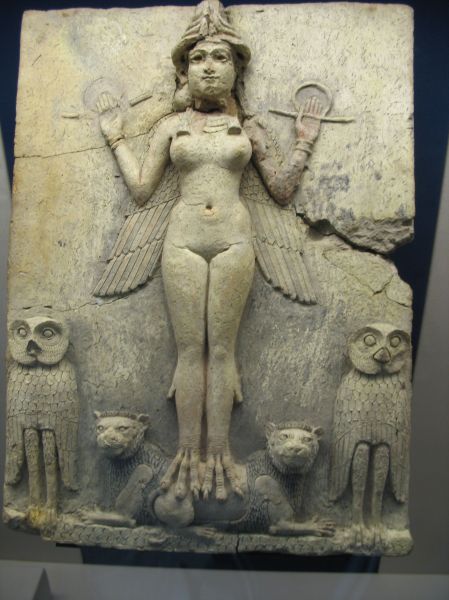
The mother goddess and the owl        https://aratta.wordpress.com/2015/10/18/the-mother-goddess-and-the-owl/

MotOWL
https://www.videomaker.com/article/c13/14089-the-eye-light An eye light is a light that creates a small sparkle of light reflected from the eye’s surface, giving sparkle to the subject’s eyes. Without the eye light, the eyes would seem lifeless and unemotional.

Psalms, Proverbs – Page 555 – Google Books Result https://books.google.ro/books?isbn=1414398883
Mark Futato, ‎George M. Schwab, ‎Philip W. Comfort -15:30 A cheerful look. Precisely, “the light of the eyes.” “Light” is equated with life in 4:18; 6:23; 13:9.

[PDF]Derivatives of Nostratic Root Morpheme *Ya – “To Shine, To Glow, To …
http://www.mcser.org/journal/index.php/mjss/article/download/9116/8803

*dī- “to shine, to glimmer”

New Indology: Sumerian and Indo-European: a surprising connection
new-indology.blogspot.com/2015/05/sumerian-and-indo-european-surprising.html
Sum. di ‘to shine, PIE *diH/daiH/diw- ‘to shine, glitter; day, Sun; god’, Skr. dī- ‘to shine, be bright’, dina ‘day’, Armenian tiw ‘day’, Luwian Tiwat- ‘Sun god’, …

Reconstruction:Proto-Indo-European/deyws – Wiktionary
https://en.wiktionary.org/wiki/Reconstruction:Proto-Indo-European/deyws
*dyew- (“sky, heaven”); *dyew- > *diw- (zero-grade) > *deyw-

EVIDENCE OF MINOAN ASTRONOMY AND CALENDRICAL PRACTICES Marianna Ridderstad

Click to access 0910.4801.pdf

Another likely celestial symbol is the ‘eye’ with very prominent ‘eye-lashes’ (CHIC:387). The ‘eye’ is sometimes depicted as ‘rising’ over a (horizon?) line, which casts the doubt that it, too, is a solar symbol (CHIC #314). This may be related to the later belief of the sun as the eye of Zeus (Olcott 1914:288).

ANTONN BARTONEK T H E PHONIC EVALUATIO N OF THE S- AND Z- SIGNS IN MYCENAEA N https://digilib.phil.muni.cz/bitstream/handle/11222.digilib/110060/E_ArchaeologicaClassica_09-1964-1_8.pdf?sequence=1
Lurja, while treating this question, starts with refusing—first in his article Opyt ctenija pilosskikh nadpisej, Vest, drevnej istorii 1955, vol. 3, pp. 8-36, but mainly in his work Jazyk i kultura 50 sqq.—to ascribe the D- series of Mycenaean signs the explosive character. He believes that due to a pre-Greek substratum there had occurred in Mycenaean several phonic changes which most Greek dialects did never fully accomplish and of which only a very few odd traces were left in the Classical Era; thus assuming the shift of the proto-Greek d into some kind of (d)z he transcribes all Ventris’s D- signs as Z-signs, and goes on designating in this connection Ventris’s Z- series—not quite convincingly—as “C- series”, ascribing it with an all-round validity the phonetic value of a “soft (palatalized) variant” of the phone k.2…………………………………………1. It is probable that the very adoption of the Linear Script for rendering Greek witnessed already the tendency of reproducing with the Z- spelling all phonic formations governed by the so-called second assibilation, i. e. the voiced substitute for the original j-, -dj-, -gj-, on the one hand [this substitute being very likely at that time not far from the affricate dz going back to d’d’], and the voiceless substitute for the inter-morphemic -t(h)j- or for any -k(h)j- and -tw-, on the other hand [the latter substitute being again probably not far from the affricate tj going back to t’t’]; in either of these cases the Z- series of signs was employed just to express rather the purely palatal, i . e. the still non-affricate, shade of the two substitutes, a shade that was just in all probability disappearing…………………..The couple of affricate phonemes ts, dz, which formed counterparts as to voice. Their phonetic character underwent the following pre-Mycenaean and Mycenaean process of evolution: from various original formations through t’t’ [which absorbed also k’k’] and through d’d’ [absorbing also g’g’ and evidently even a part of the initial proto-Greek j’-], 5 4 then through tj [which had very likely directly absorbed the original tiv] and through dz, assuming finally the forms ts, dz………………………16.The most important exceptions: Central Cretan, Boeotian, Laconian, Elean and the Thessaliotic subdialect of Thessalian with their DD(!deltadelta), or later TT—all this being, of course, only a special continuation of the affricate dz.
Nominal composition in Mycenaean Greek – Wiley Online Library
onlinelibrary.wiley.com/doi/10.1111/1467-968X.00100/pdf
Mycenaean Greek is given and a classification attempted. Thereafter, issues in their phonology …. compound must not be considered `rien autre qu’une varieÂte de la formation des noms, au meÃme titre que la ….. pu2-ru might be interpreted as `having white eye-brows’ (leyko3w and o1ýry9w), but the presence of ro still …
Me: !!
Linear A sign *79 (‘eye‘)
Linear A, “ZU

In other place thay say it is “DO”http://1.bp.blogspot.com/_a_qIRGD3pJ0/TEOGfd1eE3I/AAAAAAAAAeM/RF7U_QatvuY/s320/Minoan-seals-01.jpg

http://minoablog.blogspot.ro/2009/09/
This exclusion rule can be applied to the Linear A sign *79 (‘eye’) to show why it cannot represent the value ‘ZU’ (that was assigned to it by John Younger et al.). The case-ruling example we find on the tablet ZA4,row a.5 where the term QE-SI-*79-E can be read. The same name recurs on tablet ZA15. Now, if the reading of *79 were ‘ZU’, we would rather expect an ending ZU-WE (with a not well characterised linear A WE sign) and NOT ZU-E. On the other hand, the value suggested and used by many (e.g Glen Gordon) for this linear A sign: ‘DO’, fits perfectly, as DO-E is absolutely possible.

But the case of LinA *79 has to approached with care. Apparently, there are two distinct LinearB signs (*79 and *14) corresponding to single cluster (*79) Linear A. I label it as a cluster, as it contains signs of very variable design: it is easily possible that there are two signs lumped into a single cluster: at least one of these is (with resonably high probability) is the Linear A counterpart of Linear B ‘DO’ sign (LinB *14).

http://minoablog.blogspot.ro/2010/05/how-many-linear-signs-do-we-have.html BayndorJune 4, 2010 at 8:50 AM
I must admit, if my derivation of the Lin A *79 is peculiar, then the theory on the ‘TO’ sign must sound straightforwardly strange. It is an ‘I don’t have any better idea’ type of theory. Because Hieroglyphics features a sign: ‘bovine head in front’, that is not even uncommon, it must have a Linear A descendant. But if one checks it – based on shape, frequency and distribution – there are only two viable candidates: TO or DI. While I could not remove sign DI from the list of possible readings, it is only the TO sign that admits a good etymology. If we go with the reading DO (from *tau) for the ‘eye’, then a clearly parallel derivation would be the value TO for the ‘bull’ sign (from *thaura). I only thought of this second one, because it could prove a regular development of *aw diphtongs in Minoan into *o. Unfortunately, I could not meaningfully analyse the PO sign (as I don’t know what it depicts), or the RO sign. On the other hand, the KO sign might depict a coriander seed, but we cannot approach it from an etymological direction (as the origins of the word coriander [Lin B KO-RI-JA-DA-NA] are obscure).

Otherwise, if we don’t accept the reading DO for Lin A*79, we could still try a similar value like DWA. That would not invalidate the etymology, and could give a solution for the pressing problem of having two Linear B signs when Lin A had just one.

Various Versions of the Linear A Libation Formula, again, but now in …
http://www.academia.edu/…/Various_Versions_of_the_Linear_A_Libation_Formula_again_&#8230;
Next, na-ta-n$-ti6 (with a solar variant of L 101 or AB 79 zu in its, against the background of its origin from the Cretan hieroglyphic “eye” [= solar symbol, cf. the “all …

Anatolian go the same way,https://en.wiktionary.org/wiki/Reconstruction:Proto-Indo-European/deyw%C3%B3s
IAnatolian: *diu- (“daylight god”)
Lycian: ziw
Lydian: Divi-
Luwian: tiwat (“a sun god”)
Palaic: tiyaz, tiuna
But Luwians gos that eye sign to mean eye.Ti,eye,related to I.E.di/ti root for light:”ti6”=eye
3 articles on Celtiberian (Sasamón), Luwian hieroglyphic (Mira), and …
http://www.academia.edu/…/3_articles_on_Celtiberian_Sasamón_Luwian_hieroglyphic_Mir&#8230;
another early Cretan hieroglyphic inscription in combina- tion with the spider4 as an alternative means to render the titular expression usually occurring in form of 044-046 “trowel-adze” or 044-005 “trowel-eye” pi-tı¯ or pi-ti6 = Egyptian bi’ty “king” (Fig. 6). Furthermore, it ultimately …

Pre-Mycenaean Greeks in Crete | iurii mosenkis – Academia.edu
http://www.academia.edu/24600947/Pre-Mycenaean_Greeks_in_Crete
qu > z (Linear A zo ‘spear’ and zu ‘eye’) similar to Phrygian qu > k (que > ke,Mycenaean que, Greek te).

http://new-indology.blogspot.ro/2016/12/sumerian-and-indo-european-multifarious.html Nirjhar00727 December 2016 at 04:13
This is interesting . We already had the related discussion . In Sumerian there is UTU , in epsd it is given as utu-e3 “sunrise” , utu-šu2-uš; utu-šuš2 “sunset; the West”. There is also a ki’utu [LOCUS] ki-dutu “a cultic location; a ritual”. Not sure about the ritual . but if we read Bomhard there he gives this :
233. Proto-Nostratic root *t’ay- (~ *t’ǝy-) or *t’iy- (~ *t’ey-):
(vb.) *t’ay- or *t’iy- ‘to shine, to gleam, to be bright, to glitter, to glow; to
burn brightly’;
(n.) *t’ay-a or *t’iy-a ‘light, brightness, heat’
A. Dravidian: Tamil tī, tīy ‘to be burnt, charred, blighted’; Malayalam tī ‘fire’;
Kota ti·y- (ti·c-) ‘to be singed, roasted’; Toda ti·y- (ti·s-) ‘to be singed’, ti·y-
(ti·c-) ‘to singe, to roast’; Kannaḍa tī ‘to burn, to scorch, to singe, to
parch’; Telugu tīṇḍrincu, tī͂ḍirincu ‘to shine’, tīṇḍra ‘light, brightness,
heat’; Brahui tīn ‘scorching, scorching heat’, tīrūnk ‘spark’. Burrow—
Emeneau 1984:285, no. 3266.
B. Proto-Indo-European *t’ey-/*t’oy-/*t’i- ‘to shine, to be bright’: Sanskrit
dī́deti ‘to shine, to be bright; to shine forth, to excel, to please, to be
admired’, devá-ḥ ‘(n.) a deity, god; (adj.) heavenly, divine’, dyótate ‘to
shine, to be bright or brilliant’, dyáuḥ ‘heaven, sky, day’, divá-ḥ ‘heaven,
sky, day’, divyá-ḥ ‘divine, heavenly, celestial; supernatural, wonderful,
magical; charming, beautiful, agreeable’, dīpyáte ‘to blaze, to flare, to
shine, to be luminous or illustrious; to glow, to burn’, dīptá-ḥ ‘blazing,
flaming, hot, shining, bright, brilliant, splendid’, dína-ḥ ‘day’; Greek δῖος
‘heavenly; noble, excellent; divine, marvelous’, Ζεύς ‘Zeus, the sky-god’;
Armenian tiw ‘day’; Latin diēs ‘day’, deus ‘god’; Old Irish die ‘day’; Old
Icelandic teitr ‘glad, cheerful, merry’, tívorr (pl. tívar) ‘god’; Old English
Tīw name of a deity identified with Mars; Lithuanian dienà ‘day’, diẽvas
‘god’, dailùs ‘refined, elegant, graceful’; Old Church Slavic dьnь ‘day’;
Hittite (dat.-loc. sg.) šiwatti ‘day’, (gen. sg.) ši-(i-)ú-na-aš ‘god’; Luwian
(acc. pl.) ti-wa-ri-ya ‘sun’, (nom. sg.) Ti-wa-az name of the sun-god (=
Sumerian ᵈUTU, Akkadian ŠAMŠU, Hittite Ištanu-); Hieroglyphic Luwian
SOL-wa/i-za-sa (*Tiwats or *Tiwazas) name of the sun-god; Palaic (nom.
sg.) Ti-ya-az(-)…..,,,
C. Etruscan tin ‘day’, tiu, tiv-, tiur ‘moon, month’; Rhaetic tiu-ti ‘to the
moon’.
Sumerian dé ‘to smelt’, dé, dè, dè-dal ‘ashes’, dè, diû ‘glowing embers’, dèdal-
la ‘torch’, diû ‘to flare up, to light up; to be radiant, shining; to sparkle, to
shine’.
Buck 1949:1.51 sky, heavens; 1.52 sun; 1.53 moon; 1.84 ashes; 1.85 burn
(vb.); 14.41 day; 14.71 month; 15.56 shine; 16.71 good (adj.); 16.81 beautiful
(also pretty). Caldwell 1913:620. Bomhard—Kerns 1994:303—304, no. 119.
Different (unlikely) etymology in Dolgopolsky to appear, no. 2241, *tiʔû ‘to
shine, to be bright, to be seen’.
Buck 1949:1.51 sky, heavens; 1.52 sun; 1.53 moon; 1.84 ashes; 1.85 burn
(vb.); 14.41 day; 14.71 month; 15.56 shine; 16.71 good (adj.); 16.81 beautiful
(also pretty). Caldwell 1913:620. Bomhard—Kerns 1994:303—304, no. 119.
Different (unlikely) etymology in Dolgopolsky to appear, no. 2241, *tiʔû ‘to
shine, to be bright, to be seen’.
…………………………………………………………………….

Perhaps we have an Indo-European related Sun divinity in Sumerian?.

So, my theory(someh-how like the big-bang theory wich by common-sense resoneang advanced this hipothesys of an original emergency point)’
-so in a simylar way, but with twoo way strong evidences, in the same way I go back trough the time:
-pre euphratean stage,UNKNOWN !

Proto-Nostratic root *t’ay- (~ *t’ǝy-) or *t’iy- (~ *t’ey-)

Proto-Euphratean (n.) *t’ay-a or *t’iy-a ‘light, brightness, heat’
A. Dravidian: Tamil tī, tīy ‘to be burnt, charred, blighted’; Malayalam tī ‘fire’;

Euphratean Sum. di ‘to shine’, PIE *diH/daiH/diw- ‘to shine, glitter; day, Sun; god’
-proto Indo-european stage *t’ay- or *t’iy- ‘to shine, to gleam, to be bright, to glitter, to glow; to burn brightly’
Anatolian IAnatolian: *diu- (“daylight god”)

-proper IE stage,Sanskrit
dī́deti ‘to shine, to be bright; to shine forth, to excel, to please, to be
admired’

Averrage aproximate time-line(by me)

Proto-Nostratic-Nostratic15.000-12.000 https://en.wikipedia.org/wiki/Nostratic_languagesThe hypothetical ancestral language of the Nostratic family is called Proto-Nostratic.[2] Proto-Nostratic would have been spoken between 15,000 and 12,000 BCE, in the Epipaleolithic period, close to the end of the last glacial period.[3]

Proto-euphratean (unknown) :12.000-7000 BC ! OLD EUROPE!

Mixed Euphratean-Proto-I.E. -Archaic Sumero-tamil stage:7000-3500 B.C.OLD EUROPE!

Proto-Aegean/EBA Cycladic stage:3500-2500 B.C.

Full IE:2500-1500 B.C. (2500 Minoan was not full-IE)

Anatolian(Indo-Hittite) 2500-1000 B.C. Minoan/mixed/unknown/Linear A:2500-2000 Eteocretan,Hieroglyphic Cretan

Linear B 2.200-1000B.C.(start of greek language)

Archaic Greek:1500-500 BC; Homeric: 500BC >1
Koine:1> 500A.D.

******************* VINCA TURDAS CULTURE GODS**********************

*********************Danubian/Old European Gods ****************************


Despite the fact that there was the root :T’ay /t’iy/t’ey/t’ei/T’iy/T’iy-a/Ti,
and could have such a “T/Ti” deity, there are many evidences of a linguistic change, Ti>Di so as had egyptians Ti related deities,we could hav an IE “Di” starting deity.In such long-distance ancient times they not have an structured-organised panteon of gods by logical order.They had (many?) deities folowing not a structured order,but folowing exact their stringent practical needs (warm,feeding..)
So ,out of other many possible Gods and Goddesses and their denominations,(e.g.Bird-Mother-Goddess)this-one could be one of their gods related to living(easy catch fish feeding):
BelBrdo=(brdo/twrdo”whirlpool)” 6500BC old dwelling Danube site :
http://portalenportalen.blogspot.com/2015/02/vinca-culture.html

DAG :”(make a living=fertility)god”?With some-how celestian origin, DAG-AN: (shine-sky):“Sky-God”(old hebrew DAGON)?

Image from http://trueancienthistory.blogspot.ro/2013/05/the-babylonian-history-of-mankind.html

dagon-fish-god-with-mitre-Oannes2

Sum. dag, dadag ‘(to be) bright; to clean; (ritually) pure

This “creature”is the same with : http://www.pagannews.com/cgi-bin/wpgods3.pl?Dagon

Nostratic Etymological Index Cover – bulgari-istoria
http://www.bulgari-istoria-2010.com/Rechnici/NostraticEtymologicalIndex.pdf
Proto-Nostratic (n.) *da- ‘mother, sister’; (reduplicated) (n.) *da-da- ‘mother, sister’ (nursery words). 144. Proto-Nostratic root *dab- (~ *dǝb-):. (vb.) *dab- ‘to make fast, to join together, to fit together, to fasten (together)’;. (n.) *dab-a ‘joining, fitting, fastening’. 145. Proto-Nostratic root *dag– (~ *dǝg-):. (vb.) dag- ‘to put, to place, 

Dagon – Wikipedia
https://en.wikipedia.org/wiki/Dagon
A long-standing association with the word for “fish” dâg, perhaps going back to the Iron Age, has led to an interpretation as a “fish-god”, and the association of “merman” motifs in Assyrian art (such as the “Dagon” relief found by Austen Henry Layard in the 1840s). The god’s name was, however, more likely derived from a …

This is the VINCA FISH-GOD, many alike of different sizez were found on Danube border (LEPENSKI VIR)


Diakonoff – External Connections of the Sumerian Language | Plural …
https://www.scribd.com/…/Diakonoff-External-Connections-of-the-Sumerian-Langua&#8230;
… question (probably the Proto-Indo-Europeans); the new tribes ousted the backward ….. 15. dag ‘clean,washed’, dadag ‘clean’ 16. ene, ane …

Sumerian Lexicon

Click to access sumeriandictionaryreliable.pdf

by JA Halloran – ‎
a. Sumerian …… dág: brilliant; pure; clean (‘to go out’ + aga(3), ‘diadem, circlet, crown’). dig: v., to …

From New Indology: Sumerian and Indo-European: a surprising connection
new-indology.blogspot.com/2015/05/sumerian-and-indo-european-surprising.html
Sum. dag, dadag ‘(to be) bright; to clean; (ritually) pure’, PIE *dhagwh- ‘to burn, shine’, Old Saxon, Middle Dutch, Dutch dag, Gothic dags ‘day’, Tocharian A tsāk- ‘to shine, give light’, AB cok ‘lamp’, Old Irish daig ‘fire’, Old Prussian dagis ‘summer’, Lith. degti ‘to burn’, Skt. dahati ‘to burn’,dagdha ‘burnt’, …

Berossus | Samizdat https://therealsamizdat.com/tag/berossus/

The genotype is also attested in Berossus, as the form of the mentor of mankind, Oannes. The iconographic evidence for these apkallū is manifold and best known from various Assyrian reliefs. We usually refer to them as genii. Bīt Mēseri, however, describes them as purādu-fishes, and this coincides with iconographic …

Full text of “Lectures on the origin and growth of religion as illustrated …

A comparison of Anodaphos and Odakon shows the true reading to have been Anodakon, i.e. “Ann and Dagon (Dagan),” who are constantly associated …… and of his wife Baau (i.e. Baku, lo/m), which is interpreted night, were begotten two mortal men, Aion and Protogonos so called, and Aion discovered food from trees.

Image: DAGON FISH-GOD WITH MITRE/OANNES

https://encrypted-tbn0.gstatic.com/images?q=tbn:ANd9GcQaHPXI_J9Rre3GMz0ETnkEImjC86PgMlBjIkQy2FwNfPGpDyv2

dagon-fish-god-with-mitre-Oannes2

Image from http://www.mesopotamiangods.com/a-namerima-for-iddin-dagan-iddin-dagan-d-translation-2/

Supposed related cultures to Tartaria tablets

March 20, 2018

THE CULTURES LANDSCAPE FOR THE TABLETS

THE CULTURE LANDSCAPE FOR THE TABLETS

First,an my opinion,this is the broad lanscape:

Here you see how much close is the origin of greek At the origin point,wereProto-Aegean/Vinca-Turdas cultures. The point is very close to the origin of PIE and Anatolian languages.This could be noticed in the Anatolian-Eastern characteristics wich could be traced in Mycenaean and much more in Minoan languages.

See how close to the origin there are twoo languages of the twoo neighbouring countries Greece and Albania.

Going even more back in time,

We see that there is a common point in wich diverged Dravidian and the branch containing PIE.Folowing map,from:                                   https://aratta.wordpress.com/2015/07/16/in-the-beginning-of-our-civilization/


After this point,but close to it, possible was:
https://wikivisually.com/wiki/Proto-Euphratean_language
Proto-Euphratean is a hypothetical unclassified language or languages which was considered by some Assyriologists (for example Samuel Noah Kramer), to be the substratum language of the people that introduced farming into Southern Iraq in the Early Ubaid period (5300-4700 BC).
Dyakonov and Ardzinba identified these hypothetical languages with the Samarran culture.[1]
Benno Landsberger and other Assyriologists argued that by examining the structure of Sumerian names of occupations, as well as toponyms and hydronyms, one can suggest that there was once an earlier group of people in the region who spoke an entirely different language, often referred to as Proto-Euphratean. Terms for “farmer”, “smith”, “carpenter”, and “date” (as in the fruit), also do not appear to have a Sumerian or Semitic origin.
Linguists coined a different term, “banana languages,” proposed by Igor Dyakonov and Vladislav Ardzinba, based on a characteristic feature of multiple personal names attested in Sumerian texts, namely reduplication of syllables (like in the word banana): Inanna, Zababa, Chuwawa, Bunene etc. The same feature was attested in some other unclassified languages, including Minoan, the same feature is allegedly attested by several names of Hyksos rulers: although Hyksos tribes were Semitic, some of their names, like Bnon, Apophis, etc. were apparently non-Semitic by origin.[2]
Rubio challenged the substratum hypothesis, arguing that there is evidence of borrowing from more than one language, this theory is now predominant in the field (Piotr Michalowski, Gerd Steiner, etc.).
A related proposal by Gordon Whittaker[3] is that the language of the proto-literary texts from the Late Uruk period (c. 3350–3100 BC) is an early Indo-European language which he terms “Euphratic”.

This the point is that of proto-elamite=ancient sumero tamil=sumerian.After that point diverged indic languages and Proto-Indo European-ones.

Image; http://realhistoryww.com/world_history/ancient/Images_Indus/chart.JPG

That’s why many Indo-European languages keep strong sanskrit traces.
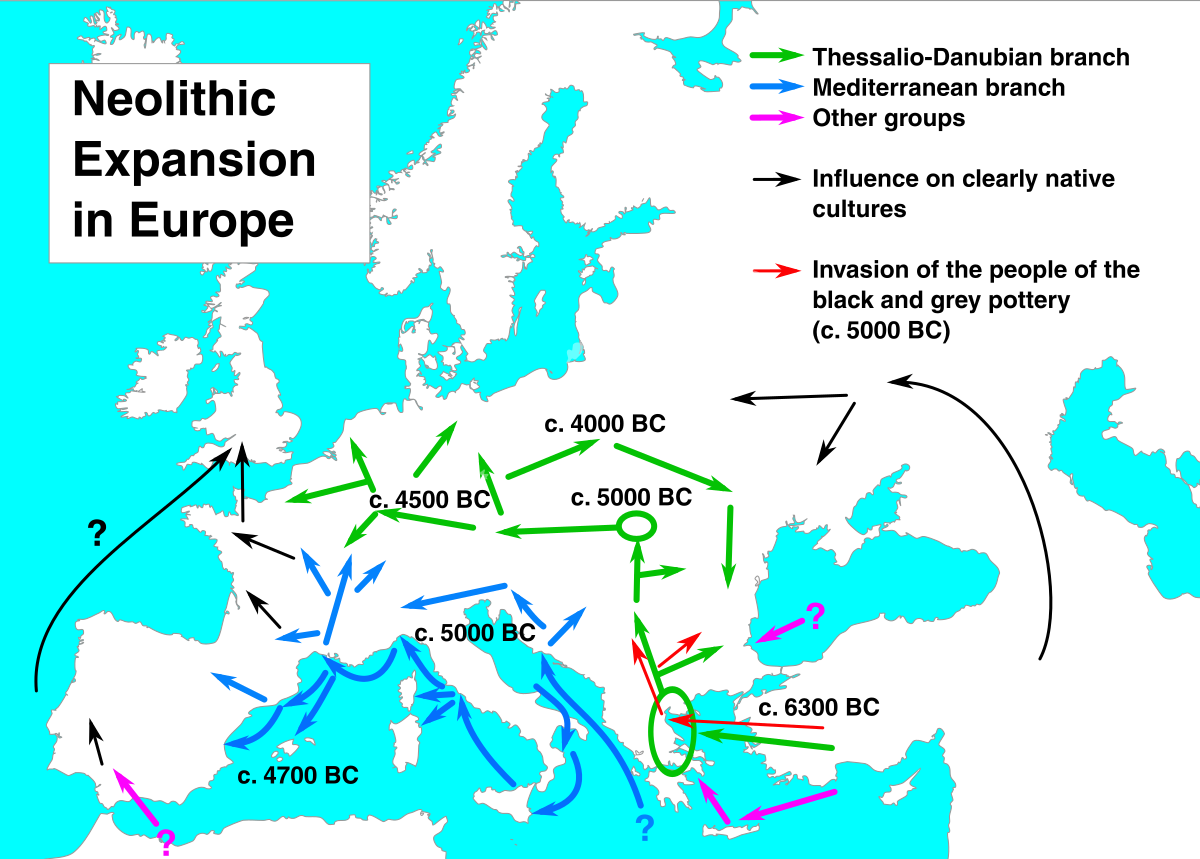
In a way or another in neolithic-bronze ages were twoo different coming waves, and there was a population>cultural influx toward Europe from East.From PIE Indo-Hittite branch, Anatolian one remained in Anatolia.      https://en.wikipedia.org/wiki/Neolithic_Europe#/media/File:Neolithic_expansion.svg


Folowing map,from: https://aratta.wordpress.com/2015/07/16/in-the-beginning-of-our-civilization/

So, in any circumstances,the supposed writings could not depass the limits:
-not older than proto-elamite=ancient sumero-tamil=sumerian 3200 B.C.
-Not younger (but same-how possible only for the round tablet)than 2200-1450 B.C. wich is the time between cretan hierogliphic,linear A and linear B.

ttps://www.google.ro/imgres?imgurl=http%3A%2F%2Fimages.slideplayer.com%2F22%2F6488709%2Fslides%2Fslide_4.jpg&imgrefurl=http%3A%2F%2Fslideplayer.com%2Fslide%2F6488709%2F&docid=D0Bos81UUoT5IM&tbnid=p9nQNs-Ub7HWyM%3A&vet=10ahUKEwj44My9kNPZAhVKa1AKHVmbD0YQMwhlKB0wHQ..i&w=960&h=720&bih=662&biw=1366&q=cycladic%20minoan%20mycenaean%20%20map&ved=0ahUKEwj44My9kNPZAhVKa1AKHVmbD0YQMwhlKB0wHQ&iact=mrc&uact=8

Beside I am not confident about supposed age of the tablets 5.200 B.C. wich is not at all possible in my opinion.(Romanian schollars gave this age of the tablets as beeing the same !? of some bones found near-by.)
https://encrypted-tbn0.gstatic.com/images?q=tbn:ANd9GcR_vsc7SH3mmcya8yaZsPyBJM-uIppTKybAoO5VyjiOTnwL-kIDzQ

Click to access 2016_2e_Anistoriton.pdf

“Between 3000/2600 and 1450, the period of the birth and development of Cretan Hieroglyphic and Linear A, […] the introduction of a language known to us from elsewhere is unlikely.”

Thus in my opinion the expected language is or close to an early Indo-European language which he terms “Euphratic”.

TARTARIA ROUND TABLET.Linear A/B approach

March 18, 2018


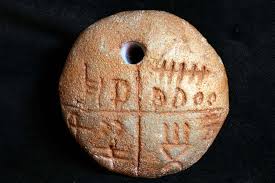
Careful/ Attention !                                                                                                                                            This post is not a decipherment or reading of any actual written content of Tartaria tablets. Given that the signs do not belong to a known and single writing system but from several, the page has a purely didactic character. It has the role of trying and testing different writings, in the idea that the tablets would have used one of them. The signs on the tablets belong to several writing systems over a long period of time and which have been used in different geographical areas. In none of the trials did the signs fall into a single type of writing, there always remained signs that came from other writings (or as coming from the unknown). Most of the signs come from the Sumerian proto-cuneiform signs. The signs in the upper half of the round tablet seem to come from archaic Greek writing. This “collection” of signs seems to be the fruit of one’s rich imagination. As A. Falkenstein and A. A. Vaiman found, (this is also my firm opinion) the author was not a scribe, he had only vague notions of writing in general, and it is not known what he intended  or he was after. There are many elements of inconsistency as well as others that take the tablets out of the usual patterns and norms of honest logic, writing and intentions. =====

SCIENTISTS ALLREADY CORRECTLY NOTICED (ME ALSO FULLY AGREE)THAT THE CLOSEST WRITING SYSTEM TO THE SIGNS PRESENT ON TARTARIA TABLETS IS SUMERIAN PROTO-CUNEIFORM.             THE PURPOSE OF PRESENT APPROACH IS ONLY TO TEST HOW CLOSE WOULD BE THE ROUND TARTARIA TABLET TO AEGEAN WRITING.

Not to wait till the finish, I am telling that the out of very few signs found, PA3,PA           the tablet is not written in any Aegean writing (Cretan Hieroglyphic,Linear A or Linear B)!

TAR ROUND CRETAN H LINEAR A-B

TARTARIA ROUND TABLET
CRETAN HIEROGLYFIC LINEAR A/B APPROACH

Image, from https://cogniarchae.com/2015/10/29/tartaria-tablets-connection-between-vinca-and-proto-linear-b-script/

TartRound

Acknowledgement
I am studing these Tartaria  tablets from more than 10 years. Soon after seeing their pictures, I was attracted bewitched/enchanted by the apparent close appearance of signs (especially the upper half of the round tablet) to those of archaic greek. (archaic eta=Heta; rho,etc.)  First of all, it seems that                   ON ALL TABLETS THERE ARE A AGGLOMERATION OF DIFFERENT TYPE OF SIGNS (PICTOGRAPHIC, IDEOGRAMS/SYLLABOGRAMS AND POSSIBLE LETTERS).
But there are some questions wich wait answers:
– Nobody could explain an such early appearance of D-shape signs. To my knowledge, they appeared first in Europe in Linear B as representing volume measures units and later in archaic Greek.    I had difficulties also with the bow-arrow  and “>>” signs.

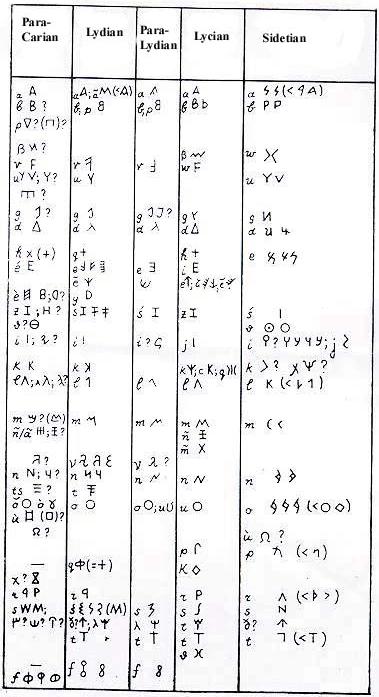
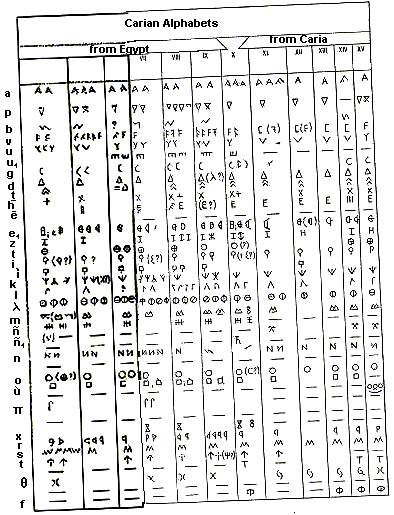
I SEARCHED IN WICH WRITING MOST OF THE SIGNS ARE TO BE FOUND                                                    – Cretan hierogliphic show an old influence from sumerian and Anatolian writings. For signs/icons placed right-downward quarter not found easy matching. They seem to be complex ideograms or kind of ligatured signs.                                                                                                                                            – For carian most of the signs were found. Highest average ! 80%. But pitty, not all signs!. Dificulty arouse not because carian  used different signs-shapes-letterss-readings in different ages and places, despite their very greek origin. Not even talk about the carian language wich is partly understood only by 1-2 men (e.g. Ignacio Adiego) out of entire world.  There are in total 25 carian alphabets. So the writing and the language each taken apart are difficult and that both combined give a GREAT MESS.                              – Other European writings as italic-venetic, iberian ond others from Europe has shown an phenomenom like frome some phoenician source letters dispersed all-over Mediterranean area. Table, from Alphabetos de ayer y de hoy                     http://proel.org/index.php?pagina=alfabetos :
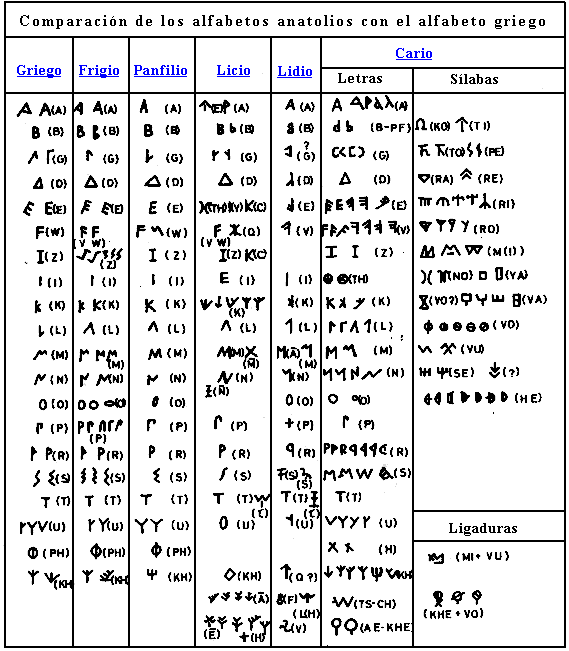
No one writing system could match found/read entirely.
Don’t believe, this happened much easy when used the proto-cuneiform sumerian library of signs.
It seems that sumerians allready wrote novels before Aegeans passed from Cretan hieroglyphic to linear A> linear B.
There is a span close to 1.000 years (700), when they used writing (3.200 BC)before Aegean/Europe (2.500BC) begun.(3.200 BC sumerian proto-cuneiform and 2500 Cretan hieroglyphic and Linear A).               This folowing picture is of hand-made by me replica.

36320642_1671848542936382_8881202476397625344_n  http://aplaceofbrightness.blogspot.ro/2008/11/moonlight-in-romania-tartaria-tablets_21.html   Folowing image: https://encrypted-tbn0.gstatic.com/images?q=tbn:ANd9GcTCGJ5DXc0fsaWc67tfd57-J-2TRy0Mwu9JqqG8dK242WM2a4_z
1-st QUADRANT ( downward half- on the right )

See the red sign  downward-right quarter                                                                                           From http://cristianluchian.co.uk/wp-content/uploads/2014/04/cristian_luchian_tartaria_tablets.jpg

Tart RED

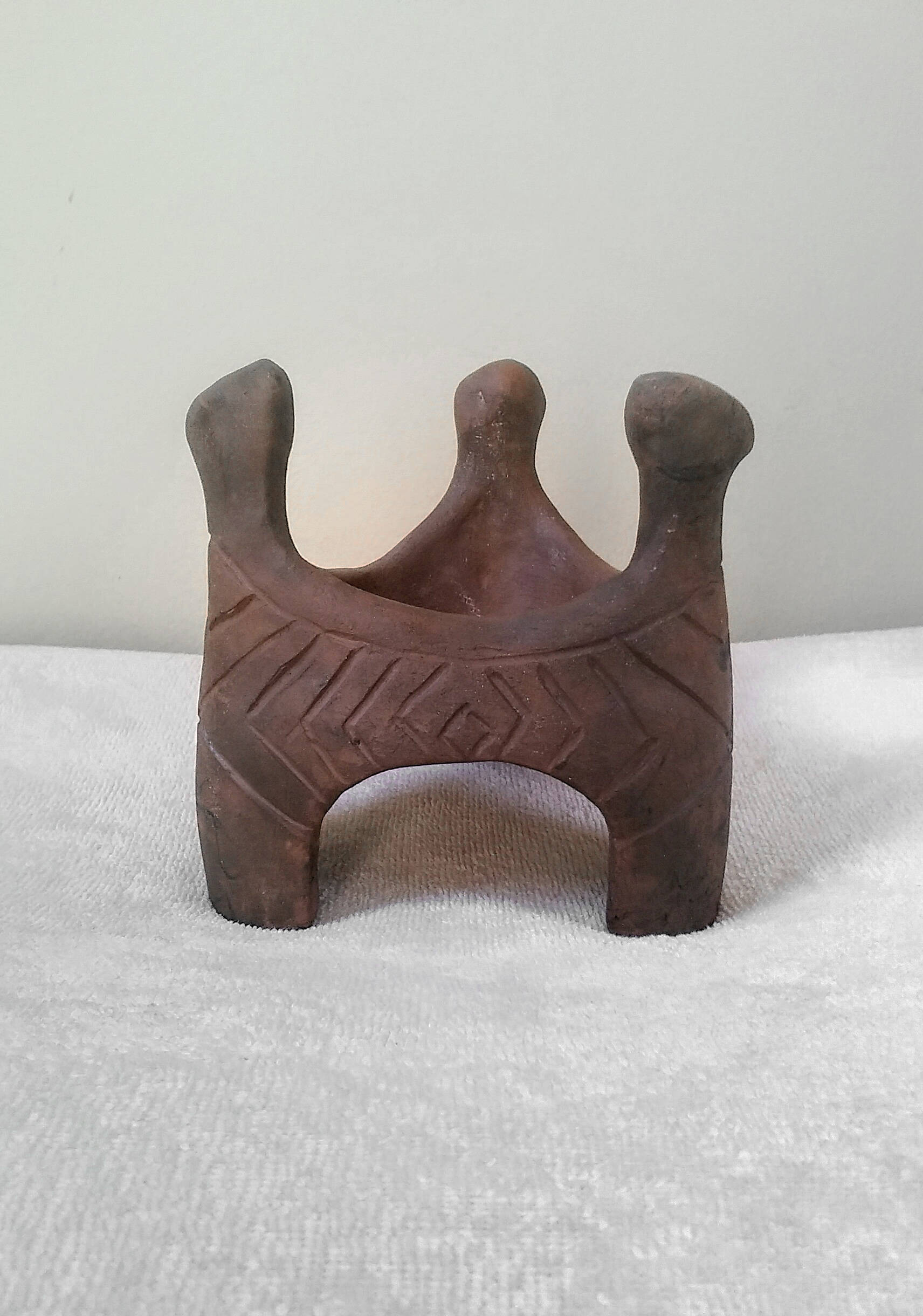
This shape is conducting me (and not a single opinion)to the idea of kind of portable altar with flames on upper side (as this real portable-altar from Vinca Culture)  Image from etsy.com 
The sign in a way is close to cretan hieroglyphic sign DE, ( turned upside-down)             From http://www.kairatos.com.gr/linear1.htm
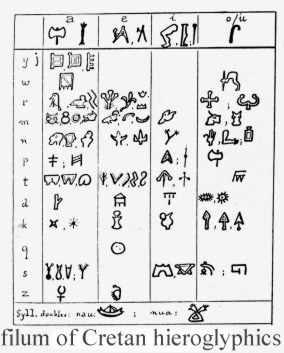
263ieroglyfikasite

Table,from http://www.kairatos.com.gr/linear1.htm

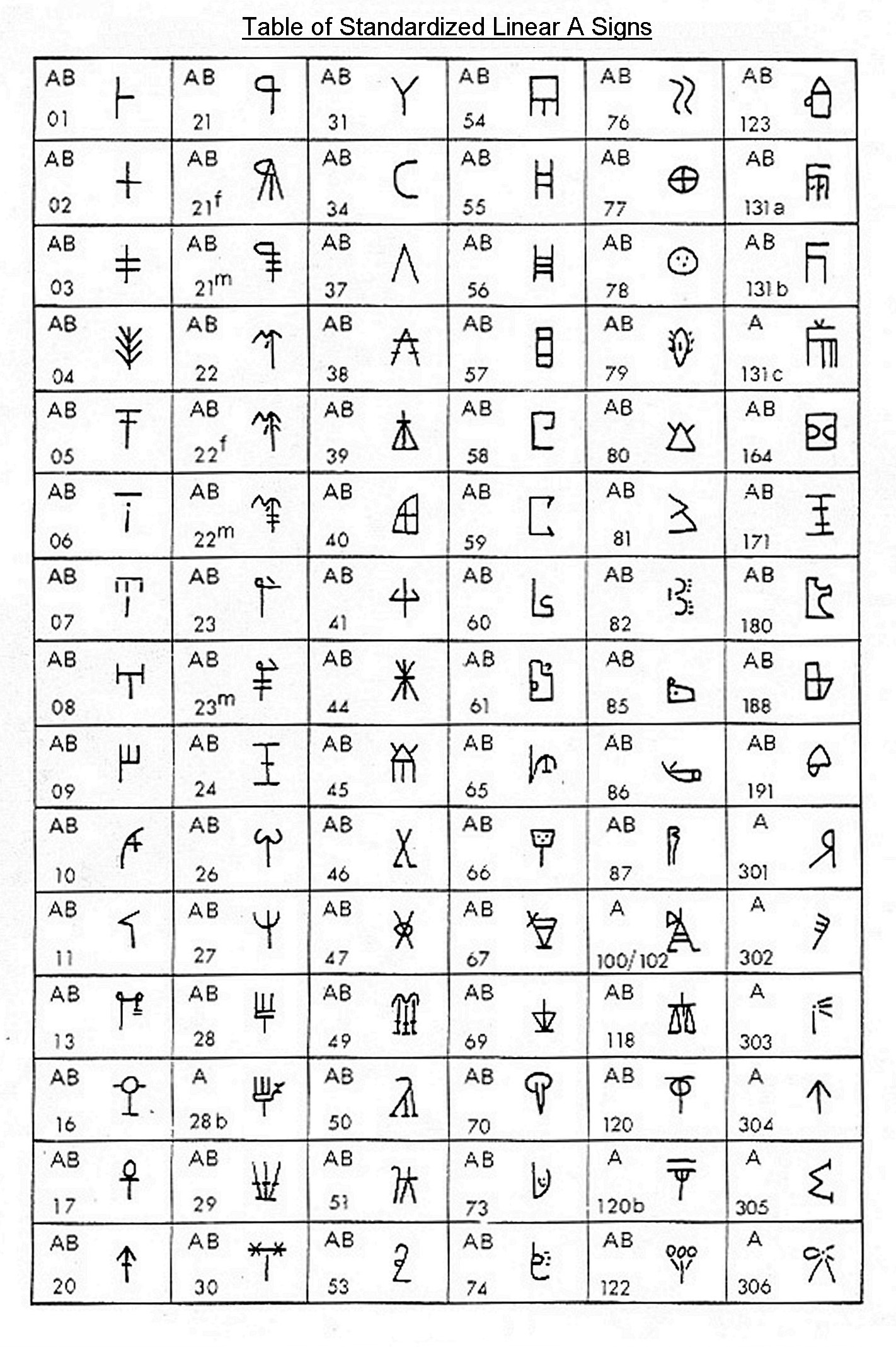
But much close is linear A(also upside-down),sign AB 45

Note.Overall shape of the tablet (cross in circle) is above linear A shape AB77.
But much close to before discussed sign is the linear A “DE” sign
in normal position and in other occurencies turned upside-down

But in the same position also DE in LINEAR B
https://image.slidesharecdn.com/mycenaeans-1229034501455786-1/95/mycenaeans-21-728.jpg?cb=1229006262 From http://www.crystalinks.com/linearb.html

linearb

From Σάββατο, 8 Νοεμβρίου 2014 Systematic analysis reveals relationship of the alphabet with other Mediterranean scripts Cosmas Theodorides http://studialphabetica.blogspot.com/  See Vinca sign E  !

FINAL READING:”DE? E?, or COMPLEX IDEOGRAM for ESCHARA/ALTAR (!incense burner !)                         ——————————————————-                                                                                         On the right, https://1.bp.blogspot.com/_DT_WSLrf76g/SSNCmagewzI/AAAAAAAAADI/9q2aaDwIMzs/s1600-h/SEgrid.JPG   From http://aplaceofbrightness.blogspot.com/2008/11/moonlight-in-romania-tartaria-tablets_21.html

segrid

From THE MYCENAEAN TREE AND PILLAR CULT AND ITS MEDITERRANEAN RELATIONS. A.EVANS http://www.archaeologicalresource.com/Books_and_Articles/Tree_and_Pillar_Cult_Medit_Evans_1901/Tree_and_Pillar_Cult-Mediterranean_Evans.html http://www.archaeologicalresource.com/Books_and_Articles/Tree_and_Pillar_Cult_Medit_Evans_1901/images/image58.png

image58

.Fig. 54. – Symbols derived from the Egyptian Ankh. 1. The Ankh. 2. Two-armed Egyptian Form. 3 and 4. Hittite Types. 5. From Mycenaean Ring. 6. On Carthaginian Stele.

Close to linear A, AB 80 “E”,or “RI”
See E signs shape, especially that one down-middle-one

Or even linear A, “MA” (having included a horizontal ligature?)
http://2.bp.blogspot.com/_a_qIRGD3pJ0/S_qxpdDgI3I/AAAAAAAAAbA/QcXKTDMye5A/s1600/Linear-A-base.jpg From John Jounger http://people.ku.edu/~jyounger/LinearA/           *80 MA, perhaps a logogram on HT 146.3, 110b.2, 5 (cf. Linear B ma-ra-tu-wo)

The sign has appearance of a female deity:

Minoan snake goddess figurines – Revolvy
https://www.revolvy.com/…/index.php?s=Minoan%20snake%20goddess%20figurines&#8230;
The snake goddess’s Minoan name may be related with A-sa-sa-ra, a possible interpretation of inscriptions found in Linear A texts. Although Linear A is not yet deciphered, Palmer relates tentatively the inscription a-sa-sa-ra-me which seems to have accompanied goddesses, with the Hittite išhaššara, which means …

http://firstlegend.info/thevenuscult.html

Syrio-Hittite Venus 18-1000 BC Central and southwest Anatolia northern Syria
The goddess Astarte is much like the contemporary Venus we see on Cyprus. Large holes apparently for ring decoration (referred to as being “pegged”), palm sized with stubby arms are a common style among other cultures too. The pinched face is found on the stubby armed figurines as well as the pillar shaped statuettes.

TANIT Image from https://www.elinritter.com/tanit-the-goddess-of-ibiza/
A-SA-SA-RA Image, from https://feminismandreligion.com/2014/11/10/has-the-phaistos-disk-been-cracked-by-carol-p-christ/  snake goddess blue background

From DOCUMENTS IN MINOAN LUWIAN, SEMITIC, AND PELASGIAN  FRED C. WOUDHUIZEN file:///C:/Users/User/Downloads/Documents_in_Minoan_Luwian_Semitic_and_P.pdf

“From these data, it may be deduced that the most important deity, with (if we include the abbreviated instances) 17 occurrences in sum, is Asasara, 3 who has been convincingly identified with the Semitic mother-goddess Asherat or Asherah. The most characteristic symbol of this goddess is the double axe, which in writing functions for the expression of the initial vowel of her name, a (E36 or CHIC 042), and as such may be used on its own to refer to her in abbreviation.4 On the south pillar of the pillar crypt in Malia (see Fig. 75), the symbol of Asherah occurs twice in combination with that of a star with either six or eight points. Now, against the backdrop of the identification of the main goddess as Asherah, it stands to reason that we are dealing here with the symbol of the daughter of this mothergoddess, Ashtarte, whose name originates from PIE *h2stḗr- “star, but we can as yet not be certain of this as we lack an instance of this divine name written out in full. However, this same shortcoming does not affect the symbol of the storm-god in the form of a trident on the north pillar of this same pillar crypt at Malia, because the hieroglyphic inscriptions from the palace of Malia and Quartier Mu at the same site positively allow for the latter’s identification as Luwian Tarkhu(nt). In these texts, namely, the name of Tarkhunt occurs in the form of the goat’s head sign TARKU (E65 or CHIC016) as much as 11 times, and is in frequency outmatched only by that of Asherah referred to in abbreviation by the double axe as much as 12 times (note that in two instances, # 098 and # 112, both deities occur together in the same text). On the other hand, it should be realized that the storm-god may also be referred to by Semitic forms of address like Haddu or Baªal, as it happens to be the case in the text of the discus from Phaistos (# 333), and the altar stone from Malia (# 328) which according to its legend ultimately originates from Skheria (= Hagia Triada) also in the Mesara. In reality, this change from a Luwian to a Semitic form of address for the storm-god may not have been as fundamental for the Minoans as it might seem to us at first sight, as on the A-side of the discus of Phaistos the storm-god is referred to in his Luwian form Tarkh˙unt, again, by his symbol the trident or bolt of lightning

The right sign is close to sign AB 80, linear A “E”( or RI)                                                                                     RIGHT SIGN, LINEAR A “E” or AN ASTRAL DEITY (as ASASARA)                                                              ———————————————–

   LEFT          RIGHT
Hier.DE        lin.A E?
lin.A AB45   lin.A AB80
lin.A DE       lin.A RI,                                                                                                                                              lin.A MA
Compared with linear B,

Also,not much difference:Lin.B:

LEFT   RIGHT                                                                                                                                                      E            E                                                                                                                                                      DE         E

Reading: De ; Ri/E EDE:”EAT /gr. edo:”(I) eat” …………..ede, the same as in quadrant with signs HD:(h)eDe (P.I.E.:”hED“)
Note
The signs seem to be independent icons, not to be read both as a word
( both signs ,DeRI/RiDe EDE DE-MA ?)

EDE:”gr.here,this one,NOW / lat.2-nd imp. “lat.EAT,feed!/Dispatch !”(gr.edo:I eat)

FINAL READING OF THE SIGN SITUATE ON THE RIGHT:                                                 “E”/”MA” ? or complex ideogram of an astral deity as ASASARA

FINAL READING FOR BOTH SIGNS:

It seems that there are or words, (E-DE/DE-MA) but rather ideograms/logograms:   altar.incense burner <&> fem.astral deity Asasara-like

QUADRANT 2

From https://2.bp.blogspot.com/_DT_WSLrf76g/SSNCIVGnLGI/AAAAAAAAAC4/3y1gwcGR4os/s1600/NEgrid.JPG
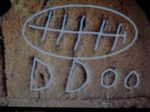
Upper-Right

Upper sign,(encircled-one)  +++++                                                                                                                 ! There is  NO SUCH SIGN 5-teeth comb in Aegean writings !                                                                 FromJOHN JOUNGER’s blog, http://people.ku.edu/~jyounger/LinearA/                                    *171, logogram on ZA 6a with agricultural commodities (perhaps also on THE Zb 5); in Linear B, it occurs with livestock (fodder? TH nodules)

https://encrypted-tbn0.gstatic.com/images?q=tbn:ANd9GcRlih20F28zX6wP_DG5SuHyypORTm7NjXCA_O2gGDnjeIyDAyi-cw

Sign +++++
Cretan Te,”wheat
https://i.pinimg.com/736x/95/30/e5/9530e511673bbc954e8153dd163f8862.jpg Cretan hieroglyphs, From https://linearbknossosmycenae.com/tag/ideograms/
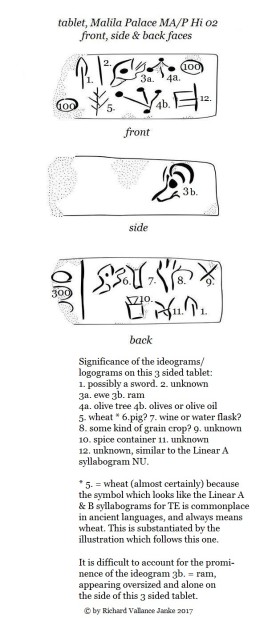
                                                                                        From From https://linearbknossosmycenae.com/ta g/ideograms/
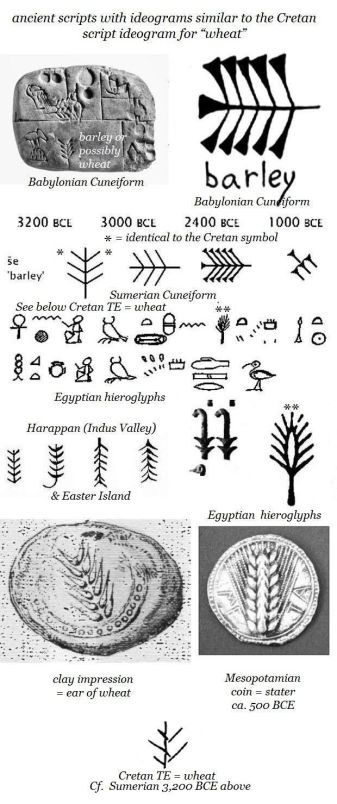
comparison of Cretan TE with symbol for wheat or barley in various ancient scripts

https://encrypted-tbn0.gstatic.com/images?q=tbn:ANd9GcRykURVevP7C91htJQXSWtUoIKlv_VE7Zk8RacOILleQApR07vw  https://commons.wikimedia.org/wiki/File:Linear_B_Syllable_B004_TE.svg                                             John Jounger http://people.ku.edu/~jyounger/LinearA/     *171, “logogram on ZA 6a with agricultural commodities (perhaps also on THE Zb 5); in Linear B, it occurs with livestock (fodder? TH nodules)”                                                                  FINAL READING: TE-TE ? what would be tete? or sign like Aegean one in some sort of local script meaning also cereal?                                                                                           CEREALS,WHEAT

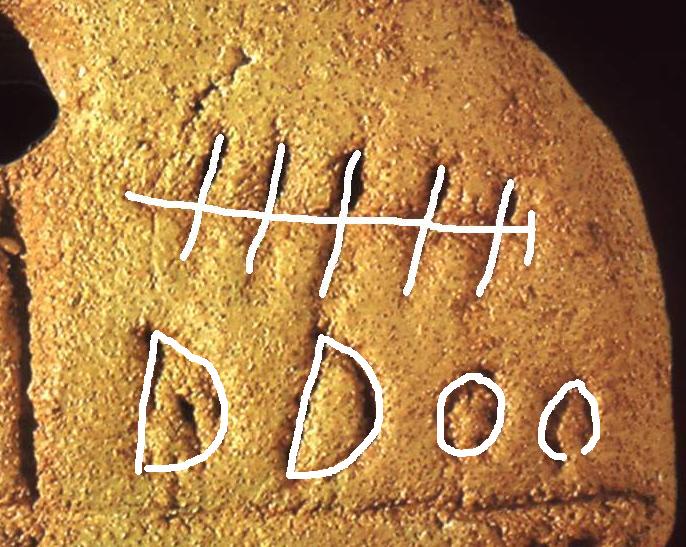
=======================================                                                                   Down, in a row : D D o o (or D D o c ?)                                                                                                                 As a long row of researchers supposed to have in those 4 signs the Moon phases, this could be taken in account, so representing a full Month with its main phases. Otherwise, I do not know of no single instance, in any known writing, other yhan Jiahu script, where the D-shape to represent the moon.  Only as C-shape:                                                                                                                                                            IURII MOSENKIS file:///C:/Users/User/Downloads/HELLENIC_ORIGIN_OF_EUROPE_Formation_of_t.pdf‘Sign *034C“has been suggested to represent MNA (or, if a disyllabic value can be
accepted, MINA), based on its resemblance to the crescent moon (Pope and Raison 1978, 28;Packard 1974, 107; Furumark 1956, 24). And while this idea has not received wide-spread agreement, it may be correct.                                                                                                                                                                  —————————————————                                                                                             The D-shape sign is missing in all Aegean before-alphabetic writings !  The folowing is a try, “in place of”/emergency solution. No credit for my part.                                                                                               :  D D :Two months? ; From http://minoablog.blogspot.com/2012/04/exploring-cretan-numeral-system.html
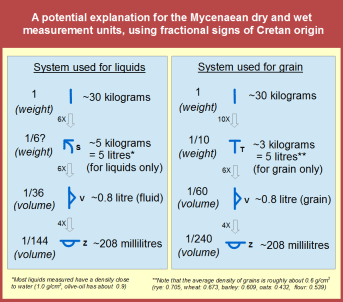
Mycenaean-measurement-systems

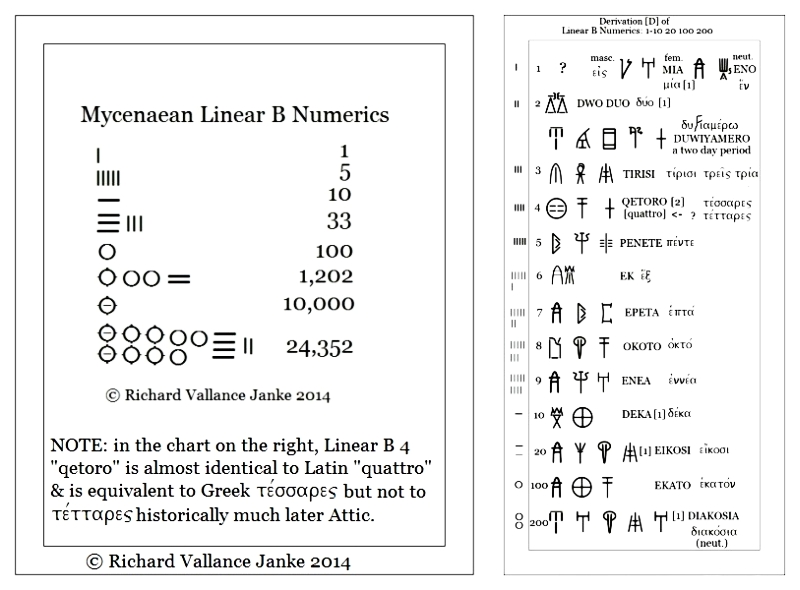
2 measures of grain, 0,8 litre/each? folowed by number 200 ! nonsense ! From RICHARD VALLANCE blog, https://linearbknossosmycenae.com/2015/02/19/mycenaean-linear-b-units-of-measurement-liquid-dry-weight-click-to-enlarge/ https://linearbknossosmycenae.com/2015/02/19/mycenaean-linear-b-units-of-measurement-liquid-dry-weight-click-to-enlarge/

units-of-mesurement-in-mycenaean-linear-b

————————————————————————————-                                                                     Sign “o”                                                                                                                                          Cretan hieroglyphic http://mnamon.sns.it/index.php?page=Simboli&id=35&lang=en sign 073                                                                                                                                                    A TABLE OF SIMILARITIES https://www.teicrete.gr/daidalika/documents/…/signary.pdf.. 073 qe (kwe),                           Cretan Hieroglyphic Grids http://www.people.ku.edu/~jyounger/Hiero/Hgrids.html .. 073 KU3 From http://people.ku.edu/~jyounger/LinearA/

 *309, only TY 2 in three variations *309a *309b– *309c –                             ———————————————————————

  Siggn “C”                                                                                                                                                From http://people.ku.edu/~jyounger/LinearA/                                                                Sign *034    has been suggested by several scholars to represent MNA (or, if a disyllabic value can be accepted, MINA), based on its resemblance to the crescent moon (Pope and Raison 1978, 28; Packard 1974, 107; Furumark 1956, 24).

               Linear A , sign A309a   http://mnamon.sns.it/index.php?page=Simboli&id=19&lang=en                                                                                                              From John JOUNGER http://people.ku.edu/~jyounger/LinearA/

sign A309, only TY 2 in three variations *309a and…. (me:nothing about meaning)

oo“-signs: mycenaean”100 ;-100” so 200 ?

https://encrypted-tbn0.gstatic.com/images?q=tbn:ANd9GcRdJZsAep5U4BWZyr3rOwSgtq9jQ-7nVqiU_yy_h9zVPfKdOLRN

D D o o : two months + 200 ?                                                                                                                     D=meno

From https://www.academia.edu/15310428/Linear_B_Lexicon_by_Chris_Tselentis_Greece_

me-no       menos            meinos                                                                                                               …………men>menas  mein>meinas

 month (men= month/moon/anAnatolian deity)

men’-o  Verb
Definition 
  1. to remain, abide
    1. in reference to place
      1. to sojourn, tarry
      2. not to depart 1a
    2. to continue to be present 1a
    3. to be held, kept, continually
    4. in reference to time
      1. to continue to be, not to perish, to last, endure 1b
    5. of persons, to survive, live
    6. in reference to state or condition
      1. to remain as one, not to become another or different
  2. to wait for, await one

https://glosbe.com/el/en/%CE%BC%CE%B1%CE%B9%CE%BD%CF%8C%CE%BC%CE%B5%CE%BD%CE%BF%CF%82    μαινόμενος livid{ adjective }very angry, furious

                D                                            o       o                                                                                    MOON/remain,abidex2=plural    egg/oo,oio/originate                                                           

D             oo                                                                                                                                         MENO MENoio              menoio=menoio(s) “MINoan(s)”

See people.ds.cam.ac.uk/naz21/bird_and_egg.Zair.pdfPDF PIE ‘bird’ and ‘egg’ after Schindler
de N ZAIR

(The sumerian proto-cuneiform signs and archaic greek letters are fitting much easier/very easy)        NOTE THAT:                                                                                                                                                      – ALLMOST ALL OF EARLIER WORLD WRITINGS WERE ECONOMICAL ACCOUNTS                                   – IN 3 SOME OF THE FIRST WRITINGS, D-SIGNS WAS FOR :                                                             1.BEVELED BOWL, DISH.DAYLY (bread,cereal)RATIO,BREAD in sumerian proto-cuneiform                           2. “LOAF OF BREAD“,”T” in Egypt                                                                                                                     3. VOLUME MEASURE IN LINEAR B

Beveled-rim bowls (left) used for the disbursement of rations … https://www.researchgate.net/…/Beveled-rim-bowls-left-used-for-the-disbursement-of-rat&#8230; “Beveled-rim bowls (left) used for the disbursement of rations represented by the sign GAR (middle, left column) which could be used to designate a ration of a …”

FINAL READING:                                                                                                                                                2 VOLUME UNITS ; 100 100                                                                                                                             “200 DOUBLE-MEASURES“?                                                                                                                                     ———————————————————

QUADRANT 3

Up-LeftRAW

RoUp-Left2

See archaic Heta-like sign No.6 “NU”?

Linear A sign “BE”/”PE”?? No!                                                           https://cogniarchae.com/2015/10/29/tartaria-tablets-connection-between-vinca-and-proto-linear-b-script/

(but exact shape of linear B sign PA3) From John Jounger  http://people.ku.edu/~jyounger/LinearA/   *56 (PA3), HT 9b.1, 132.2, 34.6

Indo-European and the Indo-Europeans – CLAS Users
users.clas.ufl.edu/drjdg/historical/pubs/IE.pdf
*peh2- ‘protect; feed’ (آHittite:ً pa-ah-sa(pahsa): protect, guards 3sg.Skt. pa-ti ‘protects’) : *peh2-trom / *peh2-dhlom … OPULENT (same root [*op-1] as Lat. opera ‘works’ etc.).

Reconstruction:Proto-Indo-European/peh₂- – Wiktionary
https://en.wiktionary.org/wiki/Reconstruction:Proto-Indo-European/peh₂-
to reconstruct *h₃ … Ancient Greek: πατέομαι (patéomai, “to eat”).

Folowing, the moon-like sign D-shaped                                                                                                          ! THERE IS NO D-shaped sign IN AEGEAN WRITINGS EXCEPT for VOLUME UNIT !
I try to be read Mi-Ni,Me-No,ME-NA ( the MOON )

A TABLE OF SIMILARITIES
https://www.teicrete.gr/daidalika/documents/phaistos_disk/signary.pdf                                  .? (as in me-na. . the moon), or qim (kwi, as in qi-si-pe- e,

https://en.wiktionary.org/wiki/%CE%BC%CE%AD%CE%BD%CE%BF%CF%82 Proto-Hellenic *ménos, from Proto-Indo-European *ménos (“mind”

Pe-MeNa ??       PEMEN >> gr.phemen see https://www.verbix.com/webverbix/go.php?D1=206&T1=%CF%86%CE%B7%CE%BC%CE%AF
gr.Phemi> phamen, phaimen

If we have linear B “PA3” then PA-MEN >gr.PHAMEN
φημί • (phēmí) https://en.wiktionary.org/wiki/%CF%86%CE%B7%CE%BC%CE%AF
1.I speak, say.
1.I think
2.(of an author) I write
3.(φησί or ἔφη used when quoting, sometimes after another verb of saying) quotations ▼
2.I say yes, agree, affirm, assert
1.(with οὐ) I say no, deny, refuse quotations ▼
2.(φημί or οὕτως φημί as interjection) yes, I would say so

https://en.wiktionary.org/wiki/Reconstruction:Proto-Indo-European/peh₂-
Semantic shift from “protector” towards “shepherd, herder” can be seen in many branches, signifying the importance of herding. Unusual is the o-grade root in Greek ποιμήν (poimḗn, “shepherd, herdsman”),

https://en.wiktionary.org/wiki/%CF%80%CE%BF%CE%B9%CE%BC%CE%AE%CE%BD
Mycenaean Greek  (po-me), Latin pascō (“put to graze”), pāstor (“shepherd”), Sanskrit पाति (pā́ti),
——————————————–
My note
Gr.hed>ed (eat) Pa(teomai)(eat)
In PIE ed :to bite=to eat used same root ED related also with teeth (edontos)

ed-, edi- – Word Information
wordinfo.info/unit/4532/ip:1/il:E
Latin: edere, “to bite, to eat; eating, eatable; consume” … Etymology: from Indo-European ed-, “eat” which produced the basic word for “eat” in many European languages. From Greek edein and Latin edere, “to eat”. eatable (adjective), more eatable, most eatable. Referring to something that is safe toeat: People have to be …

Note also:
Sumerian HEDU:”ornament” (En-hedu-ana),and

use of theses – ANU Repository

Click to access 02Whole_Lee.pdf

b The Greek words ‘hedea’. (‘pleasant-things’} and ‘hedonai’ (‘pleasures’) can denote,. 61 firstly, things or events external to the agent, secondly,. 62 the agent’s bodily sensations, and, thirdly, certain. 61 In Homer, the word ‘hedu’ seems to function in much the same way as ‘gluku’-z’Sweet’), ..

Wich come to kid <=>gr./lat.:hed,hedus= sweet                                                           FromANISTORITON Journal of History, Archaeology, ArtHistory: Viewpoints http://www.a nistor.gr/english/enback/v053.htm                                                                                              One of the faces reads: Pame-ni po-lo 100 The foals (polo(i)) for this year (pameni has the dative ending, but cf. Greek pammenos) Please also note that the …

signs PA Moon > PAMENI, PAMMENOS :”ALL MONTHs=(this) YEAR !!

https://journals.linguisticsociety.org/elanguage/pragmatics/article/download/541/541-873-1-PB.pdfCYPRIOT: How’s it going? – Pos pai;                                                                             Note                                                                                                                                           Anatolian/hittite has pa/pai :”give”

From https://archive.org/stream/dumezil-archaic-roman-religion-with-an-appendix-on-the-religion-of-the-etruscans-part-1/dumezil-archaic-roman-religion-with-an-appendix-on-the-religion-of-the-etruscans-part-1_djvu.txt                                                                       This is the list of specialized entities whose names the flamen of Ceres recites when he sacrifices to that goddess and to Tellus ( quos inuocat pamen sacrum ceriale faciens Telluri et Cereri ).

See https://en.wiktionary.org/wiki/Reconstruction:Proto-Indo-European/peh%E2%82%82 ——————————————————————————————————————————–Signs:  PA3   MOON    ( PA;PAi )

Phaistos – Wikipedia https://en.wikipedia.org/wiki/Phaistos  Phaistos also transliterated as Phaestos, Festos and Latin Phaestus, currently refers to a … After 1955 the place name, 𐀞𐀂𐀵, pa-i-to, interpreted as Phaistos (written in Mycenaean Greek), began to turn up in the Linear B tablets at Knossos,

MINOAN GREEK SOCIETY IN LINEAR A | iurii mosenkis – Academia.eduwww.academia.edu/…/MINOAN_GREEK_SOCIETY_IN_LI…                                … form of Greek ϕάϜος ‘light’ and means ‘the most lighted (*φαϜιστ-ος)1. … Four main palaces of Neopalatial period (KnossosPhaistos, Mallia, and Kato …

PAi, as in PASIPFAI ; PA=PASI =”All” as in Pasitheoi “all gods”                                                                 PA/PAi -(whatever Moon name) >? PA/PAiMi-Ni(mene,meinei) =”ALL/LIGHTED MOON” ?? P.S. One would think “all Moon” as Full Moon or as entire phases….

(The combination PA +Volume unit is kind of nonsense : ALL VOLUME UNITS!?ALL BOWL!?)                            FINAL READING : PA+VOLUME UNIT/DISH >>                                                                                             ALL (CEREAL) BOWLS/PORTIONS (?)
=====   QUADRANT 4    ====

Picture, from https://encrypted-tbn0.gstatic.com/images?q=tbn:ANd9GcST4uXpqRcb9bf0G2R9ZPKbQSLtZ1tlyirRkwcMIRHtgcLLhyZ9UQ

lowLeftdraw

Upper signs,left-one:” bow-arrow”                                                                                                                   THERE IS NO SUCH A SIGN IN AEGEAN WRITINGS !
Cretan Hieroglyphic A,U?;                                                                                                                     F Linear A  SI?  From http://people.ku.edu/~jyounger/LinearA/                                                                  *41 (SI), common                                                                                                                                    / TU/ WA ?                                                                                                                                      From  http://people.ku.edu/~jyounger/LinearA/       *323, HT 96a.3,4   (??)

Linear B,”ZO”?
NO-one match entirely,only “XE=Kse” from Cypriot syllabary
——————————————————————————–                                                             Next right sign “>>”                                                                                                                              THERE IS NO SUCH SIGN IN AEGEAN WRITINGS !
Match only “Pi” from cypriot syllabary, and linear A > :”TI”                                              From  http://people.ku.edu/~jyounger/LinearA/          *37 (TI), common                               My note:but is 90 deg. rotated!                                                                                                          AT THE LIMIT/FORCED READING:”TI” 
—————————————————————————————-                                                                 The last,downward it is linear A/B “PA”                                                                                     ———————————————————————                                                                                          Now all 3 signs appear:                                                                                                        WA    TiTi

PA                                                or Cypriot:    Xe       Pi

No mycenaean word xe-Pi,Pi-Pa or that kind.                                                                           This could be the end of my attempt to read this tablet using Mycenaean signs (Cretan Hieroglyphic/Minoan Linear A/B signs).                                                                                           I cannot take some signs from one writing and other on the tablet from another syllabary or writing.                                                                                                                        This could be a good exemple for proving a writing not partain of one supposed writing system (syllabary in our case)                                                                  Pro-argument to use (Mr.Vallance Janke, http://minoablog.blogspot.ro/2010/02/how-to-read-minoan-hieroglyphics.html ):                                                                                                      “And I do agree with the theory that Hieroglyphic signs are ultimately ancestral to the Linear sytems. These include not only Linear A, but also its offsrings outside Crete, such as Linear B in mainland Greece, Cypro-Minoan and Linear C on Cyprus.”

But give another chance: Bow-Arrow:Cretan Hieroglyphic sign 048. From: http://chainimage.com/image/table-of-standardized-cretan-hieroglyphic-signs

Related image

http://minoablog.blogspot.ro/2010/02/how-to-read-minoan-hieroglyphics.html MitchMarch 12, 2011 at 10:54 AM “The Cretan Hieroglyphic Signs and their Suspected
Linear A Equivalents”

#048, 049 ‘archery’ signs (141) = AB41 / si                                                                                        (me):And >> sign cretan Hieroglyphic sign 018:”ru2(rjiu,lu) https://teicrete.gr/daidalika/documents/phaistos_disk/signary_July2017.pdf.  So,

Si             Ru/Rju

 Pa/psa >> Pa:”All

SIRU/SIRJU PA(siteoi-like?)  SIRJU<?>SIRU or SIRJIU<?>SIRU(OSIRIS)?                                                     From the spiritual substratum of bronze age mediterranean & circum pontic …https://issuu.com/alaoupi/docs/-the_spiritual_substratum_of_bronze                               “Apart from Siru or Serio, who represents a ‘sun’ god, there is a lunar / solar trinity including Nopina (in later Greek = Nymph or Maiden), who”

From Sacred and the Profane, The – Dictionary definition of Sacred and the …https://www.encyclopedia.com/environment/encyclopedias…/sacred-and-profane         “In general the synonyms in the IndoEuropean languages for what the metalanguages imply with their contrast between profane and sacred boil down to a … In Babylonian, kug is translated with ellu (“[ritually] pure, bright, free”), mah with siru (“first-rank, exalted”),”      

From Minoan civilization originated in Anatolia! – History Forum ~ All …archive.worldhistoria.com › … › Ancient Mediterranean and Europe

In terms of culture, the Hurrians (like their other relatives the Sumerians), believe in the sky diety ANU. … SIRUTE KERAIZO SIRU to destroy

SIRU PA :”Rase/DESTROY ALL” ? Maybe; as smashing all items(idols) used in ritual? Could be.                         ———————————————————–                                                                                   IT SEEMS THAT THIS TABLET IS NOT WRITTEN IN AN AEGEAN WRITING, RATHER IN SOME ANATOLIAN VARIANT !                                                                                                                               From Alphabets of Asia Minor https://tied.verbix.com/project/script/asiam.html