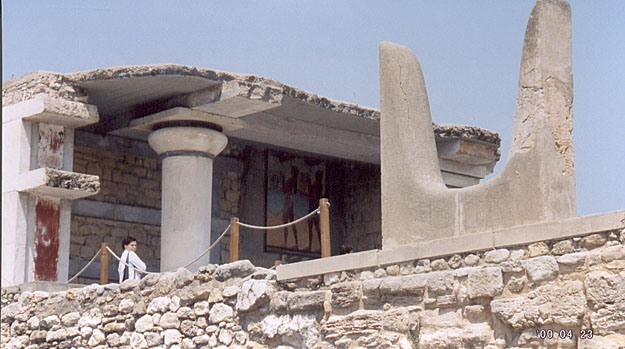
EXPLICATII PE INTELESUL TUTUROR PRIVIND TABLITELE DE LA TARTARIA

January 18, 2019

…..este usor de spus “pe intelesul tuturor“, dar nici eu nu realizez pe deplin ca ma adresez poate unui cititor a carui cunostinte lingvistice, sau in acest domeniu specific al epigrafiei, sa fie de nivel mediu (sau sub ?). Si care spre exemplu sa nu fi retinut pana in acest moment decat forma catorva litere grecesti (bineinteles, si acelea actuale), eventual care sa fi vazut cateva litere disparate, ex. feniciene sau din te miri ce alte alfabete disparate si mai departe….nu am cum sa stiu, necum sa fiu sigur; …ce sa vorbim despre semne minoice si silabograme miceniene (scierile Cretana hieroglifica, Linear A si Linear B), alfabete Anatoliene,etc.                                                                                                                Si nu stiu daca cumva constientizeaza macar intuitiv etapele foarte incete si lungi, (in special la inceput), etapele fragmentate ale evolutiei scrisului !?                            Si spre exemplu, si ma pot astepta, ca de-abea dupa ce i se explica cuiva care este mecanismul tehnic si psihologic, va intelege ca o inscriptie proto-cuneiforma nu are o citire in sensul propriu-zis, ci numai o interpretare, a carui inteles nu este foarte clar si nici unic.      Probabil trebuie sa ma impac cu gandul ca vor intelege in primul rand, (sau mai mult) cei care pe o cale sau alta s-au apropiat cat de cat de domeniul arheologiei si epigrafiei.                                                                                                                     Si pentru ca veni vorba, din pacate chiar arheologilor de la noi si din alte parti, nu le este foarte familiar domeniul  inscriptiilor; am avut ocazia sa vad din unele opinii exprimate de ei, cat de novici sant unii (mai bine nu nominalizez) in aceasta privinta.             ————————————————————————————                                                       In principiu totul este in aparenta simplu, este vorba de confruntarea si intersectia a doua domenii:                                                                                                                                         – Cel al aparitiei si evoutiei scrisului, care indiferent de locul pe pamant are la baza aceleasi principii, a caror convergenta este exprimarea cu ajutorul unui set de semne, cat mai simpla si exacta a “orice” (actiuni,idei,sentimente,etc)                                              – Celalat apartine artefactelor noastre concrete Este de asteptat sa obtinem concluzii de genul:                                                                                                                                                daca este scris; daca da, din ce faza a evolutiei lui si mai apoi daca si cat de independent este si daca, de unde a fost influentat si mai apoi care este modalitatea concreta (explicitarea amanuntita) in care se transmit informatii. Bineinteles scopul ultim, este sa aflam ce ar fi putea fi “scris” acolo.

APARITIA NEOLITICULUI IN EUROPA

Harta, din https://en.wikipedia.org/wiki/Neolithic_Europe
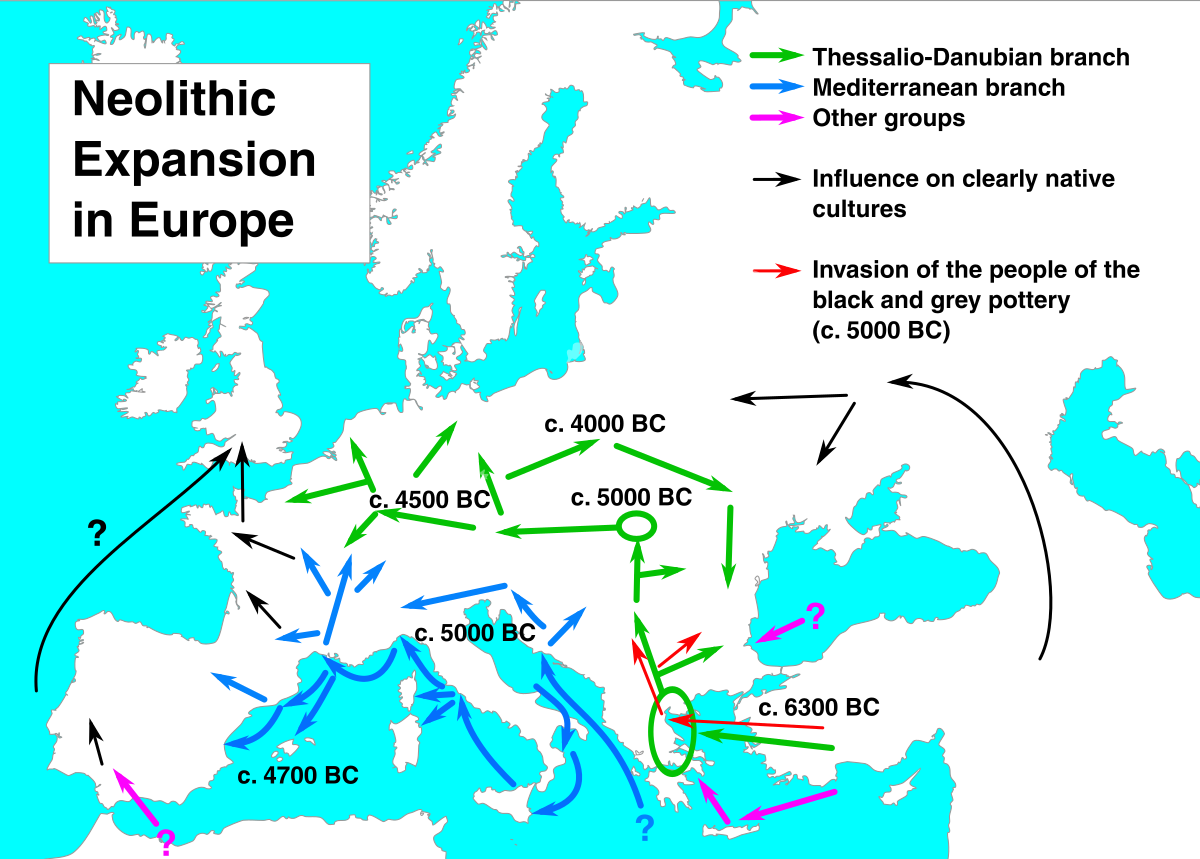
(Reprezinta cumva varianta “demica” (demografica) adica introducerea agriculturii prin migratii directe de populatii din ANATOLIA , populatii care au fost anterior mai avansate in agricultura)

INCEPUTURILE SCRISULUI IN LUME

scrisul a aparut in diferite locuri in lume mai degraba in focare independente, (Sumer, Indus, Egipt) nefiind cazul sa fi fost descoperit doar intr-un loc si de-acolo sa difuzeze in altele. A se retine, ca nicaieri in lume nu exista artefacte care sa ateste folosirea proto-scrierii (proto-cuneiforma) inainte de 3.500 B.C.                                                                                          Imaginea, din https://cdli.ucla.edu/pubs/cdlj/2006/cdlj2006_001.html

De fapt nu ar avea cum sa fie nici macar mai vechi de 3.000 B.C. Din cele ce urmeaza, voi pune in discutie chiar si aceasta varsta.                                                                                   (Dupa mine este absolut exclus ca tablitele sa aiba aceeasi varsta cu oasele, deci ca oasele sa apartina preotesei-saman care a scris tablitele !) contrar povestii sustinute si umflate de ani de zile de dl. Marco Merlini. 

Foarte interesant este faptul ca primele incercari de scris ale sumerienilor au fost in cea mai mare parte economice si numai in mica parte exercitii de scriere.Nimic religios sau de alta natura !                                                                                                                                    Din The Archaic Texts from Uruk Author(s): Hans J. Nissen https://is.muni.cz/el/1421/jaro2011/PAPVA_31/um/Nissen__1986__Archaic_Texts.pdf

“The basic questions can be reduced to why at all and when. As to why, we are helped by
the fact that c. 85 per cent of all the Archaic Texts from Uruk are what we call ‘economic
texts’, while c. 15 per cent may be classified as ‘lexical lists.                                           Neither literary nor religious nor historic inscriptions are present, and since, for the time being, we cannot attribute the lexical lists to any particular functional area, we have to conclude that because of their overwhelming majority and their character the economic texts should give us a better hint as to why the script was introduced.   ……….. The expression ‘economic‘ essentially categorizes the texts as parts of the book-keeping system: receipts, lists of expenses, of animals, of all kinds of goods, or of raw materials. ” 

INCEPUTURILE SCRISULUI IN ARIA DANUBIANA SI A CIVILIZATIEI VINCA-TURDAS

Inventia scrisului in diferite locuri in lume, a fost un proces de durata, care necesita in plus o serie de conditii minimale.  Cum ar fi atingerea de catre o cultura sau societate a unui nivel de dezvoltare economica suficient de inalt, si existenta unei societati cu o structura si organizare (cumva ierarhizata) relativ complexe.                                                                       Si in final necesitatea unei comunicari si schimb de informatie, atat in ce priveste viata si activitatea social-religioasa, dar mai ales necesitatea evidentei miscarii fizice si a distributiei bunurilor.    Aceasta avand ca rezultat intocmirea unor socoteli administrative privind aceste bunuri sau comoditati.                                                                     Da, Civilizatia Vinca a fost una din cele mai dezvoltate si complexe civilizatii (daca nu chiar cea mai  dezvoltata) pentru acele timpuri (nota-bene, inainte de cea Sumeriana si Egipteana !).Dar se pare (parerea mea) ca din pacate a fost, nu stiu cum sa zic,                                                                                                                                                             – a avut nesansa de a fi prea timpurie pentru desfasurarea unui ciclu complet al acestui fenomen al scrisului.                                                                                                            – societatea nu era una puternic ierarhizata care sa necesite o evidenta centralizata a distribuirii si redistribuirii bunurilor si serviciilor,ci era una edenica matriarhala si egalitarista.Intr-o societate in care am presupune ca bunurile sant la comun totul s-ar imparti la toti si nu mai necesita socoteli si evidente complexe !?

inceputul sscrisului a inceput cu stangul; nu a pornit de la pictograme si treptat sa treaca la ideograme, ci de la inceput a avut un “caracter digital”. “Caracter digital” insemna obtinerea unor semne complexe folosind elemente liniare (ex: I,-,L,X etc.).Daca evolua ajungea in final la una asemanatoare cu cea chineza (cu dezavantajul folosirii a mii de ideograme; la chinezi 20.000)

Din Anthrogenica https://anthrogenica.com/showthread.php?4342.

Sumerian Ubaid & Old Europe Vinca figures look like these. Dravidian Ubaid influence on the Balkan Neolithic elite? Iurii Mosenkis Elite/priest/ …

                                                                                                                                                              Din Chapter Two. GREEK WRITTEN LANGUAGE FROM 3000 BC| iurii …www.academia.edu/…/Chapter_Two._GREEK_WRITTEN_…                                            GREEK WRITTEN LANGUAGE FROM 3000 BC Iurii Mosenkis Fifteen centuries …     “Trypilla culture was a descendant of highly developed Balkan culture of Vinča.”

Ca atare, Civilizatia Vinca, a lasat in urma un bagaj impresionant de semne, care nu probabil, ci banuiesc sigur, au inceput oarecum sa fie folosite in tangenta cu activitatile economice si religioase. Privind etapele necesare care trebuiau parcurse pentru a se ajunge la scrisul propriu-zis , primii si cei mai importanti pasi au fost facuti.                           Insa din pacate, se pare ca, chiar cand ar mai fi lipsit putin ( sau putin mai mult ; acest lucru este relativ) sa se ajunga efectiv la scris, dezvoltarea culturii Vinca s-a oprit ; (ca mai apoi aceasta civilizatie sa sufere deplasari si transformari, si in final, dupa un anumit moment sau punct sa nu mai existe ca atare.)                                                                Din pacate, nu a fost inca demonstrat nici ca ar fi ajuns macar la faza proto-scrieriiAceasta ar insemna practic, si ar presupune  existenta a macar a unui exemplar de gen de inscris, a carui mesaj sa poata fi interpretat, si mai apoi sa existe un punct de vedere comun al cercetatorilor ca acest fapt s-a intamplat si e o certitudine.
Este adevarat ca majoritatea cercetatorilor au opinii si puncte de vedere comune, si anume ca semnele civilizatie Vinca par a fi “un gen de”sau “inceput de” scris, inceput de scris a carui natura in schimb tot dansii nu o pot preciza.                                  Desigur este vorba de o faza a evolutiei scrisului inspre proto-scriere.                    Unii chiar suspicioneaza existenta unui gen de/ sau a fazei de proto-scriere. Dansii se bazeaza pentru aceasta varianta, sau mai bine-zis dau ca exemplu, tablitele de la Dispilio, Gradesnita si Tartaria.     ( Pentru care fie vorba intre noi nu exista o unitate absoluta a parerilor privind vechimea si exact caror culturi le apartin.)                                                         Acest fapt, (ca nu s-a ajuns aproape de scriere) a fost acceptat si inteles de majoritatea cercetatorilor, dar nu chiar de toti (exemplu de cercetator cu o alta opinie, Dl.Marco Merlini, care sustine existenta unui scris, dar care nu poate fi citit; atunci, intreb eu mai este scris !?)  
———————————————————————-

CE ESTE SPECIFIC CULTURII VINCA IN ACEI PASI PARCURSI INSPRE SCRIS

O serie de civilizatii ,(foarte multe, ex.Sumeriana,Egipteana,Ugaritica si altele) printr-un concurs particular de imprejurari, au urmat o cale pe care azi o numim “clasica”de la pictograme spre scriere adevarata adica in final semnele aveau echivalent fonetic.          Fapt ce a permis exprimarea in scris, IN ORICE LIMBA, a oricarei idei, actiuni, sentiment sau concept. Nu-mi dau seama din ce motiv (chiar stiind aceasta desfasurare odata realizata nu mai poate fi schimbata), civilizatia Vinca-Turdas nu a urmat un astfel de parcurs.Acum, cand stau si ma gandesc, de fapt pictogramele pe zeci de mii de artefacte sant ca si inexistente. In schimb sant prezente din plin, as putea spune exclusiv semne obtinute din combinatii ale unor semne elementare liniare. Eu zic plastic ca CVILIZATIA VINCA-TURDAS A AVUT UN PARCURS  “DIGITALIZAT”. Acesta are avantajul simplitatii, in sensul creerii unor semne mai complexe pornind de la elemente simple.Apoi mai e avantajul ca pot fi standardizateDezavantajul este ca nu exista suportul intuitiv, adica pictograma care reprezinta obiectul. In acest fel este extrem de dificil daca nu imposibil sa se ajunga DIRECT la ideograme care sa reprezinte obiecte,idei si actiuni. Se pare ca asta a fost nesansa lor.                                                      Cred ca urmatorul exemplu este extrem de intuitiv:                                                                  incercati sa va ganditi ca cineva va da sarcina sa scrieti ceva (un act economic,rugaciune sau povestire) scriind cu semne, dar folosind doar semnele O si 1 .(sau oricare 2 semne)

( SUMERIENII AU AJUNS SA FOLOSEASCA IDEOGRAME COMPLEXE,                                           – DAR AU PORNIT DE LA PICTOGRAME PE CARE LE-AU STILIZAT SI FACUT TOT MAI COMPLEXE ;                                                                                                                                            – IN TIMP IDEOGRAMELE AU INCEPUT SA AIBA SI ECHIVALENT FONETIC (PARTIAL),          – PENTRU CA IN FINAL CHIAR EI NEMAISTIIND PENTRU ACELE IDEOGRAME COMPLEXE DE LA CE PICTOGRAME S-A PORNIT CU SUTE DE ANI INAINTE. )

OPINIILE CERCETATORILOR PRIVIND VARSTA SI CULTURA CAREIA LE APARTIN TABLITELE

Privind vechimea si cultura careia ii apartin tablitele de la Tartaria, nu exista o opinie comuna, si cu atat mai putin unica. Initial majoritatea cercetatorilor au luat in considerare primele ipoteze si parerea D-lui Vlassa (filiatie sumeriana, 3.200-3.000 B.C.). Apoi unii cercetatori au marit varsta; apoi dupa ce mult timp au fost centrati pe o varsta foarte veche/mare, chiar daca unii aveau si alte opinii nu le-au exprimat hotarat, probabil sa nu deranjeze orgoliul national si profesional al cercetatorilor romani.
Insa cativa totusi au facut-o (Dumitrescu s.a.).

Din Din CUI BONO? THOUGHTS ABOUT A “RECONSIDERATION” OF THE TĂRTĂRIA TABLETS ATTILA LÁSZLÓ* http://www.daciajournal.ro/pdf/dacia2016/18.pdf

4 Cf. Vlassa 1963, p. 492, 494. It is worth mentioning that, following the analysis of the dating possibilities,A. Falkenstein 1965, p. 273 suggested the very near time frame 2850‑2750 BC to date Uruk IIIb; based on this dating, V. Milojčić 1965, p. 267‑268 appreciated that the Vinča A phase and the contemporary cultures, the Tărtăria tablets,
respectively, could not date prior to 2800±50 BC.

Western-Pontic Culture Ambience and Pattern: In memory of Eugen Comsa

Lolita Nikolova, ‎Marco Merlini, ‎Alexandra Comsa – 2016 – ‎Social Science

According to them, it is possible that the tablets are from another cultural horizon … at Tărtăria should belong to the Coţofeni culture(Dumitrescu 1972: 93 fol.)

 
Este posibil ca unele artefacte sa fi cazut dintr-un strat superior, apoi artefacte ca cel tip “ancora” sant tipice altor culturi

The Position of the Tărtăria Tablets within the Southeast … – jstor

https://www.jstor.org/stable/504938 by DG Zanotti – ‎1983 –
See also S. Hood, “The Tartaria Tablets,” Scientific American. 230.5 (May 1968) …. Ezero cultures, these “anchors” are also common in the. Aegean Early Bronze … the upper strata, most likely connected with the Baden-. Kostalac presence on …

Din Acta Terrae Septemcastrensis, VII, 2008
SETTLING DISCOVERY CIRCUMSTANCES, DATING AND UTILIZATION OF THE TĂRTĂRIA TABLETS  Marco Merlini  Gheorghe Lazarovici http://arheologie.ulbsibiu.ro/publicatii/ats/ats8/merlini.pdf

“Consequently, the Transylvanian tablets have brought into sharper focus the
discrepancy between dates based upon radiocarbon method and those based upon
archaeological correlations (upgraded to “historical evidence”15): the chronological
gap was too large and the two options totally irreconcilable. If the radiocarbon
dating was truthful, the Tărtăria tablets could not be squared with the Jemdet Nasr
period even if one accepted a very early date for it, being much earlier than it. If the
Vinča culture was correlated with the Jemdet Nasr period, radiocarbon dating was
not only useless but also misleading (Milojčić 1965: 268).
We have to frame this crossroads within a period when the proponents of the
new radiocarbon chronology moved to attack and the defenders of the traditional,
conventional chronology were in defense. Indeed, the latter were open to direct
criticism from radiocarbon regarding concerning not only the Balkans and the
supposed links with the Aegean early Bronze Age on which Milojčić grounded his
chronology, but also other European areas. These difficulties “suggested that the
traditional chronology might be seriously in error in the Balkans (Renfrew 1973:
68) regarding the estimated dates, the durations of cultures, the idea that the
historical process is based on sequential series of archaeological cultures, the
diffusionist paradigm according to which the first farmers spread agriculture across
the globe sowing seeds also for most of today’s languages and system of writing. “

THE ARCHAEOLOGY OF THE ARABIAN GULF THE EXPERIENCE OF ARCHAEOLOGY 
Series editor: Andrew Wheatcroft University of Stirling                      
https://archive.org/stream/TheArchaeologyOf_258/Rice-TheArchaeologyOfTheArabianGulf_djvu.txtA group of tablets excavated at Tartaria in Rumania, has been thought by some observers to bear some resemblance to early Sumerian forms and to be ancestral to them. If this was the case, it would hint at yet another point of origin for the Sumerian people themselves; however, the Tartaria tablets may be later than first thought or, at best, may simply represent another direction from which some powerful, contributing influence travelled.

Aceasta nu fara temei, ci pentru faptul ca multe elemente nu se potriveau si nu rezulta o imagine unitara.Au avut banuiesc la baza considerente de natura arheologica si posibil si tipul de semne.Unii au reliefat faptul ca ar putea apartine unei alte culturi, ulterioare culturii Vinca (Petresti,Baden,Cotofeni,etc.) Deasemenea cercetatorii au observat o similaritate cu scrierea sumeriana proto-cuneiforma. Dar si aici au fost suficient de atenti incat au ajuns la parerea ca doar se aseamana in mare masura cu scrierea sumeriana, deci “scriere quasi-sumeriana” (A.A.VAIMAN/” On the quasi-sumerian tablets from Tartaria”), si nu poate fi de origine sumeriana.                                                 Aici sant cateva din listele primelor semne sumeriene pre-cuneiforme, unde puteti vedea si compara chiar fiecare si oricare din Dv. unele din aceste semne cu semnele existente pe tablitele de la Tartaria :                                                                                            Din  cdlibannerhttp://cdli.ox.ac.uk/wiki/doku.php?id=late_uruk_period full list of proto-cuneiform signs (very large file [93 MB]) https://cdli.ucla.edu/tools/signlists/protocuneiform/archsigns.html

Apoi si a ceasta: Proto-Cuneiform Signs by Ashur Cherry https://www.academia.edu/33396974/Proto-Cuneiform_Signs?fbclid=IwAR1jQW8KW3Esx_KIVEeHF1McmpZLIwduQgUsnm5QJccCbm7iWJYgv-dngkM

Mai exista si lista semnelor proto-cuneiforme a lui Adam Falkenstein (ATU care inseamna Archaishe Texte aus Uruk),                                                                                             Late Uruk Period [CDLI Wiki]  cdli.ox.ac.uk/wiki/doku.php?id=late_uruk_period May 17, 2016 – A. Falkenstein, Archaische Texte aus Uruk (Archaische Texte aus Uruk 1; Berlin-Leipzig 1936) PDF copy (80.6 MB). https://cdli.ucla.edu/tools/SignLists/ATU1.pdf si altele.                                                                                                                                                        Din pacate fiecarui semn din lista lui Falkenstein ii este asociat un numar de identificare si atat.Nici-o indicatie despre denumirea semnului,ori a notiunii desemnate sau vre-o legatura cu fonemele limbii sumeriene.Asa incat va dati seama cat foloseste….

Din https://en.wikipedia.org/wiki/Vin%C4%8Da_symbols                                                         “Around 3200 BC, the culture of Old Europe migrated, to the Aegean Sea and to Crete. Today, they are considered to be the origin of the Minoan civilisation, though it is a dimension that few Minoan scholars have included in their writing, instead largely opting to see Crete as yet another “stand alone” civilisation. Gimbutas stated that: “the civilisation that flourished in Old Europe between 6500 and 3500 BC and in Crete until 1450 BC enjoyed a long period of uninterrupted peaceful living.” Motifs such as the snake, intertwined with the bird goddess motif, the bee and the butterfly, with the distinctive motif of the double axe, are found both in Old Europe and Crete. But the best evidence is in the writing of Old Europe and the Linear A script of Crete, which are to all intents and purposes identical.   …………………………..
The Vinča culture appears to have traded its wares quite widely with other cultures (as demonstrated by the widespread distribution of inscribed pots), so it is possible that the “numerical” symbols conveyed information about the value of the pots or their contents. Other cultures, such as the Minoans and Sumerians, used their scripts primarily as accounting tools; the Vinča symbols may have served a similar purpose.   …………….        The discovery of smelting gave the Vinča culture – already one of the most dynamic in Europe – a near monopoly. The production of the first metal tools and jewelry unleashed a rush by cultures as far as the Atlantic and Baltic to possess Balkan products. Like the Hallstatt culture, which would later sit at the heart of one of Europe’s richest trade networks during the transition from the Bronze to the Iron Age, because of its salt deposits, Vinča was momentarily in the enviable position of possessing a technology and material unknown to anyone else. Soon, cultures as far away as Scandinavia were doing their best to imitate Balkan copper axes and daggers – but rather desperately in stone. The appetite for copper objects stimulated indirect trade with the amber-producing areas around the Baltic, extending elaborate networks and creating the first consistent trans-continental exchange system. In the meantime, coppersmith magicians noted for a particular set of grave goods, including characteristic bell beakers, spread throughout western Europe, remaining mysteriously apart from the populations they traveled amongst, at least when they were enterred in distinct tombs. ……………………                       But the advance of metallurgy during Phase C also strengthened cultures in mineralogically richer zones to the east that could specialize in production. Despite the discovery of slag and metal products at such Vinča sites as Selevac and Gomolava, the culture centered in Serbia was far more active in diffusing the new goods than producing them. Partly as a consequence, the Bulgarian Marica-Karanova V culture extended its influence along the Maritsa, then along the east bank of the Morava – enriching the Vinča sphere even as it encroached upon it. The initiative passed definitively to Varna and other metal-working centers near the mouth of the Danube once the Gumelnitsa and Karanova VI cultures of Bulgaria and southern Romania began to exploit mines at Aibunar and Stara Zagora in the second half of the 5th millennium. While Vinča was gradually forced to withdraw to the west of the Morava and abandon it’s type-site for Banjica, Varna was lavishing its dead with thousands of prestige goods made of copper and Transylvanian gold. “

Din https://drakenberg.weebly.com/vinca.html                                                                                There is no debate about it: the artefacts from the Vinca culture and Sumer are very much alike. And it is just not some pottery and artefacts: they share a script that seems highly identical too. In fact, the little interest that had been shown in the Vinca culture before the 1960s all revolved around their script. Vlassa’s discovery only seemed to confirm this conclusion, as he too immediately stated that the writing had to be influenced by the Near East. Everyone, including Sinclair Hood and Adam Falkenstein, agreed that the two scripts were related and Hood also saw a link with Crete. Finally, the Hungarian scholar Janos Makkay stated that the “Mesopotamian origin [of the Tartaria pictographs] is beyond doubt.”

Multi cercetatori au afirmat ca artefactele de la Tartaria din perioada culturii Vinca isi gasesc un echivalent apropiat in cele de la Hacilar si Beycesultan din aceeasi perioada. Intamplator am mai gasit o referinta; aici este vorba de  Creta legata de Beycesultan.

DOCUMENTS IN MINOAN LUWIAN,SEMITIC, AND PELASGIAN FRED C. WOUDHUIZEN file:///C:/Users/User/Downloads/Documents_in_Minoan_Luwian_Semitic_and_P.pdf            Appendix I: Architectural Relations between the Palace of
Beycesultan and the Palaces of Minoan Crete.………………………… 359

        Dar aici este vorba de o perioada mai tarzie decat cea a statuetelor de la Tartaria si a civ. Vinca.(tablitele sant mai tarzii decat Civ. Vinca !)

Din https://en.wikipedia.org/wiki/T%C4%83rt%C4%83ria_tablets

Possibly related finds in the region

This group of artefacts, including the tablets, have some relation with the culture developed in the Black Sea – Aegean area. Similar artefacts are found in Bulgaria (e.g. the Gradeshnitsa tablets) and northern Greece (the Dispilio Tablet). The material and the style used for the Tartaria artefacts show some similarities to those used in the Cyclades area, as two of the statuettes are made of alabaster.
—————————————————————————-                                                                         MAJORITATEA CERCETATILOR ASIROLOGI SPECIALIZAT IN SCRIEREA PRE-CUNEIFORMA AFIRMA CA NU SANT SUMERIENE CI DE “FACTURA sau INFLUENTA SUMERIANA”

Din CUI BONO? THOUGHTS ABOUT A “RECONSIDERATION” OF THE TĂRTĂRIA TABLETS ATTILA LÁSZLÓ* http://www.daciajournal.ro/pdf/dacia2016/18.pdf                                                                “A. Falkenstein, the first Assyriologist who thoroughly checked Vlassa’s conclusions and who comparatively examined, one by one, the signs from the Tărtăria tablets and their early Mesopotamian parallels. He established the existence of certain similarities in terms of the form of the tablets, the division of the surface in columns and partitions (Fächer), in which the signs were then inscribed. He noticed that, from the 20 (or 24, with variants) signs on the second and third Tărtăria tablets, precise analogies were drawn
for five, and similar forms were found for six among the archaic texts from Uruk (in German, Archaische Texte aus Uruk, abbreviated: ATU)25. All the 11 correspondences belong to the Uruk IIIb period (Djemdet Nasr), which can be dated to the time frame between 2800 and 2750 BC, also representing the chronological reference for dating the Tărtăria tablets. In Falkenstein’s opinion, the correlations established between the
Tărtăria clay tablets and the Sumerian ones indicate an impulse (Anregung) from Mesopotamia. At the same time, he stressed the fact that, unlike the Mesopotamian written clay tablets, the Tărtăria tablets were made from coarse material, were perforated (in order to be suspended?) and fired, the signs were incised (not impressed), the signs for numbers (characteristic to the Mesopotamian tablets, having an economic character) were (partially?) missing, etc”

Deci cam jumatate (11) din totalul de 20-24 au corespondente cu semnele proto-cuneiforme sumeriene.                                                                                                        

OPINIA MEA IN PRIVINTA VARSTEI SI CULTURII CARORA LE APARTIN TABLITELE

In mod gresit s-a facut identificarea varstei tablitelor cu cea a oaselor.Oasele au vechimea culturii Vinca, (cca5.500 B.C.), pe cand varsta exacta a tablitelor nu se cunoaste. Aparent dupa analiza scrisului, tablitele sant de data mult mai recenta. Nu se poate face o identitate intre varsta tablitelor si cea a oaselor intrucat ELE NU AU FOST GASITE IMPREUNA,UNELE LANGA ALTELE (OASELE CU TABLITELE). Nu se cunoaste exact care unde erau in cadrul complexului ritualic.

Iuliu Adrian Paul Enigma tăbliţelor de la Tărtăria                                            http://bjastrasibiu.ro/wp-content/uploads/2015/08/130-iuliu.paul_.pdf

“Prin urmare, această etapă cultural-cronologică reprezintă termenul post quem pentru posibila practicare a gropii de cult şi, implicit, a tăbliţelor. În consecinţă, teoretic, îngroparea complexului şi a tăbliţelor de la Tărtăria ar fi putut fi făcută în oricare din etapele de evoluţie ulterioare acestui nivel sau în niciunul din ele.Dacă o astfel de „îngropare” a unui „complex” de amploarea celui descris de N. Vlassa (Vlassa, 1963, p. 485-494; Vlassa, 1976, p. 161-197) a fost efectiv făcută, atunci elementele sale componente ar fi fost firesc să fi fost prezentate – şi păstrate (depozitate) – împreună, pentru a putea fi studiate ca un tot, inclusiv prin compararea lor cu alte vestigii similare descoperite
anterior şi păstrate în colecţia Torma Zsofia spre pildă. Jurnalul meticulos ilustrat al Zsofiei Torma, împreună cu materialele adunate, a intrat în inventarul Muzeului din Cluj, sub forma unei colecţii. După ştiinţa noastră, la această „colecţie” au avut acces, practic, două persoane. În primul rând, Márton Roska, care a studiat colecţia şi, pornind de la aceasta, a făcut verificarea stratigrafică de la Turdaş publicând apoi, cunoscutul Repertoriu (Roska, 1941). Apoi, spre sfârşitul anilor ’50, colecţia a fost studiată şi reorganizată de Nicolae Vlassa. …………………………………………                                                          Ar mai fi de adăugat şi faptul că Laszló Attila, în prezent prof. univ. dr. în arheologie la Universitatea „Al. I. Cuza” Iaşi, deşi a participat, de la începutul până la sfârşitul săpăturilor din 1961, nu a văzut – după propriile sale mărturii, repetate – nici momentul descoperirii şi nici vreuna din piesele complexului. Tăbliţele le-a văzut pentru prima oară, la muzeu, după conservarea lor. Acesta pare a fi motivul care l-a determinat pe Laszlo Attila să se preocupe îndeaproape de cercetările Zsofiei Torma într-un amplu şi documentat studiu ce ar putea fi considerat, implicit, ca o invitaţie pentru reluarea studiului asupra activităţii şi a colecţiei Zsofiei Torma, în lumina noilor cercetări privind utilizarea şi semnificaţia semnelor grafice în preistorie (Laszlo Attila, 1991,p. 37-50).”

SANSE MINIME SA FIE CONTRAFACERI ALE CUIVA (ex.Vlassa, si cu atat mai putin Torma sau cineva din anturajul ei)

Nota                                                                                                                                                    Mai multi cercetatori, au luat in calcul si ipoteza ca tablitele ar proveni de fapt din colectia Zsofiei Torma.Initial m-am gandit, ca daca apartineau colectiei sale, dansa nu ar fi scapat sa le prezinte intregii Europe, ea fiind cea mai mare sustinatoare a originii semnelor din civilizatia Vinca-Turdas in civilizatia sumeriana. Dar, fapt interesant, initial tablitele erau acoperite cu un strat gen carbonat de calciu, si posibil (nu stiu inca),nu se vedea nimic, adica nu se vedeu semnele !?!?.                                                                        Poate de-abea dupa ce au fost introduse in acid clorhidric semnele au inceput sa fie vizibile.

Din http://www.daciajournal.ro/pdf/dacia2016/18.pdf Attola Laszlo                                       “The truth is that, although with a certain delay, Vlassa himself admitted that both the tablets and the idols, which had been covered by a calcareous crust, were immersed in a hydrochloric acid bath, and it was only after this treatment that the signs incised on the tablets became visible, subsequently undergoing an air‑free impregnation process of the tablets in an autoclave, using a reversible impregnating agent, for preservation purposes14. “

Asa s-ar putea eventual explica de ce Zsofia Torma nu le-a aratat nimanui pentru ca nu avea de fapt ce sa arate.Printr-un concurs atat fericit (in acest caz) de imprejurai, de-abea dupa ce s-au vazut semnele a inceput sa se faca mare zarva in jurul lor.

Western-Pontic Culture Ambience and Pattern: In memory of Eugen Comsa https://books.google.ro/books?isbn=3110500825 Lolita Nikolova, ‎Marco Merlini, ‎Alexandra Comsa – 2016 –                                                                                                      “The tablets were wet, soft and covered with limestone. … the pit, the restorer put the tablets under a hydrochloric acid treatment, removing not only the ..”   

***************************************************                                                          DAR CUM VETI VEDEA SI MAI JOS,                                                                                             PRIN ’61 NU SE GASEA IN BIBLIOTECILE DIN ROMANIA DOCUMENTATIE DIN DOMENIUL ASIROLOGIEI, SI CU ATAT MAI PUTIN DIN DOMENIUL MAI INGUST SI DIFICIL AL SCRIERII PRE-CUNEIFORME.                                                                                   IN PLUS ROMANIA NU AVEA ASEMENEA SPECIALISTI. SI                                                      CU ATAT MAI PUTINE ERAU SANSELE PE VREMEA ZSOFIEI TORMA.                                DOAR PENTRU CINEVA DIN ZIUA DE AZI, REALATIV PREGATIT SI IN CONDITIILE IN CARE DOCUMENTAREA SE POATE FACE FACIL PE INTERNET, AR FI OARECUM POSIBIL SA INJGHEBE CEVA ASEMANATOR.                            ***********************************************

Din Thoughts about a “reconsideration” of the Tărtăria tablets Attila László http://www.daciajournal.ro/pdf/dacia2016/18.pdf

 2. In what these remarks are concerned, it is worth mentioning that indeed Vlassa did not find in the Romanian libraries of the 1960’s specialized Assyriology literature, since there were no Romanian specialists in this discipline then23. As a good expert in the field noted, Vlassa quoted,but probably did not use Falkenstein’s fundamental work (1936). Thus, contrary to the malicious remark of E. Qasim, one may consider it a true performance that, relying solely on comparisons with the Assyriology literature for the wider audiences, Vlassa succeeded to find parallels for the signs on the Tărtăria tablets24.                                                                                                                                                 —————————————————————————————————–
In orice caz, nepunandu-ma baza pe opiniile usor divergente ale arheologilor, am tras niste concluzii minimale proprii.                                                                                                Cu toate acestea, si ma asteptam cumva, multe din concluziile mele sant oarecum asemanatoare iar altele pur si simplu se suprapun pe acelea ale altor cercetatori.                   ————————————————————————————

CONCLUZII REZULTATE DIN CERCETAREA MEA INDEPENDENTA

Concluzii rezultand EXCLUSIV DIN ANALIZA SEMNELOR !

Aceastea au la baza urmatoarele elemente:
Desi semnele prezinta asemanari cu scrierea sumeriana proto-cuneiforma, multe doar se aseamana schitat, dar nu sant la fel.                                                                                  Concluzie, nu este scriere original-sumeriana, este doar de influenta sumeriana.

Din      Mesopotamien: Späturuk-Zeit und Frühdynastische Zeit
Bauer, Josef; Englund, Robert K.; Krebernik, Manfred  https://www.zora.uzh.ch/id/eprint/151545/1/Bauer_Englund_Krebernik_1998_Mesopotamien.pdf                                                                                                                                                “The presumption that decorated tokens appearing from approximately the middle of the 5th millennium B.C. in Uruk (but only from co . 3500 B.C. in Iron and Syria) led di rectly to pictographic script is the element of Schmondt-Besserot’s work which has been most debated .Comparing the graphic forms, she was able to propose the correspondence of o Iorge number of decorated tokens with later ideograms, and these identifications ore now moving through the secondary literature as if they had been justified or even in port accepted by experts. The basic argument against such facile identifications is that we know graphic similarity, in the absence of contextual proof, con be notoriously misleading, placing as it has Sumerian scribes as for afield as Rumania and China . This is the more dangerous when not even the objects being analyzed con be shown to have been included in meaningful token assemblages, i . e., when complex tokens ore not found within, or at least in context with clay balls. “
– Asemanarile cele mai mari sant (in ordine descrescatoare), cu:                                                             – scrierea Sumeriana, urmata foarte aproape de cea Anatliene si Egeene.


TABEL CU PROCENTAJELE (aproximative) IN CARE SEMNELE DE PE TABLITE SE REGASESC IN DIFERITE SCRIERI:


 Scrierea sumeriana (proto-cuneiforma)                      90%

Alfabete Anatoliene in ansamblu                                 80%

Alfabetele Cariene in ansamblu                                    50%

Scrierile Egeene Linear A/B in ansamblu                    50%


Daca in schimb luam doar semnele din jumatatea de sus a tablitei rotunde, in alf.arhaic grec 94%si apoi restul semnelor din semnele proto-cuneiforme 98%, ar rezulta o medie de 96% ! !                                                                                                                                 Aceasta analiza comparativa are doua rezultate practice:                                                   ne poate da o imagine referitor la ce fel de scris a fost folosit, si ne poate da indicii privind eventuala origine                                                                                                                     – arata ce influente au fost exercitate (de unde) si in ce masura 

A se vedea,                                                                                                                                   DOCUMENTS IN MINOAN LUWIAN, SEMITIC, AND PELASGIAN FRED C. WOUDHUIZEN         https://docs.google.com/document/d/1MlXuANT4kcZHS4RZCLwSj1TS_lNP-JJaO9dfHtIqmI0/edit                                                                                 https://mail.google.com/mail/u/0/?tab=wm#inbox/KtbxLxGgHpVDpdzfFNRNfRjtcCkfXtZpgV?projector=1&messagePartId=0.1                                                                                                                          

Un fapt care nu m-a mirat foarte mult; cred ca ma si asteptam cumva, a fost constatarea unei asemanari a ideogramelor/syllabogramelor sumeriene cu cele Egeene.   

Din Linear A Script – Ancient History Encyclopedia https://www.ancient.eu/Linear_A_Script                                                                                             “The Linear A script was the writing system used by the Minoan civilization. … that Linear A is related to the Old European Vinca culture. “

 Din https://people.well.com/user/mareev/portal/prehistory/ancient_prehistory_timeline6a.html                                                                                                                                                              “(Romania Tartaria Vinca writing [of 6000 BC] – Some of the signs incised on the Tartaria tablets proved to be almost identical with Sumerian ones of the period around 3000 B.C.  The Tartaria tablets also looked much like the written records produced in Crete ca 2000 B.C., when the earliest archives uncovered at Knossos were established.) (Scientific American – May 1968)”                                                                                                                     

The Tartaria Tablets | Antiquity | Cambridge Core https://www.cambridge.org/…/C824E021256A41A254FF5A… de MSF Hood – ‎1967

“The shapes of the tablets and some of the signs are paralleled in the Minoan scripts ..”
 

   Vedeti si un studiu comparativ privind semnele din aceste doua regiuni:                     Minoan Sumerian | Giannhs Kenanidhs Academia.edu  http://www.academia.edu/11423494/Minoan_Sumerian

Danube-Trypillia source of Minoan scripts | iurii mosenkis – Academia … http://www.academia.edu/…/Danube-Trypillia_source_of_Minoan…

 La sfarsitul paginii, aveti mai multe surse pentru documentarea unor legaturi intre civilizatiile din Orient (in principal Sumer) si aria Egeeana (ex. civilizatia minoana)

Mie mi-au atras atentia, si ma mir cum altor cercetatori le-au scapat, doua aspecte majore as zice eu:                                                                                                                                     I. Caracterul eterogen al semnelor. respectiv semne provenind din arii diferite si din perioade diferite.De fapt, inafara de asta sant  3 categorii de semne:                                        -pictograme                                                                                                                                             -ideograme si sau silabograme                                                                                                           – semne folosite in mod sigur in alte scrieri ca litere                                                               IIJumatatea superioara face “opinie separata“, respectiv semnele de acolo ar parea cele mai noi/moderne/recente.Acuma ca este o intamplare sau nu, aceasta este chiar jumatatea presupus a fi intentionat ascunsa vederii,fiind acoperita de tableta dreptunghiulara cu gaura.                                                                                                               III. Da, sant mai multe feluri de semne.Ar rezulta doua ipoteze:                                              a)- sa fie un fel de exercitiu scolar sau cineva sa-i arate altcuiva cum se scrie.Dar nicaieri nu exista ceva asemanator, iar sumerienii altfel procedau cu invataceii. Invatatorul scria pe o jumatate si elevul copia textul pe cealalta jumatate,sau scriau liste cuprinzand categorii, (exemplu lista cu diferite meserii)                                                                            b)Mai rezulta ceva si mai important si complex: cel care a facut semnele avea cunostinta de asemenea semne folosite in Sumer sau aria Egeeana. Numai ca avem o mare problema, acel cineva ori era din acea vechime si loc sau “scriitorul,scribul” apartine unei perioade mult mai apropiata de zilele noastre si le stie din documentare proprie.

Din ATTILA LÁSZLÓ, Cui bono? Thoughts about a “reconsideration” of the Tărtăria tablets http://www.daciajournal.ro/pdf/dacia2016/18.pdfn

“In her attempt to demonstrate the falsity of the tablets, E. Qasim proceeded exactly the other way around: she selected those signs from the available comparative material presented by Vlassa which also appeared on the Tărtăria tablets. By applying an intricate
logic, she thus attempted to demonstrate that the signs represented on the Tărtăria tablets were rendered (= were copied!) following the model of some Mesopotamian signs which were reproduced as an illustration in the popularizing works which were at the disposal of the Transylvanian archaeologist.”

Vlasa nu parte sa fie un bun candidat:                                                                                  ATTILA LÁSZLÓ, Cui bono? Thoughts about a “reconsideration” of the Tărtăria tablets http://www.daciajournal.ro/pdf/dacia2016/18.pdf

  “In what these remarks are concerned, it is worth mentioning that indeed Vlassa did not find in the Romanian libraries of the 1960’s specialized Assyriology literature, since there were no Romanian specialists in this discipline then23. As a good expert in the field noted, Vlassa quoted, but probably did not use Falkenstein’s fundamental work (1936). Thus, contrary to the malicious remark of E. Qasim, one may consider it a true performance that, relying solely on comparisons with the Assyriology literature for the wider audiences, Vlassa succeeded to find parallels for the signs on the Tărtăria tablets24. “

Si cu atat mai mult, inca inainte cand se stia si mai putin despre inceputul scrierii sumeriene, nu putea fi Torma si nici oricine din cercetatorii epocii sau din anturajul apropiat !                                                                                                                                                 ————————————————————————————–                        ACEASTA AGLOMERARE (daca as fi rau, “GHIVECI“) DE SEMNE INDREAPTA TABLITELE INSPRE A FI UNICATE (engl.SINGLETONS) SI CHIAR “CIUDATE”.                            NU SANT IN LINIE, CONFORME CU LINIA GENERALA  A EVOLUTIEI SCRISULUI IN LUME.                                                                                                                                                    PRIN STRUCTURA SI SEMNE REPREZINTA O ABATERE SI DEVIERE DE LA ACEEA CE AM PUTEA CONSIDERA NORMALITATE 

IV. Avand in preocupare de ani de zile semne folosite in scrieri, din aspectul grafic (forma)   concreta a unor semne am putut face niste observatii. Exemplu:                              – Semnul “H cu 3 bare orizontale sau usor inclinate” nu a aparut sub aceasta forma concreta decat in aria Egeeana la maximum  2300 B.C in scrierea cretetana hieroglifica si mai apoi in scrierile Linear A si Linear B(sylabograma PA3).Mai apoi a aparut in alfabetele arhaice grecesti ca fiind litera heta/eta.
– Semnul “D” nu au aparut decat in 2 ocazii:                                                                                      – ori extrem de rar la 3.200B.C. in Sumer, (unde au fost atestate D.S.Besserat dar nu se stie exact ce reprezentau), ori                                                                                                                 – peste inca 2.500 de ani in aria Egeeana  reprezentand in alfabetele arhaice grecesti , (care erau la inceput diferite in diferite regiuni “epichoros=”local”),ex. forma “D mare de tipar” era litera D intr-un loc sau R in alt loc.
-Inafara semnului +++++ care

ar putea reprezenta (eteocretan X,dd,tt,,Su ?)

<The Archaic Cretan Greek Alphabet http://www.carolandray.plus.com/Eteocretan/archaic_alpha.html >

  1. semksemk is found on Praisos #1. As stated above, we can discount the value /ks/ given to this symbol by the Ionians. It would be a gross anachronism to find it used this way in a late 7th century or early 6th century inscription from Crete. There are only two credible possibilities:
    • As in some other local scripts, it is merely used as a variant of zeta and, therefore, presumably denotes either /dd/ or /tt/.
    • It really is semk and is being used to represent a sibilant not known in contemporary Greek. The clear presence of Ϝσ (ws) on Praisos #3 may indicate that Eteocretan possessed a labialized sibilant []].

sau ar putea fi un numeral (50), in rest, toate semnele din jumatatea de sus a tablitei rotunde se regasesc in alfabetele arhaice grecesti (800-500 B.C.). 

Tabelul, din http://www.codex99.com/typography/13.html


                                                                                                                                                                    Din http://www.bardotbooks.com/blog/?m=201212                                               https://www.google.com/url?sa=i&source=imgres&cd=&ved=2ahUKEwjV9KL_rozgAhVB46QKHXVIBi0Qjxx6BAgBEAI&url=http%3A%2F%2Fwww.bardotbooks.com%2Fblog%2F%3Fm%3D201212&psig=AOvVaw0oFOfZMAobdvJUPai_Z6cm&ust=1548623703265514

earliest-alphabets                         ————————————————————————————                                                                      Nota                                                                                                                                                Oricine is pate pune problema, si mi-am pus-o si eu, daca exista semne de scris, la ce mai folosesc pictogramel de pa tablita pur pictografica?

 Din https://ro.wikipedia.org/wiki/Istoria_scrisului                                                                            “Primele sisteme de scriere apărute la începutul epocii bronzului nu au reprezentat o invenție bruscă. Mai degrabă, ele s-au dezvoltat pe baza unor tradiții mai vechi ce constau din diferite sisteme de simboluri care nu pot fi clasificate ca scrieri proprii deși au multe caracteristici izbitor de asemănătoare cu scrierea. Aceste sisteme pot fi descrise ca fiind protoscriere”. Aceste sisteme folosesc simboluri ideografice și/sau primele simboluri mnemonice pentru a transmite informații încă au fost, probabil, lipsite de conținut lingvistic direct. Aceste sisteme au apărut în perioada neoliticului timpuriu, încă din mileniul al VII-lea î.Hr..   …………..                                                                                     În 300 de ani, Mesopotamia a făcut (deși parțial) pasul următor (nereușit încă de alte civilizații): semnul în loc să indice un obiect, a început să reprezinte un sunet, ajungându-se astfel la posibilitatea ca scrierea să exprime limba cu relațiile existente între cuvinte.[5] Cele două tipuri de semne au continuat să existe deoarece ideogramele nu au fost înlocuite complet de scrierea fonetică. Semnele numite silabice, ce aveau valoare gramaticală și foloseau la exprimarea acelor părți de vorbire care, prin natura lor, nu puteau fi reprezentate figurativ, erau derivate din ideograme, al căror sens îl pierdeau păstrând doar sunetul. Așadar sumeriana nu a atins niciodată stadiul final din evoluția scrierii (crearea unui alfabet), neelaborându-se semne distincte pentru fiecare vocală și consoană.”

In evolutia scrisului, semnele pictografice au inceput sa aiba si semnificatie fonetica, adica sa semnifice si sunetul cu care incepe denumirea obiectului reprezentat in pictograma.Acesta se numeste “principiul acrofonic, sau rebus”                                               

Din https://ro.wikipedia.org/wiki/Discul_din_Phaistos                                                             “Glifa numărul unu, “băiatul ce aleargă”, invocă pentru Jean Faucounau numele homeric al acestuia, *κοFος (transcris de altfel în codul beta astfel: kou=ros). Cititorii proto-Ionieni ai glifei nu fac, privind-o, decât să recite silaba inițială [ku] pe care scribul a imprimat-o mai înainte. Iar cu această silabă se poate nota și oricare alt cuvânt care începe cu aceleași sunete. Următoarele două glife pot adăuga, de pildă, silabele [su] și [te]. Iar cu toate trei se poate astfel scrie cuvântul ku-su-te, sau cel fonetic echivalent, grecesc, românesc, ori al oricărei alte limbi. După contextul dat, sensul aceluiași cuvânt rostit poate fi desigur foarte diferit. Singura condiție a biunivocității lecturii pentru cititor și pentru scrib este ca aceștia să se refere la aceeași limbă.                                                                                                                                             Principiul acrofonic, înrudit cu cel al rebusului, este universal, deoarece el poate astfel nota orice limbă. Totuși, spre deosebire de rebusuri , el trebuie pus la lucru numai într-una și aceeași limbă, astfel ca el să producă reprezentarea unei scrieri fonetice și nu a unei scrieri ideografice cum sunt cele vechi egiptene sau chinezești.”

M-am gandit ca pictogramele pot fi un gen de rezumat (ex ofranda de iezi si cereale adusa unei zeitati sau un gen de ruga, etc), dar mai ales ar putea fi un ajutor pentru citirea semnelor nepictografice de pe celelate tablite.                                                               Ex.

pictograma “ied” <> semne HD :”hedus,ed,ede” =ied                                                                     pictograma “simbol vegetal” <> semn Se sau Te “cereale” deci ceva de genul asta
Deci mai degraba rezulta o varsta apropiata de scrierile Egeene (hieroglifica Cretana, Linear A si LinearB, 2200 1300 B.C.) sau scrierea Anatoliana (ex. cea cariana) si in concluzie, o varsta sub 2500 B.C.

======================================================================         IN EVENTUALITATEA CA TABLITELE AU OARECARE VECHIME, (SAU O VECHIME CAT DE CAT APRECIABILA), ESTE POSIBIL CA ELE SA FIE DE FACTURA PELASGICA, DAR CU ORIGINE IN FOCARUL IN CARE S-AU DEZVOLTAT DIFERITE SCRIERI EGEENE.SPRE EXEMPLU CHIAR DIN CRETA, UNDE PRINTRE ALTE POPULATII A FOST DETECTATA (DAR NU SI ATESTATA) SI O POPULATIE PELASGICA

Din DOCUMENTS IN MINOAN LUWIAN,
SEMITIC, AND PELASGIAN FRED C. WOUDHUIZEN                                https://mail.google.com/mail/u/0/?tab=wm#inbox/KtbxLxGgHpVDpdzfFNRNfRjtcCkfXtZpgV?projector=1&messagePartId=0.1 

“If the aforegoing analysis of the GNs Damater and Idamater holds water, it is of relevance to note that Pelasgians are recorded among the population groups of Crete by Homeros in his Odyssey XIX, 177. Moreover, the identity of this particular ethnonym to the Biblical Philistines as argued by a substantial number of scholars provides welcome additional evidence for a Cretan homeland of the Pelasgians (< *Pelastoi), as the Bible consistently traces the for the southern Levant foreign Philistines back to Kaphtor. The latter country name, namely, actually consists of the Biblical name for “Crete”,related to Akkadian Kaptara and Egyptian Keftiu.         ………………………………                                    However, the evidence for the Pelasgian language in Minoan Crete is not confined to divine names, but includes personal names of the Minoan rulers as preserved by literary tradition and collected by Fritz Schachermeyr in his stemma of Cretan rulers.17………………………………                                                                                                            Yet another category of evidence for the Pelasgian language in Minoan Crete may be provided by Minoan evidence analogous to that for an Old Indo-European substrate in Luwian of western Anatolia.  ……………………                                                                                 the leader in the Trojan war of the Peraibians and the people from Dodona and the Peneios region in Thessaly according to Homeros, Iliad II, 748-755, Gouneuv~. If so, it
deserves our attention in this connection that according to Simonides in Strabo, Geography 9.5.20 the Perrhaibians (= Homeric Peraibians) are Pelasgiotes, which is nothing but a variant form of Pelasgians.26 …………………………………….                                           All in all, we arrive at the following reconstruction in so far the Indo-European languages of Minoan Crete are concerned when viewed within the wider framework of the eastern Mediterranean migrations (see Table XVI):36

IE population group time of arrival
1. Pelasgians c. 3100 BC
2. Luwians c. 2300 BC
3. Greeks c. 1450 BC
Table XVI. Overview of the Minoan IE population groups and their approximate time of arrival in Crete. It is certainly true that of these three Indo-European languages
of Minoan Crete Luwian is recorded earliest, on Cretan hieroglyphic seals dating from c. 2000 BC onwards. As we have seen in the above, however, there is ample evidence of an Old Indo-European substrate in the Cretan Luwian context, which, in like manner as the
one in the western Anatolian Luwian context, can positively be identified as Pelasgian. This latter language, then, in all probability happens to be the vernacular of the earliest recordable Indo-European settlers in Crete. But the Linear A texts conducted in the Pelas-
gian language are of later date, being assigned to c. 1600 BC and the late 15th or early 14th century BC. It is true that I was too rash in claiming in an earlier stage of my work that the Luwians were the earliest Indo-Europeans in Crete (paper presented in 2004 included in the bibliography as Woudhuizen forthc.). On the other hand, the vindication of the three Linear A texts conducted in the Pelasgian language as the earliest evidence of Indo-European as claimed by Gareth Owens and referred to in section II.1 above37 is only valid on the basis of the deduction that this particular language indeed constitutes an Indo-European substrate, and finds no support in the actual dates of the documents in question. …………………………………………..                                                                                                 It is well known that the language of the Linear B tablets consists of an early form of Greek, the so-called Mycenaean Greek. As opposed to this, the Linear A texts on tablets as well as other objects are mainly conducted in a Semitic tongue, but, on the basis of secondary Luwian and Pelasgian influences, it can be deduced that this form of Semitic was used, at least to a certain extent, as a lingua franca for administrative and religious purposes by representatives of population groups of which the mother tongue was something other than Semitic, namely Luwian or Pelasgian, both belonging, like
Greek, to the Indo-Europan language family. Finally, the Cretan hieroglyphic documents also show evidence for the Semitic language, and even of an occasional Egyptian loan, but in the main these texts bear testimony of a local Cretan dialectal variant of Luwian as the matrix-language, which is otherwise most closely related to Luwian hieroglyphic—the script which, by the way, as we have seen in section I.1.2 above also provided the model for the bulk of the Cretan hieroglyphic signary.  ……………………….

As I have argued in Woudhuizen 2016: 81-95, these phenomena can in the western Anatolian Luwian context be attributed to an Old Indo-European substrate, the speakers of which are positively identifiable as Pelasgians. The same verdict no doubt applies in the Cretan Luwian context as well.

====================================================                                           Legaturi ale Orientului Apropiat si ariei Egeeane cu Civilizatia Vinca

Din DRAVIDIAN ÇATAL HÖYÜK, UBAID, BALKANIC AND WEST EUROPEAN NEOLITHIC PRIEST ELITE         Iurii Mosenkis   https://www.academia.edu/28607704/DRAVIDIAN_%C3%87ATAL_H%C3%96Y%C3%9CK_UBAID_BALKANIC_AND_WEST_EUROPEAN_NEOLITHIC_PRIEST_ELITE

Proto-Dravidian tokens and Çatal Höyük                                                                                   The firstokens (related to the Sumerian or pre-Sumerian hieroglyphs) were usedfrom about 9,000–8,000 BCE in Pre-Pottery Neolithic A Mureybet in Syria, and GanjDareh in Iranian Zagros. E. g., the token sign for ‘sheep’ (about 7,000 BCE) depicted asthe cross might reflect the homonymy between the names of the Sun and sheep inSumerian and Dravidian ……………………………..The second wave of the Nostratic Natufian divergence (after the first wave, probablyKartvelian) might be mainly Dravidian PPNB, Çatal Höyük, and Ubaid.Çatal Höyük bird scenes were similar to Vinča ones (V. A. Safronov), on the onehand, and to Göbekli Tepe, on the other hand. The reconstruction of the Vinča sanctuaryat Parţa (Gh. Lazarovici) is very similar to theÇatal Höyük temple…………… 

 Sum.uz, ud, ut she-goat’,udu sheep’ : Proto-Dravidian*jōḍ- goat’ >Proto-Gondi-Kui
*jōḍ- >*ōḍ-āTamil, Malayalam utal.ram, he-goat;’ Sum.utu the Sun,’uthe Sun, light, day’ : PD *oT- to burn’ > PND *od- or/and PD *uḍ- to boil; hot.’ 

The Vinča script is a contemporary of the Ubaid period; it is similar to both 1)Sumerian writing and 2) the Trojan script (via the Dispilio tablet) and then Linear A, Bwhich might be interpreted as partially based on the Dravidian language.The structure of the Dravidian languages is similar to the ‘banana’ substrate inSumerian.The earliesdate of Ubaid in Southern Mesopotamia is about 6500 BCE which wassynchronous with Çatal Höyük. The statuettes of ‘thinker’ in Vinča-influenced

 
Many words ofSumerian basic and cultural lexicon correspond with Dravidian ones.  ……..
Dravidian Ubaid influence on the Balkan Neolithic elite?Elite/priest/cult
 language of Crişand Vinča might be Dravidian (of Anatolian Ubaidorigin) because of:           1) Dravidian etymologies for several Linear A, B signs related to the Vinča script via the Dispilio tablet (Greek Macedonia; C145260 BCE) and Trojan Script;                      2) Tărtăria tablets (the age of the human bones found with the tablets: 5370-5140 calB1i. e. the Ubaid time) similar to Sumerian hieroglyphs of possible pre-Sumerianorigin while Ubaid might be related to the Dravidian substrate in Sumerian;12
3) Unetymologized words in Greek, Albanian, and Romanian (cf. Dravidian interpretation of tokens and their Balkan relationship);                                        4)A similarity between Vinča, especially the Parţa sanctuary (Gh. Lazarovici’s reconstruction), and Çatalhöyük which art may be interpreted in Dravidian;                        5) A similarity between the Ubaid ‘lizard’ figurines and the Vinča figurines whichhad the Criş parallels13
;6) Close similarity between the Karanovo IV beard figurine (synchronous with Vinča)and the Harappan ones                  7Dravidian (?) H haplogroup in Starčevo and Dravidian (?) T haplogroup (close cognate of Dravidian L haplogroup) in Linear Pottery;111
 Merlini, M., Lazarovici, Gh. Settling discovery circumstances,Acta TerraeSeptemcastrensis2008, vii, p. 153,http://arheologie.ulbsibiu.ro/publicatii/ats/ats8/acta%207.pdf 
12 Howeversigns on the tablets are similar to early Sumerian hieroglyphsof Uruk IV (late 4tmillennium BCE) and may be read in Sumerian as agricultural documents,. Sumerian hieroglyphs are readable from the Uruk IV period, late 4tmillennium BCE,so the language of the Uruk Period was Sumerian.13 I was informed about the Criş parallels by M. Yu. Videiko.

14 Haak, W. et al. Massive migration from the steppe is a source for Indo –European languages in Europehttp://arxiv.org/ftp/arxiv/papers/1502/1502.02783.pdf Halafpossible

8) Chalcolithic rite of house-burning was spread in Vinča-related cultures while
*urvillage’ and *ur– burning’ were homonyms in Proto-Dravidian; cf. Sumerian
uru(2)city,town, village’ and ùruwatch fire; light; glowing, luminous object’. V. V. Khvoika-N. B. Burdo’s interpretation of Trypillian burned houses as houses of dead correlateswith proto-Halaf burial rite in burning houses; cf. a rite of fire related to the Tărtăriatablets;15
 9) The similar round mace-heads in Vinča and Mesopotamia of the Uruk period (andpre-Dynastic Egypt as a result of the Uruk expansion).1The Via might be partially
dravidianized by the Anatolian Ubaid. The phonetic structure of theDravidian languages is similar to the ‘banana’ substrate in Sumerian and Hurrian. Sumerian writing system is good for the Dravidian word structure but not so good for Sumerian one. The strong Dravidian element in Sumerian basic and cultural lexicon17

might be interpreted as a ‘banana’ = Ubaid component.                                                         The Dravidian Ubaid roots might be suggested for                                                                           1) the Sumerian script of suggested pre-Sumerian origin,                                                      2) the Vinča script, including the Tărtăria tablets, related to the Sumerian script but not immediately,                                                                                                                                  3) the Cretan Linear A, B script derived from the Vinča script via the Dispilio tablet and theTrojan script4) the Kura-Araxes script similar to Vinča.                  The beginning of the Ubaid culture in Southern Mesopotamia is currently dated from 6500 BCE,18 i. e.earlier than the Vinča and the Vinča script. The first tokens as the prototypes of the Sumerian hieroglyphs

Dravidian Ubaid traces in later Balkans are confirmed by several Albanian andRomanian words of substrate origin which have Dravidian parallels:Romanian < Dacian mal shore’, Albanian
mal mountain20 PD*màl– mountain’Romanian < Dacian moș old man’, Albanian
mos ‘age’,mosold, aged’ : PD *mūt– old’The Proto-Dravidian language might be a source of theMinoan Linear A signs, e. g.:Linear A, B m(bull) PD*mūr– buffalo, cow’;Linear A, B m(goatPD*mē-K- goat’;Linear A, B m(fish) PD *mīn-fish’;Lin A, B ra
 ‘dog’ : PD*erVc-wild dog’ > Proto-Gondi *rac-i Greesukon, tukon fig’ of unknown origin, Linear A, B t(fig) PD *tō- ɣa kind of ficus’;Greesepia of unknown origin, Linear A, B s(sepia) : PD*śip- shell’ > ‘pearl-oyster’.Ubaid Dravidians might be related to European cult of tree (Proto-Slavicdombъ of unknown origin21 :Proto-Finnishtambof pre-Finno-Ugrian origin
22: Proto-Dravidian*tumb-a kind of tree’23and pre-Greek words in Greek (Greek
tuk-fig-tree’ Proto-Dravidian*tō-ɣa kind of ficus’24).Greedrakon of unknown origin : PD*śàrac-> Telugu trā󰄁cu
serpent.19The firstokens(related to the Sumerian or preSumerian hieroglyphs)which use began about 9,000–8,000 BCE in PPNA Mureybet in Syria and Ganj Dareh in Iranian Zagros. E. g., the token sign for ‘sheep’ (about 7,000BCE) depicted as the cross might reflect the homonymy between the namesof the Sun and sheep in Sumerian and Dravidian (Sum.uz, ud, ut
she-goat’,udusheep’ : Proto-Dravidian*jōḍ-goat’ > Proto-Gondi-Kui*jōḍ- >*ōḍ-ā
;Tamil, Malayalam utal.ram, he-goat;’ Sum.ututhe Sun,’udthe Sun, light,day’ : PD*oT-
 ‘to burn’ > PND*od-or/and PD*uḍ-to boil; hot);’ the token sign for ‘dog’ similar to the Sumerian sign might reflect common Sumerian-Dravidian name of dog.

Legaturi Orientul Apropiat(Sumer)-aria Egeeana:                                                                                                                                                                                                                                   Din http://www.ancient-wisdom.com/serbiavinca.htm 

Similarities to Other Cultures.

What we have then is the record of a civilisation that flourished in Europe between 6,000 and 3,500 BC and which appears to have enjoyed a long period of uninterrupted and peaceful living. The ‘Old European’ Vinca pottery, artefacts and writing all show an immediately noticeable similarity to what was originally thought to be an earlier Ubaid Sumerian influence from the middle east. In addition, the Cycladian/Cretan cultures are suspected of having close close artistic and possibly religious connections with the Vinca. Both of these cultures appeared following the demise of the Old European Heartland, perhaps not so coincidentally, at the same time as several other important civilisations (Egyptian, Indus Valley, Western European, Maltese Etc) appeared in the prehistoric record. ====================================================

Legaturi Orientul Apropiat(Sumer)-aria Egeeana:   

 Din Dravidian Ubaid influence on the Balkan Neolithic elite? | iurii …www.academia.edu/…/Dravidian_Ubaid_influence_on_the_…

Iurii Mosenkis “Elite/priest/cult language of Criş and Vinča might be Dravidian (of … B signs related to the Vinča script via the Dispilio tablet (Greek Macedonia; …”

                                                                                                                                                                     A se vedea,                                                                                                                                    Evangelos Papakitsos Ioannis Kenanidis https://www.researchgate.net/publication/273885539_A_Comparative_Linguistic_Study_about_the_Sumerian_Influence_on_the_Creation_of_the_Aegean_Scripts file:///C:/Users/User/Downloads/SJAHSS-31E332-346%20(3).pdf

Din SUMERIAN, UGUR (HURRIAN), HATTI, SIBERIAN / EURASIAN STEPPE, ANATOLIAN INDO-EUROPEAN FOUNDERS OF ANCIENT GREEK CIVILIZATION: MINOAN, MYCENAEAN, ARCHAIC AND CLASSICAL GREECE by Mehmet Kurtkaya http://sumerianturks.org/sumerian_ancientgreece.htm

“…Here we show that Minoans and Mycenaeans were genetically similar, having at least three-quarters of their ancestry from the first Neolithic farmers of western Anatolia and the Aegean, and most of the remainder from ancient populations related to those of the Caucasus and Iran.    …….. At the time of the founding of Minoan Greece, in the 3rd Millenium BC, there were only two major civilizations in Turkey: Ugur (Hurrian) and Ugat (Hatti). In addition to these two, Sumerians had colonies in Southeast Turkey where Hurrians lived. Hence we can easily deduct the identity of the founders of Ancient Minoan Greece, a combination of these three people: Hurrian, Sumerian and Hatti. The composition of the people and their effect on founding Minoan Greece can be found using both archaeological records as well as linguistic data from Cretan hieroglyphs and Minoan Linear A. .”

Din Agricultura in Europa a venit din aria Egeeana ?                                                                      Early farmers from across Europe directly descended
from Neolithic Aegeans https://www.pnas.org/content/pnas/113/25/6886.full.pdf

 “We use a novel approach to recalibrate raw reads and call genotypes from ancient
DNA and observe striking genetic similarity both among Aegean early farmers and with those from across Europe. Our study demonstrates a direct genetic link between Mediterranean and Central European early farmers and those of Greece and Anatolia, extending the European Neolithic migratory chain all the way back to southwestern Asia.   …………….                                                                                                                             Concluding Remarks
Over the past 7 years, ancient DNA studies have transformed our understanding of the European Neolithic transition (1–4, 12, 13), demonstrating a crucial role for migration in central and southwestern Europe. Our results further advance this transformative understanding by extending the unbroken trail of ancestry and migration all of the way back to southwestern Asia.The high levels of shared drift between Aegean and all available Early Neolithic genomes in Europe, together with the inferred unique drift between Neolithic Aegeans and Early Neolithic genomes from Northern Spain to the exclusion of Early Neolithic genomes from central Europe, indicate that Aegean Neolithic populations can be considered the root for all early European farmers and that at least two independent colonization routes were followed. A key remaining question is whether this unbroken trail of ancestry and migration extends all the way back to southeastern Anatolia and the Fertile Crescent, where the earliest Neolithic sites in the world are found.”

Dar si migratii dinspre nord inspre aria Egeeana : Din https://indo-european.info/ie/Anatolian
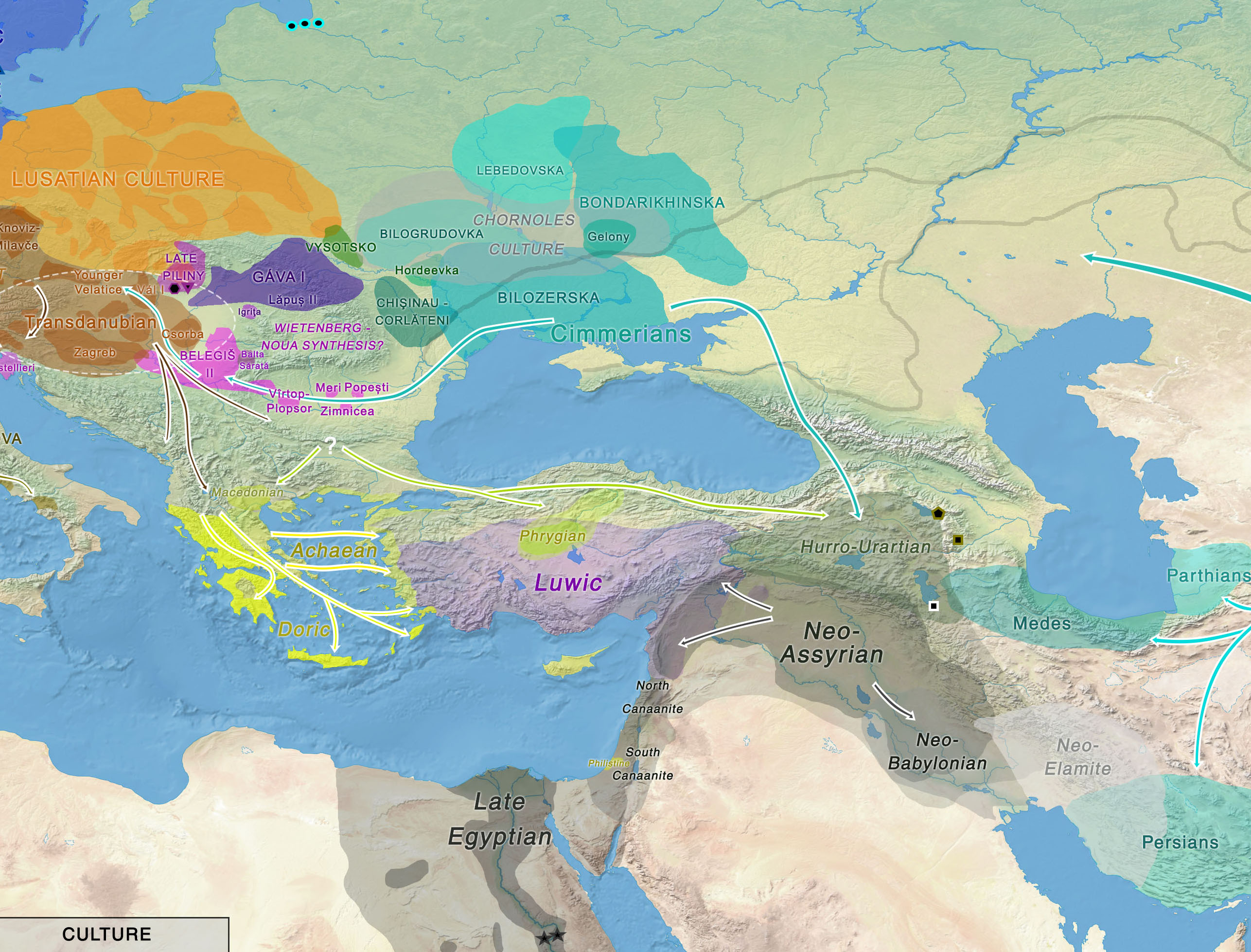
Possible connection between the cultures of Ancient Sumer and Minoan Crete http://mmtaylor.net/Holiday2000/Legends/Sumer-Crete.html

There are certain hints that the Minoan civilization might have been influenced by, or even descended from, the Sumerian / Mesopotamian civilization of a thousand years earlier. According to David Rohl(Legend: The Genesis of Civilisation, London, Arrow Books 1998), the Phoenecians and Canaanites who inhabited the coast of what is now Israel and Lebanon came from Sumeria (Ur, Uruk, Eridu) at the same time as others from the same region went to Bahrain and then to the Upper Nile, some time around 3000 BC. If the Minoan culture was actually derived from the Sumerian, as seems not unlikely, it must have happened before writing became common in Sumer, around 3000 BC. Rohl’s dates tend to be more recent than the conventional dates, so when Rohl mentions 3000 BC, he refers to a time conventionally dated rather earlier, perhaps 3500 BC.

A thousand years later, around the time of the Minoan civilisation and later, the Phoenecians of Byblos (near present-day Beirut) were great sailing traders who had a long trading history with Egypt. They knew Amnissos, the port of Knossos, and presumably traded there. The Minoans likewise were great sailing traders, who are known to have traded all around the Eastern Mediterranean and the Aegean. There must have been at least some cultural interchange between these traders who shared the same sea and presumably many of the same ports. Minoan pottery from around 2500 BC is reminiscent of Syrian pottery of the same date. This was at the height of the Ebla trading system, which traded at least from the Persian Gulf to the Black Sea, and from Afghanistan to Byblos, though the Eblaites left the sea trade to Byblos.

ebla.trade_

Part of a Sumerian seal from about 2000 BC. Rohl ,1998 inteprets the bull-man as Gilgamesh (Rohl,p170), but the bull-man image goes back to much earlier times.

The bull was important in the Minoan religion and culture, as it was in Sumer. Gilgamesh (who, according to Rohl, ruled in Uruk around 2487 BC) is shown as half-bull, half-man, as is the Cretan Minotaur in the much later Greek legend. The picture on the seal looks remarkably like depictions of the Minotaur, and it is possible that the Greeks knew of such depictions as well as of the bull cult in Minoan Crete. There are many other bull-man representations in images from Mesopotamia. Sometimes the body is bull in part or whole and the head human, sometimes the reverse. Perhaps there were similar Minoan images known to the Greeks, but as yet not discovered by modern archaeologists. So, one can assume that the bull-man “monster” was an image known to the Early Greeks of Minoan times.

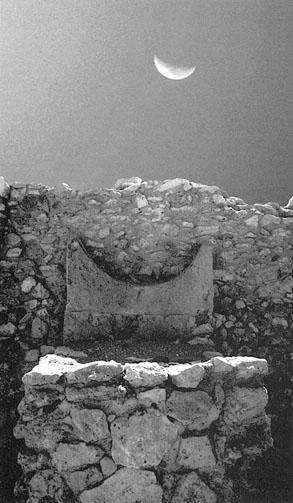
There are other similarities in the iconography of the Minoan and Sumerian cultures. The Knossos object that is said to represent bull horns looks remarkably like an Altar to the Moon on Bahrain, which Rohl says is from the Sumerian diaspora. According to Castleden, in Minoan Crete, the bull and the moon were probably aspects of the same deity, who later became Poseidon in Classical Greece. Poseidon, perhaps not coincidentally, was the Greek god of earthquakes. This linkage ties the Sumerian (according to Rohl) Altar in the Temple of the Moon even more closely to the similarly shaped bull-horn shape that was a religious element in Knossos.

Beyond these, there were other similarities between pre-literate Sumerian religious elements and those of Minoan Crete. According to Georges Roux (Ancient Iraq, Penguin 1992), the primary religious symbols in the Halaf and Ubaid periods of Sumer (covering about 5000 BC to 3300 BC) were the double-axe, the bull-head, doves, and women. According to Castleden (Minoans: Life in Bronze Age Crete, London: Routledge, 1990), the double-axe and the bull-head were the primary religious symbols for the Minoans, and doves were associated with goddesses to the extent that sometimes the dove was taken to represent the goddess. In both Sumer and Minoan Crete, a priestess would “become” the goddess in some ceremonies.

Common symbols? (Left) The Temple of the Moon–the Altar of Sin / Suen / Nanna on Bahrain. Plate 34 from Rohl’s book: (Middle) Knossos: Formalised bull horns (Right) part of a fresco in Knossos, showing many of these bull horn objects in an obviously elite area known as “the Tripartite Shrine” for spectators of some event.

Not only the iconography, but also the architecture seems to have some connection with that of Sumer. The typical Sumerian temple, at least from Ubaid times, had a “tripartite” structure. A long rectangular central courtyard was flanked on both sides by a complex of small rooms, and at one end may have had a crosswise rectangular large antechamber. The Minoan temple-palaces have this same structure, grown large. A long central courtyard, kinown in Knossos as the Bull court, is flanked by a very complex system of small rooms, and at one end (at least in Knossos) there was a crosswise rectangular room.

The architectural similarities extend to the so-called tholos tombs, beehive-shaped circular structures, which were used in Halaf time (5500 BC to 4500BC) as houses, but survived in more northern Mesopotamia as tombs into the Ubaid times (up to about 3750 BC). They appear again in Minoan Crete, and more particularly in later times in Mycenean Greece, where they were first discovered (e.g. the so-called “Treasury of Atreus in Mycenae).

It seems that the Minoan culture owed a great deal to that of pre-literate Sumer, and that contacts were maintained with the Levantine coast, which was often part of Mesopotamian empires over the years. Sumer almost always had trading relations as far afield as Anatolia and India, even as far back as 4000 BC.

The Minoans were Caucasian: DNA debunks longstanding theory that Europe’s first advanced culture was from Africa https://www.dailymail.co.uk/sciencetech/article-2325768/The-Minoans-Caucasian-DNA-debunks-longstanding-theory-Europes-advanced-culture-Africa.html                                                                                                                           “The highest percentage of shared Minoan mitochondrial DNA variation was found with Neolithic populations from Southern Europe.

Din Ancient DNA Origins of the Minoans and Mycenaeans                                  http://www.en.uni-muenchen.de/news/newsarchiv/2017/stockhammer_minoans.html

“The researchers found that the Minoans, rather than coming from a distant civilization, were locals, descended from the first Neolithic farmers of western Anatolia and the Aegean. They found that the Minoans and Mycenaeans were very closely related, but with some specific differences that made them distinct from each other. Both the Bronze Age Minoans and Mycenaeans, as well as their neighbors in Bronze Age Anatolia, derived most of their ancestry from a Neolithic Anatolian population, and a smaller component from farther east, related to populations in the Caucasus and Iran.”

Sumerian influence on Aegean writing

January 14, 2019

From Sumer,Indus Valley, in Anatolia, Cyprus,Crete,Sicily,Sardinia to North America (northern Pacific coast indian tribes), the metal ingost had all-over in ancient times (Bronze Age ),the same physical shape:                                                                            “OXHIDE”

From Who invented the oxhide ingot shape? Meluhha artisans. An archaemetallurgical journey along the Maritime Tin Route.                                                                               http://bharatkalyan97.blogspot.com/2017/04/who-invented-oxhide-ingot-shape-meluhha.html

                                                                           The large oxhide ingots were signified by ḍhālako a large metal ingot

From https://ipfs.io/ipfs/QmXoypizjW3WknFiJnKLwHCnL72vedxjQkDDP1mXWo6uco/wiki/Oxhide_ingot.html

                                                                                                    Copper ingot from Zakros, Crete, displayed at the Heraklion Archaeological Museum.

1.IN THE FOLOWINGS, I WILL SHOW SOME SIMILIRATIES OF AEGEAN SIGNS WTH THOSE SUMERIAN-ONES; such relation was noticed also not so succesfully I expecte by Iannis Kenanidis and Evangelos Papakitsos.

2. Following the transmission of meaning is another matter. Early after proto-cuneiform phase the sumerian writing evolved as one sign do add other meanings that original pictographic-one. At the point that the original meaning was lost even by sumerians!    So, if signs were transmitted, one reasonable expect, that only the shape was some-how mantained, no talking that in another distant place (Aegean) to acquire another, different meaning. So, regarding the meanings I only notice some aspects, (in the limits of my understanding), not sustain an transmition of meaning.                                                        =======================================================
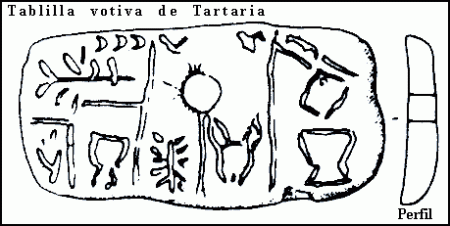
First Tartaria-sumerian Aegean triplet:

From http://aplaceofbrightness.blogspot.com/2008/11/moonlight-in-romania-tartaria-tablets_21.html

1.<metal ingot?<Pr-cuneif, sign KU < 2.KU:”metal,silver,shiny” > 3.Aegean sign JA and PA3 

1.https://cdli.ucla.edu/tools/signlists/protocuneiform/archsigns.html  Sign KU~a

sign Ga2;

INDUS SCRIPT , http://bharatkalyan97.blogspot.com/2013/04/bronze-age-glyphs-and-writing-in.html                                                                                                                               “Impressions of two cylinder seals (Sumer) and glyph of ‘ingot’. The person at the feet of the eagle-winged person carries a (metal) dagger on his left-hand, clearly demonstrating the link with this metalware catalog.Note the one-horned bull below the person who has his foot on mountain-summit.                                                                                                        Sumerian sign for the term ZAG ‘purified precious’. The ingot had a hole running through its length Perhaps a carrying rod was inserted through this hole.

From http://bharatkalyan97.blogspot.com/2016/04/indus-script-16-inscriptions-with.html

Seal stamp m-308 Mohenjo-daro (DK 11794) Hieroglyph: Three strokes connecting two linear strokes: dula ‘two’ Rebus:dul ‘cast metal’ PLUS kolmo ‘three’ Rebus: kolimi ‘smithy, forge’ Thus forge for cast metal

3. From http://www.kairatos.com.gr/linear1.htm See signs JA and PA.

.

Fromhttps://www.minoanatlantis.com/End_Minoan_Writing.php                                        See Linear A sign AB56:

———————————————————————-

http://www.oocities.org/proto-language/ProtoLanguage-Monosyllables.htm                   K?A                                                                                                                                            The Sumerian sign (Jaritz #458) depicts a ‘tubular basket’; a variant, #458a, tapers toward the top; both have top-covers; both presumably and read ga2 (among others). Another recorded reading for it is pisan, which means ‘basket’ but perhaps also ‘*shallow tray’.

An archaic variant form for Sumerian sign above (Jaritz #458), Jaritz #458a, looks very much as if it could be the ‘head’ without the hair and neck we see in Jaritz #15 under K?XA; and therefore might be a sign for ‘jaw’; but it also may be just another shape of ‘basket’. As mentioned below under K?XA, the most promising prospect for ‘jaw’ in Sumerian is ga14, a reading of Jaritz #15 that is currently without an assigned meaning. I believe the the idea of ‘jaw’ provided the prototype and nomenclature for a ‘shallow basket tray’ but there is no trace of this meaning (‘jaw’) for this Sumerian sign

=========================================================================
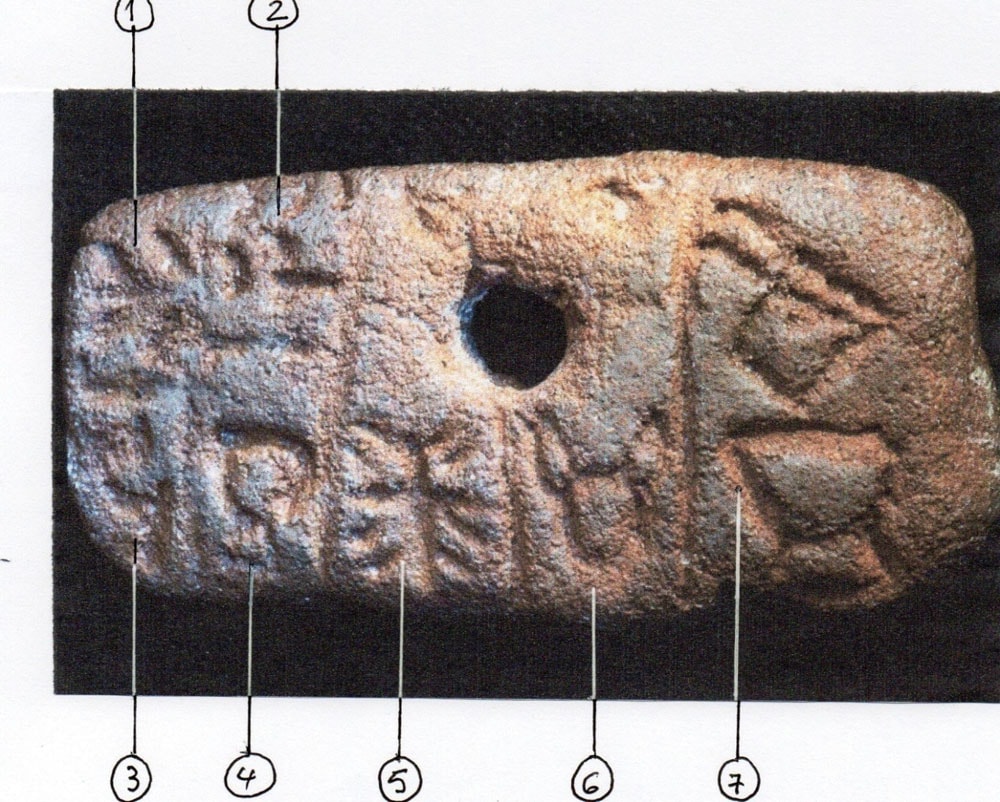
Second Tartaria-Sumerian-Aegean triplet:

                                                     See in the lowest row, from L>to> R: 2-nd and last signs

1.sum.pr-cuneif sign ZAG < 2.sum.ZAG:”the shine of metals; boundary, border, district’, ” > 3.Aegean sign A,Labrys,?Labyrinthos?

  1. From https://cdli.ucla.edu/tools/signlists/protocuneiform/archsigns.html                        Sign ZAG~a

and sign ZAG~c  sign GA’AR:

GA’AR= GAR                                                                                                                                       From https://cdli.ucla.edu/files/publications/cdlj2012_002.pdf                                                   The sign GAR was used, thus, in order to denote all cereal products counted bisexagesimally, that is, virtually all barley
product rations except beer.2. Akkadian called Sumerian – Sumerian Dictionary – Turkic World s155239215.onlinehome.us/turkic/…/SumerDictionaryEn.ht…                                          SUMERIAN DICTIONARY. Links … Common Sumerian words for magical purposes ….. Holy of Holies, BARAGGAL … Metals, ZAG (the shine of metals).

Sumerian Lexicon – IS MU https://is.muni.cz/el/1421/jaro2013/PAPVB_13/um/…/Halloran_version_3.pdf            (derives from zag, ‘boundary, border, district’, just as þúb relates to gùb). zeþ[SAL.ÁŠ.

3. From https://sites.google.com/site/raghavg602/economic-life                                                 

 see Cretan hieroglyphic signs 042 and *175

From https://linearbknossosmycenae.com/tag/labrys/

So this shape could reflect:                                                                                                               the shine of metals > double-axe.labrys, but also

boundary,border,district> place of  the other underground sumerian’s Sun,NERGAL and at Aegeans, the place of Minotaur , in fact place of Sun-Bull-God (labyrinthos)

Proto-cuneiform sign for house, temple “AB” has the close sign: https://cdli.ucla.edu/tools/signlists/protocuneiform/archsigns.html

https://en.wikipedia.org/wiki/Nergal                                                                                      Nergal seems to be in part a solar deity, sometimes identified with Shamash, but only representative of a certain phase of the sun.

Minotaur – Wikipedia https://en.wikipedia.org/wiki/Minotaur                                                     In Greek mythology, the Minotaur is a mythical creature portrayed in Classical times with the … In Crete, the Minotaur was known by the name Asterion, a name shared with Minos’ foster-father.   ………                                                                                                                Some modern mythologists regard the Minotaur as a solar personification and a Minoan adaptation of the Baal-Moloch of the Phoenicians.

He dwelt at the center of the Labyrinth

Asterion (/əˈstɪriən/GreekἈστερίων, gen.: Ἀστερίωνος, literally “starry“) or Asterius (/əˈstɪriəs/Ἀστέριος)

http://www.unmuseum.org/minot.htm                                                                                        However, they have found what looks like a labyrinth. The labyrinth wasn’t built in a cave below the palace, though. It was the palace.

labbyrinth, in fact was somebody’s house: “house,temple” =====================================

This is Mr. Kenanidis and Papakitsos aproach:

So Mr. Kenanidis and Papakitsos, no double-axe !, even the sign is like, see above “signify all barley product rations”                         ================================================================

Apropos of above sign 57 (Linear B LA32),                                                                                    (Only sumerian -Aegean:

sumerian GA2 <> Aegean JA Sumerian sign GA2~a3                                                                     from : https://cdli.ucla.edu/tools/signlists/protocuneiform/archsigns.html

Two main issues regarding Tartaria tablets wich remained unclarified.

January 11, 2019

11 jan.’19/Two main remained unclarified issues regarding Tartaria tablets

Later on, I realised that two fundamental issues regarding Tartaria tablets remained unclarified:

I.The suposition that the tablets are not (by far) so old, and could be made later than innitialy suposed.

I advanced before the hypothesis about an recent origin of the tablets. As a posibility in a time contemporaneous with the scientist Zsofia Torma, and maybe later. I will show that this hypothesis is not fesable, cause:                                                                                                 – Before 1900 the proto-writing field and research  was quite empty, thre were not research papers Even now-days the research it is in a continous progress (see proto-Elamite, Dahl, Englund).  There were very few ew schollars at the level of A.H.Sayce, in Zsofia Torma’s time.                                                                                                                      From https://en.wikipedia.org/wiki/Archibald_Sayce                                                                           “Archibald Henry Sayce (25 September 1845 – 4 February 1933), was a pioneer British Assyriologist and linguist, who held a chair as Professor of Assyriology at the University of Oxford from 1891 to 1919″     

Even A.Falkenstein (born after the death of Z.Torma) only later got a sumerian proto-cuneiform sign list, notice, without giving any corespondent meanings or interpretations to signs,

From https://en.wikipedia.org/wiki/Adam_Falkenstein                                                     “Adam Falkenstein (September 17, 1906 – October 15, 1966) was a German Assyriologist. Falkenstein studied Assyriology in Munich and Leipzig. He was involved primarily with cuneiform, particularly discoveries in Uruk, and with the Sumerians and their language. From 1930 onward, Falkenstein taught as a professor of Assyriology at the Göttingen University.”

The tablets are revealing complex aspects, I would say even “sofisticated”-ones wich are reflecting an relation between Near-East and Aegean cultures. This complexity is depassing the medium level, as even an now-days specialist, practically cannot easy show this  with a now-made written tablet as exemple.  So, the suposition that somebody contemporaneous had tried and made such a try is falling down. ”                                           ——————————————————————————-                                                              Beware, here I distance myself from the main schollar’s path, wich are talking only of       “A relation at some degree of Tartaria tablets signs with proto-sumerian writing”.

I stress that the scribe was not “their literate person”, but “ours”,meaning by this that was somebody settled in Danubian/Aegean area, even don’t bother if was an sumerian descendant or not, and totally disregarding how old would be the writing.

The aspect sized by no others, only by me, that the signs on Tartaria tablets are common to two great civilisations, Sumerian and Aegean and are icons of paramount cultural importance. The signs are only related to those sumerian-ones but pertain to whole European prehistory.                                                                                          This very aspect was not sized nor revendicated by somebody before me. The schollars limited only to notice the similarity with sumerian proto cuneiform writing and so forced to interpret the “writing” within these limits.   

Exemple of such papers:                                                                                                                     A Comparative Linguistic Study about the Sumerian Influence on the Creation of the Aegean Scripts Ioannis K. Kenanidis1, Evangelos C. Papakitsos*2                       file:///C:/Users/User/Downloads/SJAHSS-31E332-346%20(1).pdf                                                     Additional Palaeographic Evidence for the Relationship of the Aegean Scripts to the Sumerian Pictography                                                                          file:///C:/Users/User/Downloads/SJAHSS-33C734-737Additionalevidence.pdf                              In these papersmany exemples are not the best choosen-ones, not much convincing and regarding sumerian signs, there is not shown their sumerian name nor what signify or the meaning.  Only in the last mentioned paper there are scarce correct associations:  Linear B,sign”A”(labrys) with sumer.”double axe”, where sumerian sign is no double-axe, it is sum. sign ZAG, then sum.AMAR it is not correct associated.              Only in the last paper there are some few correct associated.Corect assoc. :Lin.B(LA32)”JA”, then sum.Se with Egeean Te….and that’s all.                                                 Of course because probably was not their goal, no reference to Tartaria tablet’s signs.

Eg., only some SIGNS COMPARED by me:

Sumerian           Aegean

GAR                    VOLUME UNIT       (Egypt, T,”loaf of bread” )                                                    SE                         TE                              Cereal,grain                                                                         AMAR                   MA                                                                                                                               Y                              Y                                                                                                                           KU                         PA3                                                                                                                             AB                     LABRYS                                                                                                                          PA                         PA                                                                                                                                 etc                        etc

                                       ——————————————————————————-

II. The suposition (otherwise corect) that the upper half of the round tablet is containing kind of willingly hidden, or esoteric message.

Yes, more than possible. But from wich period of time, and why to be hidden, especially the nature of the message !?

Here, the presence of one sign wich is not be found even in Aegean writings (nor in eteo-Cretan-ones) are pitty conducting us to the archaic greek writing.

It is about the well-known “D-letter” shaped sign. In the upper half of the round Tartaria tablet, only the Aegean signs Pa3(arch. Gr.Eta), sign “o” and some-how the sign “+++++” seem to existed before, and sign D appeared only in the first regional/epichoric archaic greek alphabets.                                                                                                                                This fact is pushing us away from an extremely old period, to the 800-300 years B.C. Now, what could be written there?                                                                                                     Note                                                                                                                                                         1.One don’t expect necessary an continous message as in a sentence, there could be isolated icons wich has independent meanings but close related to an single solid religious system of notions and values.                                                                                          2. I did not know before, there are even sentences wit only 2 words!                                          ———————————————————————————

Even before some years, I found that the oldest atestation in writing of the “HP” monogram, was found on some broken pot clay sherds, in some places, (probably at the origin from, or related to Samos), much more outside Greece, in the Levantine coast and Egypt.

You understand from “HP”,: “archaic eta-Rho”, where archaic eta was in the shape of “boxed-eta”, meaning closed contour, or with some earlier shape, “eta/heta a scala” meaning in the “ladder” shape.

Scholars are opinating that this sequence was abbreviation for                                     1.Hera                                                                                                                                                 2.Heros (Hero)                                                                                                                         3.proper name Heros. Same me saying.

Cause :                                                                                                                                                      – The oldest Aegean deity was at the origin Vinca mother-goddess followed by later minoan Asasara and Ida-mater,/Damater, and aftyerwards by Dione,                                     – Hera somehow is preceding Zeus,                                                                                                  – Complex nature of the Hera’s role and etymology,                                                                      I put on first place Hera, and only close-after an supposed Heros.           (remember that both Horus as Heros were kind of people saviors, Christ precursors)

From http://www.crystalinks.com/hera.html                                                                       ”Unlike some Greek gods, such as Zeus and Poseidon, Hera’s name is not analyzable as a Greek or Indo-European word. She therefore seems to be a survival of a pre-Greek “great goddess” figure – perhaps one of the powerful female divinities of the Minoan pantheon, or of some unidentified pre-Greek (“Pelasgian”) people.

From https://ro.wikipedia.org/wiki/Hera#Etimologie                                                                     ”Una dintre primele instanțe ale numelui zeiței apare pe tablele din Pylos, scrise în Linearul B,[1] un sistem de scriere care a fost găsit și pe datând încă din 1450 î.Hr.[2] folosit de civilizațiile miceniene până la colapsul acestora în secolul XII î.Hr. Aici apare ca Qo-wi-ja (Guōwiā „cea asemenea vacilor” un cunoscut epitet homeric).[1]

Numele Herei poate avea mai multe etimologii se exclud reciproc; o explicație leagă numele de ὥρα transliterat hōra, însemnând sezon, interpretându-l ca o vreme propice pentru căsătorie. Pe de altă parte, Platon consideră că e legat de ἐρατή transliterat eratē, adică „preiubit”, deoarece se spune că Zeus s-a căsătorit cu ea din dragoste, sau că numele zeiței este anagramă a aēr (ἀήρ, „aer“).[3] Plutarh susține a doua variantă sugerând că este un nume alegoric pentru poziția înălțată a acesteia.[4]

nonsense…

From https://en.wiktionary.org/wiki/%E1%BC%AD%CF%81%CE%B1#Ancient_Greek   ”HERA EtymologyUncertain. Possibly a feminine form of ἥρως (hḗrōs) or related to ὥρα (hṓra).”

Not convinced! I am binding the Hera’s name out of “protectress”, also to: er,era:”EaRth” ,hiera:”holy” and hera “Lady” !!

From https://www.etymonline.com/word/hera                                                                               ”sister and wife of Zeus, the type of virtuous womanhood, from Greek Hēra, literally “protectress,” related to hērōs “hero,” originally “defender, protector” (see hero (n.1)).”


11Ian’19/Clarificarea a doua aspecte fundamentale privind Tablitele de la Tartaria

January 11, 2019

Ulterior am realizat ca urmatoarele aspecte necesita o revenire si clarificare:

I. Supozitia ca tablitele nu sant nici pe departe atat de vechi si au fost facute ulterior. 

Am avansat anterior ca ipoteza o origine relativ recenta a tablitelor. Cum ar fi in perioada de activitate a Zsofiei Torma si chiar ulterioara. In buna masura aceasta ipoteza nu se sustine, intrucat:                                                                                                                         – Inainte de 1900 domeniul scrierii proto-cuneiforme nu era aproape deloc cercetat.Foarte putini cercetatori de talia lui A.H.Sayce, contemporani cu Zsofia Torma erau in acea vreme.

https://en.wikipedia.org/wiki/Archibald_Sayce&nbsp;                                                                          Archibald Henry Sayce (25 September 1845 – 4 February 1933), was a pioneer British Assyriologist and linguist, who held a chair as Professor of Assyriology at the University of Oxford from 1891 to 1919                                                                                   Chiar si Falkenstein (nascut dupa moartea Zsofiei T.) de-abea mai tarziu a scos lista semnelor proto-cuneiforme, nedand nici-unui semn vre-o interpretare.

https://en.wikipedia.org/wiki/Adam_Falkenstein&nbsp;                                                                Adam Falkenstein (September 17, 1906 – October 15, 1966) was a German Assyriologist. Falkenstein studied Assyriology in Munich and Leipzig. He was involved primarily with cuneiform, particularly discoveries in Uruk, and with the Sumerians and their language. From 1930 onward, Falkenstein taught as a professor of Assyriology at the Göttingen University.

Tablitele prezinta aspecte complexe, as zice eu chiar “sofisticate” care reflecta o relatie intre culturile Orientale si cea Aegeeana. Aceasta complexitate depaseste nivelul mediu. ca atare nici macar un specialist in zilele noastre, nu ar putea sa reflecte ( a se citi sa imite) aceste legaturi. Deci supozitia ca cineva relativ contemporan ar fi facut un gen de incercare, cade.                                                                                                                              ————————————————————————————————————————————

ATENTIE

Un anume aspect  nu a fost sesizat de altii, ci numai de mine, si anume ca semnele de pe tablitele de la Tartaria sant comune a doua mari civilizatii, cea sumeriana si cea Egeeana, iar icoanele au fost de o importanta culturala covarsitoare in aambele civilizatii.

. Semnele doar au legatura cu cele sumeriene si de fapt apartin preistoriei Europei in general si celei Vinca si Egeene in particular. Aceasta observatie nu a fost revendicata de nimeni pana acum.                                                                                                                     Savantii s-au limitat in a face doar o legatura cu semnele sumeriene proto-cuneiforme si a le atribui interpretarea sumeriana !                                                          Deci fara ca sa depaseasca aceste limite.                                                                               Exemple de asemenea lucrari:                                                                                                         A Comparative Linguistic Study about the Sumerian Influence on the Creation of the Aegean Scripts Ioannis K. Kenanidis1, Evangelos C. Papakitsos*2 file:///C:/Users/User/Downloads/SJAHSS-31E332-346%20(1).pdf                                                     Additional Palaeographic Evidence for the Relationship of the Aegean Scripts
to the Sumerian Pictography    file:///C:/Users/User/Downloads/SJAHSS-33C734-737Additionalevidence.pdf                                                                                                               In aceastea, foarte multe exemple nu sant fericit gasite, nu sant convingatoare si nici prea concludente, iar in privinta semnelor sumeriene nu este data denumirea sumeriana si nici semnificatia lor.Doar in ultima lucrare sant cateva asocieri relativ corecte :    Linear B,”A”(labrys) cu sumer.”double axe” cand semnul sum. nu este nici-o dubla-secure, este semnul ZAG;C,apoi sum.AMAR nu este bine asociat. Corect asoc. :Lin.B(LA32)”JA”, apoi sum.Se cu Egeean Te….si cam atat. Bineinteles, posibil pentru ca nici nu si-au propus, ca nu apare nici-o ref. la tablitele de la Tartaria.                                                                     

Ex., doar cateva  SEMNE COMPARATE de mine:

Sumerian               Aegean

  GAR                    UNIT de VOLUM       (Egypt, T,”jimbla de paiine” )                                              SE                          TE                              Cereale-boabe,grau                                                          AMAR                    MA                                                                                                                               Y                              Y                                                                                                                              KU                           PA3                                                                                                                             AB                       LABRYS                                                                                                                        PA                         PA                                                                                                                                etc                        etc           =========================================================================        II. Supozitia (altfel corecta) ca jumatatea de sus a tablitei rotunde contine un “mesaj” intentionat ascuns.

Da, mai mult decat posibil.Dar din ce perioada, de ce ar fi fost ascuns, si mai ales de ce natura ar fi putut fi !?

Aici, prezenta unui semn care nu se regaseste nici macar in scrierile Egeene (nici macar scrierea eteo-Cretana nu poate intra in discutie) ne conduce din pacate spre perioada scrierii arhaice grecesti.                                                                                                                 Este vorba despre semnul “D”. In jumatatea de sus a tablitei rotunde doar semnele Egeean PA3 (arh. grec eta) si “o”au existat, in schimb semnul “D” nu a aparut decat doar in primele alfabete grecesti.

Acest fapt ne indeparteaza total de o presupusa perioada extrem de veche (3.500-3.000 B.C.) si ne indreapta direct spre perioada 800-300 B.C.                                                              Acuma ce ar putea fi scris acolo ?                                                                                                      ————————————————————————————–                                                 Atentie, aici ma indepartez de cursul acceptat al oamenilor de stiinta, care fac o directa legatura cu scrierea sumeriana.                                                                                   Eu zic ca autorul “scrierii” nu a fost “intelectualul lor” ci al nostru, adica din aria Egeana/Dunareana, aceasta independent de faptul  ca ar fi fost mai vechi sau mai nou.       Aspectul sesizat ca semnele sant comune unor mari civilizatii, Sumeriana si Egeeana nu a fost sesizat si nici revendicat de altcineva inaintea mea. Cercetatorii s-au limitat la o interpretare facand doar legatura cu civilizatia sumeriana.                                                ———————————————————————————————————                                Inca acum cativa ani, am gasit cea mai veche atestare a asociatiei de semne “HP” a fost gasita pe bucati de artefacte din lut in Grecia si poate mai multe in Orientul Apropiat si Egipt. Sa intelegeti prin “HP” archaic eta-rho. Adica arhaic eta sub forma “boxed/cutie” adica cu contur inchis sau forma “in scarita”.                                                                         Cercetatorii au avansat ipoteza ca arfi monograma sau prescrtarea pentru Hera sau Heros. La fel zic si eu. Avand in vedere ca se pare ca                                                                    – zeitatea Hera il precede cumva pe Zeus, si avand in vedere:                                                  -lunga perioada anterioara de venerare a unei zeite Pamant-Mama (Earth Goddess), dar si natura complexa a numelui Hera, eu dau intaietate lui Hera ,urmat indeaproape de un eventual Heros. (A se retine ca Heros a fost un gen de erou salvator precursor a lui Cristos)

Din http://www.crystalinks.com/hera.html&nbsp;                                                                            Unlike some Greek gods, such as Zeus and Poseidon, Hera’s name is not analyzable as a Greek or Indo-European word. She therefore seems to be a survival of a pre-Greek “great goddess” figure – perhaps one of the powerful female divinities of the Minoan pantheon, or of some unidentified pre-Greek (“Pelasgian”) people.

https://ro.wikipedia.org/wiki/Hera#Etimologie&nbsp;                                                                              Una dintre primele instanțe ale numelui zeiței apare pe tablele din Pylos, scrise în Linearul B,[1] un sistem de scriere care a fost găsit și pe datând încă din 1450 î.Hr.[2] folosit de civilizațiile miceniene până la colapsul acestora în secolul XII î.Hr. Aici apare ca Qo-wi-ja (Guōwiā „cea asemenea vacilor” un cunoscut epitet homeric).[1]

Numele Herei poate avea mai multe etimologii se exclud reciproc; o explicație leagă numele de ὥρα transliterat hōra, însemnând sezon, interpretându-l ca o vreme propice pentru căsătorie. Pe de altă parte, Platon consideră că e legat de ἐρατή transliterat eratē, adică „preiubit”, deoarece se spune că Zeus s-a căsătorit cu ea din dragoste, sau că numele zeiței este anagramă a aēr (ἀήρ, „aer“).[3] Plutarh susține a doua variantă sugerând că este un nume alegoric pentru poziția înălțată a acesteia.[4]

aiurea…      https://en.wiktionary.org/wiki/%E1%BC%AD%CF%81%CE%B1#Ancient_Greek&nbsp;  EtymologyUncertain. Possibly a feminine form of ἥρως (hḗrōs) or related to ὥρα (hṓra).[1][2]

varza! eu leg numele de Hera/er,era:”pamant” ,hiera:”sfanta” si hera “doamna” !!

https://www.etymonline.com/word/hera&nbsp;                                                                                         sister and wife of Zeus, the type of virtuous womanhood, from Greek Hēra, literally “protectress,” related to hērōs “hero,” originally “defender, protector” (see hero (n.1)).

Tartaria tablets, sign by sign

January 8, 2019


Careful/ Attention !                                                                                                                                            This post is not a decipherment or reading of any true writing content of Tartaria tablets. Given that the signs do not belong to a single writing system but to several, the page has a purely didactic character. It has the role of trying and testing different writings, in the idea that the tablets would have used one of them. The signs on the tablets belong to several writing systems over a long period of time and which have been used in different geographical areas. In none of the trials did the signs fall into a single type of writing, there always remained signs that came from other writings (or as coming from the unknown). Most of the signs come from the Sumerian proto-cuneiform -shaped ones. The signs in the upper half of the round tablet seem to come from archaic Greek writing. This “collection” of signs seems to be the fruit of one’s rich imagination. As A. Falkenstein and A. A. Vaiman found, (this is also my firm opinion) the author was not a scribe, he had only vague notions about writing in general, and it is not known what he intended  or he was after. There are many elements of inconsistency as well as others that take the tablets out of the usual patterns and norms of  logics, writing and honest intentions.                                  ====

OUT OF SOME OUTSTANDING INTERPRETATIONS THROUGH SUMERIAN (A.A.VAIMAN and RUMEN KOLEV),                                                                                                                                                    AFTER SOME YEARS OF RESEARCH, A CLEAR IMAGE IS EMERGING:                                                     MOST OF TARTARIA TABLET’S SIGNS COULD BE FOUND IN SUMERIAN PROTO-CUNEIFORM SIGN LISTS AND (NOT AS MUCH)  HAS ALSO EQUIVALENTS IN SHAPE IN AEGEAN WRITINGS.                          AS MR. RUMEN KOLEV  FIRST NOTICED AND MADE SUCH ATTEMPTS, I FOUND ALSO MUCH MORE SIMILARITIES AND CULTURAL RELATIONS, AS BEEING ABLE TO DEDUCE/EXTRACT AND SHOW MUCH MORE AND CLOSE  (PAIRED) MEANINGS.

 NO OTHER SCIENTIST SHOW THAT SOME OF THE TABLETS SIGNS ARE PAIRED IN BOTH SUMERIAN AND AEGEAN WRITING !                                                                                                                                       IT IS ABOUT OF PARAMOUNT IMPORTANCE ICONS, COMMON IN AN EXTENDED AREA, WITH THE ORIGIN MUCH MORE FAR BACK IN TIME.                                  =================================================================

More or less, almost all the signs could be found if not in exact shape, but as a sqetch of the the sumerian proto-cuneiform signs. But some of them reflect the exact shape of the signs from later-time writings. Where the signs has the exact shape of a writing,I  marked with*.

Round tablet’s signs (R)

https://encrypted-tbn0.gstatic.com/images?q=tbn:ANd9GcSoHnmGyZZHx37HuCFCpYRgIJdQxE5vuc7vcNlb00JtKMccyZpjqA

No1. sign “+++++”   

All-three-have-symbols-inscribed-only-on-one-face.-Photo-Credit-640x480                                                                                                                       

No.2.1 sign :1-st “D”                                                                                                                      No.2.2: 2-nd “D”                                                                                                                             No.2.3, sign”o”                                                                                                                          No.2.4, sign”o/c”?                                                                                                                               No.3 sign: Downward-Right quarter,  on the right

  SEgrid                               

No.4, sign:Downward-right quarter,  on the left (red)                                                              cristian_luchian_tartaria_tablets   

No.5.sign “Z-like”lower sign                                 

 SWgrid                                                                                                                                      No.6/left sign “bow&arrow”                                                                                                      No.6/up, sign “>>”                                                                                                                             The-meaning-if-any-of-the-symbols-is-unknown.-Photo-Credit-640x480   

No.7, sign on the left, “H”-like                                                                           

No.8,sign,on right “P/D”-like

Squared tablet’s signs (Sq):

https://encrypted-tbn0.gstatic.com/images?q=tbn:ANd9GcTGmJn6uRzrDVyluR0qaLWHqYbn2UJsQbNcrjbnze7I27mP1riVZg

fig-202

Table in wich is showed every sign in wich writing was found in exact shape and most frequent: Table, from https://tied.verbix.com/project/script/asiam.html

asiam6

Note:”Anatolian, means mostly Carian) Table from https://tied.verbix.com/project/script/asiam.html

asiam41

NOTE                                                                                                                                                          Even one could find most of the signs in entire Anatolian sign library, cannot find all necessary signs in a single writing (e.g. carian or lycian).That’s why out of some attempts, I renounced, also due of little known even by specialists (e.g. Ignacio Adiego) of those awkard languages and writing systems.

Tabl.  Sign No.    Most frequent  2-nd frequecy

R             1                                  Sum.* ,Anat.

R           2.1                       Anat., Arch.Gr.*,Old.Lat.*

R           2.2                       Anat., Arch.Gr.*,Old.Lat.*

R           2.3                       Sum.*Anat.*Aegean*,Arch.Gr.*

R  2.4.(“o”/”c”?)     if “o”: Anatol.*,Aegean*; if “c” ,Anat.,Arch.Gr.*,Old Lat.*

R           3                                             Sum.*

R           4                                               None

R           5 (z-like)              Sum.,Anat.*,Aegean*,Arch.Gr.*,Old.Hebr.*

R       6(up;>>)                                      Anat.*

R    6(left)/bow-arrow                      Sum.,Anat.

R          7                                Anat*.,Aegean*,Old Hebrew*

R          8 (P?D?)                 Anatol.,Old Hebrew*,Arch.Gr.*,Old Lat.*                                                                               —————————————————

Sq         1                            Sum.*

Sq         2                         Sum.* Anat.

Sq         3                       Sum.*,Anatol.,Aegean

Sq         4                        Sum.*,Anatol.

Sq         5                       Sum.*Cypriot

Sq         6                       Sum.*,Aegean*

Sq  above 7              (Aegean?,elements in Anatol,)

Sq        7                            Sum.*

If every sign< pair >type of writing  has 1 point, then, out of 20 signs,number of signs found in:

Sumerian  12    ************

Anatolian  13    *************

Aegean     6 *******

Arch.Gr.   6 ******

Old Hebr.  3 ***

Cypriot    1 *

Old Lat.   4 ****


NOTE

1. IF the tablets are genuine show a direct/great sumerian influence/inspiration (11 sumerian-like signs)

2. After some unknown,direct-sumerian influenced !? , much plausible is Anatolian writing, close folowed by Aegean writing 

3.Signs “D” were used by sumerian only before 3.200 B.C., but very few and only on the ext. surface of clay tokens (bullae) with unknown meaning

    From Thoughts about a “reconsideration” of the Tărtăria tablets  http://www.daciajournal.ro/pdf/dacia2016/18.pdf

“Among the differences between the signs on the Tărtăria tablets and the ones on the
Mesopotamian tablets E. Qasim notices the fact (already remarked by Falkenstein in 1965) that the signs for numbers, which are constantly present on the compartmentalized Mesopotamian tablets (which contain economic texts), cannot be identified on the Tărtăria tablets. ” 

MY CONCLUSION IS THE SAME: DDoc signs ARE NOT SUMERIAN NUMBERS                                                            

It seems due the fact that were put in the recipients column on proto-sumerian signs table, could be for “pot,jar,vessel”,                 ?measure-ration?

4. Otherwise the D-shape was not used after in writing 2.500 years till archaic greek writing,(3.200-2.500=700)

5.The “H’-sign                                                       http://aplaceofbrightness.blogspot.com/2008/11/moonlight-in-romania-tartaria-tablets_21.html

NWgridhas the exact phoenician/old hebrew (Cheth/Het) shape 58537889_m

and only close to Aegean (PA3) writings .Linear A sign PA3 has no shifted vertical bars , as our sign and Old Hebrew is.                                                                   Image from https://linearbknossosmycenae.com/tag/linear-a-decipherment/page/2/

ht-88-kikina-01-datare-figs

P.S.Capital old Hebrew and Phoenician “het” and  is identical with archaic greek Heta(boxed eta) and sumerian proto-cuneiform “Ku” (Number 3,first)Imagini pentru letter archaic eta

6. Sign>>found only in Anatolian (Carian ) writing

7. I DO NOT EXPLAIN MYSELF, HOW EXACTLY THE UPPER HALF OF THE ROUND TABLET, SUPPOSED COVERED/HIDDEN CONTAIN MOST “RECENT” SIGNS.                       POSSIBLE THIS WOULD BE THE ONLY SECTION OUT OF ENTIRE BOTH TABLETS WICH CONTAIN AN DIRECT READABLE MESSAGE ? WHAT KIND COULD BE? MILITARY SECRET NO !, ESOTERIC, RELIGIOUS-MYSTIC ?.                                                                                               YES, COULD BE THE CASE.


DON’T KNOW WHAT SCRIBE WOULD MIX (real name hodge-podge”), PICTOGRAPHIC SIGNS WITH IDEOGRAMS / SYLLABOGRAMS ?! =========================================

OUT OF SOME OUTSTANDING INTERPRETATIONS THROUGH SUMERIAN (A.A.VAIMAN and RUMEN KOLEV),                                                                                                                          AFTER SOME YEARS OF RESEARCH, A CLEAR IMAGE IS EMERGING:                               MANY SUMERIAN PROTO-CUNEIFORM SIGNS HAS EQUIVALENTS IN SHAPE IN AEGEAN WRITINGS.                                                                                                                                           AS MR. RUMEN KOLEV  FIRST NOTICED AND MADE SUCH ATTEMPTS,                              I FOUND ALSO MUCH MORE SIMILARITIES AND CULTURAL RELATIONS, AS BEEING ABLE TO DEDUCE/EXTRACT AND SHOW MUCH MORE AND CLOSE  MEANINGS.                                                                                                                                          IT IS ABOUT OF PARAMOUNT IMPORTANCE, COMMON IN AN EXTENDED AREA ICONS, WITH THE ORIGIN FAR BACK IN TIME.

Toward the finish of the Tartaria tablets research.

January 1, 2019

Careful/ Attention !                                                                                                                                          This post is not a satisfactorily decipherment or reading of any actual written content of Tartaria tablets. Especially since we are dealing with proto-cuneiform signs, and therefore consequently with proto-writing.  Given that the signs do not belong to a single writing system but to several, the page has a purely didactic character. It has the role of trying and testing different writings, in the idea that the tablets would have used one of them. The signs on the tablets belong to several writing systems over a long period of time and which have been used in different geographical areas. In none of the trials did the signs fall into a single type of writing, there always remained signs that came from other writings (or as coming from the unknown). Most of the signs come from the Sumerian proto-cuneiform -shaped ones. The signs in the upper half of the round tablet seem to come from archaic Greek writing. This “collection” of signs seems to be the fruit of one’s rich imagination. As A. Falkenstein and A. A. Vaiman found, (this is also my firm opinion) the author was not a scribe, he had only scarce knowledge/vague notions about writing in general, and it is not known what he intended  or he was after. There are many elements of inconsistency as well as others that take the tablets out of the usual patterns and norms of  logics, writing and honest intentions.                                                                                                               =====

OUT OF SOME OUTSTANDING INTERPRETATIONS THROUGH SUMERIAN (A.A.VAIMAN and RUMEN KOLEV),                                                                                                                          AFTER SOME YEARS OF RESEARCH, A CLEAR IMAGE IS EMERGING:                               MANY SUMERIAN PROTO-CUNEIFORM SIGNS HAS EQUIVALENTS IN SHAPE IN AEGEAN WRITINGS.                                                                                                                                           AS MR. RUMEN KOLEV  FIRST NOTICED AND MADE SUCH ATTEMPTS,                              I FOUND ALSO MUCH MORE SIMILARITIES AND CULTURAL RELATIONS, AS BEEING ABLE TO DEDUCE/EXTRACT AND SHOW MUCH MORE AND RELATED  MEANINGS.                                                                                                                                          THERE ARE OF PARAMOUNT IMPORTANCE, COMMON IN AN EXTENDED AREA ICONS, WITH THE ORIGIN FAR BACK IN TIME. =============================================

A series of aspects noticed by me, some from the very beginning (great chances to have a kind of writing) then coupled with others, sized in the course of time ( a close symilarity with sumerian proto-cuneiform writing + more inadvertencies ) got to these conclusions and results.                                                                                                                                                     My gratitude for the most of the top-level schollars in the field of proto-writing, wich not beeing completely sure, not “hitted the nail on the head” from the begining, but generally expressed pertinent opinions.                                                                                                           Even the signs are reflecting in a greate measure the sumerian proto-cuneiform phase, nevertheless not match sumerian proto-writng in some aspects, especially some pure technical-ones.

After that, some of the first  researchers of the Danubian writing, (e.g. Mr.Marco Merlini) correctly showed the real beginning and developement of the humanity writing , pity not realised that the finaly “writing” was not yed been discovered, and the term “writing” cannot be attached to Vinca Culture. Even not that of “(fully) proto-writing”, despite the fact that most of the necessary steps were made.

I do not understand also, even the above-mentioned schollar had at disposal the literature and data=bases regarding the discovery and evolution of writing, preffered not to recognise the difussion, spread abroad from other places, (transmit,transfer,“import” by mean of cultural transmision/infusion) of any sign.

Instead he preffered for all the signs (wich every of them could be found in different period of time in tens of writings and places in the World) to atribute, religious conotations, thus unknown, mistycal, esoteric meanings. But attention! ; in his opinion, the meaning not known by entire Vinca comunity members, but only by the writer and the local (in this case Tartaria village) comunity members.

Don’t know how to synthetises better and by short, anyway I’ll begin:

This subject of Tartaria tablets created a global excitement and brawling, at an unmerited level I would say.

Cause of initial moment of discovery circumstances, are not clear, a series of good-willing romanians, but also foreign schollars spread “the oldest writing in the world“, a pre-sumerian one. From the very beginning the tablets were enclosed in a mist and mystical aura, some of above scientists beeing sure before any research that the signs had an unknown, long time-ago forgotten meaning, wich was of hidden, mystical and esoteric nature .(how comfortable !)

Besides that was attached an mystical content to the signs, carriers of ancient forgotten myths, the subject itself was encircled in mistery. So the subject and the tablets become mythical agai, and appeared an (unrelated to the signs and their meanings)  an secondary myth. Secondary mith fueled by some scientists, (e.g. Mr. Marco Merlini). He contributed by sustaining an very old age of the tablets. He associated the bones of a deceased person with the tablets.The bones were found in the proximity, somewhere in the rituallic-funerary complex.The bones seem to pertain to Vinca Culture, being dated at 5.500-6.000 B.C. In turn the real age of the tablets is not known and will be not known forever. I am not accusing anybody of anything, even if this assertion have unexpected bad consequences.

Studing the speciality literature, I realised that I could not rely AT ALL upon archeological data. As by my part, cannot atribute any age to the tablets, so I had no choice but to analyse what is 100% sure in front of me: the signs present on the tablets.

My aim was an an ideal goal, to obtain an unique, ultimate reading ( wich of course it is not possible in proto-writing) and must be validated by the scientific comunity (and so not being contested).

After this, I folowed the main phases:

Making an analysis of the signs, I found that the highest percentage of the tablet signs were found in sumerian proto-cuneiform sign list (this 1 year before) and in Anatolian alphabets (especially carian-ones), fallowed by Aegean writings (Linear A,B)

The similarity with sumerian signs was noticed by many scientist begining with N.Vlassa (Adam Falkenstein,Vasic, S.Hood, A.A.Vaiman, R.Kolev and others).                                       The last two had a very good interpretation of the signs. Comparing my readings with their readings, I sized in their papers some slight inadvertencies  incorrect sign identifications/some incorrect interpretations.                                                                            But only late  I got acquainted of the differencies and inadvertencies of some tablet signs from the common evolution line of sumerian proto-writing. These are mainly technical ones (relating to the technique of writing).But these very differencies are evidencies that the scribe was not a native sumerian. (E.g. If some signs are simylar in shape wit sumerian numbers signas, we have no proper sumerian numbers there).              Folowing an independent path I come to the same conclusions regarding the signs and the scribe. These conclusions of mine can be seen in my before posts, also read my explanations and check posting dates.                                                                                          Of course, also I was curious in wich period were written the tablets and from wich place could be, and after comparing when and where were used such signs, I obtained some symilar conclusions;

After my research I realised that regarding the place and age are resulting different posibilities wich has every of them different chances to be real, so I put them in increasing chances order.                                                                                                             Note                                                                                                                                                         DUE OF THE PRESENCE ON THE TABLET OF A HODGEPODGE OF SIGNS, wich could be of two, even three different categories. Folowing the chances to a corect identification of the scribe and the writing time and place, (the figures are raw estimates not nail-fixed):

– sumerian writing, native sumerian scribe, 3.200-2.500 B.C., 0%

-quasi-sumerian writing, scribe of sumerian ancestry, settled in Europe,  or ” of sumerian/syrian ancestors” trader with little knowledge of writing 3.000-2.000 B.C., 5%

-quasy-sumerian writing, of innitial sumerian ancestry, (minoan) settled in Aegean area (Crete), 2500-1.200 B.C.,  20% 

writing close to/derived from sumerian, toward Linear A/B (a local variant), minoan/Micenaean from Aegean area  2.000-1.000 B.C., 40%                                                                                       E.g.: From Cretan Hieroglyphics & Protolinear Script | Giannhs Kenanidhs and … http://www.academia.edu/…/Cretan_Hieroglyphics_and_Protolinea…                                                Linear-A is still regarded as a direct descendant of the Cretan Hieroglyphics, … making use of an originally Sumerian script (Papakitsos & Kenanidis 2015; ….. the “ma” sign is a sketch of a calf’s face (from Sumerian “amá(r)” meaning a calf), .

Eteo-Cretan-like writing, eteoCretan scribe (of sumerian ancestry sumerian settler in Crete) 1.000 B.C.-200 A.D.,  25%

-presence partly of archaic greek writing (archaic greek alphabet), greek writer 50%. close to present (800-0 B.C.) greek writer 60%

-writing after Christ (A.C.) 55 %

– years 1800-1900 contemporaneus writer 20%                                                                                               ——————————————————                                                                                           You see,                                                                                                                                                               I have no confidence at all in archaeological data at all, especially those regarding the age.                        Having the only tool, (analising the signs ), I concluded that there are zero chances to have an original sumerian writing; it could be at best an sumerian-influenced/inspired writing.But the very signs “P and D-letter”-shaped , also Heta/phoenician chet signare pushing only to only two large spanned in time outcomes:                                                                                                                                                          1 – one very early time,when sumerians only begun to scratch D-singns on tokens (clay volume bullae), and not on clay tablets !  (3.500-3.200 B.C.), wich has close to zero chances, and                                         2 – after another 2500 years later, (at least!) when begun to be used those signs in archaic greek (epichoric/local!)alphabets and writing. So the only real credible result is that the tablets are quite new, at least 800-500 B.C. but with chances to be much newer.                                                                                ————————————————————–                                                                               As a posibility, would be even an old signs scraping  exercise or sqetch of an unknown person, wich had relative knowledge of, and knows some sumerian signs also knows some Anatolian signs, but have slight knowledge of that signs and not skilled in such writings !??

Nicolae Vlassa ?                                                                                                                                     ? Zsofia Torma, knew sumerian and also Anatolian signs, she currently compared the signs from this 2 writings with those found on artefacts wich had discovered.It is more than strange that 1-2 years before, I found those 2 writings (proto-cuneiform and Anatolian) were closest to tablet’s writing.This could be an veridic, close to reality explanation for the presence on the tablets of a hodgepodge of signs. She made archeological research also in places containing roman artefacts. Possible she made for herself the tablets, only to exercise tracing of the signs on clay, as sumerians does before.It is weird an totaly uncommon for a true scribe to mix sumerian,Anatolian and Aegean signs!

  • ? Torma Jozsef, father archaeologist, catolic religion

– ? Karoly Torma, brother, archaeologist, catolic religion. Top-level epigraphist of his time.Made archeological research in many Dacian archaeological sites and related to romans.Knew many languages, and received the title of doctor in philology.

an german, hungarian or romanian archaeologist and researcher, close aquintance of Mr. Zsofia Torma.

NO !  AS YOU WILL SEE BELOW, BY ’61 THERE WERE NO BOOKS IN ROMANIAN LIBRARYES  REGARDING ASSYROLOGY AND EVEN LESS ON THE MUCH AWKARD NARROW DOMAIN OF PROTO-CUNEIFORM WRITING.                                                                           ALSO THEN, THERE WERE NO SUCH SCHOLLARS OR EXPERTS IN ROMANIA.             LESS CHANCES IN ZSOFIA TORMA’S TIME                                                                                     ONLY NOWDAY IN THE INTERNET AGE, IT IS SOMEHOW POSSIBLE FOR SOMEONE WICH HAS KNOWLEDGE IN THE FIELD AND HAS GREAT POSSIBILITIES TO DOCUMENT , TO SCRATCH SOMETHING CLOSE.                           

( ALSO I SOUGHT THAT SIGNS COULD BE RELATED TO Mrs. TORMA, father and brother through the title DDoc THIS WAS THE ONLY RESULTobtained by Google  search-engine :ATESTATION IN WRITING OF THIS “D D o c” SEQUENCE ;                                                        it is the abbreviation of the latin “decretorum doctor” wich is “profesor of canonic(theologic) doctrine” .Possible she received them (the tablets) as a gift from somebody, no wonder,could be in vicinity time of receiveng the academic title of doctor in science.The cruel reality is the fact that when the doctor title becomed effective she was allready dead.

Hope this last hypothesys is only a funny-one, cause if would be true will be too much for me, wich I cannot bear.

ATTENTION ! I DO NOT SUSPECT ANY PERSON TO HAD BAD INTENTIONS, NOR TO MAKE A FAKE. Nothing on this part.

PROBABLY IS AN OMENED/ILL-FATED CHAIN OF EVENTS OR ONE COULD SAY:                A SUCCESION OF MISSFORTUNATE EVENTS” ======================================================

OUT OF SOME OUTSTANDING INTERPRETATIONS THROUGH SUMERIAN (A.A.VAIMAN and RUMEN KOLEV),                                                                                                                          AFTER SOME YEARS OF RESEARCH, A CLEAR IMAGE IS EMERGING:                               MANY SUMERIAN PROTO-CUNEIFORM SIGNS HAS EQUIVALENTS IN SHAPE IN AEGEAN WRITINGS.                                                                                                                                           AS MR. RUMEN KOLEV  FIRST NOTICED AND MADE SUCH ATTEMPTS,                              I FOUND ALSO MUCH MORE SIMILARITIES AND CULTURAL RELATIONS, AS BEEING ABLE TO DEDUCE/EXTRACT AND SHOW MUCH MORE AND CLOSE  MEANINGS.                                                                                                                                         THERE ARE SOME ICONS OF PARAMOUNT IMPORTANCE, COMMON IN AN EXTENDED AREA , WITH THE ORIGIN FAR BACK IN TIME.

==========================================================================

“IF” the upper half of the round tablet is containing archaic greek letters, the reading would not be easy because before the standardisation of greek letters, there were different alphabets in different places (epichoric alpabets, epichoros=”regional”).In a place D shape was for R phoneme, in another for D.P was for R in a place and P in another.

“HEDE SE DIDOU”

d7f67-nwgridnegrid

Not probably, but sure, the people are wondering how the things comes that I not show an sure, unique readingAs I explained before, this would be unbelieveble hard, because:                                                                                                                                                   – There is not known for sure the writing system, nor the language                                      -It is true, that it seems that is closest to sumerian, followed by Aegean/Anatolian writings and corespondent languages.                                                                               Overall I did not encounter great dificulties for reading tha tablets using both sumerian and Aegean systems. But the upper half of the round tablet some-how cannot match or be, fully enclosed in that systems.                                                                                                      – Beside this, I cannot explaine myself how exactly the section supposed to be hidden and contain an esotheric message (upper half of the round tablet), happens to contain newest signs (e.g. archaic greek).                                                                                              Consequently, I came with the assumption :that’s why this portion was intentionaly covered, because is the only portion of the all tablets wich is containing an quite clear, readable, undersandable messageby the contemporaneous fellows of the scribe.

OTHERWISE, IF ONE OF YOU GIVE A BETTER SUPPOSITION/EXPLANATION, I WILL BE GLAD TO KNOW THAT ONE.

 From https://en.wikipedia.org/wiki/History_of_the_Greek_alphabet

    ! !  that’s why we do not know for sure what was intended to be written  ! !                                   ————————————————————————-                                                                       HD :hede

+++++ : Se

D -D -o –? =D D o o/u/c?, in fact has also an “i” inside first D=>DiDoo,DiDou,DiDos ?

Note: in greek, DIDOU=DIDOS=GIVE! (Voc.)

THIS one here THEE GIVE!” > THIS YOU GIVE !, or “GIVE YOU THIS !”

kind of acknowledgment, receipt, voucher for what?some measures of cereals, goats !?

https://biblehub.com/greek/3592.htm                                                                                       hode, héde, tode: this (referring to what is present)

this one here,  it refers to what precedes, to what follows: neuter  these (viz. the followingthings, as follows, thus, i

BEFORE GREEK ALPHABET COME TO BE STABLE,STANDARDISED, there was some regional (epichoric) variants in wich the sign D was for R in a place and for sound D in another !                                                                                                                                                  —————————————————————————————                                                         or: hed,EDE! (eat!) or                                                                                                                        HERA/HER(OS) SE DIDOU :”THIS/DEFEND  GIVE YOU ,:                                                                          “this/eat/ LORD/watch-over,protect, defend- give you

gr. HERA “protector,lady“, gr. hiera:”sacred objects”!

ἥρως – Wiktionary https://en.wiktionary.org/wiki/ἥρως

The word hero comes from the Greek ἥρως (hērōs), “hero” (literally “protector” or “defender”),[3] particularly one such as Heracles with divine ancestry or later given divine honors.[4] Before the decipherment of Linear B the original form of the word was assumed to be *ἥρωϝ-hērōw-, but the Mycenaean compound ti-ri-se-ro-e demonstrates the absence of -w-.

According to the American Heritage Dictionary of the English Language, the Proto-Indo-European root is *sermeaning “to protect”. According to Eric Partridge in Origins, the Greek word Hērōs “is akin to” the Latin seruāre, meaning to safeguard. Partridge concludes, “The basic sense of both Hera and hero would therefore be ‘protector’.” R. S. P. Beekes rejects an Indo-European derivation and asserts that the word has a Pre-Greek origin.[5]

The Gentleman’s Magazine https://books.google.ro/books?id=tGI3AQAAMAAJ                 The ancient manor of Wanstead was granted by Edward VI. to Robert Lord Rich, … the Latin Herus, the Low German Heer, the High German Herr (Master, Lord). … the Homeric Heros is preserved in the German Herr: the Greek Mestor, another .

-ου
Alternative forms[edit]

5:42 GIVE DIDOU 1325 {V/PAM/2S} TO THO TW 3588 {T/DSM} WHO ASKS AITOUNTI 154 {V/PAP/DSM} THEE SE 4571 {PP/2AS} AND
KAI 2532 {CONJ} TURN AWAY FROM APOSTRAFHS 654 {V/2APS/2S} NOT MH 3361 {PRT/N} THO TON 3588 {T/ASM} WHO
WANTS QELONTA 2309 {V/PAP/ASM} TO BORROW DANEISASQAI 1155 {V/AMN} FROM APO 575 {PREP} THEE SOU 4675
{PP/2GS}

SO IN THIS HARSH CIRCUMSTANCES,                                                                                           WE CANNOT KNOW FOR SURE EVEN THE NATURE OF THE MESSAGE, AN ECONOMICAL TRANSACTION OR AN RELIGIOUS-RELATED ONE.

As putea spune, un fel de final al cercetarii tablitelor de la Tartaria

December 31, 2018

O serie de aspecte sesizate de mine , unele de la inceput (sanse mari de avea scriere) apoi cuplate cu altele observate pe parcurs (doar mare similaritate cu proto-scrierea sumeriana+ multe inadvertente) au condus in final la acest rezultat.                                     Pot spune cu satisfactie, ca din cei mai de seama specialisti in proto-scriere, inafara de oarecare retinere din partea unora (probabil pentru a nu risca sa atinga orgoliul national) nu au fost siguri si nu au pus exact “punctul pe i” de la inceput, dar in general au exprimat opinii extrem de pertinente.                                                                                                                 Cum ar fi acelea, ca desi semnele reflecta in cea mai mare masura  faza proto-cuneiforma a scrierii sumeriene, totusi nu se incadreaza complet in anumite caracteristici, in special de ordin tehnic.    De acelasi profesionalism nu au dat dovada cercetatorii romani si nici cei straini aflati in imediata apropiere a lor.         ( Noi de fapt nici nu avem cercetatori asirologi)

Dupa ce unul dintre primii cercetatori, ( Dl. Marco Merlini )a observat un real inceput al demersului umanitatii in ceea ce priveste scrierea in cultura Vinca, din pacate nu a sesizat nici pe parcursul demersului sau ca acceptiunea de scriere nu poate fi aplicata acestei culturi, si zic eu nici macar pe deplin aceea de proto-scriere, desi cea mai mare parte din pasi au fost  facuti.

Nu inteleg, ca desi a avut ca si mine la dispozitie intreaga literatura si biblioteca informationala in ceea ce priveste aparitia si evolutia scrisului in lume, a preferat sa nu recunoasca “importul” sau transferul cultural a nici unui semn.                                             A preferat ca pentru toate semnele, (care aproape fiecare din ele, fie vorba intre noi a fost prezent in alte zeci de scrieri in lume) sa le atribuie o “semnificatie religioasa, mistica” care atentie, se sustine ca nu era cunoscuta de toti membrii civilizatiei respective (e.g.Vinca), ci cunoscuta doar de o stricta comunitate locala a acelei civilizatii .   Adica pe scurt, numai presupusul scrib de la Tartaria si cei din aceasta asezare cunosteau semnificatia semnelor !                                                                                   ——————————————————————————————-                                               Nu stiu cum sa sintetizez mai bine si mai scurt; dar orice lucru are un inceput, asa ca voi incepe        ———————————————————————————————-                             Acest subiect al tablitelor a creat o agitatie si zarva mondiala zic eu nemeritata.

Pentru ca desi initial o serie de aspecte legate de momentul efectiv al descoperirii nu erau pe deplin lamurite, o serie de binevoitori romani si straini inca de la inceput au lansat zvonul celei mai vechi scrieri din lume si anume a unei scrieri pre-sumeriene.     A fost atribuit un caracter si semnificatie, respectiv interpretari misterioase, mistice, ascunse (ezoterice) a.semnelorDeci inca de la inceput le-au fost atribuite un caracter si aspect mitic.Adica semnele erau expresia unor mituri ancestrale cu inteles pierdut definitiv (ce comod!)                                                                                                          Pai nu a fost destul, pe masura ce a trecut timpul a inceput sa fie inconjurate de straturi concentrice din ce in ce mai groase de interpretari si comentarii de tot felul, subiectul a inceput sa devina unul inconjurat de o aura de mister, un subiect mitic , pana a nu mai putea sa distingi ceva ( asa cum nu poti vedea gaura neagra din interiorul unei galaxii).     Mit (secundar, independent celui asociat semnelor) creat de unii cercetatori si aici nu ma sfiesc sa spun ca cel mai mare contributor a fost Dl.Marco Merlini. Faptul ca a a avut de la inceput si tot timpul cele mai bune intentii, nu il pun la indoiala.

Dansul a asociat pur si simplu oasele unei defuncte persoane, (gasite in cadrul complexului ritualic-funerar, pe undeva in apropierea tablitelor, apartinand culturii Vinca (5-6.000 BC) direct cu tablitele.

Tablite a caror varsta nu se cunoaste si nici nu va putea fi cunoscuta vreodata.

Studiind literatura arheologica de specialitate, am realizat ca din zeci de cercetatori exista foarte putine doua opinii apropiate in privinta varstei tablitelor. Bineinteles ca dansii au avut ca referinta doar analiza unor artefacte gasite in apropiere si oarecum o reflectie a semnelor prezente pe tablite.

Mi-am dat seama ca nu pot sa am nici-o baza in privinta niciunei varste asa incat nu am avut de ales si am analizat doar ceea ce era o certitudine, respectiv semnele.                Mi-am propus de la inceput o tinta de natura ideala si anume de a ajunge la o citire unica si ultimativa ( care sa fie validata de comunitatea stiintifica, si deci care pe cat posibil sa nu fie contestata ).                                                                                                               ——————————————————————                                                                                    Mai apoi am parcurs urmatoarele faze principale:

– In urma unei analize comparative am realizat ca cel mai mare procentaj de semne se regasesc in lista semnelor sumeriene proto-cuneiforme (in urma cu de-abia un an) si in alfabetele Anatoliene (carian in special).

Acelasi lucru l-au sesizat, (dar doar in privinta semnelor proto-sumeriene) multi cercetatorii asirologi dintre care amintesc doar cativa, S.HoodA.A.Vaiman , Rumen Kolev si altii. Acestia au realizat o foarte buna si apropiata interpretare (A.A.Vaiman/R.Kolev) pornind de la semnele proto-cuneiforme. Ca observatie, eu fiind in mai mare masura si mai mult aplecat si focalizat doar pe aceste tablite am remarcat:        – corecta interpretare a dansilor, dar si                                                                                              – unele usoare abateri si inadvertente in privinta interpretarile dansilor a semnelor  (vezi articolele mele).      ( am luat la cunostinta relativ de curand de observatiile privind abaterile si inadvertentele fata de linia si cursul scrisului sumerian prezente pe tablite.) Acestea sant sa zicem “de ordin tehnic” dar constituie un gen de dovezi concrete ( dovedesc dupa cum au afirmat o parte din dansii, dar si eu ), ca nu au fost inscriptionate de un nativ sumerian. Pe o cale independenta, din pacate necunoscand mai demult lucrarile dansilor am ajuns la concluzii similare.                                            Acest fapt se poate vedea si verifica urmarind cronologia postarilor mele anterioare. Avantajul ca nu am stiut mai demult si ca au fost independente este dublu. Pe de o parte cateva aspecte au fost constatate numai de mine si pe de alta parte mi-au intarit convingerea ca constatarile mele sant corecte.                                                                                                   ———————————————————————————————-                             Bineinteles ca mi-am pus si problema perioadei in care ar fi putut fi inscriptionate si a locului de origine, asta in urma analizarii diferitelor scrieri din diferite arii si diferite perioade,                                                                                                                                                Si mai pe scurt, analizand “n” tipuri de scriere si presupuse perioade in care au fost folosite, precum si locul de origine, si aici am ajuns (in mod absolut surprinzator si imbucurator) la unele concluzii similare ;

Am incercat sa fac o lista in privinta sanselor si probabilitatilor de veridicitate.                 Nota

P.S. Dupa ce in zeci de lucrari Dl. Marco Merlini a sustinut existenta unui  scris al civilizatiei Vinca, in final a ajuns sa se cantoneze in a presupune ce fel de migrant sau comerciant si a cata spita de la origine era sumerian. Sau sumerian stabilit in Transilvania ori comerciant din zona Egeeana care ar fi ajuns sa transmita acele semne sumeriene. (Semne care au fost aparent scrise aici la noi, dupa analiza argilei!)                                                                                     ——————————–                                                             Inca si mai pe scurt,                                                                                                                          DATORITA PREZENTEI UNUI AMALGAM (CA SA NU ZIC AMESTECATURA/GHIVECI) DE CEL PUTIN 2 CATEGORII DE SEMNE (care de fapt as putea arata ca pot  fi chiar 3) sansele in privinta originii tablitelor si a “scribului”, acum la cateva ore inainte de anul Nou sant urmatoarele (cifre aproximative, fiind atribuite de mine, subiective):

– Semne inscriptionate in perioada 5.000-3.500 I.E.N   0%

– Scris sumerian, scrib nativ sumerian 3500-3.000 I.E.N. 0,1%

-scris quasi-sumerian, urmas sumerian/comerciant sumerian sau syrian 3.000-2.000 B.C. 5%

– scris quasi-sumerian urmas sumerian (minoan!),comerciant sau urmas sumerian (minoan) din Creta 3.000-2.000 B.C. 50%

– scris  eteo-cretan, (din Creta) 800 B.C. 300 E.N. 25 %

-scris din perioada arhaica, alfabet arhaic grec 800-300 I.E.N. 60 %

-scris dintr-o perioada apropiata 500-100 I.E.N I.E.N. 65 %

-scris al unei persoane quasi-contemporane E.N. 70%

– “scrib” contemporan. E.N. perioada 1800-1900 80 %

Dupa mine pare a fi un exercitiu sau incercare de a trasa, inscriptiona semne, ale unei persoane care avea relativa cunostinta (dar nu complet stapana) de semnele sumeriene, dar cunostea si semnele din zona Anatoliana . dupa toate aparentele, o asemenea persoana ar putea fi cineva din grupul :

Zsofia Torma, (ea avea cunostinta de semnele cuneiforme sumeriene dar si de cele anatoliene si le compara cu semnele gasite de ea pe artefacte ). A cercetat si artefactele din Dacia si din perioada ocupatiei romane )Posibil ca a facut un exercitiu de scriere; avand cunostinta de semne sumeriene si anatoliene asa se explica amestecatura quasi-omogena de semne Sumeriene, egeene si anatoliene)

Torma Jozsef, tatal, arheolog, de religie catolica

Karoly Torma, fratele ei, arheolog si epigraf de marca, cunoscator de latina si doctor in arte/ bölcsészdoktor (A cercetat si artefactele din Dacia si din perioada ocupatiei romane )

– un cercetator maghiar,german sau roman (care i-a facut un cadou, posibil in proximitatea doctoratului)

TOTUL AR PUTEA FI  LEGAT DE ZSOFIA, TATAL SAU  FRATELE SAU prin secventa  D D o c de pe tablita rotunda.

Aceasta este prescurtarea/abrevierea in latina a titlului de “decretorum doctor” care inseamna “profesor in doctrina (teologica) ”                                                                                                      ! Singura si unicul rezultat de afisare pe Google a atestarii scrise a succesiunii  “DDOC” este legata de prescurtarea latina a lui “decretorum doctor”

Sa speram ca aceasta ultima varianta este doar “o gaselnita sugubeata” si nu are nici-o legatura cu realitatea, ( si pentru faptul ca ar fi infinit mai mult decat as putea sa suport.)

? Sumerian metal prospectors, metal-craftsmen in Romania/Serbia !?

December 29, 2018

Careful/ Attention !                                                                                                                                                These posts are not contain a satisfactorily decipherment or reading of any actual written content of Tartaria tablets. Especially since we are dealing with proto-cuneiform signs, and therefore consequently with proto-writing.  Given that the signs do not belong to a single writing system but to several, the page has a purely didactic character. It has the role of trying and testing different writings, in the idea that the tablets would have used one of them. The signs on the tablets belong to several writing systems over a long period of time and which have been used in different geographical areas. In none of the trials did the signs fall into a single type of writing, there always remained signs that came from other writings (or as coming from the unknown). Most of the signs come from the Sumerian proto-cuneiform -shaped ones. The signs in the upper half of the round tablet seem to come from archaic Greek writing. This “collection” of signs seems to be the fruit of one’s rich imagination. As A. Falkenstein and A. A. Vaiman found, (this is also my firm opinion) the author was not a scribe, he had only scarce knowledge/vague notions about writing in general, and it is not known what he intended  or he was after. There are many elements of inconsistency as well as others that take the tablets out of the usual patterns and norms of  logics, writing and honest intentions.                                                                                                      ==========

The folowing paper it is an extended analisis of metal ores exploitation in romanian teritory from neolithic time:

IT IS BASED ON SOME ARCHAEOLOGISTS AND MINE SUPPOSITIONS:

  • I found clues of sumerian-related toponims especially in Banat and Transylvania areas, in the same areas wich are rich metal deposit ores.
  • Archaeologists supposititions of sumerian craftsmen migrants in Vinca-Turdas civilisation, and metal-related finds
  • Close similarity of Tartaria tablets signs with that sumerian proto-cuneiform ones.
  • Sudden, explosive aparition “out of nowhere” of “allready developed” comunities and sttlements of Turdas and Tartaria. (Gh. Lazarovici)
  • =========================================
  • From Gheorghe Lazarovici15 and Marco Merlini Tărtăria Tablets: The Latest Evidence in an Archaeological Thriller17 https://mail.google.com/mail/u/0/?zx=5altn8zeq797#inbox?projector=1“Figure 4.3: Tărtăria and the way to gold mines from West Mountain.                          The prehistoric settlement mound of Tărtăria-Groapa Luncii is not very far from the copper and gold deposits of Zlatna region and some 18-20 kilometers from two important Neolithic settlements: Turdaş and Alba Iulia-Lumea Nouă. Tărtăria-Groapa Luncii is located near the railway station “Tărtăria”, on a small promontory 300-350 meters long and 150 wide which is 15 meters high on the Mureş River and is orientated E-W. Some time ago, a branch of the Mureş River flowed under this mound receiving fresh water from a small stream and other springs, all sourcing out from the high terrace of the settlement river which was very much eroded in time by floods. The Tărtăria mound is located inside an intensely cultivated area just 500 m from another Neolithic settlement, Balomir-Gura Văii Cioarei (Vlassa 1967: 404-408; 1969: 513-540; 1976: 114-118), famous for one of the first evidence of utilization of metals (Vlassa 1976: 118)).   ……………………………                                                                                             Generally speaking, this group of researchers believes that idea of a local independent invention of a South-eastern European Neolithic system of writing is an absurd one because of the lack of complex phenomena and processes indispensable to the invention of writing listed, for example, by Gelb (Gelb 1967: 488): developed agriculture, full metallurgy, cities with large public buildings and monumental art (Makkay 1974/5: 23). Therefore they emphasize a Sumerian influence not only in the sphere of writing but also in economic affairs (i.e. the presumption of the exploitation of copper and gold deposits in Transylvania by Sumerian prospectors and the expertise on metallurgy). Taking into account the South-eastern European Neolithic phenomena in general under Anatolian and Near Eastern umbrella, they propound the influence of the earliest Sumerian writing system and they also maintain that Europe adopted latterly inventions of other important developments, e.g. the chariot, the pottery wheel (Makkay 1974/5: 23). In conclusion, the viewpoint of an eastern-west drift of culture diffusion from 3100 and 2500 BC was based on four pillars: the identification of typological connections between the two systems of signs; the existence of a general cultural influence from the east; the difference in levels of economic, social and cultural development; the adoption by Europe of some inventions from the Near East at a later date.   ……………                                                                                                           Hood applied Cirillus’ and Metodius’ mission of evangelization along the Danube to the Neolithic South-eastern Europe and Sumerian times. Indeed according to him, the Tărtăria tablets, found in a ritual context and resembling the early tablets of Crete and Mesopotamia, may harmonize with Vasić’s idea that the Vinča ruling class consisted of mining prospectors-cum-witch-doctors from the south engaged in the exploitation of the mineral resources of the Middle Danube region by exerting a hold over their native subjects through religion and magic (Vasić 1929). Popović undertook a complex exegesis of the epic of Gilgamesh in order to find traces of a Sumerian colonization of Transylvania and thereby provide a rationale for the ritual deposition at Tărtăria (Popović 1965). Gelb attributed the tablets to Sumerian traders familiar with writing, or to an unknown inhabitant of Transylvania who had a vague idea of Sumerian documents and mimicked them (Gelb 1967: 489). Merchant adventurers moving along the routes connecting the Middle and Lower Danube, the Cyclades, Anatolia and Mesopotamia may have provided the connection. Makkay assumed that the gold from Transylvania precipitated contacts between merchants from the Near East, Anatolia and Eastern Aegean and that European area and pointed out that the ancient gold producing site of Zalatna in György valley is near Turdaş and Tărtăria. He concluded that the mines in Anatolia could no longer satisfy the sudden increase in the demand for gold by the Mesopotamian city-states and that therefore the request was channeled-possibly via the entrepreneurial merchants of the Cycladic islands-to the efficient Transylvanian mines (Makkay 1974/5: 27).”

From Old Europe https://drakenberg.weebly.com/vinca.html

“Traditionally, the Sumerian site of Uruk had been dated to 3500-3200 BC. Vlassa’s discovery was initially (before the carbon dating results) further confirmation that the “Vinca Culture” had strong parallels with Sumer. Everyone agreed that the Sumerians had influenced Vinca Culture (and the site of Tartaria), which had therefore been assigned a date of 2900-2600 BC (by the traditional, comparative methodology, which relied on archaeologists’ logic, rather than hard scientific evidence). Sinclair Hood suggested that Sumerian prospectors had been drawn by the gold-bearing deposits in the Transylvanian region, resulting in these off-shoot cultures.

From SETTLING DISCOVERY CIRCUMSTANCES, DATING ANDUTILIZATION OF THE TART

ARIA TABLETS Marco Merlini Gheorghe Lazarovici
 
“Makkay investigated the advent of cylinder seals inEurope as result of a strong influence from the cylinder seals of the Jemdet Nasr andPredynastic periods. According to him, in the Final Neolithic the knowledge of making cylinders or cylinder seals was possibly bridged on the European continent by early settlements on the Cycladic Islands and via the export of obsidian from Melos to as far as Thessaly and Thrace. The small fragment of light-coloredtrachyte tuff with engraved signs found by Torma at the Transylvanian site of  Nádorválya (
Torma 1882: 44, pl. IV, 7; Vlassa 1970: 21, fig 19) was considered the most distant example of a cylinder seal made locally under the indirect influences of the Mesopotamian ones (
 Makkay 1974/5: 26 .This group of researchers believed that the idea of a local independent invention of a Southeastern European Neolithic system of writing was an absurd because of the lack of complex phenomena and processes indispensable to the invention of writing as listed for example by Gelb (Gelb 1967: 488): developed agriculture, full metallurgy, cities with large public buildings and monumental art (Makkay 1974/5:23). Therefore, they emphasized a Sumerian influence not only in the sphere of writing but also in economic affairs (i.e. the presumption of the exploitation of copper and gold deposits in Transylvania by Sumerian prospectors and the know-how on metallurgy). Having taken into account the SoutheasternEuropean Neolithic phenomena in general under Anatolian and Near Eastern umbrella, they propounded the influence of the earliest Sumerian writing system maintaining alsothat Europe adopted latterly inventions of the other e.g. the chariot, the potterywheel (Makkay 1974/5: 23)

Apropos of the sign in the lower-right quadrant of the round tablet;on the right-side: (Picture from http://aplaceofbrightness.blogspot.com/2008/11/moonlight-in-romania-tartaria-tablets_21.html )

From FRED C. WOUDHUIZEN DOCUMENTS IN MINOAN LUWIAN, SEMITIC, AND PELASGIAN https://docs.google.com/document/d/1MlXuANT4kcZHS4RZCLwSj1TS_lNP-JJaO9dfHtIqmI0/edit

“I. Cretan hieroglyphic 30 of Asherah served as an asylum for international trade. More in general, the zealous veneration of the goddess may be compared to the predilection of the miners in Sinai for Baaalat of which their inscriptions in the Proto-Sinaitic alphabet, variously dated c. 1850 BC, c. 1600 BC or c. 1500 BC, bear testimony. “                                         ——————————————————————————————————————– Transylvanian city CUGIR                                                                                                                             From http://www.anvilfire.com/21centbs/stories/rsmith/mesopotamia_2.htmThe Sumerian terms for gold (KU.GI – ‘bright out of earth’) and silver (KU.BABBAR – ‘bright gold’) retained the original association of the precious metals with the bright (KU) domain of the gods.

de JA Halloran

dág: brilliant; pure; clean (‘to go out’ + aga(3), ‘diadem, circlet, crown’). … kug, : n., silver; precious metal; money; noble (ku, ‘to base, build’ + aga(3), ‘diadem, circlet, …

sumerian GIR :”furnace”

KUGIR:metalfurnace” ?

The assessment that Sumerian H (diacritical mark below the letter) ….. GIR 4 kiln
 

Borrowed from Sumerian 𒌋𒀜 (gir, “oven, kiln


On Tartaria round tablet we have the sumerian proto-cuneiform sign KU

Picture from http://aplaceofbrightness.blogspot.com/2008/11/moonlight-in-romania-tartaria-tablets_21.html

NWgrid

https://cdli.ucla.edu/tools/signlists/protocuneiform/archsigns.html

KUa

-ba i[ni]m ba-a-ĝá-ar
kù.g =be =÷a inim =Ø Ø -ba -e -ĝar -Ø
silver=this=LOC word=ABS VP-MM-on-place-3N.S/DO
‘This silver was claimed (lit. “A word was placed upon this silver”).’ (NG 212 2; U; 21)

WE HAVE ON THE ROUND TABLET THE SIGN KU:”kug, : n., silver; precious metal; money; noble, and on the squared-one with hole two signs (lower row 2-nd and last-one) wich resembles with proto-cuneiform sign ZAG

BOTH ARE RELATED TO METAL AND IMETAL INGOT !! https://ro.pinterest.com/rhartley5598/greek-world/                                              http://apxaioc.com/media-gallery/detail/37/327

From Mesopotamia II https://www.anvilfire.com/21centbs/stories/rsmith/mesopotamia_2.htm?fbclid=IwAR2Ou34J9HiFfX_PaudelDhE3Ldaoh4Johy-I92t5SgruokOwd-Wa1vBpr4

“There, the ores were taken to Bad-Tibira, whose name literally meant ‘the foundation of metalworking.’ Smelted and refined, the ores were cast into ingots whose shape remained unchanged throughout the ancient world for millennia. Such ingots were actually found at various Near Eastern excavations, confirming the reliability of the Sumerian pictographs as true depictions of the objects they ‘wrote’ out; the Sumerian sign for the term ZAG (‘purified precious’), was the picture of such an ingot. In earlier times it apparently had a hole running through its length, through which a carrying rod was inserted. Several depictions of a God of the Flowing Waters show him flanked by bearers of such precious metal ingots, indicating that he was also the Lord of Mining.

The various names and epithets for Ea’s African Land of Mines are replete with clues to its location and nature. It was known as A.RA.LI (‘place of the shining lodes’), the land from which the metal ores come. A text listing the mountains and rivers of the Sumerian world states: ‘Mount Arali – home of the gold’; and a fragmented text confirms that Arali was the land on which Bad-Tibira depended for its continued operations.

The Mesopotamian texts spoke of the Land of Mines as mountainous, with grassy plateaux and steppes, and lush with vegetation. The capital city of that land was described by the Sumerian texts as being in the GAB.KUR.RA (‘in the chest of the mountains’), well inland. It was a land, all texts suggest, with bright days, awash with sunshine. The Sumerian terms for gold (KU.GI – ‘bright out of earth’) and silver (KU.BABBAR – ‘bright gold’) retained the original association of the precious metals with the bright (KU) domain of the gods.

Pictographic signs employed as Sumer’s first writing reveal great familiarity not only with diverse metallurgical processes but also with the fact that the sources of the metals were mines dug down into the earth. The terms for copper and bronze (‘handsome bright stone’), gold (‘the supreme mined metal’), or ‘refined’ (‘bright – purified’) were all pictorial variants of a mineshaft (‘opening/mouth for dark-red’ metal).

From https://cdli.ucla.edu/tools/signlists/protocuneiform/archsigns.html

From http://vimfox.info/other/indus-script-crystalinks.html

=========================================================

Despre fazele A1 ale Grupelor Ariuşd şi Cucuteni https://www.academia.edu/9439222/Despre_fazele_A1_ale_grupelor_Ariu%C5%9Fd_%C5%9Fi_Cucuteni?auto=download        file:///C:/Users/User/Downloads/Despre_fazele_A1_ale_grupelor_Ariusd_si.pdf              Abstract
“In the first part we have presented arguments regarding the meaning of the Copper Age and have underlined the interest of the Neolithic population for some of the most important raw material sources, such as salt copper and gold. We have also mentioned the civilisations related with the Copper Age in Romanian territory: late Vinča, Sălcuţa, Petreşti,Gumelniţa, Cucuteni, Tiszapolgár, Bodrogkeresztúr-Toarte pastilate. After we have discussed the problem related with PreCucuteni discoveries on Transylvanian territory, where in the last period new excavations and radiocarbon data, related with the stratigraphic situations offer new information regarding the beginning of the Ariuşd group. The analyse of the Precucuteni materials in Transylvania show that mainly they are related with phase Precucuteni I. Such materials have been discovered in early Turdaş sites (=Vinča C1), in Foeni complexes (Alba Iulia), in levels Foeni-Petreşti A, in levels Iclod I and II (contemporary with Foeni group; until Iclod-Petreşti synthesis), in Petreşti A levels.                                                                                                                                           ——————————————————————————————————————————-

From SITUAŢIA EPOCII ŞI METALURGIA CUPRULUI DIN TRANSILVANIA ŞI ZONELE ÎNVECINATE, CIVILIZAŢIILE ŞI METALURGIA CUPRULUI
CUPRUL
“Metalurgia cuprului începe în lume odată cu zorii civilizaţiei neolitice. Cele mai vechi
obiecte de cupru, nu puţine ci variate, nu câteva ci zeci de piese, au fost descoperite în
multe din staţiunile preceramice sau ceramice foarte timpurii în nordul Mesopotamiei, apoi în podişul Iranian cu sursele lui1, în Levant cu sursele lui (Tina), în Anatolia, dar şi în numeroase zone din Europa2. În acele zone sunt activităţi metalurgice şi siderurgice
(Tapeh Sialk, Arismann ş.a.), exploatări miniere (zona Anarac, minele, Dorreh,Darhand, Vshnaveh) în Levant, Anatolia, Iran ş.a.3, zone cu care regiunile Carpato-Dunărene au avut contacte etno-culturale neîntrerupte de la începutul neoliticului dezvoltat. Începând cu finele Neoliticul Timpuriu, în fazele târzii Starčevo-Criş (SC), dar şi în Neoliticul Dezvoltat din România la nivel Vinča A4, care sunt contemporane, există obiecte lucrate din cupru nativ la Dubova, Gornea, Balomir, Iernut5. La Iernut există un lingou de cupru similar unora din Sardinia6, fie mai degrabă unei bucăţi de cupru nativ, similar celor
descoperite la Ergani Maden în Nordul Mesopotamiei, în sud-estul Anatoliei. Piesele
de la Iernut şi Balomir, publicate de multă vreme de N. Vlassa sunt asociate cu materialele Starčevo–Criş târzii şi Vinča A de aici”

BAZA ECONOMICĂ A ENEOLITICULUI
AURUL
Alături de cupru, metalurgia aurului, aurul, a jucat un rol important încă din neolitic. În
epoca cuprului devine deja un element de prestigiu în civilizaţiile acesteia din România58, şi special în cultura Cucuteni-Ariuşd59. Asupra metalurgiei cuprului ne-am ocupat mai sus. Tipologic, piesele din România au fost analizate de Al. Vulpe60. Despre metalurgia cuprului, bronzului şi aurului, surse, analize, s-au preocupat pe larg Mircea Rusu, Dorin Popescu şi Eugen Stoicovici61. Aurul transilvan a jucat un rol important în civilizaţiile din sud-estul Europei, aşa cum arăta J. Makkay61, dacă ar fi să îi amintim doar pe unii arheologi. Despre sursele de aur din România şi analizele lor sunt studii recente63, dar şi altele mai vechi64. Atelierul de la Cheile Turzii–Peştera Ungurească, de bijuterii de aur în primul rând (după numărul pieselor), dar şi de obiecte şi podoabe de cupru, os, scoică şi piatră aduce o nouă lumină asupra metalurgiei aurului in Transilvania. Descoperirea unui atelier cu cuptor cu instalaţii de suflat, a unor vetre de foc cu obiecte de aur pe ele, aflate în diferite stadii de prelucrare, instrumente de tăiat (cuţite şi pumnale), tuburi de os de suflat şi sudat, oase pentru îndoit şi sudat aurul, fragmente de lut cu aur în ele rămas de la topiri, plăci prelucrate sau în curs de prelucrare, plăci îndoite, resturi de la curele sau ţesături ş.a. (fig. 9), toate vorbesc despre o evoluată şi specializată metalurgie a prelucrării aurului şi cuprului65. “

The folowing paper of Mrs. Lazarivici and Mr Lazarovici are containing :                              – some valuable assertions  wich I did not know before, (or more precisely from/at the time when published), and by an independent path or way (using only close signs analysis) I came to same or a close conclusion                                                                                  – assertions wich as a consequence of my independent research, I do not agree.                       Hope the autors not get angry, but the simpliest way for me is to comment every statements or here in text the main lines, so sorrow their every assertions will be folowed by my comments.

TĂRTĂRIA AND THE SACRED TABLETS GHEORGHE LAZAROVICI CORNELIA-MAGDA LAZAROVICI MARCO MERLINI     2011                                                                                                    file:///C:/Users/User/Downloads/Tartaria_and_the_sacret_tablets.pdf

“WRITING WITHOUT BEING CAPABLE OF WRITING
Following the line of reasoning of the Mesopotamian-gate, the main questions are when and how the idea of writing, the inventory of signs of literacy, the system of writing, and the technique of inscribing clay tablets were transmitted from Mesopotamia to Transylvania. However, the answer to this issue requires the previous resolution of too many inconsistencies that affect this approach. They concern the implausibility in dating of the tablets and the culture to which they belong, as well as their diverse
time frame (from 2900 to 500 BC), inadequate chronological and factual correspondences between the Danube region and Southern Mesopotamia, the assumption of a file rouge relationship between two very distant regions, and the presence of Sumerian signs of literacy on tablets that were not imported goods, being made from local clay. ”                                                                                                                          ———————————————————————————-                                                        Comment                                                                                                                                           Yes, it is out of doubt that the tablets are of direct sumerian influence/inspiration. I came to this conclusion checking that all the signs on the tablets has  an identical or close shape with those wich could be found in the proto-cuneiform sign lists. To be more clear, if not exact shape, but the exact blueprint/sqetch of the signs. Of course, if not genuine sumerian writing, at least arise the question how those signs were transmitted from a such distant place.                                                                                                                            Yes, “implausibility in dating of the tablets and the culture to which they belong, as well as their diverse time frame (from 2900 to 500 BC)”.                                                           I totally agree with both assertions, I concluded of the same time frame 2900 to 500 BC.   I am not fully confident of beeing made of local clay, but generally agree.                             —————————————————————————-

“Since the discovery of the tablets, fertile imaginations have been put in motion in order to make up for these incongruities. If we cannot move the goods, since the tablets were processed locally in Transylvania, we can imagine the people who produced them. Was there some form of East-Southern colonization of the Balkans during this remote period? N. Vlassa strictly connected what he called “the question of the primitive script” with the issue of a possible Near Eastern origin for this literate population. Gábor speculates about a Sumerian population that emigrated in Transylvania to settle
down there forever. They utilized very early signs of writing from Ur and the surrounding area. Şt. Kovács specifies that the migration occurred about 3400 BC. Sumerians settled down there as Hungarians.J. Harmatta arrives to interpret some incisions on artifacts as depictions of Sumerian wagons and considers some Neolithic villages in Transylvania to be settled by Sumerian populations. They actually are from the Linear pottery with musical note heads culture that belongs to the Middle Neolithic
with a date to 5000–4950 CAL BC1118. However, the conjecture of Sumerian migrants from Mesopotamia who settle in Transylvania and in the northern area of the Balkans is not plausible according to the archaeological record.”                                                            ———————————————————————–                                                                       Comment                                                                                                                                              From quite long time before, I hardly suspected a kind of sumerian migration, if not directly from Sumer (cause “ is not plausible according to the archaeological record”), in one step, then through Anatolia and/or Aegean area, through one or few generations. I base this on:                                                                                                                  – generally allready agreed opinion of a demic and cultural infusion in neolithic from Near-East.                                                                                                                                                – my independent observations an clues for groups of suthern and Near-East craftsmen and  families wich entered Vinca-Turdas area (Serbia, Banat, Transylvania).                           The suspected setlements are related to metal ores locations.I will present separately the arguments (mainly from linguistics field/toponyms) for exactly metal prospectors and metal craftsmen.                                                                                                                                    ———————————————————————————————————————“Alternatively, was the transmission of literacy channeled only through indirect methods such as “contacts”? Merchant adventurers moving along the routes connecting Mesopotamia, Anatolia,Cyclades, and the Middle and Lower Danube may represent the links between the Fertile Crescent and the Balkans. J. Makkay investigates the advent of cylinder seals in Europe as a result of a strong impact from similar artifacts of the Jemdet Nasr and Pre-dynastic periods. According to him, in the Final Neolithic, the knowledge of making cylinders or cylinder seals was possibly bridged on the European
continent by early settlements on the Cycladic Islands and via the export of obsidian from Melos to as far away as Thessaly and Thrace. He considers the small fragment of light-colored trachyte tuff with engraved signs found by Torma at the Transylvanian site of Nádorválya to be the most distant example of a cylinder seal made locally under indirect influences of the Mesopotamian prototypes.
What attracted eastern traders and adventurers to Transylvania? Makkay assumes that the gold of Transylvania made traders from the Near East, Anatolia, and the Eastern Aegean establish contacts with that European area, and points out that the ancient gold producing site of Zlatna (in the György valley) is located near Tărtăria and Turdaș. “

Comment                                                                                                                                           Yes, totally agree,  if not in my opinion “merchant adventurers” (” Merchant adventurers moving along the routes connecting Mesopotamia, Anatolia,Cyclades, and the Middle and Lower Danube may represent the links between the Fertile Crescent and the Balkans” ) then, I specify: “prospectors, craftsmen and merchants”              Yes, Makkay:” the gold of Transylvania made traders from the Near East, Anatolia, and the Eastern Aegean establish contacts with that European area”.                                              I am adding, not only gold but also copper !                                                                                    —————————————————————————————————–

“He presupposes that the mines in Anatolia could no longer satisfy the sudden increase in the demand for gold by the Mesopotamian city-states. Therefore the request
was channeled – possibly via the entrepreneurial merchants of the Cycladic islands – to the efficient Transylvanian mines. I. J. Gelb attributes the tablets to Sumerian traders familiar with writing, or to a less specified “inhabitant of Transylvania” who had a vague idea of Sumerian documents and aped them.”                                                                          Comment                                                                                                                                           So sorry, with consistent efforts, along time, in a paralel research, having no confidence in contradicting archeological data, based  only on the signs analysis, without knowing the Makkay opinion, I got independently to same conclusion, that could be ” via the entrepreneurial merchants of the Cycladic islands”. ( I specify a much larger group not only merchants) .                                                                                                                      The difference between Makkay assertion and mine, is that I found and could present evidences for an Egean, and more precise Cycladic route.                                                      No, I give not much credit of Gelb hypothesis that tablets were “written” by an Sumerian trader, cause an sumerian had no reason not to use original sign and to distort the signs. —————————————————————————————–                                                “Among the different options concerning the identikit of the person who made and inscribed the clay tablets found by N. Vlassa, according to J. Makkay, one has to contemplate as the most plausible scenario, a Sumerian scribe native of Transylvania, or a Sumerian merchant trading to Transylvania in person; otherwise the artifacts could not have been produced from local clay.        

Comment                                                                                                                                          Between                                                                                                                                                 – “merchants of the Cycladic islands” and                                                                                     – “to a less specified inhabitant of Transylvania who had a vague idea of Sumerian documents and aped them.”,                                                                                                          is hard to choose, cause have no sufficient evidences to a strong support of one of them, but rather somebody from the much “accustomed with writing” area as Aegean than some Transylvania inhabitant.Could be Transylvanian inhabitant only if had an southward, eastern origin or if the tablets are so recent that I am really afraid to think of. (as to be an writing exercise of some close-fellows scientists of Zsofia Torma!)                                       ——————————————————————————————————————
“Did the trading contacts have a mere economic character or a religious nature? Vl. Popović made a complex exegesis on the epic of Gilgamesh in order to find traces of a Sumerian colonization of Transylvania and therefore a rationale for the ritual deposition at Tărtăria. S. Hood applied the schema of Cirillus’ and Metodius’ mission of evangelization along the Danube, postulating Sumerian proselytizers in prehistoric Southeastern Europe: “in Romania… the first spread of writing or of signs derived from it may have been in a strictly religious or magical context… It is not impossible that the missionaries of an earlier religion from the East brought a first knowledge of writing during the third millennium BC”. According to him, the Tărtăria tablets resemble the early tablets from Crete and Mesopotamia and were found in a ritual context because they might harmonize with the imaginative suggestion advanced by M. Vasić that the Vinča ruling class consisted of mining prospectors-cum-witchdoctors from the south. They were engaged in the exploitation of the mineral resources of the Middle
Danube region keeping a hold over their native subjects by means of religion and magic.”                                                                                                                                                     ————————————————————————————-                                                 Comment:                                                                                                                                              S.Hood:”the first spread of writing or of signs derived from it may have been in a strictly religious or magical context” .                                                                                                        I am not so sure, cause  all scientists including S.Hood’s emphasys of religious aspect, beeing unable to identify the inner structure and purpose of that writing, all pushed the matter in the ” x-zone” of religious-magical field. Spiritual life is only a reflection of the everyday real-life !                                                                                                                            “M. Vasić that the Vinča ruling class consisted of mining prospectors-cum-witchdoctors from the south. They were engaged in the exploitation of the mineral resources”         Not necessary “rulling class” , but more advanced culturally, and possible literate ones. Not “keeping a hold over their native subjects by means of religion and magic.”                         ——————————————————————————————————
A number of scholars who accept the Vinča (or Vinča-Turdaș according to the oldest terminology) horizon for the Transylvanian tablets and are puzzled by the correspondences between the oldest European inscriptions and early Sumerian pictograms/ideograms propose a different solution, preferring to recognize the parallels only in sign shape, but not in meaning. They state that the inscribed blueprint
of the Tărtăria finds, especially on the rounded one, is so similar to writing on early Mesopotamian tablets that it must have derived, even if indirectly, from it. Nonetheless, the original Near Eastern signs of literacy might have lost their authentic functions having been merely copied and used as symbols of a religious or magical character without an understanding of what they actually meant.                                                        ————————————————————————————————————                           Comment                                                                                                                                         Yes, somehow,:                                                                                                                                 “the original Near Eastern signs of literacy might have lost their authentic functions having been merely copied and used as symbols of a religious or magical character without an understanding of what they actually meant.” Aegeans took the signs and used whenever they need, they surely “renamed” the signs, atributed another another phonetics, (possible retaining some meaning ?)                                                                        E.g. sumerian sign Ku become Aegean PA3, sumerian Pa become Aegean Pa, sumerian Se become Aegean Te….                                                                                                                             ———————————————————————————————–
Semiotically, the hypothesis that the Tărtăria tablets bear only a writing-like design is based on the argument that the signs of literacy do not appear together in the same groups as they do on the Mesopotamian tablets. Two signs that occur separated, but in adjacent groups, on the Tărtăria discoid tablet are joined together on some of the Jemdet Nasr tablets to compose the name of a god: EN-GI. A Transylvanian “intellectual” copied two Sumerian signs, but was not capable to unite them to write properly the divine name. No scholar from that side expresses doubts that perhaps the ancient Transylvanians had no intention to write down the name of a Sumerian god. According to them, the illiterate presence of signs of literacy at Tărtăria might reflect the awareness that they were marks of great power, combined with ignorance of the significance of writing. The conviction that signs of literacy are carriers of magic powers is exactly the reason why their mere graphic imitations have been deposited in a ritual pit-grave with fragments of human bones. “The tablets, in all probability, are mere imitation of original Mesopotamian ones, made with a magic purpose without any real understanding, possibly by a person who saw the usage of such tablets somewhere, between Southern Mesopotamia and Southeastern Europe, without a real knowledge, however, of the art of writing… It is well-known that the
apotropaic power is specially felt among illiterate people”, explained J. Makkay some years before advancing the aforementioned suggestion of a Sumerian scribe native of Transylvania, or a Sumerian merchant trading to this region. ”                                             Comment                                                                                                                                              On ”  Tărtăria tablets bear only a writing-like design ”  comments and explanations are inconsistent, as long as many researchers not lean on sufficient on the signs real shape.I discovered by their turn superfice approaches.                                                                             ” at Tărtăria might reflect the awareness that they were marks of great power, combined with ignorance of the significance of writing. The conviction that signs of literacy arecarriers of magic powers“….                                                                                                          … not much convinced, I sustain that (they/the scribe) new quite well the significance of the signs.                                                                                                                                            The folowing asertion may be partly true:                                                                                         ” The tablets, in all probability, are mere imitation of original Mesopotamian ones, made with a magic purpose without any real understanding, possibly by a person who saw the usage of such tablets somewhere, between Southern Mesopotamia and Southeastern Europe, without a real knowledge, however, of the art of writing… ”                                          I am adding:    ”  by a person who saw the usage of such tablets somewhere, between Southern Mesopotamia and Southeastern Europe” and wich could be at the upper time-limit, even contemporaneous with us.                                                                                              “ explained J. Makkay some years before advancing the aforementioned suggestion of explained J. Makkay some years before advancing the aforementioned suggestion of a Sumerian scribe native of Transylvania, or a Sumerian merchant trading to this region. ”    or a Sumerian merchant trading to this region. ” Hard to believe “sumerian merchant” and what do you understand that could be   ” a Sumerian scribe native of Transylvania” ?                                                                                                                                                               NO! The writer is from Aegean area !!

Tracking, looking for traces and evidences on Tartaria tablets

December 22, 2018

Careful/ Attention !                                                                                                                                             This post is not a decipherment or reading of any actual written content of Tartaria tablets. Especially since we are dealing with proto-cuneiform signs, and therefore consequently with proto-writing. Given that the signs do not belong to a single writing system but to several, the page has a purely didactic character. It has the role of trying and testing different writings, in the idea that the tablets would have used one of them. The signs on the tablets belong to several writing systems over a long period of time and which have been used in different geographical areas. In none of the trials did the signs fall into a single type of writing, there always remained signs that came from other writings (or as coming from the unknown). Most of the signs come from the Sumerian proto-cuneiform  ones. The signs in the upper half of the round tablet seem to come from archaic Greek writing. This “collection” of signs seems to be the fruit of one’s rich imagination. As A. Falkenstein and A. A. Vaiman concluded, (this being also my firm opinion) that the author was not a scribe, he had only scarce knowledge/vague notions about writing in general, and it is not known what he intended  or he was after. There are many elements of inconsistency as well as others that take the tablets out of the usual patterns and norms of  logics, writing and honest intentions.                                                                                                                                                      ======

Image, from http://www.egyptsearch.com/forums/ultimatebb.cgi?ubb=next_topic;f=8;t=009931;go=older

scribe-ptahchepses

Up to date, no consistent unanimous opinions regarding:                                                             – the real age of the tablets                                                                                                                 – the kind of “writing”                                                                                                                          origin, location for the tablet and the scribe

The real age cannot be determined anymore. Taking acount of finding circumstances, not only the age (strata in wich were found the tablets) but also the exact location of cultic pit, of the pit house, and also location of every item/artefact in the ritualic-funerary complex is not sure. Taking account of the fact that begining of writing in the World is not older than 3.500 B.C. in all three places, Mesopotamia, Indus-Valley/Elam, and Egypt, (note that then was not yet proper writing), – From the start, the tablet’s age could not depass 3.500 B.C. As you see later, I show evidences that the tablets could be much, much newer. So the supposed deceased shaman/priestes with the age of the bones determined 5.500-6.000 B.C. is not at all related with the tablets.                           P.S.                                                                                                                                                          A make-up story around the poor unknokn before-deceased person, wich in the course of time unfortunately become the supposed “Lady Tartaria”, as would be good  for a novel or mooving-picture, is of no help in the scientific endeavour. On contrary, in an allready misty subject, the result is to completely envolope the matter in an undesirable deep fogg.                                                                                                                                                No way to even think to connect the bones/person (carbon c14-determined at 5.000-6.000 B.C.) with a “writing” wich with indulgence was at 3.000 B.C. !                                                     —————————————————————————————-                                                          The main researchers on the field are sustaining a proto-writing in Vinca-Culture area. It is an undisputed issue. Even so, this must be proofed/!not yet !. From the begining there are only twoo main directions:                                                                                               

A- Sustaining an Danubian/Vinca early “writing” wich precedes that sumerian-one            B -An sumerian-inspired writing. not early than that sumerian one. 

A. Is out of discussion.Scientists agree.    See talking of “before-sumerians” and of sumerians traders:

From Trade and Culture Process in European Prehistory Author(s): Colin Renfrew https://archive.org/stream/BauerA.A.A.S.AgbeDavies2010SocialArchaeologyOfTradeAndExchange/Renfrew,%20Colin_1969_Trade%20and%20Culture%20Process%20in%20European%20Prehistory_djvu.txt

The Tartaria tablets. If one accepted these three objects at their face
value, one might indeed, like Brentjes, see them as "the earliest evidence 
of Oriental trade in Europe (and of real trade at all)" and accept the 
vision of Sumerian traders proselytising Neolithic Europe. First published 
by Vlassa (1963), these three small baked clay plaques, bearing incised 
signs, were found in levels reportedly of the earlier Vinca culture, dated 
by C 14 (on other sites) to the earlier 4th millennium B.C. — earlier than 
the Sumerians or their protoliterate predecessors who are supposed to 
have written them. Milojcic (1965) eagerly seized on them in his campaign 
against the C 14 method itself and enlisted the distinguished Sumerologist 
Falkenstein to testify to the similarity of the signs with those of 
protoliterate Sumer. Various scholars, notably Popovic (1965), have used 
them to revive the old theory of Near Eastern influence on the Vinca culture.

                                                                                                                                                                     From V. M. Masson. Interaction of cultures and cultural integration http://www.archeo.ru/izdaniya-1/archaeological-news/annotations-of-issues/arheologicheskie-vesti.-spb-1994.-vyp.-3.-annotacii

 “An appreciable shift occurred in the early agricultural period, when societies which had attained similar levels of cultural and intellectual development displayed considerable receptivity to integrational processes. Yet here as well the “rejection” is evident. If the decoding of the famous tablets from the early agricultural site of Tartaria, Romania, proposed by A. A. Weiman, one of the world’s most authoritative experts in Proto-Sumerian texts (see this issue), is correct, a highly peculiar picture emerges.           In the depth of the early agricultural Balkan area with its remarkable achievements in the artistic and intellectual domains a stable complex is found which is related to the temple structures of the Sumerian civilization. No matter whether the kulturtrager from Uruk had actually built their temple somewhere in the vicinity or whether we have before us a unique case of import having no pragmatic value, it is absolutely clear that these hallmarks of urban civilizationhad in no way been integrated into the system of early agricultural communities, which, in my opinion, had achieved the initial stage of the early complex society.                                                                                                        Numerous and diverse signs found on the artefacts from the early agricultural Balkan sites are doubtless related to some symbolic and magic system, but do not represent a system of writing, which is a phenomenon different, in quality. So the Proto-Sumerian prototype did not in any way affect the local society, which was probably content with the available systems of storage and transmission of information (probably the oral and the artistic ones).”

An original independent developed Danubian/Vinca “writing” is in thin air , without support, as long as not was proofed that Danubians invented writing, more than this, they even not attained the proto-writing phase.

Now, as a ultimate option, having no sufficient confidence in the archeologic data, nor in the support of some utmost skilled in writings researchers,                                                       I had a last option to throughly analise the signs, to compare them with the main writing systems, counting the common number of signs, test those tablet signs with the known writings, as to see in wich measure they match every wryting sistem, an as result how “friendly” they behave. It seems that even later Cotofeni Culture not developed yet writing.                                                                                                                                                    ————————————————————————————————-
B. Sumerian-inspired, ( I say, at the limit) could be, as opinated prestige assyorologists Adam Falkenstein, M.S.Hood, H.Haarman, A.A.Vaiman and Rumen Kolev.                                                                                                                                                                                  Only some opinions here:

From 3 EXISTENCE OF AN ARCHAIC SCRIPT IN SOUTHEASTERN EUROPE: A LONG LASTING QUERELLE by Marco Merlini
3.A Early indications of script-like signs from Turdaş and Vinča, Troy and Knossosfile:///C:/Users/User/Downloads/Chapter_3_Existence_of_an_archaic_script.pdf

The leading position was established by A. Falkenstein, responsible for the publication of the tablets from Uruk, who pointed out a strict correlation with Uruk III B that belonged to the same cultural horizon as those of Jemdet Nasr and argued that the signs were definitely Sumerian. Falkenstein’s line of reasoning was based on four pilasters:
a) The Tărtăria signs, especially those on the rounded tablet, are highly comparable with those on the early tablets from Uruk III and Jemdet Nasr as the scholar synthesized in a chart (Falkenstein 1965:
271). According to his point of view, the connections with the early Sumerian pictograms (= protocuneiform signs) are particularly clear in the case of the symbolic hunting scene on the rectangular undrilled tablet, which was a more naturalistic representation and resembled the well-documented Mesopotamian seals impressions
b) Some signs appear to have been derived from Mesopotamian marks as numerals
c) Both the Transylvanian and the early Mesopotamian tablets show no occurrences of the wedge-shaped instrument employed for cuneiform writing
d) The shape of the rectangular tablets (relatively flat) occurred also in Mesopotamia
e) The system of dividing groups of signs within sections, which are separated by incised lines, is present also in Mesopotamia.
Establishing these connections, Falkenstein dated the Transylvanian signs around 2900-2700 BC and tried to establish parallels between them and the signs from the most ancient pre-cuneiform Sumerian documents found at Jemdet Nasr, Tell el-Far’ah, and Uruk. Unfortunately, he did not consider or did not care to consider as important some counterarguments about the same issues:
i. the Tărtăria designs show striking resemblances not only to the Pre-dynastic Mesopotamian writing but also to other scripts;                                                                             ii. on the Uruk tablets the whole shape of the sign in the case of numerals is sunk in the clay with a round-ended stylus, while at Tărtăria the equivalent signs are incised in outline;
iii. in Mesopotamia only some larger rectangular tablets are relatively flat and there are also very few small circular tablets to compare with the Transylvanian one;
iv. in addition, the string-holes on two of the Tărtăria tablets have no parallels among the early tablets of Mesopotamia (Falkenstein 1965: 269-273).
It is significant to note that the tablets from Uruk III and Jemdet Nasr do not bear a merely primitive stage of writing because they display signs that are not only ideographic but also contain a phonetic element. In this occurrence signs stand for words and not for objects, animals or structures which they literally represent, and
signs with recognized sound values are combined together to make words (Diringer 1962: 21). Then the main question regarding the marks on the Tărtăria tablets became: could they represent a similarly advanced stage of writing or had they just a superficial resemblance without any writing implications to the early Mesopotamian tablets? (Hood 1967: 104). The group of scholars which drew attention to a strict correlation between the Tărtăria signs and the Mesopotamian signs considered the graphic influence in the framework of a more general cultural strong drift from the Near East which occurred at the point of transition from the fourth to the third millennium BC or during the 3rd millennium BC (it depends on the author). Within Southeastern Europe, the culture most markedly affected was considered “that one of the Vinča-Turdaş” (Makkay 1973: 1). Müller-Karpe pointed out that human representation in relief was a common practice in Mesopotamia and that it occurred in Southeastern Europe only at Turdaş possibly because of Near Eastern influences (Müller-Karpe 1968: 307).
Makkay investigated the advent of cylinder seals in Europe as result of a strong influence from the cylinder seals of the Jemdet Nasr and Predynastic periods. According to him, in the Final Neolithic the knowledge of making cylinders or cylinder seals was possibly bridged on the European continent by early settlements on the Cycladic Islands and via the export of obsidian from Melos to as far as Thessaly and Thrace.

NO MR.MERLINI, NOT :”A.FALKENSTEIN …argued that the signs were definitely Sumerian.” He said that the tablets show to be sumerian-influenced

From Siebenbürgen: Das Geheimnis der Tartarijské Tontafeln Sueee …https://de.suenee.cz/zahada-tartarijskych-hlinenych-tabulek                                                 In 1965 brachte der deutsche Sumerologe Adam Falkenstein die … dass die Texte in Tartaria unter dem Einfluss von Sumer entstanden sind.

From A. A. Vaiman. On the Quasi-Sumerian tablets from Tartaria    http://www.archeo.ru/izdaniya-1/archaeological-news/annotations-of-issues/arheologicheskie-vesti.-spb-1994.-vyp.-3.-annotacii                                                     

It has already been mentioned that not just the signs (possibly all of them) were borrowed, but other things as well, including the material for writing, the rectangular or round shape of the tablets (the latter occurs, although rarely, in layer IV of Uruk), the manner in which the text is divided into parts by means of vertical and horizontal incisions, and the technique of writing. However, the borrowed elements are transformed in such a way that one should speak of an independent Tartarian script rather than of a Tartarian version of the proto-Sumerian script. First and foremost, people who created this script, in contrast to the Sumerians, used only knife-shaped styluses.                                                                                                                                                    The Tartarian script differs from the proto-Sumerian one also in the construction of the texts. ” ……………….                                                                                                                          Because the Tartaria signs derive from early proto-Sumerian ones present on tabiets from Uruk layer IV, the Tartaria script apparently emerged in the last quarter of the 4th Millennium ВС. Nothing definite can be said as to where it was invented, but this hardly happened in Transylvania. More likely, its homeland was an area closer to Iraq. Functionally, the tablets were obviously economical documents. ”                                                                                       ‘

From Thoughts about a “reconsideration” of the Tărtăria tablets  Attila László http://www.daciajournal.ro/pdf/dacia2016/18.pdf                                                                       

“….the study of A. Falkenstein, the first Assyriologist who thoroughly checked Vlassa’s conclusions and who comparatively examined, one by one, the signs from the Tărtăria tablets and their early Mesopotamian parallels. He established the existence of certain similarities in terms of the form of the tablets, the division of the surface in columns and partitions (Fächer), in which the signs were then inscribed. He noticed that, from the 20 (or 24, with variants) signs on the second and third Tărtăria tablets, precise analogies were drawn for five, and similar forms were found for six among the archaic texts from Uruk (in German, Archaische Texte aus Uruk, abbreviated: ATU)25. All the 11 correspondences belong to the Uruk IIIb period (Djemdet Nasr), which can be dated to the time frame between 2800 and 2750 BC, also representing the chronological reference for dating the Tărtăria tablets. In Falkenstein’s opinion, the correlations established between the Tărtăria clay tablets and the Sumerian ones indicate an impulse (Anregung) from Mesopotamia. At the same time, he stressed the fact that, unlike the Mesopotamian written clay tablets, the Tărtăria tablets were made
from coarse material, were perforated (in order to be suspended?) and fired, the signs were incised (not impressed), the signs for numbers (characteristic to the Mesopotamian tablets, having an economic character) were (partially?) missing, etc.  ……………………….                                                                                                                                Among the differences between the signs on the Tărtăria tablets and the ones on the
Mesopotamian tablets E. Qasim notices the fact (already remarked by Falkenstein in 1965) that the signs for numbers, which are constantly present on the compartmentalized Mesopotamian tablets (which contain economic texts), cannot be identified on the Tărtăria tablets. However, Qasim finds that the sign in the form
of the letter D, followed by two small circles (marked with no. 7 on the Tiumenev 1 tablet and on the second Tărtăria tablet) can be identified with the conventional sign used in the Assyriology literature for the graphic transcription of the signs impressed on the clay tablets, corresponding to the numbers 1 and 10. In order to perfect her “indictment”, E. Qasim appreciates that those two signs (in fact: two simple motifs, a semicircle or half‑moon and circle), which do not have correspondences in the real Mesopotamian signs, were imitations of the conventional transcriptions of certain signs copied from the secondary Assyriology literature, “

From http://cakravartin.com/wordpress/wp-content/uploads/2007/10/mystery-of-tatarlaka-klara-friedrich.pdf                                                                                                         “M.S. Hood, an English archeologist, who states that the disk and tablets were carried by Sumerian merchants to Tatárlaka, where the native inhabitants did not understand the written signs but copied them and used them for religious purposes.”

A.A.Vaiman, corectly named “quasi-sumerian Tartaria tablets”. But in my opinion, as that of others, not a sumerian hand scraped the signs, nor an native sumerian scribe. My opinion is that  the signs are not proper (exactly) proto-cuneiform signs. The smoking gun for other origin for the signs than directly from sumerian, by short, is the presence of the D-signs, (unused in sumerian proto-writing), the Chet/het shape of the H-sign wich in a similar shape appeared in Europe first on Aegean area (Crete).

Certainly, there is a link with the sumerian signs. And not “some signs”, but all the signs could be found in an exact shape or close in the proto-cuneiform sign list. It is not  “by chance”, the signs not appeared there by random. And retain, the first instance when such signs appeared in the World was in Sumer in the proto-writing fase.     One have the exact shape of some signs as AB(house), ARARMA(bull calf) and many others: PA, SE, LAGAB, etc. and with close shape: GAR, SA,RU, sun-God temple

B. Other writings wich are suspected are those Cretan-ones (with 3 main variants:Cretan hieroglyphic, Linear A and Linear B…+Cypro-Minoan). Here also we have not all the signs from those writings. Here, we are encountering the same problem, D-shape sign was not used by them. But I found on Tartaria tablets a good bunch of signs (ideograms/logogram/syllabograms) common /(paired!) ,and present in both writings: Sumerian and Aegean ! :                                                                                                      sumerian ARARMA/ Aegean MA ; sumerian SE/Aegean TE; sumerian PA/Aegean PA; sumerian KU/Aegean PA3

C. Phoenician/Old hebrew writings not sufficient matching.We have the exact chet/het-shape, also HD could be phoenician/old hebrew “het-qopf”.                                                   <so ? qoch:”ossuary/loculus”-KoK(aion?> Have also signs/letters “zain”, and probably “samech”.But in those writings there was no D-shaped signs.They had P sign for qof and dalet/delta sign for D.

D. Anatolian writing could be also a goot candidate (especially carian alphabets).               The only writings in wich I found 90% of the signs was sumerian and carian !

From the begining I tried to find the writing wich matching close; *only after this, in the case of “D-letter” signs, runing out of options I gave the “Moon” significance.

In my opinion, by 3.000 B.C., not moon-phases killing them but everyday necessities for making a living and apropiate the nature-gods in order to have good crops. As Mrs. Denisse Schmand Besserat demonstrated writing appeared first as a counting goods necesity.

  *! Not the case of sumerian approach where we had sumerian GAR(ninda) signs as egyptian “T”:”loaf of bread”!                                                                                                             

In a way, one could “depass” the phonetics/interpretation and translation of the signs, whatever sumerian or Aegean, having an “up from high” vision, and take directly the meaning of ideograms !                                                                                                                 eg:                                                                                                                                                      The signs on squared Tartaria tablet with hole, Image, from                                       http://su-varna.org/izdanij/Magazin%201%20conf/Pages%20from%2046%20to%2053.pdf https://encrypted-tbn0.gstatic.com/images?q=tbn:ANd9GcRPrYdeD189MSKLzKIXmzILQSZ1K0n_h1eFtByuYrEClb90EJbnoQ 

Imagini pentru tartaria tablets

In sumerian, signs:Ararma (bull-calf) + nigin5 +ABhttp://etcsl.orinst.ox.ac.uk/edition2/signlist.php

LAL×LAL.LAGAB
Borger: LAL2.LAGAB
SignSign niĝin5

nigin5: sum,whole,to enclose, confine; to encircle; to search; to turn; to return; to go around; …

bull-calf+nigin5+ AB =(sun) Bull/calf+ turning, whole +house =house,abode (of) turning(sun)   , or only last 2 signs :                                                                                              (sun) bull +house interpreted as:” house,abode (of) bull(sun) ;                                                in sumerian this sign pair could be read NERGAL wich is the pair or underground instance of the Sun-God, 

From https://cdli.ucla.edu/tools/signlists/protocuneiform/archsigns.html                  NERGAL~x                                                                                                ————————————————————————————————–                                    From  http://enenuru.proboards.com/thread/329/nergal                                                      me: What is for in this above pair on the left sign DARA;”ibex”!? (we have on pict. tablet Ibex

 DAG dwelling | E2 house | EN ….. DARA3 ~ IBEX |durah (dara3) [89x] = wild goat, mountain goat)                                                                 
 
“-I am convinced that Nergal is the netherworld aspect of the sun-god, on the basis of late mystical texts which I had looked at in the Erra thread . One text states                            dšamaš u nergal(U.GUR) istēn(1)en     (“Šamaš and Nergal are one “)                                        —————————————————————————————–     

  as in Aegean:  bull sign+ labrys =MU + labyrinth = house of (AMu,Ama?) = house of the Bull(Sun), house of MINOTAUR, labyrinth, house of the Sun-God/Sun-Bull/MINOTAURUS.                         ————————————————————————————–

Now, I will present you a particularity of the signs, wich I noticed (beeing the single one who noticed /Why ?) :

The signs are a bunch or unusual mixture of mainly three type of signs, so having an eterogen nature :

pure pictographic signs/pictograms (sqarred without hole)

ideogram/syllabograms (squarred with hole)

syllabogram/letters (round-one with hole) ; pure letters (upper half of round-one)

Due of this above, the age of the tablets could be the age of the newest type of writing.The D-shaped signs first appeared in epichoric variants of archaic greek alphabets (for letter D in a plece and for letter R in another).

So we could have in that upper half archaic greek letters.This archaic shape of eta was pronounced at the begining “He”; in this shape was used in Crete, and later in all Mediteranean as for H-letter.                                                                                       https://encrypted-tbn0.gstatic.com/imagesq=tbn:ANd9GcTqDynC22_KwCL0oLlpAu3HnTvwBisR1bQcP-kqdlTV-Puybhep

         From Unicode Character: PHOENICIAN LETTER HET (U+10907) https://www.fontspace.com/unicode/char/10907-phoenician-letter-het                          Unicode character U+10907 for Aegean fontUnicode character U+10907 for MPH 2B Damase fontUnicode character U+10907 for Quivira fontUnicode character U+10907 for FreeSans fontUnicode character U+10907 for Tuffy fontUnicode character U+10907 for Tuffy font

HERE WE HAVE HERE AN IMPORTANT CLUE                                                                             BESIDES OLDEST “D/P?” shape found as old hebrew shape P=”KOF/KOPF/kuph”,  Image result for paleo hebrew quph             THIS H-SHAPE OF HETA/ETA WITH VERTICAL REAL OFF-SET VERTICAL BARS (or the appearance of off-set bars cause of slanted horiz.bars),                                               IT IS A STRONG INDICATION OF AN PHOENICIAN-AEGEAN ROUTE/PATH !                         

 THE AGE OF THE WRITING, IT IS IN MY OPINION THE AGE OF THE NEWEST group of SIGNS (in our cas P=qopfH=het/chet/heta/eta/h, D:delta,d/r,rho)

THAT HP/HD and DDoc signs, sory for Romanian scientist wich are expecting an very old age for the tablets,

 ALL ARE POINTING  TOWARD A POSSIBLE SHORT AGE OF THE TABLETS !                         Note:                                                                                                                                                              1.This sign with off-set bars was used as letters by many peoples:                                          by cretans,etruscans, in some italic alphabets as venetic but not only,old latins, in Old Iberian writing and some writings left by migratory peoples in Europe (tungusic,gepids,etc.)                                                                                                                            2. This particularity offset-slanted it is not showing (at least not evidentiating) in Aegean writings (CH,Linear A,B), only in that listed above.

As I said, is possible to have an local-derived from archaic greek writing in upper half.

Archaic greek letter shapes, from http://www.codex99.com/typography/13.html

Archaic greek, but even old latin, venetic could be. The rest of the signs (out of upper half) could have only an magic-religious-ritual role. Not necessary carring an concrete message.
Unlike the case of Linear A/B where we have at disposal hundreds of tablets, Tartaria tablets are unique of their kind (and in the area), some strange if not weird singletons.

———————————————————————————————————————-                     For the place of origin. In my opinion, not originated, nor “written” at Tartaria, Romania.Place of origin south and again south.                                                             Image, https://encrypted-tbn0.gstatic.com/images?q=tbn:ANd9GcQ4HZP0phF6ULSoKMAAZoyrqIbV2Bv3OYkQtCnoZ-1Y8OdzlTvIUQ

Imagini pentru crete archaic eta

Taken or written by an Aegean migrant, but rather originated somewhere in actual Greece teritory, rather in Aegean area, say Cyclades(Syros) or Crete.

This hypothesis is in total acordance with studies of Mr. Evangelos Papakitsos and Iannis Kenanidis wich found evidences that at least of early minoans were in fact sumerian migrants.                                                                                                                                          As a consequence, an direct sumerian contact and cultural infusion with Balkan/Danubian civilisation is not necessary, as the influence could be transmited via Aegean.                                                                                                                                             Some (not few !) common elements (read “signs”) in Tartaria tablets (regarding the writing) to both civilisations, were evidenced independently by me in my papers.

Besides, especially due of the “cursed, damned” ,unexplained, “accidental”, but also “new” characteres/charagmata “D-lettershaped signs, present on upper half, in/from the time perspective, the supposed tablets’s age  would be expanded in an untolerable span:                                                                                                                                 – between 3.000 B.C. (close-shaped signs, but imprinted used for bread-portions/?Moon phases?) and 800 B.C. (archaic greek letters) ,D-shaped signs were not used in any world writing systems ,or                                                                                                                        – any age from “xyz” B.C. to “uvw” A.D., even as new “as could be made yersterday”.   Don’t know exact intention of the writer, so who what wanted to show to whom.

By short, we are forced to choose only one out of two (large distanced in time) possiblities:                                                                                                                                             – and old age close to 3.000 B.C. with the ununswered question regarding the meaning of the D-signs, or                                                                                                                                         – a quite new age close to 800-300 B.C.

Any world writing sistem was not invented in a couple of years, nor in the 100 years course, it is quite a long and complex matter, not depend as one expect on some local human abilities, but as a responce in complex(social and economical) societies  to their necessities and needs. 

===================================================================  From DRAVIDIAN TOKENS, UBAID, AND ITS TRACES IN BALKANS by Iurii Mosenkis https://www.academia.edu/10909671/Dravidian_tokens_Ubaid_and_its_traces_in_Balkans

Ubaid Dravidian cult language of the Vinča
The Vinča, possibly Hurrian and similar to Indo-European Linear Pottery, might
be dravidianized by the Anatolian Ubaid. The phonetic structure of the Dravidian
languages is similar to the ‘banana’ substrate in Sumerian and Hurrian. Sumerian
writing system is good for the Dravidian word structure but not so good for
Sumerian one. The strong Dravidian element in Sumerian basic and cultural lexicon
might be interpreted as a ‘banana’ = Ubaid component.                                                         The Dravidian Ubaid roots might be suggested for                                                                     1) the Sumerian script of suggested pre-Sumerian origin,                                                        2) the Vinča script, including the Tărtăria tablets, related to the Sumerian script but not immediately,                                                                                                                                         3) the Cretan Linear A, B script derived from the Vinča script via the Dispilio tablet and the Trojan scriptinvestigated by N. N. Kazanskii,                                                                              4) the Kura-Araxes script similar to Vinča.                                                                               The beginning of the Ubaid culture in Southern Mesopotamia is currently dated from 6500 BCE, i. e. earlier than the Vinča and the Vinča script. The first tokens asthe prototypes of the Sumerian hieroglyphs are dated from the 9th millennium BCE.                 The Anatolian Ubaid influence on the Balkans is confirmed by the Dravidian etymologies of the Cretan Linear A, B signs and several Paleo-Balkan words.The line of descendance Vinča (with the Dispilio Tablet closest to Linear A) >Tisza>Tiszapolgár > Bodrogkeresztúr (with Aegean relations) contacted with Baden might reflect the connection between the Vinča script and the Trojan script (Troy IIV) which N. N. Kazanskii interpreted as an intermediate element between the Vinča and Linear A.                                                                                                    As L. S. Klejn suggested, the Vinkovci / Somogyvar of the Baden origin was related to the culture of the Cretan Linear script A. So Dravidian might be a cult language of the Anatolian Neolithic and Vinča because of the Dravidian relations of the Linear A, B signs, substrate words in Greek and Dacian, and the Tărtăria tablets. The Karanovo IV bearded figurines very similato the Harappan ones and contemporary of Vinča may be interpreted as anadditional argument.”

=============================================                                                            The bablets could be so new as to have:

From https://en.wiktionary.org/wiki/serbare#Conjugation                         Italian servare Etymology From Latin servāre, present active infinitive of servō.

Serbare to keep or maintain/to preserve or reserve    “Io serbo”

From..https://en.wiktionary.org/wiki/servos                                      Latin servos m accusative plural of servus

https://en.wiktionary.org/wiki/servus#Latin                                                                   servus Etymology From Proto-Indo-European *ser-wo (“guardian”), possibly from *ser- (“watch over, protect”).                                                                                                   1.a servant                                                                                                                                  2.a serf                                                                                                                                       3.a slave

From https://en.wiktionary.org/wiki/hora#Latin                                  hōra f (genitive hōrae); first declension

  1. hour
  2. time
  3. o’clock
  4. season; time of year
  5. vocativesingular of hōra

From https://en.wiktionary.org/wiki/heros                                                                         heros 1.(literallydemigodhero       2.(transferred sense, Ciceronian) an illustrious man

From The New Monthly Magazine and Literary Journal             https://books.google.ro/books?id=JiM8AQAAMAAJ

the Latin Herus, the Low German Heer, the High German Herr, (MasterLord.) The whole meaning of the Homeric Heros is preserved in the German Herr :

So from               +++++                                                                                                                             HP    D b o c

HR      Se  R b o s    

?  Lord slaves / Lord servants /HERO** servants/ time keep,maintain /serbian *HRistos  / HAR*** keeper    ?                                                                                                             ? HAR/haro/Ede DiDou “give charis; give death; give eat”   ?

(* I not found anywhere the Christ monogram, only and only as XP ! ; **thracian heros ; *** har,slavonic haru “gift,CHARM”)  ….proto-Indo-European root Xar(Char) :”fitted in a pleasant,beautiful manner”

Basics, or starting point for I-European and Tartaria people rituals

December 12, 2018

From allmost 12 years, I sustained and stressed in a continous way that in upper half, in the left corner we have the signs for letters “HR”.This could be checked on my all previous posts. Now take a look toward what could pointing:

From https://en.wiktionary.org/wiki/Reconstruction:Proto-Indo-European/h%E2%82%81er-                                                                                                                Etymology. Of unknown origin. Possibly a late West Central Indo-European dialectal word. Within Nostratic framework derived from Proto-Nostratic *ʔer-a (“earth, ground”) (Bomhard 2015) or *ʔarV̄ (“earth, land, place”) (Dolgopolsky) with cognates such as:

Root *h₁er-                                                                                                                 1.earth

  • Ancient Greek     :*ἔρα (*éra) in ἔραζε (éraze, “on the ground”) and compounds
  • From  https://en.wiktionary.org/wiki/Reconstruction:Proto-Indo-European/h%E2%82%82er-Proto-Indo-European

Root *h₂er-

  1. to fit, to fix, to put together

From https://en.wiktionary.org/wiki/Reconstruction:Proto-Indo-European/h%E2%82%83er-                         Root*h₃er-                                                                                                                                   1.to move,to stir                                                                                                                                      2.to rise, to spring

  • Ancient Greek:ὄρος (óros)                                                                                                        —————————————————————————————————–
  • These three roots (wich are not much different) are the roots of the basic and of paramount importance things (with same numbers and order):
  • 1. h1er/EARTH (related to Earth-Mother and agriculture)  
  • 2. h2er/ religion Chartus concept (wich has the root char)
  • 3, h3er/tiling,turning the earth upside-down=plowing, and the sky-sacred mountain Note.                                                                                                                                             There are research papers where is sustained that Horus,Horos, Hora, ora, Hera are close-related (probably through pre-Indo-European languages)                                 ——————————————————————————————————————————–
  • From Proto-Indo-European Religion http://www.ceisiwrserith.com/pier/whatwasreligion.htm
  • “Rather than go into the deities, though, I would like to concentrate here on two principles. These interact with each other, but I will try to explain them separately.The first is what I call the ghosti-principle. *ghostis is a PIE word which means “one with whom one has a reciprocal obligation of hospitality.” ….The second is the *Xartus, which is the pattern of the universe. This word comes from the root *xar-, meaningto fit together, particularly according to a pleasing pattern. Both linguistically and ideologically Xartus is the root of the Vedic rta, and the concept is similar as well to the Germanic wyrd. The Xartus is the pattern of the cosmos, but not one that’s imposed from without. Instead it grows from the cosmos itself.The Proto-Indo-Europeans saw the cosmos as centered around a tree and surrounded by water, which also rose up through a well to feed the tree. The tree was the cosmos itself, an ordered arrangement of things and actions, and the water was chaos, disorder. Notice that order is fed by disorder. Left to itself, order, like an unwatered tree, becomes brittle and dead. An influx of chaos is vital to its life. Chaos is dangerous and not capable of supporting life on its own, however, and only becomes meaningful when it is drawn into Order. It is through this interaction (a kind of ghosti-relationship) that the universe can continue to exist.Order gifts chaos in another way. Things passing out of existence, not only as in living things dying, but even as each moment passing away, are going from order into disorder. If cosmos is seen as the tree, then its dying bits are fruits or nuts. This imagery is found clearly in the Norse cosmology, in which drops of honeydew fall into the surrounding waters. In this way again chaos and cosmos are joined together into a relationship. Chaos gifts order, and order gifts chaos.

    If the cosmos is a tree, then its branches form a pattern, which is the Xartus. Notice a number of things. First, the pattern forms itself out of the growth of the tree itself – as the cosmos grows, and actions and things arise and are added to the cosmos, the pattern of the branches changes. The Xartus therefore arises from the cosmos, rather than from outside it.

    Note as well that although the cosmos grows the Xartus, the Xartus has an affect on the cosmos. The growth of the tree is not completely free; branches can’t grow from anywhere, and they can’t grow in any way they wish. It may be said that the Xartus impels but does not compel.

    We form our lives within the organizing Xartus, and then our lives, like all things that happen in the cosmos, are fed into the Xartus. The things we do, as they pass away, and eventually we ourselves, also fall into the waters of chaos. Eventually, however, like the water from the well, all that we have given to chaos returns to cosmos, transformed first in the waters, and then by the tree. Like the tree, we have been fed by chaos, and we then feed chaos in turn.

    In both the ghosti-principle and the functioning of the Xartus, we see the working of the central ideology of the Proto-Indo-Europeans, that of reciprocity. This is at the root of our relationship with other people and with the gods, and at the nature of the cosmos. It is impossible to understand PIE religion without understanding reciprocity.                                                                                                                                     ———————————————————————————————————                         My note                                                                                                                                              This Xar is also the root of gr. charis, charisma of the harmony and rom.Har:”unmerited gift,charm” With this meaning charm could be also used on the Tartaria round tablet, as the tablet was supposed to be used in sorcery, witchcraft purposes. One more possible association is the graphic/icon representation of Xar/char/har:” fit together, particularly according to a pleasing pattern” for wich was used the CROSS from the most ancient time maybe conquered only by the swastika.                                                                                                                  —————————————————————————————————————————     Apropos of “the pattern of the Universe“:

  • From Cuina Turcului – a rock shelter in the Iron Gates gorges of the Danube  https://www.donsmaps.com/cuina.html Firstly, Cuina Turcului is firmly in the Gravettian – Epigravettian/microlithic tradition with a large number of backed blades and bladelets and geometric microlithic tools.                                                      The following information is taken from the excellent monograph ‘The Iron Gates Mesolithic’ by Ivana Radovanović: Cuina Turcului is situated in the Ciucarul Mare Massif between Moara Dracului and Proluca hill. The Epipalaeolithic living floors were excavated between 1964 – 1969 over an area of 160 – 180 sq. m.
    Horse bone decorated with rhomboid designs
    Photo: http://library.thinkquest.org/C006353/cuina_turcului.html The bone is decorated front and back, and is covered with small paired incisions as decoration.

    Photo: http://www.drobetaturnuseverin.net/book/export/html/2502 Cuina  bone

  • ? Mother Earth-Goddess coupled with Life/Cosmic-Tree ?                                                  —————————————————————————————–
  • upon one’s interpretation,  it is the goddess of birth and life (me: as later Goddess Hera wi’ll be)                                                                                                                        From Seimeni – neolitic şi pre-neolitic
    https://sites.google.com/site/seimenineoliticsipreneolitic/

    EA MAI VECHE REPREZENTARE A ZEIŢEI NAŞTERII ŞI A VIEŢII – O INTERPRETARE SIMILARĂ A SIMBOLURILOR INCIZATE PE FALANGA DE ECVIDEU, DESCOPERITĂ LA CUINA TURCULUI

    La Cuina Turcului-Dubova, în Oltenia, s-au descoperit, într-un inventar litic bogat, aşchii din oase, fragmente de coaste şi de corn, toate încrustate – pare-se după un scenariu – s-a descoperit o falangă de ecvideu incizată cu multă grijă. Data la care s-au făcut inciziile, calibrată C14, este stabilită de laborator ca fiind în urmă cu 12. 650 ani.

  • and on the oblong Tartaria tablet it is also the Life-Tree.