Tartaria tablets

Tartaria tablets

Archive for the ‘Tartaria tablets’ Category

« Older Entries
Newer Entries »

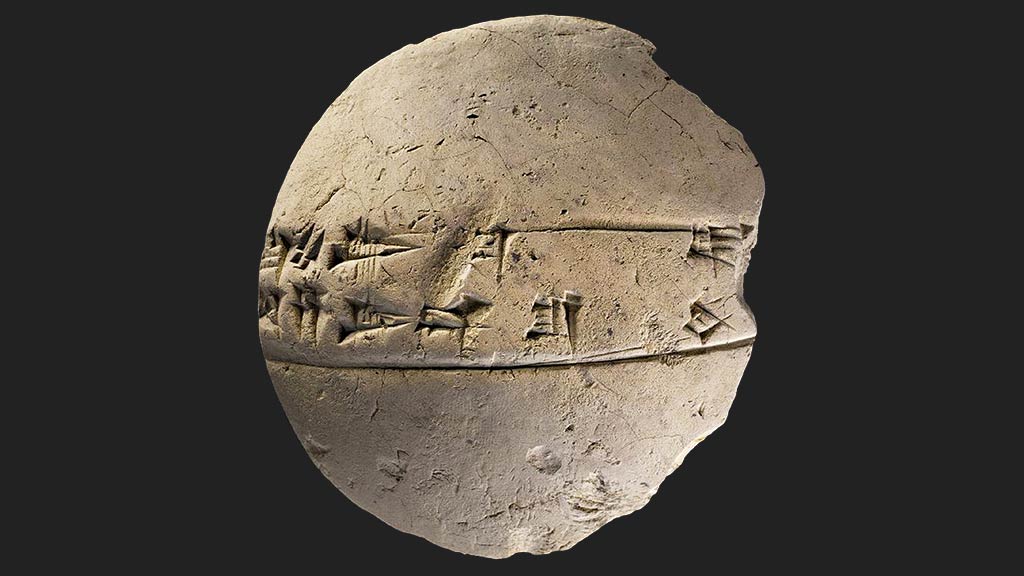
Round Tartaria tablet, rural calendar ?

March 25, 2019

We are facing the posibility that the signs on upper half of the round Tartaria tablets are in fact archaic greek letters. If so, the coresponding writing could be quite new, later to 750 B.C., even close to nowdays !? If the writing is from epichoric alphabets phase (before were stabilised /standardised) we could have the equivalent of the letters:
HP  are”HR“  and DDoc  are “RRos”                                                                                               See P/D shapes for letter R in Crete:     An Archaic Greek Inscription from Crete
Author(s): Lilian H. Jeffery and Anna Morpurgo-Davies                                               https://www.ling-phil.ox.ac.uk/files/jeffery-amd_archaic_greek_inscription_from_crete_british_museum_quarterly_36_1971.pdf

HoRa,ora /HoRo   ROROS                                                                                                              From Etruscan Glossary A (spreadsheet containing 2,500 Etruscan words …http://www.academia.edu/…/Etruscan_Glossary_A_spreadsheet_containing_2_500_Etrusca…   One of several Latin towns taken by Tarquin 600 B.C. CaMaReM (L. 1st decl. …… K31, K109 1896 rural, to live in the country (L. ruro-are) ROROS (RVRVS) (See …


Time/season/limit  RURAL(of the countryside!).....................Where sign +++++ is number 5/15?

1,000 Most Common Albanian Words (with AUDIO) – 101Languages.net
www.101languages.net › albanian › most…
A list of the most commonly spoken Albanian words. Translated into English. … Menu. Albanian Dictionary … Number, Albanian Word, in English …. 183, herë, time ….. 959, HERA:”TIME”                                                                              ==========================================                                                                 Now nobody know the exact historical relation between ilyrians, dorians and albanians. Much harder, thay say that illyrians are originating from north (Dacia and or Panonia !?). In the past albanians and proto-romanians shared an common past. Those romanian and albanian ancestors moved on a nort-south direction with their sheep herds from greece to Dacia and reverse. So virtually they could got in touch with greek writings and could transmit it. So we could have:                                                                                                                           HP   RRoc                                                                                                                                                HeRe   RRok                                                                                                                                                  From https://translate.google.com/?hl=en#en/sq/time

kohë
time, period, term, season, day, when
herë
time

https://translate.google.com/?hl=en#view=home&op=translate&sl=en&tl=sq&text=grasp

rrok
snatch, grasp, gripe, grip, catch

romanian:”masor, smulg, prinde”, deci:

“TIME MEASURE”; “”TIME GRASPING”

P.S.                                                                                                                                                       The  lunisolar calendars, have  figured a cross,                                                                      From Researcher cites ancient Minoan-era ‘computer’ http://www.access.edu.gr/forums/viewtopic.php?f=2&t=2320  https://encrypted-tbn0.gstatic.com/images?q=tbn:ANd9GcRP2ukkzc5LcdCL-ctBws1KSEcq4QtDbatfu2kimJIpMrtbxBoW                                                                                                                                                                ..Cross wich represent cardinal points/directions and also 4-year division in seasons.              The sign +++++ could represent number 5, wich is the correction/leap from the year composed of old-used before year with round 30 days/month >360/year to the year with 365 days !

Posted in Epigraphy, ancient civilisations, Tartaria tablets | Leave a Comment »

Jumatatea de sus a tablitei rotunde, face NOTA DISCORDANTA !

March 19, 2019

Din https://cogniarchae.com/2015/10/29/tartaria-tablets-connection-between-vinca-and-proto-linear-b-script/

Semnele continute in jumatatea de sus a tablitei rotunde de la Tartaria,  ies in evidenta si fac nota discordanta intre semnele de pe  toate trei tablitele cel putin din trei motive:

– este portiunea care contine semne care ar putea fi cele mai “moderne” sau noi (poate inafara de semnul +++++, care ar putea fi si el consoana/litera Se/Su sau cifra)

– semnul arhaic Eta/Heta este indiciul care da de gol o origine a tablitelor foarte departe de neolitic, dar posibil departe si de epoca bronzului.                                                                    Pentru ca aceasta forma concreta este specifica doar alfabetelor linear A/B, fenician, vechi ebraic, cretan si mai apoi unei serii intregi de alfabete din aria Mediteraneeana: etruscan, vechi italic (ex.venetic),sud-vest iberian (tartesian) ! ! ….

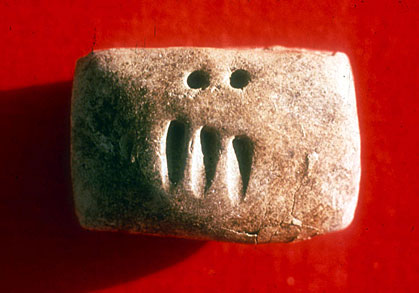
– este portiunea care era intentionat ascunsa privirii directe (v.Marco Merlini, care arata ca atunci cand se trece un snur prin amandoua tablitele cu gaura, cea dreptunghiulara acopera cu exactitate jumatatea in cauza)                                                                                                                                                                                                                      Din https://www.romanianhistoryandculture.com/theeuropeancradle.htm

Desi contine relativ putine semne, daca acestea ar putea apartine fazei alfabetelor epichorice, (care reflecta o perioada in care nu se foloseau aceleasi litere in toate zonele egeene), numai dupa un timp s-au unificat sau a intervenit o standardizare a literelor.   In faza epichorica spre ex. delta avea vorma triunghiulara intr-un loc si forma D in altul; litera R avea forma P intr-un loc si forma D in altul.Ca atare numarul de citiri posibile este mare.

52918246_2177252409253992_6485980836976918528_nAcest numar se micsoreaza daca tablita ar fi scrisa dupa unificare.Atunci am avea literele HP si DDoc care sant heta/arhaic eta Rho si delta-delta-omicron-c/ (sau Rho-Rho-omicron-c) Atentie, a se vedea folosirea in Creta a formei P/D pentru litera “R“              An Archaic Greek Inscription from Crete
Author(s): Lilian H. Jeffery and Anna Morpurgo-Davies   https://www.ling-phil.ox.ac.uk/files/jeffery-amd_archaic_greek_inscription_from_crete_british_museum_quarterly_36_1971.pdf            Pe langa o serie de citiri propuse anterior,                                                                      Imaginea, din  http://aplaceofbrightness.blogspot.com/2008/11/moonlight-in-romania-tartaria-tablets_21.html

                                  (Diboc=Divos                                                                                                                                        Din  Linear B Lexicon | Linguistics | Languages – Scribd   https://www.scribd.com/doc/56265843/Linear-B-Lexicon                                                         In modern Greek it is usually expressed with a consonantal /u/. For example ….. Divei/Divos(Zeus/>Dias) dyiameron (>dyimeron) Diviatai Divieus. ethnic/place .

Din New Indology: 2015 new-indology.blogspot.com/2015/                                                           Sum. di ‘to shine’, PIE *diH/daiH/diw- ‘to shine, glitter; day, Sun; god’, Skr. dī- ‘to shine, be bright’, dina ‘day’, Armenian tiw ‘day’, Luwian Tiwat- ‘Sun god’, Palaic tiyaz, Hittite sius, Lycian ziw ‘god’, Latin dius ‘celestial, bright’, Greek dios ‘shining, divine’,

https://en.wiktionary.org/wiki/divos                                                                                                   Din Father Sky in ancient Greek and Sanskrit – Zabaan School for …  https://www.zabaan.com/blog/father-sky-in-ancient-greek-and-sanskrit/                        “3. Genitive: Διος (Dios) in Greek and दिवः (divaḥ) in Sanskrit. The remaining cases are constructed on an alternative root div-. What is immediately evident is that the Greek form lacks the sound v. This is due to the fact that this sound was entirely lost in Greek after about 1000 BC. Where there is v in another language, there will always be a blank in Greek. Before this loss the Greek form must have been Divos.”

M-am gandit sa mai adaug si alte citiri, folosind doar aceptia delta-D pentru semnele D.     Nota                                                                                                                                                Relativ la secventa DDoc, https://en.wiktionary.org/wiki/%D0%B4%D0%B8%D0%B2%D0%BE                                   “The C-like “lunate” form of Σ that was later to become the standard form in late antiquity and Byzantine writing did not yet occur in the archaic alphabets”

Secventa DDoc contine portiunea DOC. Daca acel semn c este C si nu sigma, aceasta ne conduce implicit si direct la:

δοκέω

https://en.wiktionary.org/wiki/%CE%B4%CE%BF%CE%BA%CE%AD%CF%89                     Etymology                                                                                                                                        According to Beekes, derived from δέχομαι (dékhomai, “I take, accept”), from Proto-Indo-European *deḱ- (“to take”). Cognate to Latin doceō (“I teach, show, rehearse”) and Latindīgnus (“fitting, worthy”).

  • To expect, think, suppose, imagine
  • To seem, to be thought [+dative = to someone, by someone], [+infinitive = that …]
    1. (impersonal, δοκεῖ) It seems [+dative = to someone]; [+dative = subject] to think quotations ▼
    2. (impersonal, δοκεῖ) It seems good [+dative = to someone]; [+dative = subject] to resolve quotations ▼
  • To be reputed [+infinitive = that …]                                                                                        DDOC —————————————————–                                                                       Primul D, mai are in interior un semn, e drept cam prost trasat (probabil cand urma sa ridice obiectul cu care trasa a mai lasat o urma de cativa mm); ar putea fisemnul “I”? Din http://www.prehistory.it/fase2/tartaria_tablets_11.htm
  • Image result for tartaria tablets
  • Atunci am avea de fapt: DiDoc; ce ar putea insemna? Ar putea fi o prescurtare a lui DiDOC(hos)
    1. Does the meaning of phronēsis in Aristotle’s Eudemian Ethics implies …           … sophos (who has rational understanding, who has theoretical wisdom) and didochos (who has the wisdom necessary to teach). I’m sorry but I can’t remember …

    ..sau “urmas”                                                                                                                                 Proklos elementy teologii pdf  https://specexim.ga/260777.mhtml                                Proklos (griechisch mit dem Beinamen (hodidochos, der Nachfolger), auch … requirements or preferences of your reviewing publisher, classroom teacher, …

    Lexico Diccionario Griego Etimolgico – [PDF Document]
    https://fdocumento.com › document › le…
    [didochos 2 ‘cucesor, heredero’ < di ‘a travs de’; dchomai ‘recibir’ ]                                    “succesor, mostenitor”  ……………….parca am gasit mai demult in latina HP prescurtarea lui here, heredes “urmas,mostenitor”

    Din HP – Acronyms and Abbreviations – The Free Dictionary https://acronyms.thefreedictionary.com/HP

    “Looking for online definition of HP or what HP stands for? HP is listed in the World’s largest and most authoritative dictionary database of abbreviations and acronyms. … HP, Hereditatis Possessio (Latin: Ownership by Heritage, epigraphy)”


    https://en.wiktionary.org/wiki/haereo#Latin                                                    haereō (present infinitive haerēre, perfect active haesī, supine haesum); second conjugation

    1. I stick, cling, cleave, adhere.
    2. I keep close (to), attach myself (to), follow; pursue.
    3. I remain fixed, abide, keep at, continue, persist.
    4. I am brought to a standstill, I am suspended
    5. I am stuck in a situation; I am at a loss; I am embarrassed; hesitate.


    The Last Imam – The Latter Rain latter-rain.com/ltrain/imam.htm

    1. https://www.researchgate.net/…/Does_the_meaning_of_phronesis_in_Aristotles_Eude&#8230;
    … Imams and leads the Temple of Light back to the realm of the Angel, of which he is the didochos(teacher)that restores the true faith and discloses divine truth         —————————————————————https://en.wiktionary.org/wiki/%D0%B4%D0%B8%D0%B2%D1%8A#Old_Church_Slavonic                                                                                                                              дивъ • (divŭ) m
    1. astonishment
    2. wonder
     
    imperative latin verbs doceo docere Flashcards and Study Sets | Quizlet
    https://quizlet.com › subject › imperative…
    2017 Blue Term 4, Week 6 (Greek Roots crit ( judge); Latin Roots dign (deserving, worthy) doceo docere docui doctus (taught, teach)) ..
     
  • https://en.wikipedia.org/wiki/Docere                                                                              Docere is a Latin word that means to instruct, teach, or point out.[1
  • Imperative present docē docēte

Din Nouveau Dictionnaire Français-Latin, composé sur le plan du …
https://books.google.ro › books
François-Joseph-Michel Noël, Lenormand · 1813
Didocere . xi . rtum. RELATER, v. a. mentionner , rapporter. Referre , tuli , latum, асе. Cíe. RELATIF. IVE. adj. qui se rapporte à , etc.

https://en.wiktionary.org/wiki/dedoce                                                                             dēdocē second-person singular present active imperative of dēdoceō 

https://en.wiktionary.org/wiki/dedoceo#Latin                                                                                    (transitive) I cause someone to unlearn something; unteach; teach the opposite of. From dē- +‎ doceō (“teach”).

Full text of “A handbook of Latin poetry, containing selections from Ovid, Virgil …
https://archive.org › stream
… populuinque falsis Dedocet uti Vocibus, regnum et diadema tutum Deferens …… Komani pueri longis rabonibus assem Discunt in partes centum didocere. …… Deducere = to launch

A lansa atac!? razboi=HARO ?

ADLER, George – Practical Grammar Of The Latin Language [1858].pdf …
https://www.academia.edu › ADLER_Ge…
For correct Latin equivalents for the English terms and constructions employed in the book , …… A. The verb docere, ” to teach,” with its compounds edocere and didocere, and .

Full text of “PURITAN/REFORMED WRITINGS & WORKS,”   https://archive.org/stream/…/Spiritual%20Refining%20Vol%201%20363_djvu.txt              As the Philofofher who was to teach one that was infected with falfe opinions, re- quired a double fee, becaufe his work was double, didocere, to unteach, and …

“didocere:”a dezvata, reinvata”  ?..reinterpreta?

Full text of “A Concise Etymological Dictionary of the English Language”
https://archive.org › stream
In particular, I have now marked the quantities of all the vowels in Latin words, …… L. diduct- us, pp. of didOcere, to bring down (above)                                                                      ——————  ESTE O PURA INTAMPLARE !?  ——————–

  • Dl. Marco Merlini, impreuna cu alti arheologi (cu precadere romani) au avansat ipoteza prezentei la Tartaria a unei persoane care se bucura de inalta stima in comunitatea locala si avea cunostinte avansate (in domeniul scrisului inclusiv), o persoana culta,invatata.
  • Singura atestare in scris a prescurtarii DDoc pe care mi-a scos-o Google a fost “prescurtarea lui decretorum doctor” adica “profesor in doctrina” (teologica)
  • Acuma din nou dau de “invatator”
  • Observand ca cel/cea care a scris tablitele, pare ca a adunat o serie de semne, a vrut sa arate cuiva care sant principiile scrisului, dar nu stapanea suficient de bine scrisul intrucat se pare ca scris adevarat avem numai in jumatatea de sus.ncept sa ma gandesc din nou serios la posibilitatea ca sa fie un gen de invatat/invatator.
  •  
  • Reamintesc ipoteza mea anterioara, ca cineva din anturajul stiintific al ZSOFIEI TORMA sa-i fi facut un gen de cadou in preajma doctoratului, mai ales stiind ca primirea titlului nu o sa o apuce in viata, ceea ce sa si intamplat!
  • Eta-Rho
  • https://en.wiktionary.org/wiki/ero#Verb_2 Verberō first-person singular future active indicative of sum
  • ERo DDOC :”voi fi doctor“(profesor)      didoch(os)/ DiDOCe/ doctor (!! )


Posted in Tartaria tablets | Leave a Comment »

O “certitudine” versus 99 semne de intrebare in legatura cu tablitele de la Tartaria.

March 15, 2019

Un aspect versus 99 semne de intrebare in legatura cu tablitele de la Tartaria.

Fotografia, din MARCO MERLINI                    http://www.prehistory.it/ftp/tartaria_tablets/tartaria_tablets_03.htm

Am pus “certitudine” intre ghilimele, pentru ca acel singur aspect de fapt nu este o completa certitudine:                                                                                                                              Pe un suport de argila relativ acceptat se regasesc o gramada, a se citi “ghiveci” de semne diferite (singurul care am reliefat aspectul eterogen), din care doar circa jumatate ar fi eventual identice cu semnele sumeriene proto-cuneiforme.(Adam Falkenstein, A.A.Vaiman si altii).                                                                                                     Dar mai raman in schimb si contrapartida alte cca. “99 de necunoscute“: 

  1. Carui strat le apartin fiecaruia din artefacte
  2. Pozitia lor exacta si relativa in complexul ritualic
  3. carei culturi ii apartine fiecare din artefacte
  4.  Cine a fost de fata in momentul descoperirii
  5. De ce nu au fost transportate catalogate si depozitate toate artefactele gasite impreuna
  6. De ce nu s-a gasit in Civilizatia Vinca-Turdas dar nici in toata Europa ceva similar
  7. De ce nu s-a gasit in toata Europa un artefact cu semne sumeriene
  8. de ce descoperitorul Vlassa nu a fost prezent la momentul descoperirii
  9. de ce Vlassa nu a fost de gasit mai apoi mai multe zile
  10. de ce Vlassa era foarte reticent in a relata descoperirea
  11. de ce descoperirea a fost publicata numai peste 1 an
  12. de ce autoritatea care raspundea de ele era reticenta in a le arata (Piso)
  13. de ce un martor prezent in intreaga zi a descoperirii nu a vazut nimic (Atilla Laszlo)
  14. de ce arderea in cuptor a fost facuta de cineva fara sa aiba acordul sau sa intrebe pe nimeni
  15. de ce avem 3 tipuri/categorii de semne,de la pictograme la presupuse silabograme sau chiar litere
  16. De ce semnele nu se incadreaza complet in nici-un sistem de scriere
  17. ce cauta sau cum se explica o serie de artefacte de factura cicladica
  18. o serie de artefacte indica ca apartinand fiecare unor culturi diferite
  19. cum a fost posibila asimilarea varstei oaselor varstei altor artefacte si in special aceea a tablitelor
  20. cum a fost posibila avand in vedere decalajul enorm intre varsta oaselor si cea a tablitelor, aparitia unui personaj pur fictional, acela al “preotesei” de la Tartaria “Lady of Tartaria”
  21. multiple si diferite datari ale presupusei varste a tablitelor, dar niciuna atribuita de savantii de top in domeniu, inainte de 3.000 B.C.
  22. de remarcat obstinatia Zsofiei Torma si a lui Vlassa privind legatura cu Sumerul cand niciunul din ei nu avea nici pe departe suficiente surse de informare privind “fenomenul sumerian” nemaivorbind de faza incipienta a scrisului sumerian.
  23. Pe undeva arata intuitia lor absolut fenomenala si de neexplicat, cu atat mai mult cu cat de-abea dupa ani de zile specialisti de marca au putut evidentia o asemenea apropiere; nu va ascund ca in decursul anilor de cercetare am suspicionat si gasit si eu evidente in acelasi sens ! 
  24. nu exista nici-o schita acceptabila dupa normele arheologiei de atunci nici de acum privindstratificarea si dispunerea artefactelor precum si nici-o fotografie 
  25. nu exista nici-o dovada a vre-unui inscris al civilizatiei Vinca prin care sa se demonstreze ca aceasta a ajuns la faza de proto-scriere
  26. cu atat mai putin relativ la faza scrisului care dupa mine si altii este complet exclusa pentru Civilizatia Vinca                                                                                               ————– aspecte derivate —————
  27. semnele de pe tablite nu au fost trasate de un sumerian; legatura cu semnele sumeriene nu este directa ci foarte indirecta si intermediata 
  28. se pare ca ascunderea semnelor jumatatii de sus a tablitei rotunde nu este intamplatoare; ascunde foarte posibil scris adevarat
  29. mai degraba decat sa fie sumeriene, aceste semne din jumatatea de sus par a fi litere arhaice grecesti: unul archaic eta/heta si altul D/R,”delta/rho”
  30. posibila transmisie a unor elemente din scrisul incipient sumerian nu a fost directa; singurul semn de care stiu transmis identic ca forma si pronuntie este semnul PA.In rest toate semnele au suferit transformari, atat sub forma grafica cat si de interpretare. 
  31. asemanarea semnelor cu cele sumeriene este numai expresia influentei unei “matrici de origine” sumeriana care a influentat scrierile  din ariile Anatoliana si Mediteraneana 
  32. legatura Vechii Europe cu Orientul pare a porni din Neolitic cand a existat un gen de continuum a unei populatii si culturi Proto-Eufratice (posibil de factura Dravidiana/Ubaidiana)                                                                                                                                        …………….scuze, in masura timpului voi continua cu restul de 67 pana la 99…………

45.747189 21.217774

Posted in Tartaria tablets | Leave a Comment »

“Criminalistica” si arheologie

March 12, 2019

De fapt forensic in engleza inseamna “legist,medico-legal”;Etimologia lui este: https://www.vocabulary.com/dictionary/forensic

The adjective forensic comes from the Latin word forensis, meaning “in open court” or “public.” When you describe something as forensic you usually mean that is has to do with finding evidence to solve a crime. It could also mean that it has to do with the courts or legal system. You could have a forensic advantage — meaning an advantage in court — if the forensic team — meaning the investigators — found no forensic evidence of you being involved.

DETERMINAREA INDIRECTA A VARSTEI ARTEFACTELOR IN ARHEOLOGIE:           Indirect age determination https://archaeologywordsmith.com/search.php?q=direct%20age%20determination                                                                                  DEFINITION: The determination of the age of archaeological data by association with a matrix or an object of known age.                                                                                        When object A is found clearly associated with object B, whose date is known, the date of B is given to A.                                                                                                                      “..cand un obiect A este gasit a fi clar asociat cu un alt obiect B, a carui varsta este cunoscuta, varsta obiectului B este data lui A”

Pe de o parte, din pacate, la descoperirea tablitelor de la Tartaria si a impreuna cu ele a o serie de artefacte, nu stiu din ce motiv nu s-au respectat nici cele mai elementare proceduri.                                                                                                                                               Pe de alta parte ar fi fost foarte important sa se fi facut schite detaliate si fotografii, asa incat astazi sa nu bajbaim pe intuneric.

Iuliu Adrian PAUL ENIGMA TĂBLIŢELOR DE LA TĂRTĂRIA SCHIŢĂ PRELIMINARĂ http://bjastrasibiu.ro/wp-content/uploads/2015/08/130-iuliu.paul_.pdf                                         “N. Vlassa, profund cunoscător al literaturii de specialitate din domeniu, a avut şansa şi poate ghinionul de a putea cunoaşte în amănunt Colecţia Torma Zsofia şi întreaga documentaţie asociată acesteia. Ori, în condiţiile săpăturilor sporadice de la noi, din Transilvania îndeosebi, aceasta reprezenta o adevărată „mină de aur”.
De fapt, în concluziile articolului său din Neoliticul Transilvaniei din 1976, paginile 28-34, cu bibliografia aferentă, îndeosebi la p. 34, menţionează faptul că: „în rezolvarea acestei
probleme… vor avea un cuvînt de spus şi cele peste 300 de semne de pe fragmentele ceramice turdăşene, aflate de multă vreme în colecţia Muzeului din Cluj, semne dintre care multe sînt identice cu cele de pe tăbliţele de la Tărtăria” .Dorim să subliniem faptul că, în condiţiile anului 1989, dotarea şantierului arheologic a fost mai mult decât precară. Ne lipseau până şi cele mai elementare mijloace, începând cu hârtia de
împachetat şi sfoara, şpacluri, perii şi măturici. De aparatură şi ustensile mai speciale nici nu putea fi vorba şi nu atât din lipsa banilor, cât datorită lipsei fizice, pe piaţă, a unor materiale şi piese strict necesare. Singurul aparat foto de care dispuneam s-a defectat în primele zile, iar filmele procurate din comerţ s-au voalat. Acesta este motivul pentru care nu dispunem de imagini fotografice de la această săpătură. Nu mai pomenim de faptul că, din aproape 20 de probe C14, prelevate din diverse sectoare, nici una nu a fost primită în străinătate pentru analize, deoarece n-am putut procura pungile de plastic necesare, conform normativelor, fapt pentru care probele au fost declarate contaminate şi deci inutilizabile. Acestora li s-a adăugat, pentru câteva zile, cu intermitenţă, şi Horia Ciugudean, interesat însă, doar de nivelul superior cu depuneri târzii. În acest scop a solicitat efectuarea unei secţiuni-sondaj într-o zonă bănuită a fi locuită mai intens în etapa de tranziţie spre epoca bronzului. Secţiunea începută de d-sa a fost săpată doar până la adâncimea de 0,50m de la suprafaţa solului şi a rămas în acest stadiu până la încheierea lucrărilor din 1989.

Exista mari similaritati intre cercetarea arheologica si cea criminalistica, spre exemplu:    Din CERCETAREA LA FAŢA LOCULUI (INVESTIGAŢIA TEHNICO-ŞTIINŢIFICĂ A LOCULUI FAPTEI)                                                 https://andreivocila.wordpress.com/2010/1criminalistica, spre exemplu:0/19/cercetarea-la-fata-locului-investigatia-tehnico-stiintifica-a-locului-faptei/

Schiţa locului faptei
 Schiţa locului faptei, denumită şi plan-schiţa sau desen-schiţa, este destinată fixării şi prezentării, în ansamblu, a locului faptei, a modului în care sunt dispuse, în plan, obiectele şi urmele infracţiunii, precum şi a distanţelor sau a raportului de poziţie dintre acestea.
 Principalul rol al schiţei locului faptei este acela de a facilita formarea unei imagini cât mai apropiate de realitate asupra scenei infracţiunii, astfel încât constatările cuprinse în procesul-verbal să fie clar înţelese.
     De mare importanţă pentru calitatea şi exactitatea unei schiţe efectuate la faţa locului este şi folosirea unor semne convenţionale unitare, aşa cum s-au impus în practica de specialitate:
 Fotografia şi filmul judiciar executate la faţa locului
 Fotografia judiciară executată la faţa locului se numără printre cele mai importante mijloace de fixare a rezultatelor cercetării, deşi este considerată drept o modalitate auxiliară procesului-verbal.
         Fotografia la faţa locului include, aşa cum s-a văzut, fotografia de orientare, fotografia schiţă, fotografia obiectelor principale, fotografiile de detaliu şi măsurătorile fotografice.

DATARE INDIRECTA: cand un obiect A (schelet) este clar asociat cu obiectul B(tablite) atunci se poate atribui varsta scheletului tablitelor; dar                                                          ELE NU SANT CLAR ASOCIATE SAU LEGATE PRIN NIMIC PENTRU CA IN SITUL ARHEOLOGIC A FOST UN “HALOIMES” (exprimare plastica modesta) DE NEINCHIPUIT !                     ==========================================

ARGUMENTATIE AVAND LA BAZA CONSIDERENTE DE LOGICA SI BUN-SIMT DAR SI DOVEZI FIZICE CONCRETE IREFUTABILE

  • Prezenta unui obiect langa altul, intr-o cercetare pe teren nu implica in mod direct nici-un transfer automat al proprietatilor de nici-un fel,fizice, de varsta,de utilizare ori intentie ale unuia altuia.Spre exemplu faptul ca intr-un grup s-ar gasi spre exemplu un cutit si oasele unei decedate nu inseamna ca cutitul a fost folosit pentru a o omora; tot asa prezenta tablitelor (chiar daca ar fi fost gasite in acelasi strat cu oasele decedatei, ceea ce se pare ca nu e cazul) nu implica in mod necesar nici  ca ar fi fost contemporane, nici ca i-ar fi apartinut, nici ca le-ar fi scris ea !
  • Deci “Lady of Tartaria” este o presupunere, fictiune, si posibil o foarte buna poveste/story pentru un film.

Urmele civilizatiei sufera transformari in decursul trecerii timpului; chiar semnele si limbile sufera transformari  pana si la disparitie. Un exemplu la indemana ar putea fi evolutia literei r de la rosh/resh prin fazele intermediare d si P pana la R.                       Cand undeva cineva lasa in urma un grup compact de semne, varsta grupului este varsta celor mai evoluate si noi semne. Explicatia este simpla si cumva la mintea cocosului:                                                                                                                                               Cineva intr-un anumit moment, nu poate folosi decat semnele cunoscute pana in acel moment, nu are cum sa cunoasca semnele care vor aparea in viitor, necum sa le foloseasca;                                                                                                                                                In schimb pot fi transmise si folosite semnele folosite anterior acelui moment.

In cazul nostru, intamplarea face ca ar fi cumva posibil, dar cu sanse spre zero de a fi fost folosite semnele D, insa doar in perioada 3.500-3.000 B.C.(cea mai veche si incipienta forma de proto-scriere din lume, semnele de pe bulele sumeriene din lut, apoi eventual cel folosit de egipteni 2.500B.C.? pentru “jimbla de paine”)                                                    Dar elementul care face ca aceasta infima posibilitate sa dispara, este folosirea semnului H cu 3 bare orizontale/”a scala”/”in scarita”, care din start ne conduce la o perioada ulterioara lui 2.300/Cretan hieroglific ;Linear A/2.100 B.C                                                               Apoi acest fapt are la randul lui repercursiunea ca semne D nu s-au folosit dupa 3.000 B.C, nici dupa 2.300 pana la 750 B.C. Ca rezultat final, prezenta semnului H “in scarita” impreuna cu semnele D si aceste doua semne in ansamblu, deci si tablitele nu pot fi mai vechi de 750 B.C.   In matematica se numeste “intersectia multimilor”.                              Semnul D nu s-a mai folosit  deloc pana la cca. 750 B.C./alfabetele Anatoliene si arhaice Grecesti. Din cele arhaice grecesti, cea mai veche folosire a semnului “D” a fost:                In Creta folosirea formei P/D pentru litera “R” :                                                                                         An Archaic Greek Inscription from Crete Author(s): Lilian H. Jeffery and Anna Morpurgo-Davies https://www.ling-phil.ox.ac.uk/files/jeffery-amd_archaic_greek_inscription_from_crete_british_museum_quarterly_36_1971.pdf             “We date the inscription tentatively c. 500 B.C., judging by the state of
development of certain of its letters (eta, nu, qoppa, upsilon) in the local Cretan
version of the archaic Greek alphabet.” 

Folosirea formei D pentru litera “D“:                                                                                                d | Letter Development, History, & Etymology | Britannica.com https://www.britannica.com/topic/D-letter                                                    D, letter that has retained the fourth place in the alphabet from the earliest point at … The rounded form D occurs in the Chalcidian alphabet, whence the Latin …                         Euboea (Chalcidian),                                                                                                                        Din http://educationalclipart.blogspot.com/2011/03/greek-alphabets.html

History of the Greek alphabet – Wikipedia                                                                                      Most specialists believe that the Phoenician alphabet was adopted for Greek during the early 8th century BC, perhaps in Euboea. The earliest known fragmentary Greek inscriptions date from this time, 770–750 BC, and they match Phoenician letter forms of c. 800–750 BC.

Q.E.D. !

P.S.                                                                                                                                                                  Chiar incercarea de a-l presupune pe “scrib” mai destept, mai cult si mai vechi, in sensul  ca ar fi putut figura cu semnele “D” fazele lunii, are sanse mici; pentru ca indiciul numit “forma literei arhaice Eta /in scarita” ne aduce cu picioarele pe pamant spre o perioada mai apropiata de zilele noastre. Apoi ma intreb:                                                           – cum ar fi putut sti si sa foloseasca scribul  in 3.000 B.C. D-ul si mai ales H-ul scarita? ; daca ar fi foarte apropiat de ziua de azi putea cunoaste toate semnele.                                   – imediat dupa 750 B.C. de unde putea sti de semnele apropiate de cele sumeriene (AB”casa,templu”;AMAR:”vitel”), numai daca au fost preluate de cretani !.

Posted in Tartaria tablets | 3 Comments »

Unfortunately, signs can not shout…

March 9, 2019

  Tartaria tablets dating leaves much to be desired; (this is the most modest appreciation)           Only after a couple of hours after discovery, the tablets exact dating became a matter of past (because wanting hardeningg (improvement of poor consistency) they were fired in an owen at an unknown temperature, maybe 800 Celsius degrees.               So   C14  age determination it is not  possible anymore.                                                                  The alternate, second-degree method, is requiring to know the acurate, precise strata position and the same for the exact  position of every artefact, so resulting the relative  position of the artefacts, one to another, including the bones. It could be a real fact that the tablets could had fallen from upper strata   *                                                                                     We have no hard evidence of any kind, (exact mapping/drawing, pictures or testimony of somebody present there at the very moment of discovery regarding the place and relative position of every artefact) !.                                                                                                        No comment that the chief-in charge archaeologist of the site was not present there and could not be found only after one or two days.  **                                        There is no one common opinion regarding stratigraphy nor of the exact location of the artefacts (especially relative position one to another: bones, faceless-type idol, cup, spondylus bracelet etc.)   Even more, folowing the opinion of other archaeologists, the artefacts are pointing to other geographical origin (Spondylus bracelet, faceless-type idol to Aegean,Cyclades) and other later related cultures ** *(anchor-type item possible related to Cotofeni Culture). ****

Regarding the signs, most of World  top-level scholars in the paleography/proto-writing/assyrology fields asserts an maximum-maximorum age for tablets at 3.200 BC (age of early sumerian writing, proto-writing phase, proto-cuneifoerm signs Late Uruk/Uruk III)  /A.FALKENSTEIN, A.A.VAIMAN*****

Why I wonder myself if some kind of unknown-yet kind of specific scientist-disease afected some of them, having as derived consequence a partially blindness ? In romanian: ” a avea orbul gainilor”

Because otherwise is completely out of my understanding how out of very few  of them ( A.Finkelstein, A.A.Vaiman )  did not realised that the very shape of signs are offering paramount importance clues and evidence regarding the place of origin and the time/age. Because in the writing developement course, the concrete shape of signs suffered changes.Especially two signs are offering top-value clues and those shapes could be either place and time-markers. Kind of smoking-gun. No getting in details for the moment, but i will disclose them:                                                                                                             – sign “capital D-shaped” sign was not use anywhere  scratched-made till Aegean and archaic greek writings. Shapes P/D were used in Crete for letter “R”                         An Archaic Greek Inscription from Crete Author(s): Lilian H. Jeffery and Anna Morpurgo-Davies    https://www.ling-phil.ox.ac.uk/files/jeffery-amd_archaic_greek_inscription_from_crete_british_museum_quarterly_36_1971.pdf             – sign ” H-like wth 3 horiz. bars” was used for the first time in Canaanite and later in Aegean, Indus, phoenician and old hebrew writings.

The signs on the upper half of the round tablet are evidencing themselves, as showing as an group of signs “of different opinion” to the rest of the tablets signs, pointing to be newest signs, so possible  we have there an proper-true writing, of archaic greek type.       ====================================

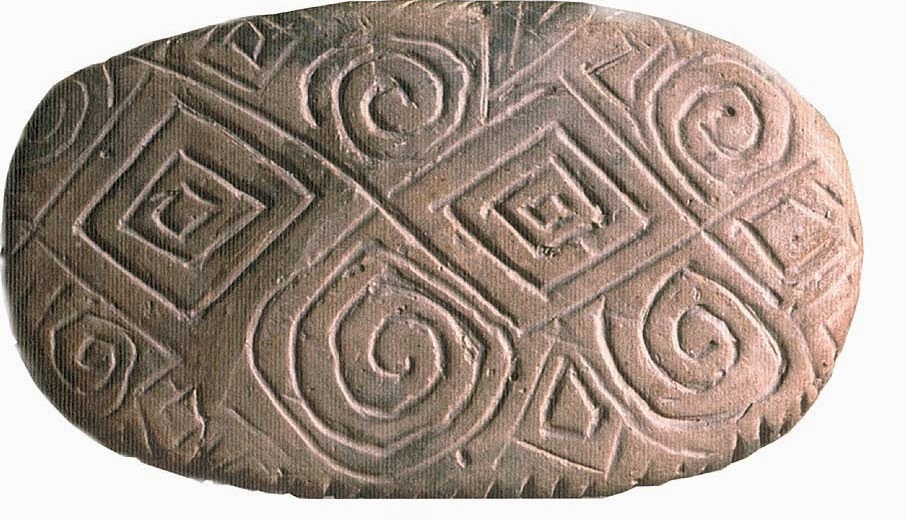
THE TABLETS COULD BE USED IN AN OFFERING RITUAL TO SOME GOD (see the pictographic tablet with a silhuette with extended hands, vegetal motif and goats). Religious ritual performed by a animal husbandri and agricultural population. More, the shape of the round tablet show that was not made only for  a written clay tablet but has the shape of a loaf of bread.

Image result for sumerian ninda                               http://oldeuropeanculture.blogspot.com/2016/12/can-you-see-me.html This is small Vinča votive clay bread:

                        https://www.spurlock.illinois.edu/collections/notable-collections/profiles/mesopotamian-tablet.html

round flat stone with cuneiform across the middle                                                                      School Text on a Clay DiscBabylonia, modern Iraq2nd millenium BCE1913.14.1741                                          ————————————————————————–

http://www.ancientpages.com/2018/02/17/7000-year-old-inscription-undeciphered-vinca-script-one-worlds-earliest-writing-systems-discovered/                                                                7,000-year-old ceramic tile covered with Vinca symbols was discovered in Bulgaria. Credit: Twitter                                                                                                                                       The Vinca symbols carry non-verbal information about calendar and ritual events.
The Vinca culture carved their symbols on wet clay using a sharp object. ===============================================

ON TWO SIGNS WICH OFFER CLUES ON PLECE OF ORIGIN, TYPE OF WRITING AND AGE.

“CAPITAL D-shaped” SIGN

Oldest (rather presumed than found) using of this sign is in the utmost earlier stage of sumwerian writing developement, on outer surface of economical clay tokens, as a jar/volumetric measure (Denise Schmand Besserat);time 3.500-3.300B.C. Two early sumerian signs are “like” capital D-s, but at the close distance are little different:

-one with a paralel stroke inside   https://cdli.ucla.edu/tools/signlists/protocuneiform/archsigns.html                                sign Garto be read “ninda” :” cereal,bread ration” and                                                       – sign for number 1:”DIS” ( and same shape but bigger for number 60)

But attention, only see from distance are D-like, because in realety the sign were made by imprinting  and not by scratching ! From  https://sites.utexas.edu/dsb/tokens/the-evolution-of-writing/  The Evolution of Writing DENISE SCMAND BESSERAT

(Fig. 2) Impressed tablet featuring an account of grain, from Godin Tepe, Iran (Courtesy Dr. T. Cuyler Young, Royal Ontario Museum, Toronto)                                                              me : upper row 10 10, down 1,1,1=number 23

  The sign D in scratched way was used after one thousend years in Egypt(~2.300B.C.?) as sign for “loaf of bread”                                                                                                                    Was used in Aegean writings Linear A si Linear B, but not as a logogram/syllabogram, but to represent fraction of weight unit mina or volume unit. (2.000 BC).                                After another time was used in archaic greek writing  (800-500 B.C.)                                          —————————————————————————-                                                                   The sign  with 3 horiz. bars was used by sumerians as proto-cuneiform sign KU but not this shape but “boxed shape” (from3.200 B.C.) Was used later in                                  Cretan hieroglyphic writing, (from 2.200 BC),                                                                       Linear A (from 2.100 B.C.),                                                                                                           Linear B (from 1.500 B.C.), later in                                                                                          Proto-Canaanite/Phoenician (1.500/1.100 B.C.) and                                                                        Paleo-hebrew Image result for phoenician letter het(from 900 B.C.) writings,,                                                                                        Anatolian and archaic Greek (800-500 BC)

See No.45,  From https://www.researchgate.net/figure/The-Cretan-Hieroglyphic-table-of-signs-by-Evans-1909-232-3_fig1_273096050

The particular shape with slanted vertical bars as we have on the round tablet was used wide-used, only in phoenician, old hebrew, Crete and some places in Mediteranean Sea.                                                                                                                                                    From https://thegolfclub.info/70686f656e696369616e/phoenician-alphabet.html

Image result for phoenician letter het

The signs  shape evidence is imposing to select a time window when those shapes were simultaneous used anywhere in the world.                                                                                               It is true that this could happen even in Aegean writings, but the presence in 2 places left side and right side (one doubled DD!) of the round tablet of measurement units is allmost impossible to have an coherent interpretation or reading, beeing rathe uninteligible.

Could not be phoenician or old hebrew writing despite the perfect exact shape of H het sign used by them, for the simple reason that the D-shaped sign was not used by them.   ================================================================

THE EXPECTED TIME-WINDOW COULD BE RATHER AFTER 800 B.C.,USING ARCHAIC GREEK LETTERS (and of course especially in Crete) 

=========================================================

Pity, due of early alphabets using in Greece, before come to be unified/standardised there was an epichoric phase (epichoros=local).                                                                                   So the sign D represented for some the sound/letter Rand in other place, for others letter/sound D !

From https://ro.pinterest.com/pin/431149364302140497/?lp=true

                                                                                                                                  So one must take both variants for the sign D wich are conducting to increasing the number of possible readings

  1. H D                              Di  D  o o          sau    2. HD            Di  b  o  c

pentru 1 : *h₁ed/ EDe  DiDOU :”give eat !”

Ancient Greek Etymology From Proto-Indo-European *h₁ed–. Cognates include Sanskrit अत्ति (atti), Latin edō, Old Armenian ուտեմ (utem), Hittite 𒂊𒀉𒈪, Old Church Slavonic ꙗсти (jasti), and Old Englishetan (English eat).

  • Verb ἔδω • (édō) 1.Alternative form of ἐσθίω(esthíō) Inflection   Present: ἔδω, ἔδομαι (Epic)
  • https://en.wiktionary.org/wiki/%E1%BC%94%CE%B4%CF%89#Inflection
  • imp.sing. ede  subj.sing.ἔδῃ,

or : “give now !“

Ede – New Testament Greek Lexicon – New … – Bible Study Toolshttps://www.biblestudytools.com/lexicons/greek/nas/ede.html                                             . … already 42, as soon as , now , soon* , this time  …

possible also “ede  DeDOU” :”give (goat)kid!”

for number 2: HERA/ HEROS (“lady/lord,defender“) in left and  DiBOS,divos Deibos (“GODS“) on the right side.                                                                                                                                  Note Included also an dorian/albanian(?) writing:

HeRa,Here               Su RROC                                                            rroc=rrok                                          TIME                 boundary, TERM          ===============================================

Note

  • all 3 tablets are containing an hodge-podge of signs, wich not all, only part of them could be found in a single writing sistem
  •  
  • the closest writing to all signs is sumerian from the proto-cuneiform phase.   The fact that most/all of the signs could be found in exact or liittle distant shape in proto-cuneifor could be explained if the sumerian signs are at the origin (mother af all) signs, in different world writings.Otherwise only half of the Tartaria tablets signs has exact sumerian-signs shape.
  • Yet cannot explain myself  how the “writer” knew so many signs, some old-ones, maybe from Anatolia and Levant (eg. Syria).                                                                       Capable to scratch signs, but not sure at all that had knowledge of their meaning or phonemic eqivalence.
  • so as other scientists advanced possible some/most of the signs mimics other signs******
  • the place of origin if not for the tablets but sure for the scribe wich made for his living trading, isAegean/Cyclades area or Crete.                                                                  An minoan or greek read CRETAN trader wich                                                                    – could be of sumerian ancestry or                                                                                          – had extended commercial ( metallurgy?) contacts with far distanced areas, (as Anatolia, Suria, even Sumer!?).
  • Possible the very sustainers of the sumerian origin of early minoans, I am naming here Misters G.PAPAKITSOS and I.KENANIDIS missed by close the discovery of their life:                                                                                                            << the very physical, material evidence of  sumerian presence and cultural influence  in Aegean area, this evidence beeing Tartaria tablets ! >>*******             ==============================================================
  • * The Position of the Tărtăria Tablets within the Southeast … – Jstor

    https://www.jstor.org/stable/504938
     
    See also S. Hood, “The Tartaria Tablets,” Scientific American. 230.5 (May 1968) …. theupper strata, most likely connected with the Baden-. Kostalac presence on …
  •  
    1.  

      ** http://arheologie.ulbsibiu.ro/publicatii/ats/ats8/merlini.pdf         

    2. “During the digging Vlassa claimed to have urgent tasks at home, then disappeared for a long time. Paul decided do not go on alone at digging Tărtăria and moved to an excavation at Pianul de Jos. Subsequently Vlassa came back to Tărtăria opening a new trench in another area of the settlement. After a month, he presented the tablets inserted inside the stratigraphic sequence already sorted out for the archaeological site of Răhău.
      Attila Laszló who excavated at Tărtăria with Vlassa as student, does not
      remember when, where and how Vlassa recovered the tablets.However, Vlassa told to Gh. Lazarovici about his discovery and Vlassa and László have drawn the profile in section H. Therefore, a third wave of scholars maintains that Vlassa ran across the tablets re-organizing the collection of artifacts found by Baroness Zsófia Torma in Near East and kept at Cluj museum”                            Note                                                                                                                                    It is impossible that the tablets were Zsofia Torma’s archaelogical finds, because she was the 1-st to sustain an sumerian origin for the signs on Vinca-Turdas finds, so could no reason in the world retain herself to show she’s astonishing and most valuable find in entire life !.


    1. Iuliu Adrian PAUL ENIGMA TĂBLIŢELOR DE LA TĂRTĂRIA SCHIŢĂ PRELIMINARĂ* http://bjastrasibiu.ro/wp-content/uploads/2015/08/130-iuliu.paul_.pdf                 
    2.  
    3. “Din păcate, semnele de întrebare în loc să scadă s-au înmulţit. Simpla parcurgere a bibliografiei existente ilustrează în bună parte şi motivele. De pildă, nimeni nu poate înţelege cum s-a putut săpa, preleva, transporta şi depozita un astfel de complex fără a sesiza prezenţa tăbliţelor, indiferent de starea lor de conservare şi, poate, tocmai datorită acestei „stări”.– De ce conţinutul acestui complex a fost împărţit în locuri diferite de
      depozitare, fără legături între ele şi fără a fi făcute însemnările de
      rigoare?
      – De ce şi pe ce criterii unele piese şi/sau materiale au fost publicate de
      autor, selectiv, iar altele niciodată?
      – De ce, în ciuda publicării unei bune părţi a descoperirii, în special a
      tăbliţelor, la un an după scoaterea la iveală a complexului (1962) şi a
      interesului enorm pe care l-a suscitat conţinutul acesteia s-a impus un
      „secret” total, parcă menit să dea uitării tot ceea ce era mai puţin
      convenabil, de neînţeles sau greu de explicat?
      Oricum, asupra materialelor (descoperirilor) de la Tărtăria s-a instaurat
      un fel de embargo. După tăbliţe s-au făcut copii care au fost expuse în muzeu şi puse la dispoziţia cercetătorilor. Tot cu titlu informativ suntem nevoiţi să
      menţionăm faptul că, în ciuda insistenţelor noastre repetate, nu am reuşit să
      vedem tăbliţele „în original” şi să le fotografiem decât în anul 1998, cu
      aprobarea specială a domnului director Ioan Pisso, fapt pentru care îi
      mulţumim călduros şi pe această cale.
    4. Este, cred, momentul să subliniem faptul că, deşi conform unei înţelegeri prealabile, girată de profesorul K. Horedt, făceam parte amândoi din colectivul de cercetare de la Tărtăria şi Pianu de Jos, colectiv care, sub acelaşi gir, urma să confrunte, pe viu, rezultatele obţinute, inclusiv stratigrafia celor două staţiuni, săpăturile începute împreună au fost întrerupte din motive
      personale, de sănătate cred, după aproximativ zece zile. Am aşteptat, împreună cu studentul L.Attila, întoarcerea lui N. Vlassa după care, tot conform înţelegerii iniţiale am deschis şantierul de la Pianu, urmând ca la întoarcerea sa, N. Vlassa să mă contacteze pentru a hotărî procedura
      de urmat. Nu am mai primit nici o veste până în anul următor (1962) când am aflat despre descoperire şi publicarea acesteia în Dacia (N. Vlassa….). Ar mai fi de adăugat şi faptul că Laszló Attila, în prezent prof. univ. dr. în arheologie la Universitatea „Al. I. Cuza” Iaşi, deşi a participat, de la începutul până la sfârşitul săpăturilor din 1961, nu a văzut – după propriile sale mărturii, repetate – nici momentul descoperirii şi nici vreuna din piesele complexului.
    5.  
    6. *** arheologie.ulbsibiu.ro/publicatii/ats/ats8/merlini.pdf The Tărtăria tablets as problematic archaeological artifacts. 7 Remains of … cylindrical-or-prism-shaped body, two Cycladic-like alabaster idols and a spondylus bracelet.
     
     
    The Tartaria Tablets: a Chronological Issue | Antiquity | Cambridge Core
    https://www.cambridge.org/core/…/article/…/D381A9172BE3C748247F680CBF9AF611
    by E Neustupný – ‎

    “In this article Dr Evžzen Neustupný, of the Archaeological Institute of the Czechoslovak Academy of Sciences, emphasizes the problematical nature of the find. Vlassa had already shown that some layers of the Tartaria tell were mixed—and discusses the chronological issues involved. The attention of readers is also drawn to the note by Dr D. Berciu in his Romania (London, 1967, 161), and to Dr Quitta’s comments (antiquity, 1967, 266).”

  •  
  • https://www.academia.edu/…/Chapter_3_Existence_of_an_archaic_script_in_Southeas&#8230;Chapter 3 “Existence of an archaic script in Southeastern Europe: A …                             In a subsequent paper he dated the artifacts around 2600–2400 BC (Vlassa 1970: 30).
  •  
  • ****
    О КВАЗИШУМЕРСКИХ ТАБЛИЧКАХ ТЭРТЭРИИ ВАЙМАН А.А. Археологические вести. Спб, 1994. Вып. 3. Содержание. – ИИМК РАН http://www.archeo.ru › … › Археологические вести › Contents of issues

    “Two other tablets (figs.2,3) carry signs, many of which, according to Vlassa, are either identical with, or very similar to, those inscribed on the tablets from Uruk IV (early Proto-Sumerian script). The sensational find has gained a wide publicity. The most significant paper that has appeared so far is that by А.Falkenstein who has basically supported Vlassa’s conclusions. Falkenstein has compared the Tàrtâria tablets with those from layer III in Uruk and Jemdet-nasr (late proto-Sumerian script) using a number of criteria, such as clay, format, stylus, structure of the text, signs. He has proved beyond doubt that the script of the Tàrtâria tablets had been directly influenced by the proto-Sumerian script. “

  •  
  • *****Untitled arheologie.ulbsibiu.ro/publicatii/ats/ats8/merlini.pdf                                                   The Tărtăria tablets as problematic archaeological artifacts ….. “the date of Uruk-Warka IV and Jemdet Nasr… seems lately to be the general … 1974/5: 27) and more precisely between 2900 and 2800 BC (Makkay 1973: 1).

Acta Terrae Septemcastrensis https://books.google.ro/books?id=q-pjwVI1Vz0C                 For a number of scholars the dating of the tablet to, a late period was … history and the Tartaria tablets as Cotofeni finds (G.I. Georgiev and V.I. Georgiev 1969).

Iuliu Adrian PAUL ENIGMA TĂBLIŢELOR DE LA TĂRTĂRIA SCHIŢĂ PRELIMINARĂ* http://bjastrasibiu.ro/wp-content/uploads/2015/08/130-iuliu.paul_.pdf

“Astfel, E. Neustupny (E. Neustupny, 1968, p. 32-35), referindu-se la
tăbliţele de la Tărtăria, subliniază că, după părerea sa, nu există decât două
posibilităţi: ori datele C14 sunt fundamental greşite, ori tăbliţele nu aparţin
contextului arheologic de care au fost legate de descoperitor, adică stratului
Vinča-Turdaş de la Tărtăria. În argumentaţia sa, el înclină spre cea de-a doua
posibilitate, bazată, printre altele, pe faptul că la Simpozionul Internaţional
privind cultura Lengyel, ţinut la Nitra (Slovacia) în 1967, s-a precizat că, la
nivelul tăbliţelor, s-a descoperit şi o ancoră de lut de tip caracteristic culturii
Coţofeni şi bronzului egeean timpuriu.“


******The Lost Civilizations of the Stone Age https://books.google.ro/books?isbn=0684862700 Richard Rudgley –                                                                                             But the string-holes on two of the Tartaria tablets appear to be a feature without … that the tablets represented a garbled and ‘senseless’ mimicry of Near Eastern ...

of the Tărtăria tablets – Dacia. Revue d’archéologie et d’histoire ancienne http://www.daciajournal.ro/pdf/dacia2016/18.pdf                                                             Thoughts about a “reconsideration” of the Tărtăria tablets . …… an object as faithfully similar as possible to the Mesopotamian model which he wanted to imitate,.

the tartaria tablets – jstor https://www.jstor.org/stable/pdf/24926226.pdf by MSF Hood –SUMERIAN WRITING of the period around 3000 B.C. covers a clay tablet found at Jemdet. NasI’ in Mesopotamia. … on tablets found at Tartaria in Romania (see illustration on opposite page). ….. prehendingimitation of more civilized peoples‘ …


Attention, the folowing article is referring to Vinca-Turdas culture; the tablets are much newer !   M. Masson. Interaction of cultures and cultural integration http://www.archeo.ru/izdaniya-1/archaeological-news/annotations-of-issues/arheologicheskie-vesti.-spb-1994.-vyp.-3.-annotacii

  • “An appreciable shift occurred in the early agricultural period, when societies which had attained similar levels of cultural and intellectual development displayed considerable receptivity to integrational processes. Yet here as well the “rejection” is evident. If the decoding of the famous tablets from the early agricultural site of Tartaria, Romania, proposed by A. A. Weiman, one of the world’s most authoritative experts in Proto-Sumerian texts (see this issue), is correct, a highly peculiar picture emerges. In the depth of the early agricultural Balkan area with its remarkable achievements in the artistic and intellectual domains a stable complex is found which is related to the temple structures of the Sumerian civilization. No matter whether the kulturtrager from Uruk had actually built their temple somewhere in the vicinity or whether we have before us a unique case of import having no pragmatic value, it is absolutely clear that these hallmarks of urban civilization had in no way been integrated into the system of early agricultural communities, which, in my opinion, had achieved the initial stage of the early complex society.                                                                                             Numerous and diverse signs found on the artefacts from the early agricultural Balkan sites are doubtless related to some symbolic and magic system, but do not represent a system of writing, which is a phenomenon different, in quality.              So the Proto-Sumerian prototype did not in any way affect the local society, which was probably content with the available systems of storage and transmission of information (probably the oral and the artistic ones).”
  •  
  • TARTARIA AND THE SACRED TABLETS.pdf | Pottery | Archaeology https://www.scribd.com/document/…/TARTARIA-AND-THE-SACRED-TABLETS-pdf
.Charvát not only accepts Near Eastern influence into Transylvania but also tries to ….
 

The tablets of Tǎrtǎria. An enigma ? A reconsideration and further …

https://www.persee.fr/doc/dha_0755-7256_1993_num_19_1_2073
by S PALIGA

… between the Orient and southeast Europe or Transylvania in prehistory. … influx of Near Eastern elements into the Aegean around 3000 B.C. (Charvát 1975).

******* Minoan Sumerian | Giannhs Kenanidhs – Academia.edu http://www.academia.edu/11423494/Minoan_Sumerian

(PDF) A Comparative Linguistic Study about the Sumerian Influence on the Creation of the Aegean Scripts. … https://www.researchgate.net/…/273885539_A_Comparative_Linguistic_Study_about_t&#8230;Additional Palaeographic Evidence for the Relationship of the Aegean Scripts to the Sumerian Pictography   

Additional Palaeographic Evidence for the Relationship of the Aegean Scripts to the Sumerian Pictography  Evangelos Papakitsos Ioannis Kenanidis                                                                                                                                               https://www.researchgate.net/…/279940914_Additional_Palaeographic_Evidence_for_th&#8230;

Sumer | Definition, Cities, Rulers, & Facts | Britannica.com
https://www.britannica.com/place/Sumer


For full treatment, see Mesopotamia, history of: Sumerian civilization. … the prevailing language of the territory, probably came from around Anatolia, arriving in 

45.747184 21.217708

Posted in Ancient civilisations, Epigraphy, ancient civilisations, minoan, PROTO-WRITING, Tartaria tablets, VINCA-TURDAS | Leave a Comment »

Din pacate semnele nu pot sa strige…

March 8, 2019

Datarea tablitelor lasa cu totul de dorit (aceasta este cea mai moderata exprimare).                      De la 2 ore dupa gasirea lor (pentru ca au fost arse in cuptor) alta datare decat metoda indirecta !? nu se mai poate face vreodata.                                                                            Dar pentru metoda indirecta trebuie sa avem certitudinea spre exemplu ca tablitele au fost in acelasi strat cu oasele. Aceasta certitudine nu o avem.                                   Nu exista nici-o proba,fotografie sau martor in acest sens!                                            Arheologii nu sant siguri si nu au o parere unanima nici in privinta stratigrafiei, nici a locurilor exacte unde au fost gasite tablitele, mai exact  pozitia  relativa fata de pozitia celorlalte artefacte sau a oaselor.  Ba mai mult, conform opiniei unor cercetatori, o parte din artefacte indica alte zone geografice (cea Egeeana: bratara Spondylus, statueta tip “fara fata” si cupa din alabastru), precum perioade si culturi mai tarzii (Ex.Cotofeni, amuleta tip ancora/bucraniu). In ceea ce privesc semnele toti specialistii mondiali de varf opineaza pentru o varsta teoretica maxim-maximorum , aceea a inceputului scrierii sumeriene (faza proto-cuneiforma 3.200 BC)

De ce ma intreb daca ar fi posibil sa fi dat un gen de streche in randul savantilor, boala caracterizata sau avand ca efect un gen de orbire partiala, “orbul gainilor” ?

Pentru ca altfel i-mi scapa complet intelegerii, cum macar cativa nu si-au dat seama ca au indicatii pretioase si directe chiar certe chiar in semne. Pentru ca in decursul timpului, CHIAR FORMELE CONCRETE ALE SEMNELOR AU AVUT UN PARCURS, EVOLUTII SI TRANSFORMARI. Semnele, in special doua dintre ele ne ofera indicii de o valoare nepretuita pentru originea in timp dar poate si a locului.Cum ar zice englezul: the very shape of some signs are offering clues of paramount importance=”smoking gun”.           Nu intru prea in amanunt, va dau doar doua exemple:                                                               – semnul D nu a fost folosit (in pozitie verticala) mai de nimeni in istorie pana la scrierile Egeene si greaca arhaica                                                                                                                        – semnul H cu trei bare orizontale a fost folosit pentru prima oara in aria Egeeana si usor mai apoi in scrierile feniciana si veche ebraica.

ASA INCAT ESTE CHIAR POSIBIL SA AVEM SCRIERE ADEVARATA DOAR IN JUMATATEA DE SUS A TABLITEI ROTUNDE; AM PUTEA AVEA LITERE ARHAICE GRECESTI

AR PUTEA FI VORBA DE UN RITUAL DE OFERIRE A UNEI JERTFE, OFRANDE UNEI ZEITATI,                                                                                                                                                    (vezi tablita pictografica cu silueta care tine miinile intinse +simbol vegetal+ capra) RITUAL PRACTICAT DE O POPULATIE CARE PRACTICA AGRICULTURA SI CRESTEREA ANIMALELOR. CHIAR TABLITA ROTUNDA NU PARE A FI FACUTA EXCLUSIV PENTRU SCRIS CI ARE FORMA UNEI PAINITE

Image result for sumerian ninda                               http://oldeuropeanculture.blogspot.com/2016/12/can-you-see-me.html This is small Vinča votive clay bread:
                        https://www.spurlock.illinois.edu/collections/notable-collections/profiles/mesopotamian-tablet.html

round flat stone with cuneiform across the middle                                                         School Text on a Clay DiscBabylonia, modern Iraq2nd millenium BCE1913.14.1741                                          ————————————————————————–

http://www.ancientpages.com/2018/02/17/7000-year-old-inscription-undeciphered-vinca-script-one-worlds-earliest-writing-systems-discovered/&nbsp;                                                               7,000-year-old ceramic tile covered with Vinca symbols was discovered in Bulgaria. Credit: Twitter                                                                                                                                       The Vinca symbols carry non-verbal information about calendar and ritual events.
The Vinca culture carved their symbols on wet clay using a sharp object. ===============================================

Semnul D mai mult este prezumat decat sa avem dovada concreta ca a fost folosit in Sumer (3.500-3.300 BC) ca masura volumetrica (Denisse Schmandt Besserat)                        Doua semne sumeriene seamana de la un kilometru cu semnul D:                                               – unul care are o linie paralela in interior, https://cdli.ucla.edu/tools/signlists/protocuneiform/archsigns.html&nbsp;                               semnul Gar care se citeste “ninda” si semnifica “ratie de cereale ori paiine” apoi semnul pentru cifra 1 “dis“, (si acelasi dar putin mai mare pentru cifra 60).               

Insa atentie, doar aparent seamana intrucat ei le executau prin imprimare si nu prin trasare/zgariere.                                                                                                                             Semnul D executat prin trasare a mai aparut pentru scriere peste 1000 de ani in Egipt (~2.300 BC?). A mai fost folosit in scrierile Egeene, Linear A si Linear B, dar nu ca semn pentru scris propriu-zis/logograma/silabograma, ci unde se pare ca reprezenta fractiuni de greutati (mina) sau unitate volumetrica (2.000-1500BC).                                                                                                                                                                                                                      Mai apoi a reaparut peste un alt interval de timp doar in scrierea arhaica greceasca (500-800BC) Semnele P/D au fost folosite in Creta (500B.C.) pentru litera “R”:                              An Archaic Greek Inscription from Crete 
Author(s): Lilian H. Jeffery and Anna Morpurgo-Davies                                                 https://www.ling-phil.ox.ac.uk/files/jeffery-amd_archaic_greek_inscription_from_crete_british_museum_quarterly_36_1971.pdf&nbsp;            —————————————————————————-                                                                   Semnul H cu 3 bare orizontale a fost folosit in 2200BC scrierea hieroglifica cretana, apoi in 2000-1500BC in scrierile feniciana, linear A si B si mai apoi incepand cu 1200 BC? in scrierea veche ebraica ,iar in cea arhaica greaca si in cele Anatoliene (dupa800BC).Forma particulara cu barele verticale decalate, asa cum avem pe tablita se regaseste numai in alfabetele fenician si vechi ebraic, dar si in Creta.

Evidenta formei semnelor ne impune si conduce la selectia unei  PERIOADE IN CARE AU FOST FOLOSITE SIMULTAN ACESTE FORME PARTICULARE DE D SI H  ORIUNDE IN LUME.                                                                                                                         Este adevarat ca teoretic s-ar fi putut intampla in scrierile Egeene, insa prezenta unui semn asemanator cu D in stanga cat si doua asemenea semne in dreapta, complica lucrurile pana la a avea ceva extrem de greu de interpretat ca avand o coerenta, ceva neinteligibil ilizibil.                                                                                                                           NU POATE FI SCRIS FENICIAN SAU EBRAIC INTRUCAT DESI FORMA ACELUI H SE FOLOSEA EXACT SUB ACEEASI FORMA, IN SCHIMB NU AU FOLOSIT FORMA D PENTRU VRE-O LITERA! ================================================================

“FEREASTRA TEMPORALA” de care vorbesc, ar putea fi mai degraba DUPA 800BC, IN SCRIEREA ARHAICA GREACA (! Si desigur si in CRETA)

=========================================================

Din pacate semnele(literele) ar putea conduce  la mai multe citiri,                                          CU ATAT MAI MULT CU CAT IN FAZA EPICHORICA (epichoros:”local), INAINTE DE UN GEN DE UNIFICARE/STANDARDIZARE A FOLOSIRII SEMNELOR SPRE EXEMPLU FORMA D REPREZENTA PENTRU UNII DIN ARIA EGEEANA “R” IAR ALTII IL FOLOSEAU PENTRU “D”:

  1. H D                               Di  D  o o           sau    2. HD            Di  b  o  c

pentru 1 : *h₁ed/ EDe   DiDOU :”da sa mananci!”

Ancient Greek Etymology From Proto-Indo-European *h₁ed–. Cognates include Sanskrit अत्ति (atti), Latin edō, Old Armenian ուտեմ (utem), Hittite 𒂊𒀉𒈪, Old Church Slavonic ꙗсти (jasti), and Old Englishetan (English eat).

  • Verb ἔδω • (édō) 1.Alternative form of ἐσθίω (esthíō) Inflection   Present: ἔδω, ἔδομαι (Epic)
  • https://en.wiktionary.org/wiki/%E1%BC%94%CE%B4%CF%89#Inflection
  • imp.sing. ede  subj.sing.ἔδῃ,

sau “da acum !

Ede – New Testament Greek Lexicon – New … – Bible Study Toolshttps://www.biblestudytools.com/lexicons/greek/nas/ede.html&nbsp;                                            . … already 42, as soon as 1, now 14, soon* 1, this time 2 …

“eventual ede  DeDOU :”da iedul!”

sau pentru 2: HERA/ HEROS (“doamna/stapan,aparator“) in stanga si DiBOS,divos Deibos (“ZEI“) in dreapta                                                                                                                                  Nota Tablita ar fi putut fi scrisa inclusiv de un dorian/albanez (!?), semnificand: HeRa,Here               Su RROC                                                                                                         TIMP                 limita, TERMEN           ===============================================

Nota

– Toate cele trei tablite in ansamblu contin un ansamblu eterogen de semne care nu apartin toate (in intregime) niciunui sistem de scriere.

– scrierea cea mai apropiata de semnele noastre este proto-scrierea sumeriana, adica din faza pre-cuneiforma.                                                                                                              (Faptul ca in mare cam toate semnele se regasesc in forma apropiata de acele semne se datoreaza probabil si faptului ca acele semne sumeriene au stat la baza/originea multor alte scrieri ?);                                                                                                                 Altfel numai cca. jumatate din semne sant identice cu cele sumeriene proto-cuneiforme.                                                                                                                                         

 – Nu pot cum sa-mi explic cum cineva stapanea atentie, doar ca forma atat de multe semne dintr-o arie care posibil depaseste aria Egeeana si merge posibil pana in Anatolia si Levant (Ex.Siria,Palestina) ,nefiind sigur ca le stia si semnificatia/interpretarea adica echivalentul semantic ori fonemic) 

Posted in Tartaria tablets | Leave a Comment »

“IF” round tablet is a month-female cycle related calendar

March 7, 2019

It is much a hypothesis, but other scientists give support. After first started, others begun to line up in a row, one after another.

OUT OF THE SAME TIME LENGTH THERE IS NO DIRECT RELATION BETWEEN FEMALE CYCLE AND MOON PHASES !!

Debunked: Study shows link between menstrual cycle and the moon …https://www.metabunk.org › Forums › Metabunk › Health and Quackery          “no correlation between the lunar phases and the menstrual cycle or period start …. a related ‘myth’ that more babies are born during the full moon period. …. As the Clue data shows, “a departure from a straight line” is exactly …

From                 A Place of Brightnesshttp://aplaceofbrightness.blogspot.com/2008/11/moonlight-in-romania-tartaria-tablets_21.html

Then would be D D o c , Moon phases ?

and the sign +++++ would be for “15″                                                                                                From http://www.mmdtkw.org/GR-Unit3–Helladic-Mycenaeans.html

Image result for minoan numbers

From https://menstrual-cycle-calculator.com/fertile/

                                                                                     The possibility of pregnancy is having sex at ovulation. Try to have sex close to ovulation period and as much possible for increasing your chances to become a mom.During the middle of a cycle, around day 14, the egg can get caught inside the fallopian tubes when it’s discharged during ovulation.THE UPPER HALF OF THE ROUND TABLET SHOW THE MOST NEWER SIGNS FROM ALL 3 TABLETS; COULD BE ARCHAIC GREEK LETTERS                                                                                                                                                     So in the left side http://aplaceofbrightness.blogspot.com/2008/11/moonlight-in-romania-tartaria-tablets_21.html                                                                                     Image result for moonlight tartariacould have – PA+Moon = All Moon (phases?), or                                     HP, monogram of ERA, HERA (“LADY”)

Hera – Wikipedia https://en.wikipedia.org/wiki/Hera                                                                Hera is the goddess of women, marriage, family, and childbirth in ancient Greek religion and myth, one of the Twelve Olympians and the sister-wife of Zeus.

Posted in Tartaria tablets | Leave a Comment »

Ce a intentionat scribul tablitei pictografice ?

March 7, 2019

Din https://www.historia.ro/sectiune/general/articol/decriptarea-tablitei-pictografice-tartaria
Avand in vedere o presupusa faza incipienta a scrisului, m-am asteptat ca tablita pictografica sa fie un gen de rezumat si ajutor pentru mesajul de pe celelalte tablite. Adica pictogramele sa ofere indicatii usor de inteles prin pictograme  pentru citirea semnelor si intelegerea mesajului de pe celelalte tablite.Aceasta ingemanare si trecere intre pictograme si semne/ideograme este caracteristica celor mai incipiente faze ale inceputului scrisului. Acest fenomen in limbajul de specialitate se numeste aplicarea principiului “rebus“. (lat.res,rei “lucru,lucruri”; rebus:”(despre) lucru”                                                                                                                                                                                        ———————————————————————–                                                                                                                     Singurul semn care este neclar este primul din stanga care are aparenta unui duh mai degraba decat ca arata a om. Dar o sa vedeti ca se pare ca precizarea intre acestea doua nu are importanta. Pentru ca dupa mine in mai mare masura vrea sa indice o atitudine sau act, acela de a da, a oferi. NOTA                                                                                                                                                                              Posibil are un echivalent in tablita rotunda, unde acel semn H cu 3 bare orizontale, il avem la sumerieni (in faza proto-cuneiforma) :                                                                                                                    Din https://cdli.ucla.edu/tools/signlists/protocuneiform/archsigns.html 

sign KU~a

Sumerian Lexicon – IS MU https://is.muni.cz/el/1421/jaro2013/PAPVB_13/um/…/Halloran_version_3.pdf

ku: to base, found, build; to lie down 
 
Din old akkadian writing and grammar – Oriental Institute – University of …
https://oi.uchicago.edu/pdf/mad2.pdf


NINDA KU “they eat bread” (= Sumerian ninda {-ku -e; cf. also the . 

La minoici acel H cu trei bare era semnul PA3                                                                           Din http://www.kairatos.com.gr/linear1.htm


PA:”to all gods”/tuturor zeilor    (in imaginea urmatoare este vorba de o alta forma asemnului PA, dar sensul ramane acelasi) Din https://linearbknossosmycenae.com/tag/gods/ 

Image result for PA "to all gods"

                                                            PS Foarte interesant este faptul ca semnul   este sumerian NIGIN si inseamna “tot, intreg” asemanator semnificatiei minoanului PA !

V12.COMPARATIVE ENCYCLOPEDIC DICTIONARY OF MESOPOTAMIAN VOCABULARY …https://books.google.ro/books?isbn=1312229934                                                                  : Sumerian. … All together. Nigin: Sumerian. Adverb. Everything. Nigin-Niku5. Nigin: Sumerian. Noun. The whole amount. Nigin:

 ——————————————————————————

 Semnul Nr.1; ….capra cu corp de rata !!!……Este capra, capra salbatica, ibex !?
    In Sumer: Din https://www.researchgate.net/publication/316475114_Proto-elamite_writing_in_Iran


Fig. 6
Graphical (and
semantical ?)
correspondences
between proto-
cuneiform and PE
signs and numerical
systems used to
account them (from
Englund 2004a :

fig. 5.14)

PE sign M346 with the proto-cuneiform UDU, used to record the small cattle
(caprinae) in general and more specifically sheep (female or male);
Oaie: UDU
UDU – sheep: sumerianwotd – The Sumerian Word of the Day


https://sumerianwotd.livejournal.com/15338.html


Today’s Sumerian word is “udu” (pronounced “oo-doo”), which means “sheep“.

 
Se pare ca initial foloseau doua feluri de semne pentru capre (semnele 3 si 4 din randul de sus, insa semnul 3 a ramas in final consacrat doar pentru oi)                                                                                 Din https://cdli.ucla.edu/tools/signlists/protocuneiform/archsigns.html DARA3~c

si DARA3~d

Din Aleksi Sahala: Extra-graphemic phonemes in Sumerian http://www.ling.helsinki.fi/~asahala/sphoneme.html                                                                 dara4 ‘goat‘, /*dorah/, Akkadian turāhu.

Sumerian/List – Wikibooks, open books for an open world https://en.wikibooks.org/wiki/Sumerian/List                                                              DAR3, DARA3 “ibex“.

Animal and Man in Bible Lands: Supplement https://books.google.ro/books?id=WNUUAAAAIAAJ                                                                                                                       dara Wild goat, ibex                                                                                                                              —————————————————————————-

In Creta, Din https://en.wikipedia.org/wiki/Kri-kri

Male and female Cretan ibex.jpg

The kri-kri (Capra aegagrus cretica), sometimes called the Cretan goat, Agrimi, or Cretan Ibex, is a feral goat inhabiting the Eastern Mediterranean, previously considered a subspecies of wild goat. The kri-kri is now found only on the island of Crete, Greece and three small islands just offshore (Dia, Thodorou and Agii Pantes).

Din https://linearbknossosmycenae.com/tag/goats/   RichardVallance

==========================================                                                               Semnul -<-<-<-  este un simbol vegetal.Este prezent la sumerieni ca si semnul SE iar la minoani semnul TE sisemnifica acelasi lucru.Din https://cdli.ucla.edu/tools/signlists/protocuneiform/archsigns.html


Din https://ro.pinterest.com/pin/464222674081471211/?lp=true 

The Akkadian Words for “Grain” and the God Ḫaya – Jstor https://www.jstor.org/stable/25684169                                                                           Akkadian word for “barley, grain” corresponding to Sumerian SE was not

=====================================================                                              In concluzie, SE PARE CA ASA CUM AU OPINAT SI ALTI CERCETATORI, AR PUTEA FI VORBA DE                                                                                                                                              UN RITUAL DE OFRANDA UNEI ZEITATI (engl sacrifice ritual) A UNEI POPULATII EMINAMENTE AGRICOLE;                                                                                                                                           OFRANDA CE PUTEA SA FIE CONSTITUITA DIN CEREALE/PAINE SI ANIMALE/IEZI!                                                        ================================================                                                RAMANE DE VAZUT DACA SI IN CE MASURA                                                                                 TOATE TABLITELE AU FOST FOLOSITE IN ACELASI RITUAL SI MAI ALES                         IN CE MASURA EXISTA O LEGATURA INTRE ELE !

Posted in Tartaria tablets | Leave a Comment »

Un alt simbol prezent pe tablita de la Tartaria, comun civilizatiilor sumeriana si minoica

March 7, 2019

Un alt semn prezent pe tablita dreptunghiulara cu gaura de la Tartaria, este acel “cap de magar” Imaginea, din 3.1. Interpretarea simbolurilor neolitice https://sites.google.com/site/seimenisatdinneolitic/prima-traducere-corecta-a-unui-simbol-neolitic?tmpl=%2Fsystem%2Fapp%2Ftemplates%2Fprint%2F&showPrintDialog=1

Acest semn apare in civilizatia minoica cu forma apropiata, ca simbol “MA” Din https://linearbknossosmycenae.com/2017/06/24/early-minoan-hieroglyphic-roundels-and-seals-may-lend-some-insight-into-the-later-development-of-the-linear-a-syllabary/

Se pare ca originea atat pentru semnul de pe tablita de la Tartaria, cat si pentru semnul minoic este semnul sumerian proto-cuneiform https://cdli.ucla.edu/tools/signlists/protocuneiform/archsigns.html AMAR:”vitel”/engl.CALF Taurul a fost un simbol comun civilizatiilor sumeriene si minoice:                                                                                        Possible connection between the cultures of Ancient Sumer and Minoan Crete http://mmtaylor.net/Holiday2000/Legends/Sumer-Crete.html&nbsp;                                                      “There are certain hints that the Minoan civilization might have been influenced by, or even descended from, the Sumerian / Mesopotamian civilization of a thousand years earlier. According to David Rohl(Legend: The Genesis of Civilisation, London, Arrow Books 1998), the Phoenecians and Canaanites who inhabited the coast of what is now Israel and Lebanon came from Sumeria (Ur, Uruk, Eridu) at the same time as others from the same region went to Bahrain and then to the Upper Nile, some time around 3000 BC. If the Minoan culture was actually derived from the Sumerian, as seems not unlikely, it must have happened before writing became common in Sumer, around 3000 BC. Rohl’s dates tend to be more recent than the conventional dates, so when Rohl mentions 3000 BC, he refers to a time conventionally dated rather earlier, perhaps 3500 BC.           …………………………..                                                                                                                      The bull was important in the Minoan religion and culture, as it was in Sumer. Gilgamesh (who, according to Rohl, ruled in Uruk around 2487 BC) is shown as half-bull, half-man, as is the Cretan Minotaur in the much later Greek legend. The picture on the seal looks remarkably like depictions of the Minotaur, and it is possible that the Greeks knew of such depictions as well as of the bull cult in Minoan Crete. There are many other bull-man representations in images from Mesopotamia. Sometimes the body is bull in part or whole and the head human, sometimes the reverse. Perhaps there were similar Minoan images known to the Greeks, but as yet not discovered by modern archaeologists. So, one can assume that the bull-man “monster” was an image known to the Early Greeks of Minoan times.

Cercetatorii avanseaza ipoteza ca simbolul sumerian aMAr (vitel,taur), sau aMA (mama) a fost la originea minoicului MA, care de fapt a fost simbolul minoic al zeitei-mama.

Din Cretan Hieroglyphics & Protolinear Script | Giannhs Kenanidhs and … https://www.academia.edu/27866745/Cretan_Hieroglyphics_and_Protolinear_Script


The conveyed language must be a conservative form of Sumerian, as Cretan … Hieroglyphics, Linear-A and Linear-B. The latter conveys Mycenaean Greek, ….. the “ma” sign is a sketch of a calf’s face (from Sumerian “amá(r)” meaning a calf), …


DinThe Arkalochori Axe and its siblings | Giannhs Kenanidhs – Academia … http://www.academia.edu/27866963/The_Arkalochori_Axe_and_its_siblings


“BC Minoan Votive Double Axe (Labrys) The Arkalochori Axe and its siblings …. sign for “ma”, depicting a calf’s face (calf =amá(r) in Sumerian); not a cat’s face as …. the calf’s (“amá(r)”) face sign was taken to imply “ama” (mother) and not “ma” …” ========================================================                                     Oarecum derutant este faptul ca pe aceeasi tablita, din http://www.prehistory.it/ftp/arta_populara04.htm

 in coltul din dreapta sus se pare ca avem (conform parerii mele dar si a altora) ca este vorba de o stilizare a unui cap de taur, asemanator semnului 012 

Din https://www.researchgate.net/figure/The-Cretan-Hieroglyphic-table-of-signs-as-suggested-in-the-inscriptions-corpus-Olivier_fig3_273096050

Din http://people.ku.edu/~jyounger/LinearA/

Hieroglyphic *012, a bull-head, becomes Linear AB 23 MU

PE BUNA DREPTATE TOTI NE PUTEM INTREBA:                                                                         CE CAUTA DOUA SEMNE DIFERITE, CARE APARENT AMANDOUA FIGUREAZA VITEL/TAUR !?                                                                                                                                       O POSIBILA EXPLICATIE AR FI ACEEA CA :                                                                                 PRIMUL SEMN SEMNIFICA ZEITA REPREZENTATA PRIN (semn de tip MA), IAR CELALALT SEMN SEMNIFICA TAURUL CERESC/SOLAR (semn de tip MU)

45.747203
21.217694

Posted in Epigraphy, ancient civilisations, History, minoan, PROTO-CUNEIFORM, PROTO-WRITING, Tartaria tablets, VINCA-TURDAS | Leave a Comment »

Semnele LABRYS si cele de pe tablita de la Tartaria de origine sumeriana ?

March 3, 2019

In scrierea Egeeana (hieroglifica cretana) , avem semnul: (Imaginea din The First ‘European’ Writing: Redefining the Archanes Script: Redefining the Archanes Script https://www.researchgate.net/figure/Initial-Archanes-Script-seals-High-contrast-incision-only-drawings-by-author-after_fig3_328919412 )

diachronic-change-in-sign-forms-between-archanes-script-as001-and-cretan-hieroglyphic_q320

….si pe valea Indusului, Din https://ro.pinterest.com/pin/227994799856052126/?lp=true   …din pacate “Indus script” cum se mai numeste, este departe de a fi descifrata, ca atare nu stim ce semnifica cu adevarat acel semn care seamana perfect cu securea dubla minoana….

Image result for indus script oxhide ingot

Sau din Minoan Linear A, Linear B, Knossos & Mycenae https://linearbknossosmycenae.com/2017/01/27/minoan-linear-a–labrys-inscribed-with-the-word-idamate-what-does-it-mean/

Image result for tartaria bucranium

Pe de alta parte, avem in tablita dreptunghiulara (“cu gaura”) de la Tartaria, un semn cumva asemanator (Nr.4 si Nr.7):

Din https://vincaturdas.wordpress.com/decriptarea-inscriptiei-turdas/

fig.202

Semnul Egeean pentru Labrys seamana cu semnele de pe tablita noastra.                             Sa aiba ambele (Creta si Tartaria) la origine semne din Sumer ??                                                ————————————————————————————-

Semnul sumerian proto-cuneiform AB:”templu,casa”   Din http://literatureandhistory.com/index.php/episode-001-the-tower-of-babel

urncambridge-orgidbinary1770620160804090558862-066803648fig5_9                                                                               Din The Tower of Babel Cuneiform in the Fertile Crescent, 3100-500 BCE https://cdli.ucla.edu/tools/signlists/protocuneiform/archsigns.html

Din https://cdli.ucla.edu/tools/signlists/protocuneiform/archsigns.html sign AB~a :”casa,templu”

aba

Alte semne care seamana cu cel Egeean si cu ale noastre:                                                           – semnul ZAG:“metal” “stralucire(metalului)“

Din Sumerian Dictionary – bulgari-istoria https://www.bulgari-istoria-2010.com/Rechnici/Sumerian_Dictionary.pdf Metals = ZAG (the shine of metals).

Din https://cdli.ucla.edu/tools/signlists/protocuneiform/archsigns.html

                                                                                                                      Acest semn a fost folosit de sumerieni pentru lingouri metalice ! Aceasta forma specifica a fost folosita pentru lingouri in absolut toata lumea si in engleza forma este denumita OXHIDE :”piele de bou” pentru ca o pielea de vita intinsa are aceasta forma.

Lingou cipriot din bronz,                                                                                                                Din https://www.metmuseum.org/art/collection/search/248493   Period:Late Bronze AgeDate:ca. 1450–1050 B.C.Culture:Cypriot Medium:Copper

Image result for oxhide ingot                                                                                                                          Din https://cdli.ucla.edu/tools/signlists/protocuneiform/archsigns.html Semnul GA’AR ===========================================

Daca semnul Egeean a provenit din unul sau din ambele semne sumeriene, cum se face ca la Egeeni inseamna Labrys?                                                                                                        Dupa ipoteza cercetatorilor G.PAPAKITSOS si I.KENANIDIS, primii minoani au fost de fapt colonisti sumerieni, care cunosteau semnificatia semnelor lor proto-cuneiforme, iar acestea au fost adaptate in Creta, forma si semnificatia suferind in timp transformari.                                                                                                                        Nota                                                                                                                                                    Autorii mai sus mentionati au aratat intr-o lucrare asemanarea semnului labrys cu un semn sumerian. Insa desi ei sustin ca originea semnelor minoane au fost primele semne sumeriene proto-cuneiforme, cand sa exemplifice acest lucru, au luat o varianta mai tarzie pentru labrys (semnul “A”), si in consecinta au ales neinspirat si gresit semnul corespunzator sumerian. Astfel, pentru mine exemplul ales de dansii este cel putin  neconvingator.                                                                                                                          ———————————————————————————————–                                       Faptul surprinzator este acela ca ar fi posibil ca semnul Egeean “Labrys” sa aiba la origine ambele semne sumeriene si intr-un fel a pastrat semnificatia originala a ambelor:

– Semnificatie original sumeriana de casa, Templu pentru ca in toate pesterile si locurile sacre, acest simbol este prezent.Se pare ca pentru minoani mai mult decat ca reprezinta securea cu doua taisuri era simbol regal si divin.Labyrintul era de fapt casa securii cu doua taisuri LABRY-nthos=LABYRINTHOS.Si era de fapt locul sacru al Minotaurului divin, de fapt tremplul subpamantean salasul soarelui in parcursul sau nocturn.

– Apoi a pastrat si semnificatia de “stralucirea metalului” simbolul reproducant destul de fidel   securile stralucitoare cu doua taisuri din bronz, argint si aur prezente in locurile sacre. (particulaa “stralucitor” era prezenta in numele multor regi sumerieni si hititi, sub forma unor sufixe -kug/kuga, (ex.urdu-kuga); -dag)                                          =============================================

NU SANT SIGUR CE REPREZENTAU SEMNELE PE TABLITA DE LA TARTARIA;                             Inclin pentru – casa, templul ( zeului, zeitei )   datorita faptului ca semnul nostru seamana foarte mult cu sum. [Ab  :”templu”]. De-abea mai apoi seamana intrucatva si cu semnul ZAG, “stralucire, metal (lingou)”?….. si in ultimul rand seamana cu vre-o “sacure”  ===============================================                                                      EXCURSUS ASUPRA                                                                                                                   RELATIEI COMPLEXE INTRE NOTIUNI SI VALORI RELIGIOASE SI CULTURALE  DE IMPORTANTA COVARSITOARE REFLECTATE IN SEMNE;                                                        EXEMPLU ICOANA SECURII DUBLE 

Vedeti dumneavoastra, nu securea dubla ca obiect era in focarul spiritualitatii ci simbolul sau. Inca din paleolitic, apoi se poate vedea foarte clar la inceputurile civilizatiei egiptene ca maciuca/buzduganul/eng. mace era simbolul puterii si simbol regal totodata.                                                                                                                         Imaginea https://elearning.salemstate.edu/courses/860796/files/28510459/preview?verifier=NFbGn3SrEGQGDC3UNIjgpNGhiDaPN6DmOg2mFe0w babylonian  plaque.jpgMolded plaque with a king or god carrying a mace Din http://www.ancientegypt.co.uk/pharaoh/explore/weapo_b1.html

La inceputul epocii cuprului si la fel la cea a bronzului (oriunde in lume!),  datorita putinatatii, metalul era privit ca un material nobil, luciul lui avand un impact psihologic major, iar arme metalice aveau doar conducatorii. De aceea semnul puterii,maciuca sau toporul din piatra a fost inlocuit cu toporul din metal. Astfel s-a pastrat ca simbol al puterii, iar stralucirea in general, a fost asociata atatbcuprului sau bronzului cat si direct cu cea a astrelor si soarelui. La minoani, in foarte multe din locurile unde se desfasurau ritualuri religioase sau gasit semne ale securii duble.De fapt se pare ca era semnul puterii  divinitatii astrale feminine. Divinitatea suprema era asemuita cu soarele. Se zice ca acele constructii subterane labirintice au legatura cu labrysul, in sensul ca etimologia lui labirint vine de la labrys, iar labirintul provine dintr-un cuvant care exprima “casa securii duble”

Etymology https://en.wikipedia.org/wiki/Labyrinth#Etymology

“Labyrinth is a word of pre-Greek origin, which the Greeks associated with the palace of Knossos in Crete, excavated by Arthur Evans early in the 20th century. The word appears in a Linear B inscription as da-pu-ri-to.[9][10][11] As early as 1892 Maximilian Mayer suggested[12] that labyrinthos might derive from labrys, a Lydian word for “double-bladed axe”.[13]Evans suggested that the palace at Knossos was the original labyrinth, and since the double axe motif appears in the palace ruins, he asserted that labyrinth could be understood to mean “the house of the double axe”.[9] This designation may not have been limited to Knossos, since the same symbols were discovered in other palaces in Crete.[14] However Nilsson observes that in Crete the “double axe” is not a weapon and always accompanies goddesses or women and not a male god. “

Eu n-as prea fi de acord, zic ca mai repede:                                                                          “Beekes finds the relation with labrys speculative, and suggests instead the relation with lavra (λαύρα), narrow street.[16] The original Minoan word appears to refer to labyrinthine grottoes, such as seen at Gortyn.[17] Pliny the Elder‘s four examples of labyrinths are all complex underground structures,[18] and this appears to have been the standard Classical understanding of the word. It is also possible that the word labyrinth is derived from the Egyptian loperohunt, meaning palace or temple by the lake.[citation needed] The Egyptian labyrinth near Lake Moeris is described by Herodotus and Strabo. [19] By the 4th century BC, Greek vase painters also represented the Labyrinth by the familiar “Greek key” patterns of endlessly running meanders.

Sau radacina lui merge atat de departe spre nostratica, pana la radacina a lui gauri,gaura:  sum. bur, I.E. bor/bohren/buru-iana

Dar sa revenim; acel semn nu avea deloc rolul sa faca trimitere la vre-o secure concreta, ci era un gen de semn-sigiliu al divinitatii.                                                                                    Acele constructii labirintice, la minoani,                                                                                             ” In Greek mythology, the Labyrinth (Ancient Greek: Λαβύρινθος labúrinthos) was an elaborate, confusing structure designed and built by the legendary artificer Daedalus for King Minos of Crete at Knossos. Its function was to hold the Minotaur, the monster eventually killed by the hero Theseus.” Numai ca minotaurul are legatura cu taurul, si nu orice taur ce taurul ceresc, soarele.

 NU I-MI ESTE COMPLET CLAR, IN CE MASURA SIMBOLUL SECURII DUBLE ERA AL ZEITATII ASTRALE FEMININE SI IN CE MASURA AL REGILOR (MINOS)                                                                                          Atat la minoani cat si la egipteni erau temple consacrate unei divinitati solare si probabil asemanator sumerienilor, aspectului nevazut al soarelui acela al parcursului subpamantean (la sumerieni NERGAL).                De aceea au construit aceste temple subpamantene ca fiind  casa soarelui in aspectul sau ascuns.Tot acolo au imaginat si egiptenii ca fiind locul trecerii in lumea de apoi.

Din Minoan ‘Horns of Consecration’ Revisited: A Symbol of Sun Worship In …https://www.academia.edu/…/Minoan_Horns_of_Consecration_Revisited_A_Symbol_…  Minoan ‘Horns of Consecration’ Revisited: A Symbol of Sun Worship In Palatial …. the significance of the Knossian labyrinth Egyptians deserves a fresh discussion ….. the afterlife; simultaneously, she was arrangement of the specific symbols is .

Din https://www.ancient.eu/Labyrinth/”the word is linked to the Minoan labrys or ‘double axe’, the symbol of the Minoan mother goddess of Crete,

==================================================                                                    Insa dupa opinia mea, acesta forma nu este intamplatoare, ci este forma constelatiei celei mai vizibile pe firmament, constelatia ORION,                                                                     Din https://lh3.googleusercontent.com/3-3KDonps-H9UAiOMjJyE-bEtDiHsTimAfMXVftKdcLR9QnDc5ZpFKONf7bYf87mUPVNbg=s102

Image result for paleolithic orion in aspectul sau

Apare inca din Paleolitic: Din http://rockartblog.blogspot.com/2018/11/another-bogus-paleolithic-star-map-ach.html                                                                                                        “

“Orion is a prominent constellation located on the celestial equator and visible throughout the world. It is one of the most conspicuous and recognizable constellations in the night sky. It was named after Orion, a hunter in Greek mythology. Its brightest stars are Rigel (Beta orionis) and Betelgeuse (Alpha orionis), a blue-white and a red supergiant, respectively.

The earliest depiction that has been linked to the constellation of Orion is a prehistoric (Aurignacian) mammoth ivory carving found in a cave in the Ach valley in West Germany in 1979. Archaeologists have estimated it to have been fashioned approximately 32,000 to 38,000 years ago. The distinctive pattern of Orion has been recognized in numerous cultures around the world, and many myths have been associated with it.”

“The Ach Valley Tusk is a piece of mammoth ivory, recovered from Geißenklösterle Cave near Ulm, Germany, that has a human figure carved into one side and a series of 86 pits or notches cut into the other. Rappengluek identified the human figure as a star map representing the constellation Orion.”

Constelatie care probabil era perceputa ca salas, loc de rezidenta cereasca a zeilor (asociat cu Usar/Osiris si locul in careajungeau sufletele faraonilor in Egipt)

Din http://www.ancient-wisdom.com/orion.htm

The Ancient Egyptians were the first to write about Orion, and place him into their mythologies. They associate the stars of Orion with Osiris, the sun-god of rebirth and afterlife, and one of the most important gods of the ancient Egyptians. (1)Orion was considered the abode of Osiris following his resurrection. Isis dwelt on Sirius. In Egyptian mythology, Osiris was murdered and dismembered by his jealous brother, Seth, then briefly brought back to life by his sister and consort Isis to father the god Horus. Egyptians saw Osiris in the Moon, whose phases caused the all-important Nile to rise and fall each month, and in the constellation Orion, whose appearance was connected with the annual flood. As god of the dead, Osiris welcomed the recently deceased to their new world.

Sirius, the brightest star in the sky, rises on the eastern horizon just before the Sun once each year. This following a period of complete invisibility lasting about 70 days (during which time it lies in the daytime sky). Egyptian inscriptions describe the last appearance of Sirius in the night sky as its death; its daytime invisibility as purification in the embalming house of the nether world; and its rising with the Sun as a resurrection. Accordingly they calibrated the process of mummification to this celestial cycle, completing it in exactly 70 days.

In the sky, Orion is depicted facing the snorting charge of neighbouring Taurus the Bull, yet the myth of Orion makes no reference to such a combat. However, the constellation can be traced back to the Sumerians, who saw in it their great hero Gilgamesh fighting the Bull of Heaven. The Sumerian name for Orion was URU AN-NA, meaning light of heaven. Taurus was GUD AN-NA, bull of heaven. Gilgamesh was the Sumerian equivalent of Heracles. One of the labours of Heracles was to catch the Cretan bull, which would fit the Orion–Taurus conflict in the sky. Ptolemy described him with club and lion’s pelt, both familiar attributes of Heracles, and he is shown this way on old star maps.

=========================================================

Nota                                                                                                                                                       Pe placuta rotunda de la Tartaria, avem un semn, (cel din stanga)

d7f67-nwgrid asemanator cu semnul sumerian proto-cuneiform KU:”metal” https://cdli.ucla.edu/tools/signlists/protocuneiform/archsigns.html

Din [PDF]Elementary Sumerian Glossary – bulgari-istoria


https://www.bulgari-istoria-2010.com/Rechnici/Foxvog_Sumerian_Glossary.pdf


ků(g) holy, sacred; shining, bright, clean, pure

 
[PDF]Sumerian Lexicon – IS MU


https://is.muni.cz/el/1421/jaro2013/PAPVB_13/um/…/Halloran_version_3.pdf
by JA Halloran kug, kù: n., silver; precious metal; money; noble (ku, ‘to base, build’ + aga(3), ‘diadem, …

Deci iar este posibil sa avem de lucru daca nu chiar cu metalul atunci cu “lucitor,stralucitor”

A se vedea si Centrul Cultural „Lucian Blaga” Sebeș

REPREZENTAREA UNUI LINGOU DE TIP KEFTIU PE O PLACĂ DE CENTURĂ DIN BRONZ DIN TRANSILVANIA ŞI CONEXIUNILE SALE Cristian Ioan POPA

Click to access 08_CIPopa.pdf

=================================                                                                                                          Din The Minoan Double Axe Goddess and Her Astral Realm https://www.academia.edu/2143502/The_Minoan_Double_Axe_Goddess_and_Her_Astral_Realm                                                                                                                                                     N. Ch. Stampolidis, A. Kanta and A. Giannikouri (eds.) Athanasia. The Earthly, the Celestial and the Underworld in the Mediterranean from the Late Bronze and Early Iron Age., 2012 J. MacGillivray

<< 1.6. Mesopotamian origins                                                                                                         The double-bitted axe symbol first appears as amulets, along with those of a goddess, bucrania and birds, in the Early Halaf period (c. 6500 to 5600 BC) from Tell Dahab in the Amuq, and Arpachiyah near Nineveh in Iraq’s Khabur valley, and again in the Late Halaf period (c. 5600 to 5300 BC) from Chagar Bazar in the Khabur area of Syria. Relevant here is that the horizon sign, Egyptian djew, Aegean ‘horns of consecration’,is also found in Mesopotamia earlier than in Crete in the Jemdet Nasr period (c.3000 BC) at Tell Brak in Syria, Nuzi and Tepe Hissar in Iraq. Hood demonstrates the Elamite origin of the double-bitted axe tool, the oldest surviving example of which dates to Susa I, the Early Uruk period c. 4,000 BC. Inscribed double-axe signs appear in Uruk IV (3300-3100 BC) and III (3100 – 3000 BC) and at Fara at the same time; important to note here are the central dots. The written and inscribed Proto-Elamite double axes belong to approximately 2250 BC in the Early Bronze Age, and so quite close to when they first appear in the Cretan scripts.


Introduction
Of all the religious symbols and emblems that appear in the Minoan civilization the double axe is the most conspicuous, the real sign of Minoan religion and as omnipresent as the cross in Christianity and the crescent in Islam,’ declares Martin Nilssonin his fundamental study of the Minoan-Mycenaean religion.
How, we ask, could a Mesopotamian tool become such aprominent Cretan icon, and what could it represent?In Crete, effigies of the common lumberjack’s tool, with or without the haft, are first found in burials, caves and on mountainpeaks. These contexts suggest funerary, chthonic and celestial functions for the double axe symbol in the Pre- andProtopalatial periods from EM IIA to MM IIB. In the Neopalatial period, MM III to LM I, the symbol appears throughout Crete and Aegean artists combine it with others, such as the bucranium, stylized mountain, vegetation, rosette/star, garment/knot, and multiple bows (‘snake frame’). Birds and the horizon sign (‘horns of consecration’) are added to this repertoryin the Postpalatial period, LM II-III, to create complex emblems. But, of what? Despite the symbol’s widespread Cretanpopularity, there is little agreement as to its meaning and no full study of its transformation during the Bronze Age.
Sir Arthur Evans, who gave us the first modern re-creation of the Bronze Age Cretans, our Minoans, initially saw the double axe as their most sacred symbol, which he thought represented bull sacrifices. This view, bolstered by bucrania incised onaxe heads and double-bitted axes depicted with bovine heads, is still very much prevalent.
But, these bucrania are bovine,as likely to be cows as bulls. And, a quick look at Minoan iconography shows that daggers, not axes, cut victim’s throats in the sacrifice scenes that appear under Greek influence in the Late Bronze Age.Evans first placed the double-bitted axe, Homer’s peleke, in the hands of a Minoan god on the basis of its later association to Zeus Labraundos in Lycia.
But the Phrygian mother goddess Cybele, venerated as the Idaian Mountain Mother and akinto Greek Rhea and Egyptian Aset (Isis), was also associated with the double axe – Hesychius relates that κυβελις was another name for πελεκυς.
This goddess association better suits the Bronze Age iconography, which shows the tool almost exclusivelyin close proximity to women, and ‘never seen in the hands of a male god’, as Nilsson observes.
Thus, Evans concluded that it was ‘the special iconic form of the supreme Minoan divinity, the Great Mother, and her male satellite.’
But, can we assumethat the double axe carried the same meaning throughout the Cretan Bronze Age, and how might this relate to its meaningin Egypt and Mesopotamia, where it originates? And, how does an axe come to symbolize the ‘Great Mother’?Here, I review briefly the double-bitted axe symbol’s Aegean, Mesopotamian and Egyptian history, consider its likely inspiration, and then return to Evans’s Great Mother interpretation with a fuller appreciation and understanding.
 
 
1. History
1.1. Prepalatial Crete
The double-bitted axe, a well-balanced lumberjack’s tool, first appears in Crete with metallurgy near the start of the BronzeAge.Cast in moulds like most other bronze implements in the Minoan tool kit, the double-bitted axe was ideal for felling thetrees essential to builders, wainwrights and shipwrights.
As such, it remained popular throughout the Bronze Age. But, thedouble-bitted axe also appears in effigy alongside the tool. Non-utilitarian double axes in copper, lead and stone are foundat the Early Minoan funerary complexes in the Mesara and Mochlos in approximately 2800-2600 BC. Three are pendants,perhaps amulets worn in life and/or attached to the deceased.Votive examples come from Mochlos Tomb II and KamilariII. Large examples, probably for display, are found outside the tombs at Apesokari II and Platanos B. The votives from the Chamazi peak sanctuary also belong to this time, and two broken examples come from possible ritual contexts at Vasiliki.


The symbol’s funerary use, both as grave offering, and for display in adjacent open areas where funerary rituals likely took place, firmly link the double axe to the early Cretan’s eschatology, and Branigan believes that this is the Early Minoan originof the Minoan double axe goddess depicted often in Late Minoan art.
The symbol may also appear as a design on pottery, if we regard the ‘butterfly’ motif painted on Koumasa Style EM IIApottery from Koumasa, Knossos, the Eileithiea cave, Myrtos-Pyrgos and Pseira, as shorthand for the double axe.
The butterfly/double axe design is also found on four juglets from the EM III-MM IA Vat Room Deposit at Knossos, and appears in EM III-MM IA East Cretan Light-on-dark Ware.
These are contemporary with the double axe’s appearance inCrete’s earliest scripts: on a sealing from the Monolithic Pillar Basement, at Knossos, and in the so-called ‘Archanes script’at the Fourni cemetery at Archanes, where it is part of what is later recognized as the Minoan Linear A ‘libation formula’.This strongly suggests that the Cretans assigned the double axe sign a phonetic value when developing their first scripts .


                                                                                                                                                               1.2 Protopalatial Crete
The double axe is the most frequent sign incised onto blocks when the Minoans, starting in MM IB, build Crete’s first greatbuildings with central courts, known to archaeologists as palaces. It appears in the Minoan Hieroglyphic script, and also asan individual sign, mark, or graffito on pottery. It also appears on its own in Minoan glyptic, as we see in the Malia atelier dessceaux, and on sealings from Knossos, and Phaistos.
One of the latter, from the MM II Phaistos sealing deposit, is particularlyinteresting as it preserves the impression of an Egyptian-style scarab engraved with at least two double axe heads eachcombined with a loop in place of the haft.
This combination is quite common in the late Neopalatial period, where wesee an Egyptian inspiration, discussed below, which fits well with its scarab support here. Another motif combination, whichis quite common in the next phase but appears now, is the oval or disc centred above the head, evident on a ring sealingfrom Knossos and a sealing from Phaistos.
The double axe’s continued votive and/or ritual role is shown by the deposit of two large and thirty-two small bronze examplesin a Protopalatial (MM I-II) stratum high atop Mt Juktas, designated by Evans, who first explored the site, as the ash altar.
Their excavator, Alexandra Karetsou, believes that the Juktas cult was similar to that on Mt Petsophas near Palaikastro, andthat it was to the ‘mountain mother’ and her male consort.
The six small bronze examples from the MH I tumuli at Kastroulia in Messenia are unique in the Greek Peloponnese and mayindicate a unique Cretan presence there.
The double axe does not figure on Protopalatial pottery, unless we consider the reserved zone left when a circle has twodots placed at the top and bottom, and the principal motif on an unusual vase from Phaistos
 
1.3. Early Neopalatial Crete
Unmistakable depictions of the double axe, often elaboratedand embellished


with vegetal, astral/solar and bucranium motifs,appear suddenly on pottery in MM IIIB and LM IA.
Votive axes arealso embellished with elaborate designs that recall vegetation,as we see on numerous examples from the Arkalochori hoard.
Spyridon Marinatos, who excavated the Arkalochori rock shelter,placed these votives in the MM III-LM I periods. A specific LM IA datefor their manufacture may be proposed for two reasons. The firstis their very close similarity to the double axe’s early appearancein wall painting at Akroriti in Thera.
The second is that none ofthe Arkalochori axes has the
 double bit doubled or extended, afeature not seen until LM IB.The Linear A script also uses the double axe sign (08) and a clue toits phonetic value of ‘a’ comes from Cypro-Minoan and Linear B.
If this value is inherited unchanged from the earlier Cretan scripts, asOlivier believes,
the double axe sign, which appears at the start ofthe Linear A ‘libation formula’, so called because of its frequencyon stone libation tables, and believed to denote a divinity,
maybe the first sign in a divine name or title. Already in the Archanesand Hieroglyphic scripts, we see juxtaposed the double axe (042)and ‘sepia’ sign (019), essential elements in the common ‘libationformula’ that most read as A-SA-SA-RA and take to be a femaledivinity’s name (Fig. 1).
The double axe icon, then, could beshorthand for a Minoan goddess whose name begins with ‘a’ andis called something like Ashera.Two Arkalochori votive axes have Linear A inscriptions (Fig. 2),which some read as either I-DA-MA-TE, or I-DA-PHA-TE.
The latter reading suggests a male god called Itar, father of the godsafter whom the Mt Ida is called. The former appeals more hereand may be read in two ways. If sign 28, read as ‘i’, at the startfunctions like the Egyptian introductory interjection ‘i’ in religioustexts,
we could read ‘O Demeter’. This works well with the DA-MA-TE inscription on a stone bowl from Kythera.
Another readingcould be ‘Ida Mate’ – ‘Idaian Mother’ – the name for the Anatoliangoddess whom the Phrygians called Cybele, their ‘MountainMother of Ida’, comparable to Egyptian Aset (Isis), equivalent toDemeter and Rhea for the ancient Greeks. As we have seen  one of Cybele’s attributes is the double axe, or peleke. Another is the wild feline, and one is struck by the possibility, if we read back from Linear B, that the Minoans used the feline head (sign 80)to denote the phonetic ‘ma’. Either of the latter readings gives us a votive offering to the Minoan equivalent of Aset (Isis),Demeter, Rhea, and Cybele called, either Mate, mother, or Demeter.One Arkalochori axe has an inscription in a singular pictographic script that could represent an earlier offering than themajority, and perhaps be from a group that wrote a script and spoke a language different to that/those in the morecommon Cretan scripts.
The Theran fresco examples from Xeste 4 are two double axes painted to represent gold with incised lines suspended froman elaborate offering stand, which also has the multiple – triple in this case – archery bows that Evans called the ‘snakeframe’, possibly a bovine bucranium and Egyptian djew
sign that Evans called the ‘horns of consecration’, held by a redhaired male in a procession that climbs the building’s stairs.
This is the earliest securely dated association of the multiplebow with the double axe, and perhaps bucranium and djew motif, all together in the same composition. There is a directassociation with the bovine head as the double axe icon now appears frequently between the horns of a bucranium (Fig.3), perhaps most famously on the niello Dendra cup.
The earliest firm evidence for metal signet rings with representations of double axes with people, common in LM IB andlater, is on a LM IA sealing from Akrotiri in Thera.
Here we see a figure, perhaps male, in an elaborate garment holding theemblem on its haft. This sort of large emblematic axe in the art coincides with the appearance of what Evans called ‘double
axe stands’ – stone pyramidal bases, perhaps symbolizing mountains, with sockets at the top designed to receive just such astout haft with double axe at the top, as clearly depicted in Minoan glyptic and later on the LM III Agia Triada sarcophagus(Fig. 4).
These stands are found at Knossos and elsewhere starting in LM IA. Taken with the double axe’s emblematicappearance on signet rings, these pyramidal stands show how the symbol emerges in LM IA as one of the Minoans’s mostprominent icons, no longer restricted to peaks, caves and cemeteries. To judge from where double axe stands are found atPalaikastro, this icon may have been displayed in upper story shrines, perhaps even on the roof.
Such a prominent displayfunction helps to explain the four huge and striking double axes from Nirou Khani which, when polished would shine brightlyand be visible from afar.
A variant of the double axe appears on LH I pottery, contemporary with LM IA, on the Greek mainland, where the votiveexamples in bronze from the hilltop sanctuary at Kynortion, beneath the shrine of Apollo Maleatas overlooking Epidauros,suggest either that the Achaeans also had a ritual use for it, perhaps similar to that of the Cretans, or, more likely given itsrarity there, that this sanctuary was founded and frequented by Minoans, who also established their peak sanctuary inKythera 
 
1.4. Late Neopalatial Crete


The LM IB period following the cataclysmic Thera eruption sees the construction of Crete’s grandest buildings during theMinoan Renaissance, or what Nicolas Coldstream and George Huxley aptly termed the ‘Minoan Indian Summer’.
This iswhen Mycenae rises to Aegean prominence and Tuthmose III renders the Levant firmly under his control.
The double axeemblem takes on even greater prominence and elaboration with a number of significant innovations.The double-bitted axe head is itself doubled so that the head has four bits. This is evident on Minoan Marine Style pottery, in
wall painting, glyptic, ivory, and metal votives.
Significantly, the haft instead of the head is doubled on LH IIA pottery.
This doubling may indicate a doubling of the divinities represented by the icon.
The decorative motif on LM IB pottery often has a small horizontal stroke above the staff, which links it directly to Linear Asign 08b. This sign could signify, either a long ‘a’, or aspirated, ‘ha’, and, significantly, appears at the start of the divine namea-sa-sa-ra.
Perhaps most striking is the symbol’s incorporation of new elements, such as the length of cloth or rope that Evans dubbed the‘Sacral Knot’ motif in place of the haft (Fig. 5).
This Sacral Knot is also reproduced in faience and ivory, which underscoresits importance.
Evans compared it to the Egyptian ankh, symbol for eternal life, but a closer likeness may be found in theEgyptian tiet, also known as the Blood of Isis, or the Isis Knot, the length of cloth that secures the gods’ garments. The tiet is often combined with the sistrum in Hathor icons, because Isis and Hathor are largely merged in Egypt’s New Kingdom.This possible link with Egypt’s tiet, or Isis Knot, permits us to read the familiar scenes in many LM IB and later seals and signets,where the axe, the garment, the knot and the bovine head, may be attributes of the Minoan equivalent to EgyptianAset(Isis)/Hathor. One of Hathor’s many guises is the great primeval cow goddess who suckles and protects pharaoh, so sheis often shown as a cow or woman with bovine ears. Another is as ‘Lady of the West’ who welcomed the deceased to theafterlife with purifying and refreshing water.
On the ceiling of her temple at Dendera we see Hathor with her cow ears risingbetween the twin sycamore trees on the horizon symbolized by the
djew, well known to Aegean archaeologist’s as Evans’s‘horns of consecration.’ fig.6
                                                                                                                                                               1.5. Postpalatial Crete
The supremacy of the Danae and their arrival in Crete coincident with the drawn outviolent military campaigns from the LM IB to LM IIIA1 periods sees the introduction ofnew burial practices in Crete. Single inhumations in boxes, or larnakes appear in largecemeteries. Vance Watrous believes that the Minoan-Mycenaean larnax is based onthe Egyptian linen chests that were buried with their owners.
These linen chests weredecorated with scenes from the deceased’s afterlife and emblems from mortuaryritual. In Crete, we see afterworld depictions based on Nilotic prototypes ‘probablythe result of Cretan contacts with Egypt,’ Watrous suggests.
The Minoan painterssubstitute Hathor’s head rising above the horizon sign, as shown on the ceiling of her Dendara temple, with the double axe. (Fig. 7)Best known of these LM III larnakes is the finely painted plastered example from AyiaTriada.
Here we see doubled double-bitted axes atop vegetal shafts set into steppedpyramidal stands with birds perched on top (Fig. 4). The bird, which first appearswith the double axe in LM III, stands atop single posts or columns in the protopalatialperiod, and so it may be associated here with the haft rather than the axe head. Thisbird could symbolize a host of concepts, but one attractive explanation comes fromthe Egyptian story that Aset (Isis) became a swallow and fluttered around the pillar or tree that contained the body of her dead brother/husband Osiris.The double axe, bird and
djew remain together in Cretan art, especially in funeraryart on larnakes, until the end of the Bronze Age (Fig. 7). The horizon sign and the birdon the tree or pillar have convincing Egyptian parallels. Could the double axe alsohave a related meaning in Egypt >>


Posted in Tartaria tablets | 8 Comments »

« Older Entries
Newer Entries »
  • You are currently browsing the archives for the Tartaria tablets category.

  • Pages

    • About
    • AI assistant Gemini in my research regarding Tartaria tablets
    • Brakethrough in the tablets from Tartaria
    • China vs SUA vazute ca si galaxii in coliziune
    • Consciousness, what is its marker?
    • Conștiința, care e markerul ei ?
    • Conștiința, care e markerul ei ?
    • Descărcarea conștiinței sau încărcarea minții. Convorbire cu asistentul IA Gemini.
    • Mars, why hurry ?
    • Tablets are related? Working method.
    • Tablitele de la Tartaria: conversatie cu asistentul AI Gemini
    • TARTARIA ROUND TABLET. Sumerian approach.
    • Who were Dacians !??
    • 意識的標誌是什麼?
    • 意識的標誌是什麼?
    • 意識的標誌是什麼?
  • Archives

    • January 2026
    • October 2025
    • February 2024
    • January 2024
    • December 2023
    • November 2023
    • January 2022
    • December 2021
    • November 2021
    • October 2021
    • September 2021
    • August 2021
    • July 2021
    • June 2021
    • May 2021
    • April 2021
    • March 2021
    • February 2021
    • January 2021
    • December 2020
    • November 2020
    • September 2020
    • August 2020
    • June 2020
    • February 2020
    • January 2020
    • December 2019
    • November 2019
    • October 2019
    • August 2019
    • July 2019
    • June 2019
    • May 2019
    • April 2019
    • March 2019
    • February 2019
    • January 2019
    • December 2018
    • November 2018
    • August 2018
    • June 2018
    • May 2018
    • April 2018
    • March 2018
  • Categories

    • Ancient civilisations (69)
    • Astronomy (8)
      • SpaceX (1)
    • Blogroll (1)
    • Epigraphy (1)
    • Epigraphy, ancient civilisations (61)
    • History (74)
      • Gobekli Tepe (38)
    • I.A. (6)
    • KOGAION (3)
    • Limba Romana (1)
    • LINEAR A/B (7)
    • Linguistics (20)
    • minoan (9)
    • Mycenaean (4)
    • PROTO-CUNEIFORM (28)
    • PROTO-WRITING (31)
    • Romanian language (2)
    • SpaceX (1)
    • Tartaria tablets (220)
      • Vinca-Turdas culture (6)
    • Uncategorized (1)
    • VINCA-TURDAS (15)

Blog at WordPress.com.
Entries (RSS) and Comments (RSS).

  • Subscribe Subscribed
    • Tartaria tablets
    • Join 102 other subscribers
    • Already have a WordPress.com account? Log in now.
    • Tartaria tablets
    • Subscribe Subscribed
    • Sign up
    • Log in
    • Report this content
    • View site in Reader
    • Manage subscriptions
    • Collapse this bar
 

Loading Comments...