Archive for the ‘History’ Category

Göbekli Tepe’de Tanrı mı Ruhlar mı?

February 10, 2021

Sayfa adresi: https://tartariatablets.com/2021/02/10/gobekli-tepede-tanri-mi-ruhlar-mi/

https://www.nationalgeographic.com/magazine/2011/06/gobeki-tepe/ Tarihinden MÖ 8000’e kadar uzanan bu gerçek boyutlu heykel, dünyanın en eski tapınağı olan Göbekli Tepe’den dokuz mil uzaklıkta, Türkiye’nin güneydoğusunda bulundu. Avcı-toplayıcılar karmaşık bir sosyal yapıya geçerken, insan veya tanrı tasvirleri görünmeye başladı. https://www.facebook.com/bronzeagecollapse/posts/the-urfa-manworlds-oldest-statue-of-a-humana-neolithic-narrativeurfa-man-carved-/859111487609255/ adresinden

Image result for urfa anatolian gods

“Urfa Adamı”… Dünyanın En Eski İnsan Heykeli… Neolitik Bir Anlatı: {“Urfa” adamı: Oyma taş, gözler obsidiyen. Göbekli Tepe, Anadolu, Türkiye Ca. MÖ 8000. İlk önce bir insan formunun hayat heykelinden daha büyük. Bu, Karlsruhe’deki bir sergiden aynı büyüklükte bir replikadır. Aslı Şanlıurfa, Türkiye müzesindedir.} Dünyanın en eski heykeli, 1993’te Balıklıgöl’de bulunan iki metre yüksekliğindeki bir erkek heykelidir. Kireçtaşı heykeli gözleri obsidiyenden oyulmuş bir adam iki eliyle genital organını ele geçiriyor. Bulunduğu bölgeden dolayı bu ismi alan Urfa Adam heykeli, birçok nedenden ötürü olağanüstüdür. Birincisi, Göbekli Tepe’de bulunan yüzlerce oymadan [https://www.facebook.com/photo.php?fbid=10155548813808349…] türünün tek örneğidir. Heykel 6 metre boyunda ve taştan oyulmuş. Kesinlikle insansıdır ve siyah obsidiyen gibi görünen gözlerle tüysüz bir adamı tasvir eder.

Eğer bu MÖ 8.000’de ise muhtemelen MÖ 9.600’de, birinci dünya tanrısı olduğundan şüpheleniliyor. tanrılar henüz icat edilmemişti. MÖ 9.600’deki tanrı nasıl düşünülür? ne zaman roman gaddar “dün” animistik inanç ve varlıklar kadar:

GENİŞ ERİŞİLEBİLİRLİK İÇİN KULLANILAN TERMİNOLOJİ VE METİNİN ANLAŞILMASI:

https://en.wikipedia.org/wiki/Numen 20. yüzyılın başlarından beri numen, din tarihinde bazen animistik öncesi bir aşama olarak ele alınmıştır; yani, daha önceki bir zamandan miras kalan bir inanç sistemi. Numen ayrıca sosyologlar tarafından, özellikle batı geleneğindeki fikirler hakkında yazarken, bir nesnede bulunan büyülü güç fikrine atıfta bulunmak için kullanılır. …. Numen, pl. numina, “ilahiyat” veya “ilahi mevcudiyet”, “ilahi irade” için Latince bir terimdir. Latin yazarlar bunu şu şekilde tanımladılar: [1] Cicero bir “ilahi zihin” (divina mens), “nümerik her şeyin itaat ettiği bir tanrı” ve insanların hayatını kaplayan “ilahi bir güç” (vis divina) ” . ” Ağustos boyunca kuşların hareketlerine ve ağlamalarına neden olur.

Https://en.wikipedia.org/wiki/Animism’den << Animizm (Latince’den: anima, ‘nefes, ruh, yaşam’) [1] [2] nesnelerin, yerlerin ve yaratıkların hepsinin bir farklı ruhsal öz.

Potansiyel olarak, animizm her şeyi – hayvanlar, bitkiler, kayalar, nehirler, hava sistemleri, insan el işi ve hatta belki kelimeleri – canlı ve canlı olarak algılar. Animizm, din antropolojisinde pek çok yerli halkın inanç sistemi için bir terim olarak kullanılır, özellikle organize dinlerin nispeten daha yeni gelişmesinin aksine. Her kültürün kendine özgü farklı mitolojileri ve ritüelleri olmasına rağmen, animizmin yerli halkların “ruhsal” veya “doğaüstü” perspektiflerinin en yaygın, temel çizgisini tanımladığı söyleniyor. Animistik bakış açısı o kadar yaygın ve yerli halkların çoğuna özgüdür ki kendi dillerinde “animizm” e (hatta “din”) karşılık gelen bir kelimeye bile sahip değildirler; [9] bu terim antropolojik bir yapıdır. … ..…. Büyük ölçüde bu tür etnolinguistik ve kültürel tutarsızlıklar nedeniyle, animizmin dünyadaki yerli halklar için ortak olan atalara ait bir deneyim tarzına mı yoksa kendi başına tam teşekküllü bir dine mi atıfta bulunduğu konusunda görüşler farklılaşmıştır. Şu anda kabul edilen animizm tanımı yalnızca 19. yüzyılın sonlarında (1871), onu “antropolojinin ilk olmasa da en eski kavramlarından biri” olarak formüle eden Sir Edward Tylor tarafından geliştirildi.…. … .. Animizm, tüm maddi fenomenlerin failliği olduğu, ruhsal ve fiziksel (veya maddi) dünya arasında sert ve hızlı bir ayrım olmadığı ve ruhun veya ruhun veya hissiyatın sadece insanlarda değil diğer hayvanlarda da var olduğu inancını kapsar. bitkiler, kayalar, dağlar veya nehirler gibi coğrafi özellikler veya doğal çevrenin diğer varlıkları: su spriteleri, bitki örtüsü tanrıları, ağaç spriteleri, vb. Animizm ayrıca, kelimeler, gerçek isimler veya metaforlar gibi soyut kavramlara bir yaşam gücü atfedebilir. mitoloji >>

Https://en.wikipedia.org/wiki/Animism#Shamanism << sitesinden Şaman, bir ritüel sırasında tipik olarak trans durumuna giren yardımsever ve kötü ruhların dünyasına erişimi ve etkisi olduğu kabul edilen bir kişidir. Mircea Eliade’ye göre şamanizm, şamanların insan dünyası ile ruh dünyaları arasında aracılar veya haberciler olduğu öncülünü kapsar. Şamanların ruhu düzelterek rahatsızlıkları / hastalıkları tedavi ettiği söylenir. Ruh / ruhu etkileyen travmaları hafifletmek, bireyin fiziksel bedenini dengeye ve bütünlüğe geri kazandırır. Şaman ayrıca topluluğu etkileyen sorunlara çözümler bulmak için doğaüstü alemlere veya boyutlara girer. Şamanlar, yanlış yönlendirilmiş ruhlara rehberlik etmek ve yabancı unsurların neden olduğu insan ruhunun hastalıklarını iyileştirmek için başka dünyaları / boyutları ziyaret edebilirler.>>

Bir Animizm Tarihi ve Çağdaş Örnekleri https://brewminate.com/a-history-of-animism-and-its-contemporary-examples/ << Animist düşüncenin temel taşı, bir tür metafizik varlıkların varlığının doğrulanmasıdır ( insanların, hayvanların, bitkilerin ve hatta cansız nesnelerin ve fenomenlerin yaşam kaynağı (veya yaşam gücü) olarak görülen ruhlar veya ruhlar gibi. Animistik kültürler için, bu varlıkların varlığı (ilgili işlemsel ve isteğe bağlı nitelikleriyle) hem doğal dünyada hem de insan dünyasında tanık olunan sayısız değişikliğin açıklamalarını sağlar. … .. Animizmin bir din olmadığını savunan düşünürler, daha “bölümsel” tanrılara olan inançla çok tanrılığın ve dolayısıyla tam anlamıyla dinsel düşünce olarak kabul edilen şeyin geliştiğini iddia ediyorlar. Bu teorisyenlere göre, çok tanrılı inançlar, animist dünya görüşünün temel ruhlarının önüne geçer. Bunun aksine, animizmin bir din olduğunu savunanlar, büyülü ayinlerde bile, animistin tanımladığı ruhlara yönelik bir ibadet biçiminin olduğu gerçeğine odaklanır >>.

This image has an empty alt attribute; its file name is 220px-Autel_animiste._Village_Bozo%2C_Mopti%2C_Bandiagara%2C_Mali._Date_du_clich%C3%A9_25-12-1972.jpg
Https://en.wikipedia.org/wiki/Animism adresinden Animist altar, Bozo village, MoptiBandiagaraMali, in 1972

GÖBEKLİ TEPE’DE HAYVAN BİR DİN BİÇİMİMİZ VAR. DOĞRU TANRILAR YOK, İNSAN GİBİ HİÇBİR FAKAT KESKİN TANIMLANMIŞ BİR İLAHİ VARLIK YOKTUR. T-FORM BUNUN ŞEKLİDİR. YAŞAM GÜCÜ RUHUDUR. SUMERIAN “ME” YAKININA YAKIN (VEYA DAHA SONRA BİRLEŞTİREN) BİR ŞEY. VE MUHTEMEL AYRICA TI VE ZU / yaşam ve bilmek. MERKEZİ, EŞSİZ BİR RUH İLAHİSİ VARDIR, HERKESİN İÇİNDE YAŞAM GÜCÜ BULUNMAKTADIR YANINDA FARKLI KABELELERİ TANIMLAYAN TOTEMLER VARDIR.

========================

Bir ay önce bir hipotez yaptım. Sümer uygarlığı 4.000 I.E.N. Dünyadaki en gelişmiş medeniyet, ama aynı zamanda Bereketli Hilal bölgesinde. Kanımca, sadece en gelişmiş olanı olabilecek daha eski birinden gelmesi mantıklı. Ve bölgede bilinen en eski ama aynı zamanda gelişmiş, o zamanlar için daha üstün olan hangisi? (Tahıl ve hayvanların Anadolu yakınlarından da evcilleştirilmeye başlandığı göz önüne alındığında). Göbekli Tepe tasarısının bazı toplulukları var (Nevalı Çori?, Çatalhöyük?) Ve daha fazlası. Göbekli Tepe’den birkaç bin yıl sonra, Sümerlerde ilahiyatla ilişkilendirilen proto-çivi yazısı işareti T’yi buluyoruz. Kesinlikle T simgesi ve ideogram çok daha eskidir, Sümerler proto-yazmayı keşfetmeden önce varmış gibi görünüyor. https://cdli.ucla.edu/tools/SignLists/protocuneiform/archsigns.html ME~a

Göbekli Tepe ve Sümerlere aynı biçimde aktarılan ve mevcut olan başka bir işaretimiz (aslında bir simge) olduğu için bu işaretleri iletme hipotezini yapmak için cesaretli hissediyorum. Bu, el çantasının simgesidir.

T işareti Sümerler ME’yi temsil eder: “varlık, öz, ilahi kararname, kehanet, ayin ve diğerleri, örneğin kavga. https://www.sumerian.org/prot-sum.htm me, mì; ge : işlev, ofis, sorumluluk; ideal norm; bir tanrının gücünün olağanüstü alanı; ilahi kararname, kehanet; kült. ;olmak

On the Original Meaning of Sumerian ME (Images of …vdi.igh.ru › issues › articles On the Original Meaning of Sumerian ME (Images of Weltanschauung and the Methods of Their Study). Yemelyanov Vladimir V. [orijinal anlamı << yaşayacak >>]

Bu ilahi bilgi ME’ler, onu tanrı Enki aracılığıyla tapınaklar aracılığıyla halka dağıtılması için veren yüce tanrı Enlil tarafından toplandı ve Enki bunları doğrudan değil, yerel Ensi liderleri / valileri aracılığıyla >> insanlara verdi. ME’ler (bilgi; bir set = birkaç = ben-ben) deneyim ve bilgi alışverişi. Burada, aynı şekilde, şamanlar, kabile liderlerine pratik sosyal, maddi ve dini yaşamın tüm alanlarındaki bilgileri dağıttılar.

Göbekli Tepe’de, periyodik olarak avcı-toplayıcılardan oluşan daha büyük bir topluluk (ve yine de muhtemelen 300 km’lik bir yarıçap içinde yerel) toplanır. Aynı ilgi ve kaygılara sahip farklı bir topluluğa ait olduklarını düşündükleri için bir araya geldiler. Bağlayıcı, ilk etapta maddi bir ilgi değil, sosyal, kültürel ve dini nitelikteki unsurların toplamından oluşuyordu. Orada bilgi ve avlanma teknikleri değiş tokuş edildi, klanlar içinde bir tür liderlik organizasyonu yapıldı, ortaklar arandı ve değiş tokuş edildi ve şamanik-animist ritüeller uygulandı. Ölüler, atalarının kültü sayesinde süreklilik ve kültürel-dinsel birliğe kavuştu.

T sembolü, aynı zamanda T sütunları da hayatın sembolleriydi. Hayatın özü olarak algılanan bir animist varlık, bir ruh olması mümkündür. Kalabalıklar bile, yaşamın onurlandırıldığı ritüelleri ve dini alayları topladı ve uyguladı. Hayat döngüsünün yeniden başlamasına odaklanan yıllık festivaller olabileceğini bile varsayıyorum, muhtemelen yeni yılın başlangıcına odaklanan bir şenlik.

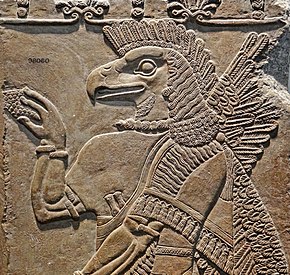
Bir ölü kültünün yaygın ve yaygın uygulamasını göremezdim (örneğin Etrüsklerde olduğu gibi). Ölüm, yaşam döngüsünün doğal bir parçası olarak algılandı. Evet, hipotez ilerledikçe, kuşlar (özellikle kartallar) yaşam alanı ile ölüler diyarı arasında haberciler olarak görülüyordu. Vinca-Turdas Uygarlığı’nın (M.Ö.6.000) bir kuş-tanrıçası varsa, neden daha eski bir uygarlık, insan benzeri bir antropomorfik değil, tanrı olarak bir kuşa sahip olmasın?

Bu ölüler, pratikte atalar kültü aracılığıyla, topluluğun sürekliliğini ve bütünlüğünü her şeyden daha fazla sağladı. Bununla bağlantılı olarak şamanların rolü büyük önem taşıyordu. Çünkü onlar, ritüellerle, tüm bileşen unsurların aralarındaki bağlantıları ve eklemlenmeyi ayrıntılı olarak sağlamada ve sürdürmede tam bir otorite ile kredilendirildiler.

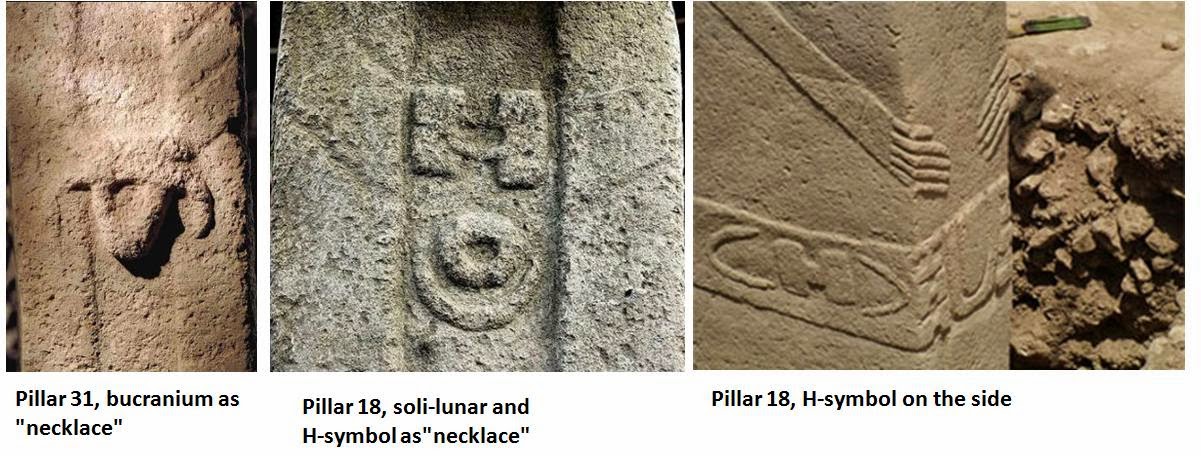
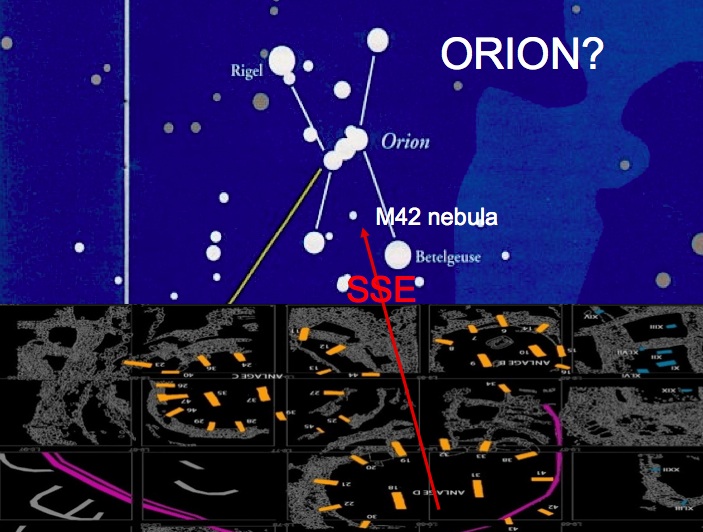
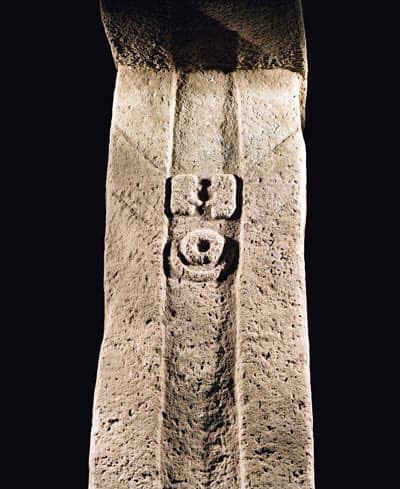
Birçoğu, T ve H işaretlerinin olası bir bağlantısının, ölüler aleminin yanı sıra başka bir saf ruhani gerçekliğe giriş kapılarını temsil ettiğini ifade eder. Güney Ermenistan’da, aslanların birçok kültürde kraliyet kapılarını koruduğu bilinen bazı mağara resimlerinde (aslan işaretlerini T işaretleriyle değiştirerek) bulundu. Bazıları, Mısır’da T sembolünün kapı anlamına geldiğini söylüyor. Sonra ben ve diğerleri, Mısırlılar tarafından ruhlar için istenen varış noktası olarak bilinen takımyıldız Orion olarak H işaretine atıfta bulundular (KA = ruh)

-Eğer aşamasına ulaştılarsa; bir tanrı düşünürdü, o tanrının en azından küçük bir ölçüde antropomorfik olduğundan başka hiçbir şey görmüyorum. T yıldızları, yüzeysel olarak şekillendirilmiş ellere sahip olsalar bile antropomorfik şekiller değildir. Son derece stilize edilmiş şekillerdir. Sonra heykelcikleri bulunacak ve hepsinin benzer olması gerekiyordu. Urfalı adam gibi. Şamanların antropomorfik bir tanrıya razı olmadıklarını düşünüyorum. İnsanlar ve az çok gizli bir tanrı arasındaki aracı rolünü kaybedebilirlerdi. Belki onlar, hayal edilmemişlerse de T şekli için rıza göstermişlerdi.

Rolul cu totul special al vulturului la civilizatia PPN Gobekli Tepe.

February 2, 2021

PPN vine de la Pre-Pottery Neolithic, adica neolitic pre-ceramic, care d.p.d.v. arheologic se imparte in perioadele A,B si C, A fiind cea mai veche. Asemenea procupari au avut foarte multe din marile civilizatii cunoscute, sau posibil aproape toate.Ma refer la civilizatiile Vinca-Turdas, Egipteana, Sumeriana, asiriana si cele Pre-Columbiene. Ca este vorba de Zeita Mama Pasare, Horus, Zu/Anzu, Quetzalcoatl (sarpele cu pene). Pe monumentele de la Gobekli Tepe sunt prezente mai multe specii de pasari, insa vulturul este figurat in numar mult mai mare.

Din https://en.wikipedia.org/wiki/Ninurta

Ninurta cu traznetele sale il urmareste pe Anzu , care a furat Tabletele Destinelor din sanctuarul lui Enlilwho (Austen Henry Layard Monuments of Nineveh, 2nd Series, 1853)
Ninurta - Wikipedia
Ninurta

Din http://www.brothersoftheserpent.com/2019/07/

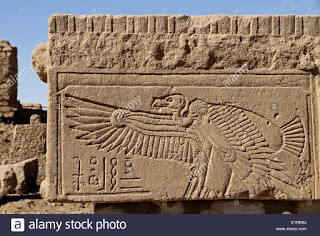
A “Vulture Stone” image from Elephantine, in Egypt

Populatia siturilor gen Gobekli Tepe, o populatie de culegatori-vanatori, avea preocupari mundane dar si de natura social-spirituala.In legatura cu viata de zi cu zi nu aveau mari necunoscute,cunoscand indeaproape tot ce este legat de natura si animale in manifestarile lor concrete. Dar cum este construit Universul, cum este articulat si functioneaza si daca si ce anume sta la baza si il misca, aici intrau intr-un taram absolut misterios si plin de secrete. Aveau cunostinta faptului ca partea consistenta a misterelor universului, si probabil si cea mai importanta este continuta in cer. Omul culegator-vanator avea mii de senzori si antene de o mare acuitate prin care percepeau realitatea terestra. datorita capacitatii crescute de a decela tipare, cautau tipare in orice din natura.Pentru ca voiau sa cunoasca mai mult, credeau ca cerul este un rezervor imens de secrete si tipare pe care incercau sa le desluseasca.

Pasarile erau vazute ca niste creaturi in buna masura fantastice care aveau legatura directa cu cerul si secretele lui incifrate in bolta instelata. Credeau ca pot fi sau chiar sunt mesageri, atat de sus in jos, in a aduce cunostinte de acolo, cat si de jos in sus a-i ajuta dupa moarte. Faptul ca vulturii sunt necrofagi i-a facut sa-i puna in relatie directe cu moartea in sine si concret cu mortii lor. Se pare ca e vorba de specia de vulturi plesuvi, care ca si condorul au gatul golas.

Din http://thehiddenrecords.com/gobekli-tepe-taurus-bull

Wayne Herschel - Author - The Hidden Records - discovered 35 ancient star  map cases around the world showing human origins from one of three sun  stars near the Pleiades

Dar legatura este si cu viata, atat timp cat o civilizatie nu cu foarte mult mai noua avea credinta ca stramosul lor este o creatura pasare. Asta pentru ca au pus i relatie directa ideea de reproducere cu cea de oul de origine si deci pasare.

Din GÖBEKLI TEPE’S VULTURE STONE: A WARNING ACROSS TIME OR SIGNPOST TO THE LAND OF THE DEAD? http://www.andrewcollins.com/page/articles/sagittarius.htm

Göbekli Tepe's Vulture Stone - A Warning Across Time or Signpost to the  Land of the Dead?

Parerea mea este ca nu s-ar fi gandit ca vulturul poate avea legatura cu mortii, eventual sa aiba un rol de transportatori sau alt rol necunoscut, daca nu vedeau cum cauta cadavre in general si astfel intelegeau un gen de apropiere sau relatie cu mortii.

Mai este o imagine care exemplifica si mai bine ritualul lor in care dupa cate s-a constatat pe de o parte lasau cadavrele sa fie descarnate de vulturi si pe de alta parte dezmembrau craniul:

Din

Semnele H de la Gobekli Tepe

January 31, 2021

Din New deciphering of Gobekli Tepe http://a9414495.eu5.org/origin/gobekli.html

New decoding of Gobekli Tepe temple

Aceste semne sunt prezente in numar relativ mare.Problema semnificatiei lor a mai fost dezbatuta si este in continuare.Eu am avut o sugestie de apropiere cu semnul sumerian proto-cuneiform PA. https://cdli.ucla.edu/tools/SignLists/protocuneiform/archsigns.html

Sumerian Lexicon – Sumerian Language Pagewww.sumerian.org › sumerian << Lexicul sumerian a beneficiat de mai multe … (ńiš) pa: frunze, muguri, germeni; ramură; aripă; pană >> semnul Pa este compus din 2 semne PAP

Sumerian Lexicon – IS MUNIis.muni.cz › jaro2013 › PAPVB_13 › Halloran_version_3 The Sumerian lexicon has benefitted from several classes … pab, pap, pa4: father; brother; man; leader [PAP]

M-am bazat pe faptul ca o serie de semne au fost folosite in Orientul Apropiat cu mult inainte de aparitia proto-scrierii.Altfel semnele au o istorie care nu are capat inapoi in timp.Nu am fost pe deplin multumit si acum reiau problema.Foarte interesant este faptul ca eu am facut apropierea acestui semn cu constelatia Orion si cu faptul ca ar putea fi o ligatura a doua semne Tau, dar cu surprindere am constatat ca si altii au facut-o.

Image result for gobekli tepe "orion"
Andrew Collins Gobekli Tepe’s Cosmic Blueprint Revealed Creator: Andrew Collins 

Am avut ideea sugubeata de a vedea daca sumerienii au folosit undeva doua semne Tau.Semnul T avand semnificatia “ME” .Am cautat sa vad daca au folosit doua semne ME.In monumente nu le-am gasit inca ligaturate sau nu, de fapt nici nu le-am prea cautat inca. In schimb le-am gasit in scris.Consider toate ipotezele ca fiind virtual valabile.Insa in prima parte o sa explicitez ipoteza mea “me-me” iar in a doua parte voi prezenta opiniile altora.

IPOTEZA MEA, 2T=H=”ME-ME

Din http://www.saradistribution.com/oldesttempleofworld.htm

The Oldest Temple in the World - Xirabresk, girê navokê, göbeklitepe

Vedeți mai bine Tau-ul ligaturat în semnele „I” ale GT, din următoarea imagine: http://thehiddenrecords.com/gobekli-tepe-taurus-bull sau de pe https://i.pinimg.com/564x/5c /d1/94/5cd194173a978386122812f338d685e8.jpg

Wayne Herschel - Author - The Hidden Records - discovered 35 ancient star  map cases around the world showing human origins from o… | The pleiades,  Star map, Ancient

Dublarea icoanelor este evidentă în existența stâlpilor principali dublati, altfel cei mai vechi ai G.T., stratul A. Dacă forma Tau ar putea fi relația cu viața și divinitatea, două Tau sunt un simbol nou; ce ar putea însemna? Să presupunem dublul aspect divin: relația cu viața de pământ și cu cerul. Atât a fost posibil sa fie cunoscut de ei si reprezentat întreg universul. Doar de câteva sute de ani umanii au aflat că cerul are de fapt o adâncime. Până atunci era imaginat ca un capac, acoperis al Pământului, care este figurat in portiunea liniei orizontale superioare a lui T. Deci T ar fi legatura vieții cu cerul și divinitatea și T-ul rasturnat legatura vieții cu Pământul. Rezulta ca prin pictograma H se realizeaza legatura vietii de pe Pamant cu Cerul, o poarta intre Cer si Pamant.

Din List of Mesopotamian deities – Wikipediahttps://en.wikipedia.org › wiki › List_of_Mesopotamian… << Deities in ancient Mesopotamia were almost exclusively anthropomorphic. They were thought … Both the Sumerian and Akkadian languages contain many words to express the … Ninkarrak, Meme, Bau, and Ninisina, is the Mesopotamian goddess of healing and the divine patroness of doctors and medicine-workers.>>

Din World’s First Known Written Word at Göbekli Tepe on T-Shaped Pillar 18 Means God Manu Seyfzadeh, Robert Schoch Institute for the Study of the Origins of Civilization, College of General Studies, Boston University, Boston, MA, USA https://www.scirp.org/html/1-1140123_90367.htm?fbclid=IwAR1kPHutMJikYFQzqFqkiI5-QIx_aKfA5-oB2_LoBOVksqVAPe5C64HjyFs <<Susținerea în continuare a unei conexiuni lingvistice între hieroglifele luwiene și imaginile de la Göbekli Tepe sunt până în prezent simboluri luwiene netraduse asemănătoare cu iconografia în formă de T a lui Göbekli Tepe și un simbol asemănător cu H, care a fost cuvântul luwian pentru „poartă” >> Inca si mai mult, in lucrarea de mai sus se afirma ca simbolul H cu 2 semilune de pe pilonul G.T. seamana cu logograma luwiana 360 pentru zeu si ca atare semnifica cuvantul “ZEU”

Laroche #360 Luwian hieroglyph denoting "god". From Laroche (1960: p. 187).

Pictograma reprezentand poarta catre Univers / intreg Universul, acea pictogramă a fost folosită pentru a împodobi diferite elemente de piatră, astfel fiind utilizate cu diferite orientări. În niciun caz nu ne așteptăm ca sumerienii să copieze cu exactitate icoanele celor de la G.T., așa că nu este de mirare să nu găsim acest semn în forma identica la sumerieni.

Din www.researchgate.net › publication Rezultate de pe web (PDF) Ancient Near Eastern Gods Enki and Ea: Diachronical … Enki-Ninki Deities and the God Enki in Old- Sumerian Sources 46. 3.5. Enki in Old- Sumerian … ME.ME the me-s. dEN.KI (of? / to?) Ea. AL6.

www.jstor.org › stable The Accounts of the Origin of Writing from Sumer, Egypt and China – JStor me me available, first to gods, and then through them to the human world. So, if me are of divine origin, we have to admit that “the scribal art

babylonian-collection.yale.edu › …PDF The Exaltation of Inanna, by William W. Hallo and J. J. A. van Dijk. Yale … true that the colophons of Sumerian and Akkadian literary series-which correspond to the … R-imin-bi, 5: “totality of me‘s”; me-zi, 60. me-zu

ore.ac.uk › download › pdfPDF Nippur Bibliography – CORE 1 ian. 1992 — Barton, G. A. Sumerian Business and Administrative … Zettler, R. L. ” The Genealogy of the House of Ur-me-me: A Second …

krieger2.jhu.edu › pdf › jcooper “Enlil and Namzitara” Reconsidered [“Enlil and Namzitara”] is a Sumerian variation of a well-known theme, … The Genealogy of the House of UrMe-me: a Second Look. AfO 31:.

hal.archives-ouvertes.fr › doc…PDF Masters’ Writings and Students’ Writings: School Material in … – HAL 7 apr. 2015 — learning cuneiform writing, Sumerian vocabulary and grammar, … The [ texts] in Sumerian and Akkadian, from A-A ME- ME.

etheses.bham.ac.uk › eprintPDF Stealing the Enemy’s Gods: An Exploration of the Phenomenon of … accompanied by recitations of incantations in Sumerian and Akkadian; the incantations and the ritual … 23. me-me-ni ina IGI LUGAL

etcsl.orinst.ox.ac.uk › cgi-bin › etcsl The Electronic Text Corpus of Sumerian Literature … udun-mah-e du8-a-zu. 20. zar gu2-nida-am3 si sa2-sa2-am3. 21. munu4 sahar jar-ra a sig9- ga-zu. 22. ur me-me nam gam-gam-ma-am3

escholarship.org › content Rezultate de pe web UNIVERSITY OF CALIFORNIA, SAN DIEGO Death… eScholarship.org The Electronic Text Corpus of Sumerian Literature, Black … me-me) noble guard (gam-gam- ma-am3) it even from the potentates (?)” ( ETCSL …

www.researchgate.net › publication (PDF) Ancient Near Eastern Gods Enki and Ea: Diachronical … Enki-Ninki Deities and the God Enki in Old- Sumerian Sources 46. 3.5. Enki in Old- Sumerian … ME.ME the me-s.

Daca la sumerieni exista semnul si notiunea ME, ei fac referire la faptul ca existau si foloseau mai multe, o multime de ME. Multimea cunostintelor, totalitatea lor reprezenta cunostintele lor despre intregul Univers, cel terestru, si cel ceresc, cu totul fiind demn de o adanca admiratie si respect, astfel de factura divina.

Din HAMLЕT  MARTIROSYAN. THЕ LION CHARACTЕR THЕ PETROGLYPHS OF SYUNIK AND THЕ ANCIENT WORLD https://www.academia.edu/12277907/Lion_Character_in_the_Petrogliphs_of_Syuniq_and_the_Ancient_World << Tot ce s-a spus mai sus cu privire la uși arată că, în percepțiile mitologice ale viziunii lumii antice, ușile care leagă diferite lumi erau printre cele mai importante elemente ale ordinii mondiale. Pe scurt, dacă nu există ușă, nu există nici o modalitate de a comunica cu Divinitatea. Acest simbol al viziunii mitologice a lumii a ușilor sau coloanelor care formează ușile a fost dezvoltat devreme și vedem cele mai vechi surse ale sale în complexul templelor de la Portasar (Göbekli Tepe) (X mileniu î.Hr.) și petroglifele Syunik (înainte de mileniul XIII î.Hr.) Anumite fapte indică faptul că diferiți zei aveau numere și forme diferite de porți. Am văzut mai sus că putem interpreta stelele  în formă de T de la Portasar (G.Tepe) [imaginea 61, prima imagine] ca ideograme obiective cu semnificația „deschidere, ușă, poartă. De asemenea, am văzut că mult mai târziu, ideograma a fost utilizată cu același sens atât în ​​Sumer, cât și în Egipt 82 ( Sumer., caracterul T = ME și Egipt. T = rw = „ușă hieroglifică). Aceste și alte fapte referitoare la Portasar/G.Tepe prezentate mai sus (cavitatea ușii sculptate din piatră monolită cu sculpturi de leu pe coloane, coloanele gemene ale templului subteran cu imagini de leu) atestă faptul că la Portasar/G.Tepe ușile aveau o semnificație ritual-religioasă importantă și erau legate la închinarea la niste zeitati specifice. >>

“MONTES SERRORUM” and SERRI

April 25, 2019

                                                                                                             ! PREZENTA POSTARE  REPREZINTA SI SUSTINE  IPOTEZA CONFORM CAREIA SCRIBUL AVEA O VAGA CUNOSTINTA DE O SUMA DE SEMNE DE ORIGINE SUMERIANA, DAR NU LE STAPANEA INTELESUL SI CA ATARE DOAR LE-A EXPUS.                                          CUNOSTINTELE SALE IN A SCRIE CU ADEVARAT S-AR REZUMA STRICT LA JUMATATEA DE SUS A TABLITEI ROTUNDE !

Din The Lost Civilizations of the Stone Age Richard Rudgley                                                  << the tablets represented a garbled and ‘senseless’ mimicry of Near Eastern writing >>

Din discovery.ucl.ac.uk › Josiffe_10082208_thesis                                                                         an investigation into the origins of writing – UCL Discovery
https://discovery.ucl.ac.uk/PDF by C Josiffe – 
<< Tărtăria tablets has been … He suggested that these scratch marks had been made as mimicry of the signs themselves … >> 
Din Acta Terrae Septemcastrensis
<<The hypothesis that the Tartaria tablets represent only a writing-like design was … had a vague idea of Sumerian documents and aped them (Gelb 1967: 489).>> ====================

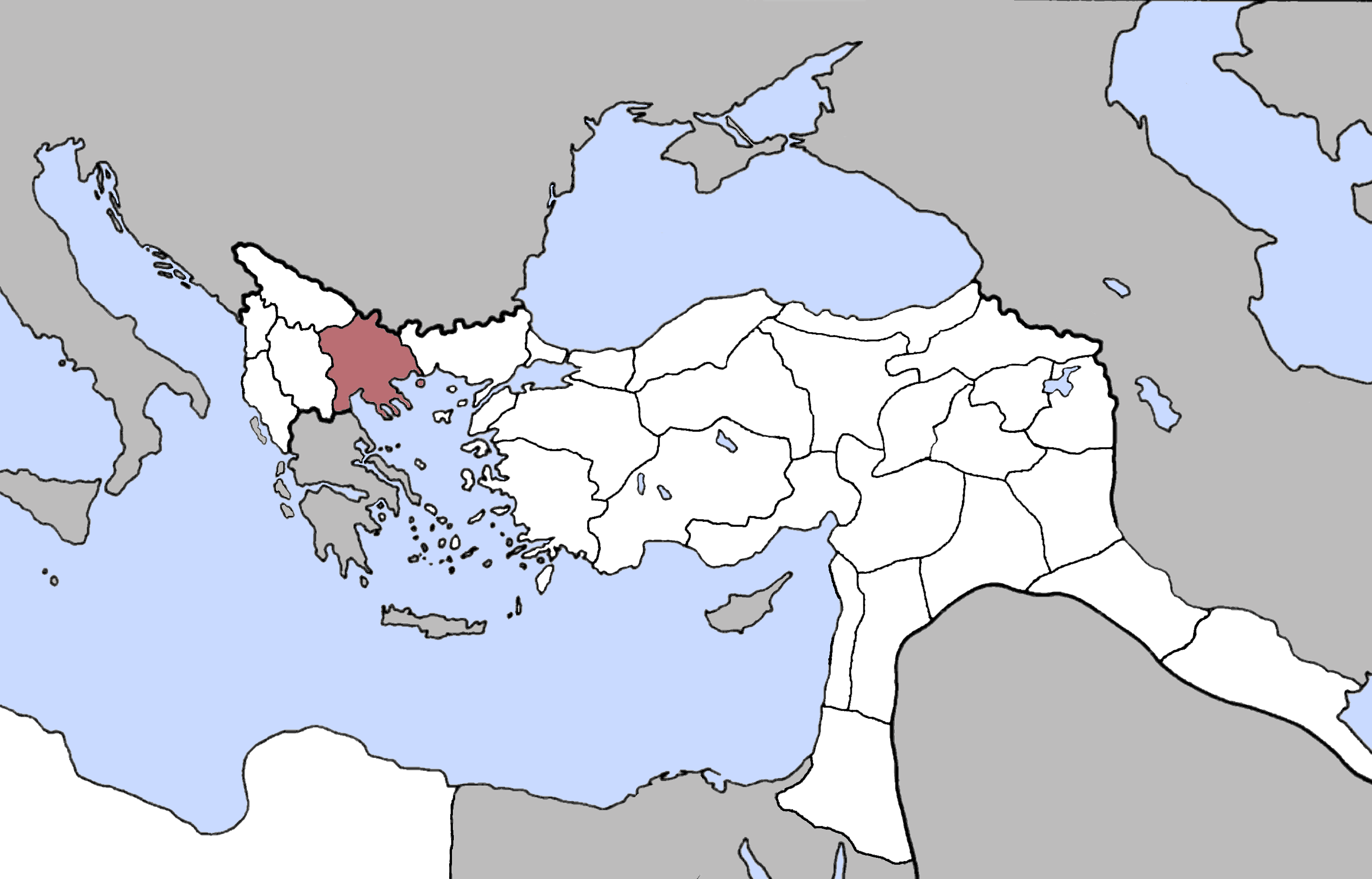
In urmatoarele,                                                                                                                                                                                                                                                         – reafirm ipoteza avansata anterior de cercetatori conform careia  SERII erau un trib dacic din CAUCALAND=TRANSILVANIA si nu unul provenit din Caucaz                                                                                                    – Avansez ipoteza ca MONTES SERRORUM se refera la CARPATI si mai precis la MUNTII RETEZAT !                                                ===============================

 Din Storia d’Italia del medio-evo: De’ popoli barbari avanti la loro … https://books.google.ro/books?id=ymgtAAAAYAAJ

SERRI (Monti). Della Dacia di là dal Danubio. 1 Goti si riparano fra le loro inaccessibili gole de’Serri, perischi- var l’impeto di Valente. Augusto ( A.367 ) , p. 804.
Din https://archive.org/stream/OEnigmaSiUnMiracolIstoricPoporulRoman/O%20enigma%20si%20un%20miracol%20istoric-%20poporul%20roman_djvu.txt
Nu te poţi împiedica de a nu releva deosebirea dintre cele două 
migraţiuni: una sprijinită pe un text precis: rezumatul lui Eu- 
tropius, privind regiuni delimitate de geografia politică a impe- 
riului roman ; cealaltă întemeiată dimpotrivă pe tăcerea izvoarelor 
istorice, pe fapte de ordin linguistic şi urmând totuşi un itinerar 
mai complicat decât acel arătat de texte. E vorba într’adevăr de 
o adevărată călătorie în zig-zag a strămoşilor poporului român. 
« Daco-ilirieniî » ar fi străbătut întâi Banatul, ar fi ajuns în Transil- 
vania şi s’ar fi răspândit de acolo, printr’o nouă expansiune dela 
nord spre sud şi est, în Muntenia şi în Moldova. Dintre toate 
naţiunile deprinse a călători, Românii, enigma şi miracolul Evului 
Mediu, ar deţine astfel cu siguranţă recordul nestabilităţii teri- 
toriale ! .....................
Oare aceste rânduri au fost scrise de vre-un partizan îndârjit 
al continuităţii daco-romane, care ar refuza să se plece în faţa 
mărturiilor categorice ale izvoarelor ? Deloc ; ele privesc Alsacia 
după plecarea legiunilor şi instalarea definitivă a triburilor ger- 
manice pe malul drept al Rinului, care au cotropit din nou Galia, 
pentru a nu o mai părăsi, în primii ani ai secolului al V-lea. Ceea ce 
pare a dovedi că ipoteza unei retrageri a populaţiei rurale în pă- 
durile şi în munţii Daciei, în primii ani ai ocupaţiei barbare, nu 
ar fi aşa de absurdă, cu atât mai mult cu cât ea este dovedită chiar 
pentru unii cuceritori ; regele got Atanaric, în 376, s’a retras cu 
toţi ai săi în Caucaland, locum altitudine silvarum inaccessum et 
montium, pe care Sarmaţii tocmai îl părăsiseră şi care e identi- 
ficat azi cu unii munţi din Banat. încă din 367, Goţii se refugiau 
în Montes Serrorum, Carpaţii, în faţa înaintării ameninţătoare a 
legiunilor împăratului Valens. Mai înainte încă, în 323, împăratul 
Constantin a surprins dincolo de Dunăre pe o înălţime împădu- 
rită, în Muntenia, bandele lui Rausimod care tocmai pustiiseră 
Moesia superioară şi Tracia şi le-a silit să înapoieze locuitorii pe 
care-i luaseră cu sine l ). De altă parte, dacă populaţia civilă ră- 
masă în Dacia n’a lăsat urme epigrafice ale persistenţei sale de 
a locui ţinuturile cotropite, emigraţii instalaţi dincolo de Dunăre, 
în noua «Dacie », creată de Aurelian, după cum August stabilise 
odinioară Germanii pe malul drept al Rinului 2 ), nu au lăsat 
nici ei mai multe. Ceea ce ar face să se creadă că numărul lor nu 
a fost aşa de mare, după cum s’ar presupune în urma părăsirii 
totale a unei provincii de populaţia ei civilă şi militară.
Din Storia d’Italia del medio-evo: De’ popoli barbari avanti la loro … https://books.google.ro/books?id=ymgtAAAAYAA
SERRI (Monti). Della Dacia di là dal Danubio. 1 Goti si riparano fra le loro inaccessibili gole de’Serri, perischi- var l’impeto di Valente. Augusto ( A.367 ) , p. 804.

Din Three Problems of Historical Geography: Dafne, Montes Serrorum and Caucaland, “Études Balkaniques“, Sofia, 36, 2000, 3, p. 132-143 Alexandru Madgearu                       https://www.academia.edu/1305500/Three_Problems_of_Historical_Geography_Dafne_Montes_Serrorum_and_Caucaland_%C3%89tudes_Balkaniques_Sofia_36_2000_3_p._132-143

From https://theodora.com/encyclopedia/s/serros_seres.html                             SERES, Serros or Siros, chief town of a sanjak in the vilayet of Salonica, European Turkey, on Lake Takhino, a navigable expansion of the river Karasu or Struma (ancient Stryrnon), 43 m. by rail N.E. of Salonica. Pop. (1905) about 30,000, of whom about half are Bulgarians (one-third of them being Mussulmans), nearly one-fourth Greeks, about one-seventh Turks and the remainder Jews. Seres is built in a district so fertile as to bear among the Turks the name of Altin Ovassi, or Golden Plain, and so thickly studded with villages as to appear, when seen from the outliers of Rhodope on the north, like a great city with extensive gardens. It is the seat of a Greek archbishop and patriarch. It consists of the old town, Varosh, situated at the foot and on the slope of the hill crowned by the old castle, and of the new town built in the European fashion on the plain, and forming the commercial centre.

Seres is the ancient Seris, Sirae or Sirrhae, mentioned by Herodotus in connexion with Xerxes’s retreat, and by Livy as the place where Aemilius Paulus received a deputation from Perseus. In the 14th century, when Stephen Dushan of Servia assumed the title emperor of Servia, he chose Sirrhae as his capital; and it remained in the hands of the Servians till its capture by Sultan Murad II. (1421-1451).

Image from https://en.wikipedia.org/wiki/Salonica_Vilayet

From https://www.revolvy.com/page/List-of-ancient-Daco%252DThracian-peoples-and-tribes

======================================================                                         From https://www.nihilscio.it/Manuali/Lingua%20latina/Verbi/Coniugazione_latino.asp?verbo=serro%20&lang=EN_     

INDICATIVE Present meaning
ego serro I saw                                                    rom:  “eu fierastruiesc, tai cu fierastraul, ?RETEZ?

From http://www.dicolatin.com/FR/LAK/0/SERROS/index.htm                                                  SERRI, ORUM, m pl

accusatif pluriel SERROS
SERRI, ORUM, m pl
1 siècle après J.C.PLINIUS (Pline)
Serres n. m : peuple voisin du Caucase voir: Serres
SERRI,SERRO,SERRORUM MONTES :?”Muntii retezati, RETEZAT“?

————————————————————————————–                                                          From https://en.wiktionary.org/wiki/herus                                    Noun herus m (genitive herī); second declension

  1. master of the house or family
  2. owner, proprietor
Case Singular Plural
Nominative herus herī
Genitive herī herōrum
Dative herō herīs
Accusative herum herōs
Ablative herō herīs
Vocative here herī

Synonyms dominus

==============================================

In upper half of Tartaria round tablet, From https://www.unmyst3.com/2012/10/tartaria-tablets.html

we could have: In “DDoC” sequence. sign “C”                                                                                                            In handwritten Greek during the Hellenistic period (4th and 3rd centuries BC), the epigraphic form of Σ was simplified into a C-like shape.[4] It is also found on coins from the fourth century BC onward.[5] This became the universal standard form of sigma during late antiquity and the Middle Ages. It is today known as lunate sigma (uppercase Ϲ, lowercase ϲ), because of its crescent-like shape

So, maybe  +++++ DDoc = Se/Si  RROS

Sirros HeRo :”DOMINUS SERRI?/CARPATHIANS?

P.S. Folosind alfabetul Sud-Vest Iberian (Tartessian) am putea avansa o posibila legatura intre tribul Burilor,Burebista si o populatie de factura Celtica.Dupa alfabetul Tartessian, HD=BUR                                                                                                                                                 In albaneza BURe=”sot,barbat”   si in basca/euscara BURU;”CAP”    (? BURE-BISTA~bure-vista=capetenie de vaza                                                                                      https://en.glosbe.com/en/sq/tail bisht=tail (probably tail as end)

Basque language – Wikipedia


=================================

SERRI                                                                                                                                                       Avand in vedere ca SERRI au aparut pentru prima oara in Banat, avansez ipoteza ca acest trib ar putea proveni din zona Thesaliei,Thesalonic, Serres. Numele lor ar putea fi legat de Muntii Retezat, dar si de faptul ca este o populatie cumva “retezata” de locul de origine, SERES, Serros or Siros vechiul Seris, Sirae or Sirrhae                                                  P.S.                                                                                                                                                             – Nu ar fi exclus ca sa existe o legatura cu populatiile Epocii Brinzului timpuriu din aria Cicladelor, insula Syros/Siroos!                                                                                                              MONTES SERRORUM

-CAUCA-land se refera la Transilvania.CAUC inseamna “CAUS” si se refera la aria circumscrisa si inchisa de Carpati, depresiunea Transilvaniei.

(PDF) 35917843 Dacia Land of Transylvania | Ion Gheorghe …  https://www.academia.edu/4276122/35917843_Dacia_Land_of_Transylvania

In turn, the Sarmatians chased the IndoEuropean Scythians (Scythe Armed Men) ….. One of them was the Cauci/Chauci, so large and powerful a group that, for a period of time, some of the Carpathian Mountains were named the Caucaland..
http://www.archeus.ro/lingvistica/CautareDex?query=CAUC                               CAÚC^2, cauces.n. (Înv. și reg.) Căuș Latcaucus.
The word “caucus” has its roots in the Greek “Kaukos“.The word “Caucasian”, from the Greek “Kaukasious (equivalent to “Kaukos“+ ios adj. suffix) + -AN.”
Indo-European etymology : Query result
starling.rinet.ru/cgi-bin/response.cgi?root=config&morpho=0&basename…


Dar si pentru Munti Carpati, care reflecta aspectul zimtat  si astfel le-au atasat o denumire “MONTES SERRORUM”=”MUNTII RETEZATI“, denumirea actuala “MUNTII RETEZAT”

See: ELEMENTS OF CARPATHIANS GEOGRAPHY IN THE
OLD HISTORIC AND CARTOGRAPHIC DOCUMENTS
Petru URDEA , Claudia URDEA** https://geografie.uvt.ro/wp-content/uploads/2015/06/08_Urdea.pdf                                                                                             For instance, on the map of Petrus Kaerius, a map called painting-map (Ziegenbalg,
1993), entitled “Vetus description Daciarum nec non Moesiarum” published in Hague in
1541, the Carpathians, “Carpathes Mons” appear both at west from the upper course of Tisa, “Tibiscus flu” and at east of the upper course of Olt, “Aluta flu”. It is interesting that the text ,,Serrorum montes, ardui et inacceßi, niƒi per quam peritis. Amen’’, (Ridged mountains, abrupt and inaccessible. Not even at least for skilled mans. Amen.) appears between Aluta flu (Olt river) and the mountains at west (Figure 3).

!!   Figure 3: Fragment of the Kaerius map (1541) 

Un alt simbol prezent pe tablita de la Tartaria, comun civilizatiilor sumeriana si minoica

March 7, 2019

Un alt semn prezent pe tablita dreptunghiulara cu gaura de la Tartaria, este acel “cap de magar” Imaginea, din 3.1. Interpretarea simbolurilor neolitice https://sites.google.com/site/seimenisatdinneolitic/prima-traducere-corecta-a-unui-simbol-neolitic?tmpl=%2Fsystem%2Fapp%2Ftemplates%2Fprint%2F&showPrintDialog=1

Acest semn apare in civilizatia minoica cu forma apropiata, ca simbol “MA” Din https://linearbknossosmycenae.com/2017/06/24/early-minoan-hieroglyphic-roundels-and-seals-may-lend-some-insight-into-the-later-development-of-the-linear-a-syllabary/

Se pare ca originea atat pentru semnul de pe tablita de la Tartaria, cat si pentru semnul minoic este semnul sumerian proto-cuneiform https://cdli.ucla.edu/tools/signlists/protocuneiform/archsigns.html AMAR:”vitel”/engl.CALF Taurul a fost un simbol comun civilizatiilor sumeriene si minoice:                                                                                        Possible connection between the cultures of Ancient Sumer and Minoan Crete http://mmtaylor.net/Holiday2000/Legends/Sumer-Crete.html&nbsp;                                                      “There are certain hints that the Minoan civilization might have been influenced by, or even descended from, the Sumerian / Mesopotamian civilization of a thousand years earlier. According to David Rohl(Legend: The Genesis of Civilisation, London, Arrow Books 1998), the Phoenecians and Canaanites who inhabited the coast of what is now Israel and Lebanon came from Sumeria (Ur, Uruk, Eridu) at the same time as others from the same region went to Bahrain and then to the Upper Nile, some time around 3000 BC. If the Minoan culture was actually derived from the Sumerian, as seems not unlikely, it must have happened before writing became common in Sumer, around 3000 BC. Rohl’s dates tend to be more recent than the conventional dates, so when Rohl mentions 3000 BC, he refers to a time conventionally dated rather earlier, perhaps 3500 BC.           …………………………..                                                                                                                      The bull was important in the Minoan religion and culture, as it was in Sumer. Gilgamesh (who, according to Rohl, ruled in Uruk around 2487 BC) is shown as half-bull, half-man, as is the Cretan Minotaur in the much later Greek legend. The picture on the seal looks remarkably like depictions of the Minotaur, and it is possible that the Greeks knew of such depictions as well as of the bull cult in Minoan Crete. There are many other bull-man representations in images from Mesopotamia. Sometimes the body is bull in part or whole and the head human, sometimes the reverse. Perhaps there were similar Minoan images known to the Greeks, but as yet not discovered by modern archaeologists. So, one can assume that the bull-man “monster” was an image known to the Early Greeks of Minoan times.

Cercetatorii avanseaza ipoteza ca simbolul sumerian aMAr (vitel,taur), sau aMA (mama) a fost la originea minoicului MA, care de fapt a fost simbolul minoic al zeitei-mama.

Din Cretan Hieroglyphics & Protolinear Script | Giannhs Kenanidhs and … https://www.academia.edu/27866745/Cretan_Hieroglyphics_and_Protolinear_Script


DinThe Arkalochori Axe and its siblings | Giannhs Kenanidhs – Academia … http://www.academia.edu/27866963/The_Arkalochori_Axe_and_its_siblings


TARTARIA SQUARED TABLET WITH HOLE/19 Linear A/B approach

February 8, 2019

AKNOWLEDGEMENT

This page must be understood to be kind of probe and testing, as to check in wich measure, or how close the supposed Tartaria tablet writing goes toward, or fitts the Aegean-one. You must know that the signs on the tablets are closest to sumerian proto-cuneiform ones. Then follow at the same level Anatolian and Aegean writings. The conclusion is:                           – there is no genuine sumerian nor genuine Aegean writing on tablets.              MANY ASSYROLOGISTS (AND ME ALSO) SUSTAIN (in the best case), AN QUASI-SUMERIAN WRITING                             But no wonder, is reflecting an Anatolian-European continuum, and there would be a simple explanation for this fact:                                                                                  Possible, as hypothesised Mr.I.Kenanidis and G.Papakitsos for minoan writing, the Minoans were early sumerian migrants.I AM EXPECTING THAT UNDER DIRECT SUMERIAN INFLUENCE, MINOANS SOME-HOW ADAPTET THEIR CONCEPTS (particularly that of the signs) TO THEIR CULTURE OF OLD-EUROPE TYPE ;                                                                                                   DON’T KNOW FROM WICH STAGE OF THIS PROCESSUS ARE COMING THE TABLETS !  ==============================================================

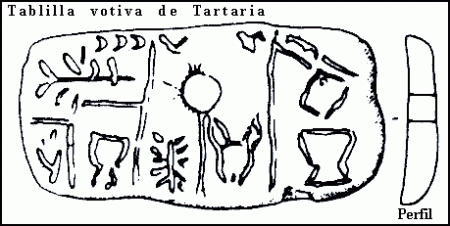
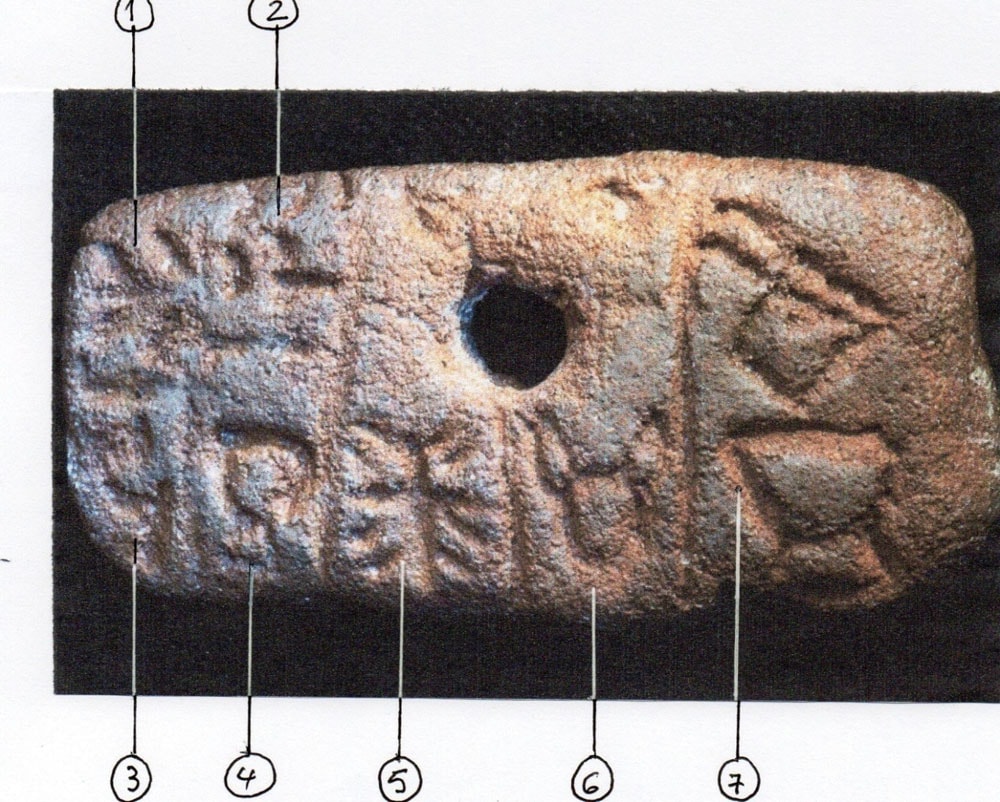
TARTARIA SQUARED TABLET WITH HOLE/2018 Linear A/B approach

Image from ESCRITURA DE TARTARIA http://www.proel.org/index.php?pagina=alfabetos/tartaria

tartaria1

We have upper-left side, those D-s (3 signs)

(In close shape, but by imprinting, sumerians used to express numbers.

Were found in economic transactions.Signs are not imprinted as in sumerian (cuneus cuneiform) technique with the opposite edge of sharpened-one edge of stylus, so I wonder if  the writer was a native sumerian.

From https://www.voceavalcii.ro/39794-decrypting-of-tartaria-inscription-part-2-rectangular-amulet.html

Here maybe No.2, where the indication line is black.

Those 3 signs, “>>>”?, “)))”,could be (as in sumerian) number 3 or 30.                                                    (after Rumen Kolev http://www.su -varna.org/izdanij/Magazin%201%20conf/Pages%20from%2046%20to%2053.pdf interpretation:”3 (months ?)                                                                                                      CONCLUSION: “30/3 (Months ?)”                                                                                                              ——————————————————————————–

  1. Close to these signs, downward, we have sign No.1 as ear of cereal
  2.  
  3. Usually associated with agriculural products as barley:                                             Image,from http://www.mesopotamia.co.uk/writing/story/page06.html
  4.                                                                                  From http://people.ku.edu/~jyounger/LinearA/

LINEAR A *04 (TE), common

In linear B,

Linear B, Cretan“TE” “Wheat

https://encrypted-tbn0.gstatic.com/images?q=tbn:ANd9GcRykURVevP7C91htJQXSWtUoIKlv_VE7Zk8RacOILleQApR07vw

Note that this sign rather pertain to proto-writing. Cause in linear B we have signs for specific kind of grains (wheat visa barley):

https://encrypted-tbn0.gstatic.com/images?q=tbn:ANd9GcRHPdQSYyE8qr4n115PLPH_UBTyeNB9XKrQDADDWG3bdzC2-UEQZQ

(Rumen Kolev http://www.su-varna.org/izdanij/Magazin%201%20conf/Pages%20from%2046%20to%2053.pdf interpretation, with the sign underneath:”3-months corn in the temple”                            CONCLUSION: Together those 2 signs,could be interpreted as                                                                                        “ (30), 3 /volume measures of some sort of cereal grain”(gr.sitos) ?”                                  =====================================================

Next downward,this Y-shaped sign (! drawn separately in a box !)will see what could be.

  1. (sign No.3)

Table from https://www.researchgate.net/figure/The-Cretan-Hieroglyphic-table-of-signs-as-suggested-in-the-inscriptions-corpus-Olivier_fig3_273096050

the-cretan-hieroglyphic-table-of-signs-as-suggested-in-the-inscriptions-corpus-olivier No.019 ;024 ?                                                                                                                                                        Y-sign= linear B= “SA?

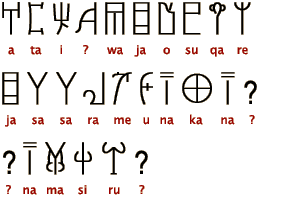
From http://www.ancientscripts.com/lineara.html “Once again applying Linear B reading to the previous Linear A texts, we see the sign sequence ja-sa-sa-ra-me. This sequence is very interesting because it appears very often in many other such votive inscriptions in slightly different variants.

lineara_ladle

FINAL READING: “SA”                                                                                                                            From   http://people.ku.edu/~jyounger/LinearA/&nbsp;                                                                     *31, SA, perhaps a logogram for *SA-SA-ME?;

From http://people.ku.edu/~jyounger/LinearA/&nbsp;                                                                                     JOHN JOUNGER SA (HT 114b.1) or SI (HT 30.1) = paid?

FINAL READING: “SA”  ========================================================                                     Next, to the right, vertical separation line ! sign 4

Next,downward, folow a sign No.4

wich ressemble violin,labrys?/ 2 merged lozenges ?;

b4dd6746fe84b265e714daef471f2b89

Note: the sign  is repeated as the last sign on the tablet

Close to the cretan hierogliphic sign 042 (Labrys) <see table above>

https://enijote.wordpress.com/2017/11/25/double-axes-and-the-limits-of-knowledge/

Not much to see.  But here’s its Linear A counterpart:

The sine qua non is the interpretation of labyrinth as “Place of the Double Axes,

The Cretan Hieroglyphic evidence is even more explicit:

There are saying that the sign is at the origin of “A”:

From Essays on Ancient Anatolia in the Second Millennium B.C. https://books.google.ro/books?isbn=3447039671

Prince Mikasa no Miya Takahito (son of Taishō, Emperor of Japan) – 1998 – ‎Civilization, Assyro-Babylonian

reconstructed an IE *peleku14 of sacred use that would go back to a pre-IE digging implement of the Mesolithic of NW Europe and pre-Mesolithic … Mycenaean dapur-, Hittite tabarna/tla- barna/labarna(s) from a Sumerian balag, Assyrian pilakku, Sanskrit paraqu, Greek pelekus, designating a certain type of axe.

    (Rumen Kolev:”temple”,good!)

By one side, the sign has the exact shape of the sumerian proto-cuneiform sign “AB=house,temple” and by the other side labrys is the king, divinity icon, and present in most of the minoan temple/shrines, especially in Minos palace. So could be the house of the labrys :LABYRINTHOS.                                                                                                    CONCLUSION:  LABRYSICON related either to Goddess A-Sa-Sa-Ra  and ITS HOUSE-TEMPLE, cave-shrine, LABYRINTHOS                                                                                                ——————————————————————————————                                                  Next, an insect/miriapod-like sign !?! is found in more and less simylar shape all over:

As a refference, Sumerian “DINGIR”/God/sky    From https://cdli.ucla.edu/tools/signlists/protocuneiform/archsigns.html&nbsp; sign “AN


          sum.AN it is:God, Heaven

But! If URUK “dingir” has 8-11 spikes our sign have 12 (limbs)

Note that is not in a shape of wheat-ear or plant but is in a star-like shape.The difference in “spikes” number is not much problematic in my opinion.So why not,or possible to be something star-like i.e. “a GOD”?   But much,much close,(if rotated 90deg)    (count the number of lines! totaly 12 in sumerian sign as in our)                           ——————————————————————

From http://www.namuseum.gr/collections/prehistorical/mycenian/mycenian13-en.html

“KE”? (2-nd in the first row) ??

(Rumen Kolev rendering:”Sun”)                                                                                    CONCLUSION:                                                                                                                                            I will change my final interpretation of the sign, from “God, Heaven” ,”Sky-God” to “SUN”, cause beginning from minoan time, appeared the multy-rayed symbol and sure was the Sun !                                                                                                                                          —————————————————-                                                                                                 Next, donkey head-like picture or sign shape.In sumerian the sign was AMAR:”CALF”, but minoans took the sign and changed finaly to a kat-like shape.

 LINEAR B “MA

Note the scribal hand sign Ma with big ears as in our tablet!

(Rumen Kolev rendering:”bull Enlil”)

  CONCLUSION                                                                                                                                  The “long-eared head” is not related as in sumerian to AMAR “calf” ,Sun- calf/bull , but derived from the sumerian root “ama=mother”, it is MA: Aegean Mother-Goddess MA: Aegean Mother-Goddess                                                                                 ————————————————

Second sign from the end backward,right edge,upper sign.Sincerely at this sign I run out of… resources.

Sign Mo, MU !

See the paper: BUCRANIUM SYMBOL AND SIGN Cornelia-Magda Lazarovici, Gheorghe Corneliu … – Arheovest  arheovest.com/simpozion/arheovest3/03.pdf

“In Vinca-Turdas culture were found hundreds of artefacts of different kinds with the shape of a bucranium (bull-head). Or shape intricated or depicted in a way or another in them.”

The horned-head as poor as is depicted could be that of a bull. Especially cause of the sturdy/massif head.

But I explain why radher is bull. (Rumen Kolev http://www.su-varna.org/izdanij/Magazin%201%20conf/Pages%20from%2046%20to%2053.pdf rendering “bull” and the underneath sign “in/of/for the sacrifice”!?)

Cause the Bull was related to Gods/SUN and rullers (MinoTAUR).As in ancient East the bull was associated with the Sun.                                                                                            CONCLUSION                                                                                                                                        Horned-like icon is the Aegean Bull, “MU“, whoever was related to.                                       ——————————————–                                                                                                            And downward we have the very icon of  Sky-God and of the Earth counter-part,ruller Minos the DOUBLE-AX shape,

Note: By sumerians bull head associated with double ax-shape was sign AMAR + sign AB

Meaning         Bull-calf  + House/abode

Wich by them those pair-signs, ment       NERGAL      (a pair of the Sun, underground hypostasis)

(the fierry hott Sun of the mid-day time, later an underwold&death GOD(dess)

So, we have the heavenly Bull=SUN asociated with his GOD/royal sign LABRYS and his temple-house LABYRINTHOS

As Zeus Labraundos,Keraunos was depicted with the axe in his hand.

In this case nothing is necessary to be added and those signs don’t need to be much comented/translated or interpreted, it could be,

INTERPRETATION OF THE WHOLE TABLET:                                                                          AN OFFERING, ( 3/30 grain, wheat? units) SACRIFICE on THE SHRINE,TEMPLE TO THE MOTHER-GODDESS and to the SUN-BULL-GOD.                                                                                                                       ———————————————     

From ПЛОЧКИТЕ ОТ ТАРТАРИЯ И ЧАШАТА ОТ СУВОРОВО – ДВА „НАДПИСА” НА
РАННАТА ДУНАВСКА КУЛТУРА И РАЗШИФРОВАНЕТО ИМ
Румен Колев         interpretation of the last 2 signs: “cattle in/of/for the sacrificed”)

“LADY OF TARTARIA” or HOW A “GOOD INTENTION” AT RISK TO BECOME A HOAX

February 6, 2019


,             “LADY OF TARTARIA” ; SCIENCE OR SCIENCE-FICTION ? or

HOW A GOOD INTENTION HELPED WITH LIGHT-MINDEDNESS CREATED A GHOST

The very begining was in ‘61, when at Tartaria village, site LUNCA, in unclear circumstances was unearthed a group of artefacts.Their exact or relative position is even now an enigma.Anyways the first wrong step was to atribute the same origin,age and culture to entire bunch.                                                                                  But only the bone’s age was determined with accuracy (5.300B.C.)                                   After this bone age determination, in an optimistic exuberance burst, this 5.300 B.C. age was atributed to all artefacts. (mainly by Romanian scientists an italian Marco Merlini). Soon, later on, some foreign archaeologists realised that something is wrong.   This given age seemed too old (from artefacts/20pcs., and writing analisis) .                                     Now begun an array of given ages. Note that some of artefacts pertain indeed to Vinca Culture! For few artefacts and the tablets, luckily all somwhere around 2.750 -2.500 B.C. :

From  Chapter 3 “Existence of an archaic script in Southeastern Europe: A …www.academia.edu/…/Chapter_3_Existence_of_an_archaic_script_in_Southeastern_E… …… “presupposing they belonged to much later, to the Coţofeni cultural horizon”               me: (3.500-2.500B.C.)

From Acta Terrae Septemcastrensis https://books.google.ro/books?id=q-pjwVI1Vz0C            “2900-2500 BC as the anchor evidences (Dumitrescu 1969a: 92, 99-100, 588-589)”.

(Maybe N.Vlassa in his way was close-by as before all, to advance an age around 2.800 BC.

From Chapter 3 “Existence of an archaic script in Southeastern Europe: A …www.academia.edu/…/Chapter_3_Existence_of_an_archaic_script_in_Southeastern_E…   tablets from about 2900-2700 BC (Vlassa 1976: 33) to 2500 BC (Hood 1967: 110)

From Acta Terrae Septemcastrensis https://books.google.ro/books?id=q-pjwVI1Vz0C “the Tartaria tablets as Cotofeni finds (G.I. Georgiev and V.I. Georgiev 1969). … e.g. Petresti, Baden-Kostolac or Cotofeni

The Romanian conservative group maintained 5.300 B.C. for all artefacts.                 My recollection is that due of sustaining tablet’s age same as of the bones, Mr. Marco Merlini , baptised deceassed woman “Lady of Tartaria”.He imagined that this lady (wrote the tablets?) used them in religious rituals beeing a high esteemed person in comunity, and kind of priestess. Attention, all over the World no one artefact carring pre-writing was found before 3.300 B.C.                                

THE REAL AGE OF THE TABLETS WAS NOT DETERMINED (tablets were put in a kiln,and carbon was degraded) AND CANNOT BE DETERMINED ANYMORE                          …………Until a new scientific method will be discovered, there is no chance for exact,real age determination.    For the tablets there is no other way to determine whatever you want than signs analisis.

Out of some romanians and Marco Merlini, most of foreign archaelogists and all sumerologists, give for the tablets an maximum-maximorum age of 3.200 B.C.but most of them around 2750.

Now I am asking you : how could a person deceased at 5.300 BC to write or use some tablets wich were made in 3.200 or 2750 B.C.E?

Now 5.300-3.200=2.100 5300-2750=2.550

After priestess died, passed 2.100 years or maybe 2.550 till the tablets were written.Even if great-grandchildrens had the clay passed another (2.100-3×40):40=50 generations to be written !   Then the deceased could be in her spare time anything she wanted lady-shaman/witch or priestes. But don’t know for sure because she had no at least these very tablets in her hands to perform rituals with them.But scientists,unlike to to take the work slow and steady, with caution, rushed with astounding figures. World media was filled with “the oldest writing in the World” (of course writing before Sumer)                                                                                   —————————————————————————-                        It seems that the raw reality is pushing toward an quasi-sumerian writing on the tablets (not sumerian proper,but sumerian-like).This sumerian-like writing was introduced in Europe by sumerians, in Crete.The greek top-level researchers  EVANGELOS PAPAKITSOS si IANNIS KENANIDIS, hypothesises that early sumerian migrants were first minoans.Also their folowers/relatives in crete were also of the same stock, minoans. Greek researchers that even Aegean people had the capacity to invent a writing, they took an allready mede one.The sumerian proto-cuneiform signs were at the origin of Aegean Proto-Linear script.This script is at the base of all other folowing Aegean writings as Cretan hierogliphic, Linear a ,cipro-minoan and Linear B.                                                 ———————————————————                           You maybe know that the language and writing of minoans it is inthe course of deciphering.Bu the greatest dificulty or task are not signs, wich most of them are alike that Linear B-ones, but the language.No clear family language was found for sure for minoan language.It show characteristics as Luwian has of a banana-language.This means that there are repeting phonemes like in word ba-NA-NA.Exemple minoan Goddess A-SA-SA-ra.The above mentioned scientists searched for a language wich has agluttinative caracter (glued phonemes).Glued phonemes of the type CV(consonant-vowel)The only close-by language found was sumerian.                                    ———————————————————————

So my result research finding is that’s why  the Tartaria tablets has an type of writing by far much close to sumerian (as first noticed and atested top-level assyrologistas as:Adam Falkenstein,A.A.Vaiman,Rumen Kolev, and many others; and me also).

So it seems that the Tartaria tablets writing is coming from Aegean area,much sure Crete,where an writing and language close to sumerian-ones was used. But this not happened before 2.500 B.C. (oldest age for the oldest Agean type of writing=Cretan hierogliphic) So with indulgence and adding an securing time, this kind of writing CANNOT BE OLDER THAN 2.500 B.C. SAME FOR THE AGE OF TARTARIA TABLETS.In this case, the void span between the living “TARTARIA LADY” and the age of the tablets could be 2.800 YEARS !                                               NOTE THAT THE CRETAN HIEROGLIPHIC USED ICONS,AND ONLY FOR RELIGIOUS PURPOSES,AND WAS NOT YET A WRITING!

https://en.wikipedia.org/wiki/Linear_A                                  Linear A is a writing system used by the Minoans (Cretans) from 2500 to 1450 BC. Along with Cretan hieroglyphic, it is one of two undeciphered writing systems used by ancient Minoan and peripheral peoples. Linear A was the primary script used in palace and religious writings of the Minoan civilization.

So imagine a Lady wich not existed, (at least in the time when tablets were made) is worth of S.F. So inventing a lady can loosing the trust in science and scientists.

It is understandable that the tablets could contain something old, relating to ancient religions and miths. But the tablets were encircled by a mythical aura.So a myth around an object wich contain myths.Mith in a myth.

But relative to “Lady of Tartaria”,an fictional  person, a priestess(?) was created and constant artificialy inflated. Not beeing enough a entire story was constructed around Lady of Tartaria. A story good for a best-seller,or mooving-picture.But not good at all for science wich was not pushed forward with this contribution, no one milimeter, but rather pushed back in the dark of nescience.


IDENTIFIED: AGE, PLACE OF ORIGIN, THE SCRIBE AND WRITING FOR TARTARIA TABLETS ?

February 4, 2019

Careful/ Attention

This post is not a satisfactorily decipherment or reading of any actual written (true writing) content of Tartaria tablets. Especially since we are dealing with proto-cuneiform signs, and therefore consequently with proto-writing.  Given that the signs do not belong to a single writing system but to several, the pages has a purely didactic character. It has the role of trying and testing different writings, in the idea that the tablets would have used one of them. The signs on the tablets belong to several writing systems over a long period of time and which have been used in different geographical areas. In none of the trials did the signs fall into a single type of writing, there always remained signs that came from other writings (or as coming from the unknown). Most of the signs come from the Sumerian proto-cuneiform -shaped ones. The signs in the upper half of the round tablet seem to come from archaic Greek writing. This “collection” of signs seems to be the fruit of one’s rich imagination. As A. Falkenstein and A. A. Vaiman found, (this is also my firm opinion) the author was not a scribe, he had only scarce knowledge/vague notions about writing in general, and it is not known what he intended  or he was after. There are many elements of inconsistency as well as others that take the tablets out of the usual patterns and norms of  logics, writing and honest intentions.                                                                                                                                                     ======

IDENTIFIED:                                                                                                                                  AGE, PLACE OF ORIGIN, THE SCRIBE AND WRITING FOR TARTARIA TABLETS

In the Tartaria tablets research endeavour, participated the folowing professional categories:

– Archaeologs without epigraphy qualifications

– Archaeologs with epigraphy specialisation

-Specialists in the writing systems field (Assyrology>sumerology>early sumerian writing=proto-cuneiform=proto writing)

– Multidisciplinary specialists (usualy not excelling in none of them)

– Autodidact/amateur individuals researchers

So the resulting opinions are an array of diverse and dispersed (not necessary the same or converging) on particular issues.There are as diverse as grouping in folowing categories:

-The tablest are pertaing to danubian Civilisation (in particular to Vinca-Turdas Culture), “Turdas villager” scribe, local script, and due of the complex and archaic nature, cannot be “read”

-The tablets are close folowing the very begining of sumerian writing (proto cuneiform=Late Uruk 3.200 B.C.)  so could be somwhere 2.750 B.C. Not sumerian writing proper but quasi-sumerian.The scribe could have been an sumerian prospector/trader?

– Were evidentiated connexions and symilarities betwen sumerian and Aegean writings.In Aegean the PROTOLINEAR SCRIPT, not apeared as a local invention, but carried by sumerian migrants wich were in fact early minoans.The spoke a creole language having sumerian characteristics. )./E.PAPAKITSOS & I.KENANIDIS                        Out of me,no one compared, paired or evidenced similarities of the tartaria tablets signs with those sumerian proto-cuneiform and Aegean scripts.

– One low-level comparison attempt  between Tartaria tablets signs and Linear B-ones/ COGNIARCHAE

If allmost some moths before, close to one year, I allready stressed that Tartaria tablets signs are similar and has the closest correspondence in sumerian proto-cuneiform ones, and weighting that it is improbale to have an native sumerian scribe, I hypothesised that the tablets are somhow originating from Aegean area.The scribe could be an sumerian prospector or trader? Bu rather an sumerian follower relative. Despite I read some four Evangelos Papakitsos si Iannis Kenanidis papers,wich showed that Aegean scrpts (begining with Aegean Proto-Linear) were originating insumerian early writing, and minoans were in fact early sumerians migrants settled in Crete. They’re opinion is that the sumerian matrix and was preserved and mentained till, toward our era, and could be noticed also in eteocretan script. Maybe due I took those assertions rather as hypothesis, and because their excursus was not much convincig to me, not gave much attention. In particular cause in one of my papers I analised their comparisons where I put my remarks that there are not the best choosen ones , me beeig able to give some much accurate, and much better ones. Interesting enough at that time I was still searching for the place of the scribe, where was from!!. With consistent delay came the “flash”, and realised that much more than sugesting the origin of Aegean writing (wich allready I noticed to be similar to the tablets) but also minoan’s origin.

I searched for the scribe in every places, but realising that could not be an sumerian native only if teleported ! …..But the “sumerian” fellow was at only two steps away in Crete, “disguised” as a So wasn’t necessary to search for a trader wich arrived in Vinca area, from far-away Sumer, could com easier from much closer Crete.If the tablets were written in Crete, there is no need for travelling of the scribe.Now I explain completely myself why the signs are in great measure alike, but not identical with those sumerian ones, but a part of them are similar with those used in Anatolian and Aegean writings. Knowing at an satisfying level sumerian proto-cuneiform writing, but also those Aegean-ones, I was able to make an double comparison (in the same time with those sumerians and also with those Aegeans).This task was’nt complete by anybody else You see, there happened many times in history, when scientists are anticipating an phenomenom, thing,etc. But only after this phenomenom was practicaly phisically evidenced, the hypothesis become an real fact Here, we have something alike, scientists Papakitsos and Kenanidis come with the theory that early minoans were sumerian migrants wich knew sumerian proto-cuneiform signs, and adapted them to Aegean (Crete) as Cretan proto-linear script appeared.Papakitsos &Kenanidis showed how this fact is real,interpreting Psycro inscription and Malia stone.  But the perfect exemple is coming from tartaria tablets, because its showing and preserving in a much great measure, pregnant and strong sumerian characters.

In the summer, got in touch with canadian scientist Richard Vallance, and he encouraged me, enlisting me in an World List of Aegean Bronze Age researchers.

When got in touch with Papakitsos-Kenanidis team, and told them that I found similarities and connections of Tartaria tablets signs with Aegean writings, they were rather reticent, making me to understand that our tablets are preceding (by far?) the Aegean-ones and not commented on some possible connections.

NOW, I AM SURE AND AFFIRM, ALLEGE, ASSERT THAT:

1-THE TABLETS ARE REAL, NOT FAKES;                                                                              THEIR AGE IS AFTER 3.000 B.C., POSSIBLE EVEN 2.500-2.000B.C                                              Note                                                                                                                                                     This not the real age of the tablets (wich cannot be known forever), but an estimate based of an exhaustive analisis of the signs !

2- PLACE OF ORIGIN: AEGEAN AREA (CYCLADES BUT MUCH SURE CRETE), BUT EVEN TARTARIA village (see clay analisis)

3 SCRIBE IDENTITY: MINOAN (SUMERIAN MIGRANT SETTLED IN CRETE,OR A RELATIVE/FOLLOWER) OCCUPATION:CRAFTSMEN/METTALURGIST-PROSPECTOR/TRADESMAN

4. THE SCRIBE (WHOEVER COULD HAVE BEEN) WAS FAMILIAR WITH ANCIENT SIGNS, ESPECIALLY THOSE SUMERIAN PROTO-CUNEIPHORM-ONES (used in 3.000 B.C.).

5WRITING : QUASI-SUMERIAN                                                                                             Note:                                                                                                                                               Apparently there are on all three tablets a mixture of 3 type/cattegories of signs.  There are strong clues that upper half of the round tablet is the only part wich is containing TRUE WRITING so, kind of coherent message; and it is written using newer signs ( archaic greek).

6 LANGUAGE: KIND OF CREOLE (probably PRESENTING STRONG SUMERIAN TRAITS).                      It seems that one would face the same difficulty that encounter scientists to decipher minoan language and correspondent Linear A writing (UNKNOWN LANGUAGE !)

=========================================================

Now, upon me, remain only two possibilities.If it is about an early phase of writing, it could be:

1-A reflection,exemplification, local European production of that sumerian-ones or minoan-micenaean, or more, even a true local variant of such early writings.

2- a reflection (imitation) of one cited above, and more having added a true writing only in upper half (of round-one)

BUT ONE LAST OBSTACLE REMAIN:
EVEN IF ONE COULD “READ” THE TABLETS, (EG. HAVING WORDS COMPOSED FROM LATIN LETTERS WITH APARENT RANDOM SUCCESION) IS DIFICULT TO EXTRACT WORDS WITH MEANINGS, AS YOU DON’T KNOW THE LANGUAGE WICH WAS USED, SO IN FACT CANNOT “LISTEN” THOSE WORDS IN THEIR RESPECTIVE LANGUAGE.                                               
AS IN THE CASE OF MINOAN LANGUAGE and WRITING(LINEAR A),WE DO NOT KNOW WHAT LANGUAGE SPOKE THE SCRIBE !              =============================================================

EXCERPTS FROM MR. EVANGELOS PAPAKITSOS and IANNIS KENANIDIS PAPERS:

A Comparative Linguistic Study about the Sumerian Influence on the Creation of the Aegean Scripts Ioannis K. Kenanidis1 , Evangelos C. Papakitsos*2 file:///C:/Users/User/Downloads/Minoan_Sumerian.pdf

COMMENTARY                                                  Every script in the world always conforms to the special features of the language it is initially devised for, and every script always is precise enough in phonemically representing the language it is created for. It is clear that the Aegean scripts are syllabic of the CVtype (consonant-vowel); i.e., all signs represent syllables ending in a vowel only, with no consonant clusters. This means that the script was originally devised for a CV-type language, namely a language in which all consonants are followed by vowels. There are many such languages, a very well-known of them being the Japanese. When a script is devised for a CV-type language, it is naturally a CV-type syllabary, as it is actually the case with the Japanese kana syllabaries. A CV-type pure syllabary was never initially devised for any language other than a CV-type language. While today we know of many CV-type languages, all Greek dialects were (and remain) foreign to the CV pattern. Another linguistic direction is required [2]: “In contrast with mainland Greece, Cyprus and Crete in the 2nd millennium are both multilingual societies in which the different languages are written down. It is tempting to assume that this points to stronger links with the Near East than with Greece.” It is recognized by eminent Greek linguists that there was a linguistic substratum in the Aegean area (e.g., see [33][41]). Other proposals about an adstratum instead [42] do not change the essence of our argument. This substratum is not regarded as Indo-European (IE), based on the unknown etymology of plant-names and toponyms [33]. The Aegean scripts denote that a CVtype language was spoken by those who created them. None of the IE languages is of the CV-type. The mainland of Greece and of Anatolia was inhabited by people speaking IE languages. The existence of a Semitic language (e.g., Akkadian) is also very probable in Crete, but it is not of a CV-type either. All such proposals roughly correspond to all the different ethnic groups that may have inhabited Crete or retained merchant delegations there. None of them, though, spoke a CV-type language. Ancient Egyptian was not of the CV-type, if we judge from Coptic, from renderings of Ancient Egyptian in other languages and from the ancient Egyptian script itself. Egyptian was an AfroAsiatic language, and those languages are generally not of the CV-type. Consequently [9]: Without doubt, the Minoans at the beginning of the second millennium did not ‘re-invent’ writing independently, even if they were well able to take their first steps in this direction without knowledge of the Mesopotamian or Egyptian systems. However, starting with ideas from elsewhere, they created an original and astonishingly uncomplicated system for recording the sounds of their language by means of signs.” So, the issue of identifying the language behind the Aegean scripts remains the same: all the languages around Aegean, which we know of hitherto, are incompatible to the CV-pattern. CV-type languages are usually agglutinative ones. Duhoux suggests that Linear-A is “agglutinative rather than conjugatingbecause of the high number of affixes it contains (in 59% of the words) compared to Linear-B (12% respectively) [43]. What we seek is a non-IE agglutinative language of those times (3rd millennium BC) to fit with the “kana” pattern of Linear-A/B and their predecessor. Olivier states that [9]: “A priori, no language attested in the third or second millennium from the eastern Mediterranean or its surrounding areas can be excluded … the languages spoken by people from the coasts of Asia Minor or Syro-Palestine must be favoured. … Between 3000/2600 and 1450, the period of the birth and development of Cretan Hieroglyphic and Linear A, … the introduction of a language known to us from elsewhere is unlikely.” The nearby agglutinative language of the 3rd millennium BC, well-studied and recorded, is the Sumerian. Additionally, the only highly civilized people close enough, speaking an agglutinative language well known to have CV-type phonotactics, were the Sumerians (or the bilingual Akkadian scribes / scholars because of the “sprachbund” [44][45]). Thus, the present research had been directed towards a comparative study for discovering any relation between the Sumerian language and the Aegean scripts.                                                                   EVIDENCE                                                                                                                                    Firstly, we will concentrate on some aspects of linguistic taxonomy and methodology before we proceed to the direct evidence of the last subsection (A Sample).                             A Protolinear Script. There is a suggestion that Linear-A constitutes a linearization of the Akkadian cuneiform signs [22]. However, it is normal for a script to evolve from pictorial signs (as the Sumerian pre-cuneiform and the Aegean writing signs too) into non-recognizable forms (as the late cuneiform), and rarely the reverse. It has been recognized that Linear-B is not simply a derivative of Linear-A, just as the creation of the Aegean scripts does not constitute a simple process of evolution, from the Cretan Hieroglyphics to Linear-B [27][35]. There are Aegean inscriptions found in various places (Tel Haror, Tel Lachish, Samothrace and Troy) that both Linear-A and B scripts have to be taken into account for their interpretation [46]. Although there are several different theories for explaining this necessity, there is also the possibility of a Protolinear script [47], which both Linear-A/B evolved from, for conveying different languages. In other words, the Protolinear could be the parent of Linear-A and Linear-B, while the Cretan Hieroglyphic could be regarded mainly, but not exclusively [8], as the decorative and ritual form of that system for use especially on seals [48].The hypothesized Protolinear script consists of 120 syllabograms of the V and CV patterns, as they have been found in Linear-A/B scripts, one for each syllable of a dialect close to the Archaic Sumerian language. There are also a few signs of disyllabic nature. The signs are those that are common to both Linear-A and B scripts (62) and those that are exclusive to each syllabary. So, we have a script of simplified icons (signs) depicting items, where the phonetic value of each sign is related to the Archaic Sumerian word for the depicted item. Many of them are related to the associated signs of the Cretan Hieroglyphic, also to the Sumerian pictograms and sometimes to the cuneiform equivalents. A sample is presented in the next section, for the curious reader. One debatable feature of such a script would be the interpretation of the items depicted by the icons and another is the assignment of the phonetic value to each sign.                                                    THE.METHODOLOGY                                                                                                                       We cannot recognize what an ancient sign depicted by simply looking at a modern hand copy of it in a list presenting a tentatively reconstructed syllabary and putting our imagination to work. To go to the pictorial origin, we have to see all forms of the letter in all related scripts, and observe carefully how objects are usually depicted in the Minoan art. We have to study, in addition, the logograms of Linear-A/B and the Cretan Hieroglyphic too, and also observe the tendencies of each script. When the hitherto unknown phonetic value of signs (e.g., /ru/, /to/) is discovered, then it is tested in the actual context of the signs and so confirms that it makes really good sense. It should be understood that the original script was pictographic as much as it was linear: every sign was a sketch readily recognizable by all as a common object, the whole name of which was instantly recalled by all speakers of the language of the nation that created the script. The comparative study was conducted in parallel including four factors: § the depicted object and its sign of the Aegean script, § the relation and similarity of the previous sign to equivalent Sumerian ones, § the assigned phonetic value of the sign of the Aegean script, § the similarity of the previous phonetic value to Sumerian words denoting the depicted object. At least three factors should match in order to confirm the relation. Following the above mentioned methodology, the entire set of Linear-A/B signs can be identified as monosyllabic (rarely disyllabic) Sumerian words naming the depicted objects, noting that in Sumerian language a closing consonant of a monosyllabic word (i.e., CV-C) was not pronounced unless it was followed by a vowel in the case of compounding or affixation. Thus, in all the following examples, the closing consonant is separated by a dash. This is a predominant rule of the Sumerian phonology that facilitated the process of creating the syllabary by using the rebus principle. The rebus principle is merely the use of a picture to stand not for the object depicted, but for the name of the depicted object, even in context where the sound of that name stands for something totally different than the object shown. There is an important rule that always goes together with this principle: the whole name of the depicted object is used and not a part of the name (unlike the acrophonic principle). The rebus principle had been invented by the Sumerians, according to Fischer [4], whose influence expanded to Nile, Iran, Indus Valley and maybe to the Balkans (as he suspects, and it is argued too herein, through the Aegean scripts). The phonology of the used words is of a dialect close to, but simpler than, the Archaic Sumerian (the reconstruction is explained, together with the transcription system, in [49])……………………………

DISCUSSION                                                                                                                                   Based on the very small number of different handwritings that are recognized on Linear-B tablets of Knossos and Pylos (111 of the so called “Hands”), Hooker [54] suggested the existence of a scribal guild, favored also by Finkelberg [46]. This is a reasonable explanation for the observed incongruity of Linear-B to the phonotactics of the Mycenaean Greek language, provided we deduce that the scribes were non-Greeks, and their script was originally devised from a nonGreek language. This can also explain why they did not even slightly enhance the script in order to represent the Greek language somewhat more precisely, for their own convenience, just as the Cypriot Greeks did with the Cypriot Syllabary. This could also be the reason why Linear-B was completely forgotten when the Achaean palaces declined, so the non-Greek scribes working there could not find employment. Then, no documented writing system was used in Greece for a period of about 350 years, after which the Greeks adopted a non-Greek script again: the Phoenician alphabet………………………..

The notion of a scribal guild can be extended in the past, for the creation of Linear-A and the Cretan Hieroglyphics, as a minimalistic reasonable assumption (although many evidence regarding culture and religion indicate a much stronger oriental relationship that its presentation is beyond the scope of this article). A relatively small number of Sumerian seals-makers and scribes could have been hired, from the communities of the Levant [55], in order to create the necessary infrastructure for the development of the contemporary commercial best practices. They were, after all, the original inventors of such practices with a long tradition and expertise at the end of the 3rd millennium BC. Even for the case of bilingual Akkadian scribes, the choice of the Sumerian language for devising the Aegean scripts would be a significant advantage, because monosyllabic words could be easily found in order to match common or culturally important objects for the signs of a syllabary. The creation of these scripts is a distinct trade-mark compared to the rest (Eastern Mediterranean) of that era, which is an ever-lasting desirable commercial asset. Once the Minoan authorities / society had decided to develop their commerce, both domestically and overseas, they would inevitably have to deal with the contemporary international best-practices (i.e., sealing of goods and keeping records). For example, about the usage of clay sealings [9]: “As in the Near East such objects generally served to secure the integrity of the contents of various types of container.” About the usage of scripts, it is suggested that Linear-A conveys a Semitic language (as a lingua franca) written by Luwian scribes in order to adhere to international standards [22]. In this respect, generally and diachronically, there are only two options: § to develop the required practices from scratch, which is usually a costly and slow trial-anderror process or § to hire professionals, being experts in the required practices. The latter option is mutually beneficial. The employer acquires the proper practices quickly and safely, while the employees assure their prosperity by having the monopoly of know-how. Who possessed such know-how at the end of the 3rd millennium BC? Sumerians proved to be excellent traders and colonists throughout the entire Near East, even at the end of the Uruk period [56]. According to Kramer [57]: “…by the third millennium BC, there is good reason to believe that Sumerian culture and civilization had penetrated, at least to some extent, as far East as India and as far West as the Mediterranean, as far South as Ancient Ethiopia and as far North as the Caspian”. Crete was known to Mesopotamia at least since the era of Sargon the Great, who lived approximately between the 24th and the 23rd centuries BC [58]. On the tablets of Mari (18th century BC) it is stated that “the hand of Sargon” had reached places beyond the “upper sea” (Mediterranean) as far as the island of copper (Cyprus) and Kaptara. The latter is regarded as the most ancient reference to Crete, “Kaptara” being its Akkadian name [14]. The name for Mediterranean in Sumerian is “ab-ba igi-nim”, found in many texts, e.g. in the inscription on the statue of Gudea (Period: Lagash II, ca. 2200-2100 BC): “a-ab-ba igi-nim-ta (from the Upper Sea = Mediterranean) a-ab-ba sig-gasze3” (to the Lower Sea = Persian Gulf). Even with some chronological inaccuracy, the previous period (24th to 18th centuries BC) adequately covers the creation time of the Aegean scripts. What could be the “hand” of Sargon the Great other than merchant stations and/or delegations, at least? Nevertheless, both linguistic and non-linguistic pieces of evidence, that will be presented shortly, indicate a longer and deeper Sumerian influence on the Aegean civilization of the 3rd and 2nd millennia BC.

CONCLUSION

In conclusion, the inadequacy of the Linear-A/B scripts to convey properly the phonology of the Mycenaean Greek, or the other languages proposed in Crete, is attributed herein to the origins of those syllabaries. Notably, considering the conveyed languages by Linear-A, all proposals are based on the comparative study of toponyms and anthroponyms or divinity names. Such a study, though, is not necessary when an Akkadian name is written in Akkadian cuneiform or a Luwian one in a relevant script. The Aegean scripts are acting like a distorting filter for the languages that they convey, making their identification even more difficult. Such a distortion is more or less always expected in the conveyance of words transmitted through a foreign writing system. Based on the previous linguistic evidence and conditions, it has been suggested that a very suitable candidate language as the base for creating the Aegean scripts could be the Sumerian. Being an agglutinative language, it both exhibits the matching syllabic pattern of the CV-type, and it can justify the phonetic values of the Linear-A/B and Cypro-Minoan signs as well, through the rebus principle. It is also suggested that the formation of each Aegean script could have been conducted in the late 3rd millennium BC by means of absorption from a parent script, named Protolinear, being created by a scribal guild of Sumerian linguistic origin.

A Decipherment of the Eteocretan Inscription from Psychro (Crete) Ioannis K. Kenanidis1* and Evangelos C. Papakitsos file:///C:/Users/User/Downloads/Kenanidis432017ARJASS36988deciphermentofinscription.pdf

INTRODUCTION                                                                                                                                   In 1958, Marinatos [1] reported the existence of an inscription from Psychro (Crete) that belonged to the private collection of Dr. S. Giamalakis (Fig. 1). It was engraved on a piece of stone, the shape of which showed that it was made to fit into an architectural construction, namely into an empty triangle formed over a door of a very small structure. Based essentially on Kritzas [2], Brown [3] attempted to prove that the inscription is a modern fake, his main argument being that it contains what appear to be Minoan syllabic signs (those three at the bottom of the inscription), that is signs of a script supposed to have been extinct 900 years before the inscription that was dated to 300 BC; another one of Kritzas’ arguments is that the inscription is on baked clay and not stone – something that has nothing to do with the language of the inscription anyway. Kenanidis & Papakitsos [4] have presented all arguments proving that the inscription is genuine. Those who discarded the inscription as a fake have relieved themselves of the obligation to interpret it, however, as we hold that the inscription is genuine, we must interpret it here in accordance to all our previous research.

First by Marinatos [1] and later on by Brown [5] and Duhoux [6], the inscription was attributed to an Eteocretan language. Numerous attempts have been made to interpret the text. The proposed languages included Hittite [7] and Semitic [8,9], even Slavic [10]! The shortcomings of each one of the previous attempts were reasonably exposed by Brown [11], although the latter implies that there was only one non-Greek language spoken in Crete (contrary to the linguistic evidence which makes it clear that more than one non-Greek languages were spoken in Crete [12,13,14]). Thus, to all those readers interested in the Eteocretan languages of ancient Crete, a novel approach of decipherment is presented herein, for the first time based on the Cretan Protolinear script theory [12] that suggests the affinity of the Psychro inscription to the Sumerian dialect of Crete. It will be demonstrated that the application of the Sumerian language for this decipherment provides a coherent and meaningful interpretation of the text on this inscription.                                                                                2. DECIPHERMENT GUIDELINES                                                                                            Knowing that the conventionally called Eteocretan inscriptions convey more than one language, we had to determine which language is conveyed by the Psychro inscription. One factor that makes this difficult is that the inscription language is for the most part rendered in a script foreign to the language conveyed, so the phonemes are not expected to be rendered with precision [4]. Another difficulty is that even when the language is determined, we still have to understand the specific features of that language for the given date and place. These difficulties have been overcome by following the latest linguistic evidence about the affinity of the Aegean scripts to Sumerian [15,16,17,18] and especially by confirming the existence of a Cretan Protolinear script [12,19,20,21,22,23, 24]. It is exactly the following three facts that made others regard the inscription as fake or unreadable, which opened our way to read it:1) We were facilitated by the fact that this inscription is well preserved, with not even one letter missing or unreadable. 2) The three Minoan syllabograms on the inscription clearly point to the fact that the whole inscription is in the language of those who originally created the Minoan civilization along with the Cretan Protolinear script. 3) It was impossible for others to explain how the Minoan script survived until 300 BC, while that very fact confirms the existence of the Cretan Protolinear script: As explained in previous works, the Cretan Protolinear script was created by the Minoans, who were Sumerian settlers [12,20,21,22]; the Cretan Protolinear script in the form of Linear A and Linear B was used by all the different nations that inhabited Crete and the Aegean.                                               However, in the hands of non-Minoans (i.e. Hands of nonSumerians) the Cretan Protolinear script was distorted as time passed, and eventually forgotten, because the script was difficult for nonMinoans (=non-Sumerians).                                                              On the other hand, in the hands of Minoan Sumerians the Cretan Protolinear script could not be significantly distorted or forgotten, no matter how many generations would pass.                                                                                                                          This is because the Cretan Protolinear script (henceforth in this work referred to simply as “Protolinear”) was phonetic and pictographic at the same time: every phonetic (syllabic) sign was a sketch of a readily recognizable object in the Minoan Sumerian culture.                                                                                                                           So, for those who had Minoan Sumerian as their first language, every syllabic sign had the native name of the thing that the sign depicted, and they always knew what the signs depicted.                                                                                                                       They could not alter the shape of the signs lest they would be no more recognizable and if a sign was not recognizable it could not have a native (Minoan Sumerian) name, so it could not have a phonetic value. This is why the Protolinear script could not be altered in Minoan hands; while for non-Minoans there was no connection between depicted object and phonetic use of the Protolinear signs.  Therefore, the Protolinear script survived unaltered as long as the Minoan nation existed.                 And we know that the Minoan Sumerian language, as other non-Greek languages spoken in Crete, was spoken not only until 300 BC but also much later [21], because those populations were relatively isolated geographically and socially.                                                                                                         The Sumerian language in Mesopotamia remained in use as a classical and hieratic language until about the year 100 AD . It was easy for a language to be kept for many centuries among different languages when there was no obligatory schooling and no mass media. An example is the many languages mentioned in the Bible, Acts 2, all spoken during the 1st century AD, including Elamite, a language no less old than Sumerian, and languages “of Mesopotamian people” among which were Sumerian and Akkadian – all those languages, when the eastern part of the Roman empire was rapidly Hellenised and the empire’s official language was Latin. We shall also briefly mention what is detailed in [21], that even after the pre-Greek languages were forgotten, they left some impressive phonological traits in some dialects of Crete and other islands: the most outstanding being a retroflex “l”; also, a strong tendency to eliminate consonant clusters, and the emphatic pronunciation of some stop consonants, to mention only a few traits that have been left from Sumerian. Apart from linguistic evidence, there is an abundance of cultural instances that show the influence and lingering of the Minoan Civilization even through the Classical times. The comparison of the Bronze Age Aegean (culturally Minoan) wall paintings to the Etruscan ones reveals a remarkable resemblance [26]. Those who have an idea of the Minoan religious symbols and ideas will be impressed by the coins of Tenedos island (Fig. 2) minted in the 5th and 4th centuries BC. Such coins are presented here because they most loudly prove that the Minoan Sumerian culture and religious ideas were totally alive in some Greek city states inhabited by Greeks of Minoan ancestry at least until the 4th century BC, while those symbols are a mystery for modern archaeologists as they were for the other ancient Greeks as well, who could only make up some totally fanciful and frivolous interpretations [27,28,29]. To be serious with the interpretation, on the right of Fig. 2, the coin’s verso depicts a double axe which is the most renowned religious symbol of the Minoans. The double axe symbolised the power and the duality of God An, the supreme deity of both the Minoans [12] and the Mesopotamian Sumerians [30]. The double axe symbol was also used as a very common syllabic (phonetic) sign in the Aegean scripts [12,20,21,23] and it is present, although not so common in the Sumerian (preCuneiform) pictography [17,22]. On the coin’s recto, the double-face head (manly face left, woman’s face right) clearly symbolised the same duality of the deity (masculine-feminine, yin-yang Kenanidis and Papakitsos; ARJASS, 4(3): 1-10, 2017;as we would say in modern terms). Although this representation can be interpreted as Zeus and Hera (or another mythological couple) as many scholars speculate [29], yet such a dual head representation has never been seen elsewhere in the entire Antiquity: it was a non Greek symbol that surprised the Greeks, but it was quite ordinary for the Minoans who saw a dual deity everywhere and represented the duality of the deity by all their religious symbols. Since such important Minoan Sumerian cultural elements were kept alive in a Greek city state during the 5th and 4th century BC, we cannot find any justification for considering strange a Minoan inscription in Crete of the year 300 BC. We understand that the Psychro inscription (Fig. 1) spoke about something related to building and dedicating a small shrine, because of the stone’s triangular shape that was obviously made to fit into a triangle formed over a door of a small structure …………………..

  1. CONCLUSION

It has been demonstrated so far that the Psychro inscription can be meaningfully deciphered through the conservative Sumerian dialect of Crete, spoken by the the scribe’s ancestors who had invented the Cretan Protolinear syllabary.This particular scribe used the Greek alphabet for the most part of this inscription, because it was the writing system known by all people in Crete and around the Aegean, and also because the Greek alphabet was the only available writing system proper for writing on hard material, and the only system actually used for stone inscriptions. On the other hand, the Cretan Protolinear syllabary was used almost exclusively on unbaked clay tablets, and it was only suited for writing on soft material; still, the word “cətiləə”, being so important culturally and ritually as explained, had to be written in the Cretan Protolinear that was the national script, hailing from a most ancient tradition, for the person who wrote the inscription. It is something analogous to using some Greek phrases in the Orthodox Eucharist ceremony conducted in a non-Greek language. Although it is only this stone that we know of the whole structure built, the inscription was true when it said this shrine will not ever collapse”: it is the shrine of the Minoan civilization.

AM IDENTIFICAT “SCRIITORUL”,LOCUL DE ORIGINE SI SCRISUL PENTRU TABLITELE DE LA TARTARIA

February 4, 2019

Atentie!                                                                                                                                                                  Aceasta postare nu este o o descifrare sau citire a unui presupus continut scris propriu-zis. Cu atat mai mult cu cat avem de-a face cu semne proto-cuneiforme, si deci in consecinta cu  proto-scriere. Avand in vedere ca semnele nu apartin unui unic sistem de scris ci mai multora, pagina are un caracter pur didactic. Are rolul de a incerca si testa diferite scrieri in idea ca pe tablite s-ar fi folosit unul din ele. Semnele de pe tablite apartin mai multor sisteme de scrisi dintr-larg interval de timp si care au folosite in diferite arii geografice. In niciuna din incercari semnele nu s-au incadrat intr-un singur tip de scriere, totdeauna au ramas semne care au provenit din alte scrieri (sau din necunoscut). Cele mai multe semne provin din cele sumeriene proto-cuneiforme.Apoi privind asemanarea, in ordine descrescatoare este aceea cu semnele Linear A/B si cele Anatoliene. Semnele din jumatatea superioara a tablitei rotunde par a proveni din scrierea arhaica greceasca.Cel mai degraba aceasta “adunatura” de semne pare a fi rodul imaginatiei bogate a cuiva.Dupa cum au constatat A.Falkenstein si A.A.Vaiman, (aceasta fiind si parerea mea ferma) autorul nu a fost un scrib, avea doar vagi notiuni privind scrisul in general si nu se stie ce a urmarit. Exista multe elemente de neconcordanta precum si altele care scot tablitele din tiparele si normele uzuale ale  logicii, scrisului si intentiilor oneste.

==========                                                                                                                                                       La cercetarea tablitelor, au participat pana acum urmatoarele categorii profesionale:                           – arheologi fara specializare in epigrafie                                                                                                         – arheologi cu cunostinte de epigrafie                                                                                                             – specialisti in sisteme de scriere>asirologie>scriere sumeriana >proto-scriere sumeriana                         -specialisti pluridisciplinari (din fiecare un pic….)                                                                                             -cercetatori autodidacti “amatori”          

Ca atare, au rezultat opinii care doar partial si sporadic sant convergente; principalele teorii sant:                – tablitele apartin civilizatiei Danubiene (Vinca), scrib “Turdasean”, scrisul este autohton si datorita complexitatii si caracterului extrem de arhaic al tipului de scris nu poate fi descifrat                                      – tablitele dateaza imediat dupa faza proto-scrierii sumeriene care a inceput la 3200BC si au varsta cca 2750 BC si nu prezinta scris sumerian propriu-zis ci scris “de factura sumeriana”. Autorul presupus a fi comerciant (sumerian?)                                                                                 

 – Au fost evidentiate legaturi directe intre scrierile Egeene si cea sumeriana. Scrierile Egeene nu au aparut din neant nici local ci au avut la origine scrierea sumeriana.Minoanii au fost la origine migranti sumerieni, care vorbeau un dialect apropiat de limba sumeriana. Nu au fost observate nici consemnate  legaturi ale tablitelor de la Tartaria cu acest fenomen (nici cu scrierea sumeriana nici cu ceele Egeene)./E.PAPAKITSOS & I.KENANIDIS                                                                                      

– Legaturi intre semnele tablitelor si scrierea Linear B/in rev. ANISTORITON

Desi deja in urma cu lunide zile, aproape 1 an am afirmat ca semnele tablitelor au cel mai apropiat corespondent si similaritate cu cele sumeriene, si apreciind ca fiind cu totul improbabil ca scribul sa fie nativ sumerian, am apreciat ca tablitele provin din aria Egeeana si scribul ar fi putut fi un prospector sau comerciant sumerian, dar mai degraba un urmas al unui nativ sumerian.                                                                                                  Cu toate ca am citit cca 4 lucrari ale cercetatorilor Evangelos Papakitsos si Iannis Kenanidis care au afirmat ca scrierile egeene sant rezultatul direct al adaptarii scrierii sumeriene, ca minoanii au fost de fapt urmasii primilor migranti sumerieni stabiliti in Creta.Au spus deasemenea ca amprenta si caracterul tipic sumerian s-a conservat si transmis pana inspre era noastra si pana in scrierea eteo-cretana.                                Probabil datorita faptului ca acele afirmatii le-am considerat mai degraba ipoteze, si datorita faptului ca demonstratia dansilor nu mi s-a parut prea convingatoare, nu i-am dat importanta cuvenita. Mai ales ca intr-o lucrare de-a mea am analizat exemplificarile dansilor si am remarcat si spus ca nu sant cele mai fericite, pentru ca eu pot da exemplificari mai bune, si care au o mai mare acuratete. Foarte interesant, pe undeva eu inca tot cautam sa gasesc de unde provine scribul !!.                                                                Cu oarece intarziere “mi-a cazut fisa” ca dansii tocmai mai mult decat au sugerat originea scrierilor Egeene, dar si a minoanilor. Asta seamana a fi la mine reactie intarziata, lentoare in gandire? Eu cautam scribul nu stiu pe unde, realizand totusi ca nu putea sa fi fost sumerian numai daca era teleportat. !                                                                                   ……………Dar “sumerianul” era de fapt la 2 pasi in Creta, “deghizat” in minoan. Asa incat nu a mai fost necesar sa banuiesc ca un comerciant ar fi ajuns in aria Vinca tocmai din Sumer, putea sa vina de mai aproape din Creta.                                                                          Daca tablitele au fost scrise in Creta nici nu ar mai fi necesara deplasarea scribului.    Acum i-mi explic complet de ce semnele seamana in cea mai mare masura cu cele sumeriene, nefiind identice dar o parte sant similare cu cele folosite in scrierile Egeene si Anatoliene.Cunoscand la nivel multumitor scrierea sumeriana pre-cuneiforma, dar si cele Egeene, am putut face o dubla comparatie ( a semnelor de pe tablite simultan cu cele sumeriene si totodata cu cele Egeene).Acest lucru nu l-a mai facut nimeni.

Vedeti dumneavoastra, de multe ori s-a intamplat in istorie ca oamenii de stiinta sa anticipeze existenta unui fenomen sau obiect initial ca o ipoteza, pe baze pur teoreticeDupa ce fenomenul sau obiectul a fost decelat faptic, fizic, de-abea atunci teoria s-a confirmat  dovedit ca fiind adevarata. Aici avem asemanator, cercetatorii Papakitsos si Kenanidis au emis ipoteza aparitiei scrierilor Egeene ca urmare directa a influentei scrierii sumeriene.Au putut si incepe prin a exemplifica faptic prin incercarile de citire a doua inscriptii, cea de la Psychro si cea de la…                               Dar sprijinul perfect vine de la tablitele de la Tartaria.Din Grecia avenit fundamentul teoretic si inceputul demonstratiei existentei fenomenului, dar sprijinul si dovada, echivalentul fizic perfect sant tablitele de la Tartaria.Pentru ca prezinta caracteristici aproape depline a unei scrieri de tip sumerian.

In vara, atunci cand am gasit similaritati cu scrierile Egeene, si am luat legatura cu cercetatorul canadian Richard Vallance  , acesta m-a incurajat si m-a inclus in lista mondiala a cercetatorilor care studiaza Epoca bronzului Egeeana.

Cand am luat legatura cu cercetatorii Papakitsos si Kenanidis, acestia avand in minte vechimea exagerata a tablitelor atot-vehiculata anterior, s-au exprimat ca nu ar fi scriere egeeana si nici legatura cu scrierile Egeene intrucat tablitele de la Tartaria sant mai vechi preced (scrierile Egeene).                               =============================================

ACUM SANT SIGUR,SI POT AFIRMA CA: 

1-TABLITELE AU VECHIMEA ULTERIOARA LUI 3.000BC, f.f.POSIBIL 2500-2000BC        Nota                                                                                                                                             Aceasta nu este o datare propriu-zisa a tablitelor, (acest lucru nemaifiind posibil),ci este o apreciere bazata exclusiv pe o analiza exhaustiva a semnelor.

2 – TABLITELE NU SANT CONTRAFACERI ORI FALSURI  

3- LOCUL DE ORIGINE A TABLITELOR: aria EGEEANA,Ciclade(?) dar mai sigur CRETA (sau chiar TARTARIA?/vezi analiza argilei)

4- IDENTITATEA SCRIBULUI: MINOAN= MIGRANT SUMERIAN STABILIT  IN CRETA, sau mai degraba URMAS AL UNUI NATIV SUMERIAN STABILIT IN CRETA OCUPATIE: MESERIAS ex.metalurg SAU PROSPECTOR/COMERCIANT   

5- “SCRIS”: “DE FACTURA SUMERIANA”                                                                                       Nota                                                                                                                                                           Scris intre ghilimele deoarece este proto-scriere,semnele fiind cel mai aproape de cele sumeriene proto-cuneiforme.Exista indicii puternice ca jumatatea de sus a tablitei rotunde contine scris propriu-zis, de genul arhaic grec.

6- LIMBA , UN GEN DE “CREOLA (mai apropiata de sumeriana decat de orice alta limba?)

DAR RAMANE O PROBLEMA SI INCA UNA FOARTE MARE:                                                       CHIAR DACA PRIN EXTREM IDENTIFICAND SEMNELE, AM EXTRAGE ECHIVALENTUL IN SUNETE SAU CUVINTE, NU AM STI CE INSEAMNA, NECUNOSCAND LIMBA IN CARE AU FOST SCRISE.                                                                                                                                 ACEEASI PROBLEMA O AU CEI CARE LA ORA ACTUALA FAC MARI EFORTURI SA IDENTIFICE SCRISUL LINEAR A SI LIMBA CORESPONDENTA,MINOICA.

==================================================================            Acum dupa mine au ramas in mare doar doua posibilitati. Daca sant o faza incipienta de scris, ar putea fi,                                                                                                                                        – o reflectare ,exemplificare deci o productie locala Europeana a proto-scrierii sumeriene sau a a celei minoane-miceniene sau mai mult decat atat chiar o asemenea varianta locala de scris incipient.                                                                                                      – o reflectare grosiera (imitatie) a uneia din acestea de mai sus, si posibil continand in plus scris adevarat doar in jumatatea de sus a tablitei rotunde.

==================================================================             EXTRASE DIN LUCRARILE DOMNILOR EVANGELOS PAPAKITSOS si IANNIS KENANIDIS:

A Comparative Linguistic Study about the Sumerian Influence on the Creation of the Aegean Scripts Ioannis K. Kenanidis1 , Evangelos C. Papakitsos*2 file:///C:/Users/User/Downloads/Minoan_Sumerian.pdf

COMMENTARY Every script in the world always conforms to the special features of the language it is initially devised for, and every script always is precise enough in phonemically representing the language it is created for. It is clear that the Aegean scripts are syllabic of the CVtype (consonant-vowel); i.e., all signs represent syllables ending in a vowel only, with no consonant clusters. This means that the script was originally devised for a CV-type language, namely a language in which all consonants are followed by vowels. There are many such languages, a very well-known of them being the Japanese. When a script is devised for a CV-type language, it is naturally a CV-type syllabary, as it is actually the case with the Japanese kana syllabaries. A CV-type pure syllabary was never initially devised for any language other than a CV-type language. While today we know of many CV-type languages, all Greek dialects were (and remain) foreign to the CV pattern. Another linguistic direction is required [2]: “In contrast with mainland Greece, Cyprus and Crete in the 2nd millennium are both multilingual societies in which the different languages are written down. It is tempting to assume that this points to stronger links with the Near East than with Greece.” It is recognized by eminent Greek linguists that there was a linguistic substratum in the Aegean area (e.g., see [33][41]). Other proposals about an adstratum instead [42] do not change the essence of our argument. This substratum is not regarded as Indo-European (IE), based on the unknown etymology of plant-names and toponyms [33]. The Aegean scripts denote that a CVtype language was spoken by those who created them. None of the IE languages is of the CV-type. The mainland of Greece and of Anatolia was inhabited by people speaking IE languages. The existence of a Semitic language (e.g., Akkadian) is also very probable in Crete, but it is not of a CV-type either. All such proposals roughly correspond to all the different ethnic groups that may have inhabited Crete or retained merchant delegations there. None of them, though, spoke a CV-type language. Ancient Egyptian was not of the CV-type, if we judge from Coptic, from renderings of Ancient Egyptian in other languages and from the ancient Egyptian script itself. Egyptian was an AfroAsiatic language, and those languages are generally not of the CV-type. Consequently [9]: “Without doubt, the Minoans at the beginning of the second millennium did not ‘re-invent’ writing independently, even if they were well able to take their first steps in this direction without knowledge of the Mesopotamian or Egyptian systems. However, starting with ideas from elsewhere, they created an original and astonishingly uncomplicated system for recording the sounds of their language by means of signs.” So, the issue of identifying the language behind the Aegean scripts remains the same: all the languages around Aegean, which we know of hitherto, are incompatible to the CV-pattern. CV-type languages are usually agglutinative ones. Duhoux suggests that Linear-A is “agglutinative rather than conjugating”because of the high number of affixes it contains (in 59% of the words) compared to Linear-B (12% respectively) [43]. What we seek is a non-IE agglutinative language of those times (3rd millennium BC) to fit with the “kana” pattern of Linear-A/B and their predecessor. Olivier states that [9]: “A priori, no language attested in the third or second millennium from the eastern Mediterranean or its surrounding areas can be excluded … the languages spoken by people from the coasts of Asia Minor or Syro-Palestine must be favoured. … Between 3000/2600 and 1450, the period of the birth and development of Cretan Hieroglyphic and Linear A, … the introduction of a language known to us from elsewhere is unlikely.” The nearby agglutinative language of the 3rd millennium BC, well-studied and recorded, is the Sumerian. Additionally, the only highly civilized people close enough, speaking an agglutinative language well known to have CV-type phonotactics, were the Sumerians (or the bilingual Akkadian scribes / scholars because of the “sprachbund” [44][45]). Thus, the present research had been directed towards a comparative study for discovering any relation between the Sumerian language and the Aegean scripts. EVIDENCE Firstly, we will concentrate on some aspects of linguistic taxonomy and methodology before we proceed to the direct evidence of the last subsection (A Sample). A Protolinear Script There is a suggestion that Linear-A constitutes a linearization of the Akkadian cuneiform signs [22]. However, it is normal for a script to evolve from pictorial signs (as the Sumerian pre-cuneiform and the Aegean writing signs too) into non-recognizable forms (as the late cuneiform), and rarely the reverse. It has been recognized that Linear-B is not simply a derivative of Linear-A, just as the creation of the Aegean scripts does not constitute a simple process of evolution, from the Cretan Hieroglyphics to Linear-B [27][35]. There are Aegean inscriptions found in various places (Tel Haror, Tel Lachish, Samothrace and Troy) that both Linear-A and B scripts have to be taken into account for their interpretation [46]. Although there are several different theories for explaining this necessity, there is also the possibility of a Protolinear script [47], which both Linear-A/B evolved from, for conveying different languages. In other words, the Protolinear could be the parent of Linear-A and Linear-B, while the Cretan Hieroglyphic could be regarded mainly, but not exclusively [8], as the decorative and ritual form of that system for use especially on seals [48].The hypothesized Protolinear script consists of 120 syllabograms of the V and CV patterns, as they have been found in Linear-A/B scripts, one for each syllable of a dialect close to the Archaic Sumerian language. There are also a few signs of disyllabic nature. The signs are those that are common to both Linear-A and B scripts (62) and those that are exclusive to each syllabary. So, we have a script of simplified icons (signs) depicting items, where the phonetic value of each sign is related to the Archaic Sumerian word for the depicted item. Many of them are related to the associated signs of the Cretan Hieroglyphic, also to the Sumerian pictograms and sometimes to the cuneiform equivalents. A sample is presented in the next section, for the curious reader. One debatable feature of such a script would be the interpretation of the items depicted by the icons and another is the assignment of the phonetic value to each sign. THE METHODOLOGY                                                                                                                                We cannot recognize what an ancient sign depicted by simply looking at a modern hand copy of it in a list presenting a tentatively reconstructed syllabary and putting our imagination to work. To go to the pictorial origin, we have to see all forms of the letter in all related scripts, and observe carefully how objects are usually depicted in the Minoan art. We have to study, in addition, the logograms of Linear-A/B and the Cretan Hieroglyphic too, and also observe the tendencies of each script. When the hitherto unknown phonetic value of signs (e.g., /ru/, /to/) is discovered, then it is tested in the actual context of the signs and so confirms that it makes really good sense. It should be understood that the original script was pictographic as much as it was linear: every sign was a sketch readily recognizable by all as a common object, the whole name of which was instantly recalled by all speakers of the language of the nation that created the script. The comparative study was conducted in parallel including four factors: § the depicted object and its sign of the Aegean script, § the relation and similarity of the previous sign to equivalent Sumerian ones, § the assigned phonetic value of the sign of the Aegean script, § the similarity of the previous phonetic value to Sumerian words denoting the depicted object. At least three factors should match in order to confirm the relation. Following the above mentioned methodology, the entire set of Linear-A/B signs can be identified as monosyllabic (rarely disyllabic) Sumerian words naming the depicted objects, noting that in Sumerian language a closing consonant of a monosyllabic word (i.e., CV-C) was not pronounced unless it was followed by a vowel in the case of compounding or affixation. Thus, in all the following examples, the closing consonant is separated by a dash. This is a predominant rule of the Sumerian phonology that facilitated the process of creating the syllabary by using the rebus principle. The rebus principle is merely the use of a picture to stand not for the object depicted, but for the name of the depicted object, even in context where the sound of that name stands for something totally different than the object shown. There is an important rule that always goes together with this principle: the whole name of the depicted object is used and not a part of the name (unlike the acrophonic principle). The rebus principle had been invented by the Sumerians, according to Fischer [4], whose influence expanded to Nile, Iran, Indus Valley and maybe to the Balkans (as he suspects, and it is argued too herein, through the Aegean scripts). The phonology of the used words is of a dialect close to, but simpler than, the Archaic Sumerian (the reconstruction is explained, together with the transcription system, in [49])……………………………

DISCUSSION                                                                                                                                   Based on the very small number of different handwritings that are recognized on Linear-B tablets of Knossos and Pylos (111 of the so called “Hands”), Hooker [54] suggested the existence of a scribal guild, favored also by Finkelberg [46]. This is a reasonable explanation for the observed incongruity of Linear-B to the phonotactics of the Mycenaean Greek language, provided we deduce that the scribes were non-Greeks, and their script was originally devised from a nonGreek language. This can also explain why they did not even slightly enhance the script in order to represent the Greek language somewhat more precisely, for their own convenience, just as the Cypriot Greeks did with the Cypriot Syllabary. This could also be the reason why Linear-B was completely forgotten when the Achaean palaces declined, so the non-Greek scribes working there could not find employment. Then, no documented writing system was used in Greece for a period of about 350 years, after which the Greeks adopted a non-Greek script again: the Phoenician alphabet………………………..

The notion of a scribal guild can be extended in the past, for the creation of Linear-A and the Cretan Hieroglyphics, as a minimalistic reasonable assumption (although many evidence regarding culture and religion indicate a much stronger oriental relationship that its presentation is beyond the scope of this article). A relatively small number of Sumerian seals-makers and scribes could have been hired, from the communities of the Levant [55], in order to create the necessary infrastructure for the development of the contemporary commercial best practices. They were, after all, the original inventors of such practices with a long tradition and expertise at the end of the 3rd millennium BC. Even for the case of bilingual Akkadian scribes, the choice of the Sumerian language for devising the Aegean scripts would be a significant advantage, because monosyllabic words could be easily found in order to match common or culturally important objects for the signs of a syllabary. The creation of these scripts is a distinct trade-mark compared to the rest (Eastern Mediterranean) of that era, which is an ever-lasting desirable commercial asset. Once the Minoan authorities / society had decided to develop their commerce, both domestically and overseas, they would inevitably have to deal with the contemporary international best-practices (i.e., sealing of goods and keeping records). For example, about the usage of clay sealings [9]: “As in the Near East such objects generally served to secure the integrity of the contents of various types of container.” About the usage of scripts, it is suggested that Linear-A conveys a Semitic language (as a lingua franca) written by Luwian scribes in order to adhere to international standards [22]. In this respect, generally and diachronically, there are only two options: § to develop the required practices from scratch, which is usually a costly and slow trial-anderror process or § to hire professionals, being experts in the required practices. The latter option is mutually beneficial. The employer acquires the proper practices quickly and safely, while the employees assure their prosperity by having the monopoly of know-how. Who possessed such know-how at the end of the 3rd millennium BC? Sumerians proved to be excellent traders and colonists throughout the entire Near East, even at the end of the Uruk period [56]. According to Kramer [57]: “…by the third millennium BC, there is good reason to believe that Sumerian culture and civilization had penetrated, at least to some extent, as far East as India and as far West as the Mediterranean, as far South as Ancient Ethiopia and as far North as the Caspian”. Crete was known to Mesopotamia at least since the era of Sargon the Great, who lived approximately between the 24th and the 23rd centuries BC [58]. On the tablets of Mari (18th century BC) it is stated that “the hand of Sargon” had reached places beyond the “upper sea” (Mediterranean) as far as the island of copper (Cyprus) and Kaptara. The latter is regarded as the most ancient reference to Crete, “Kaptara” being its Akkadian name [14]. The name for Mediterranean in Sumerian is “ab-ba igi-nim”, found in many texts, e.g. in the inscription on the statue of Gudea (Period: Lagash II, ca. 2200-2100 BC): “a-ab-ba igi-nim-ta (from the Upper Sea = Mediterranean) a-ab-ba sig-gasze3” (to the Lower Sea = Persian Gulf). Even with some chronological inaccuracy, the previous period (24th to 18th centuries BC) adequately covers the creation time of the Aegean scripts. What could be the “hand” of Sargon the Great other than merchant stations and/or delegations, at least? Nevertheless, both linguistic and non-linguistic pieces of evidence, that will be presented shortly, indicate a longer and deeper Sumerian influence on the Aegean civilization of the 3rd and 2nd millennia BC.

CONCLUSION

 In conclusion, the inadequacy of the Linear-A/B scripts to convey properly the phonology of the Mycenaean Greek, or the other languages proposed in Crete, is attributed herein to the origins of those syllabaries. Notably, considering the conveyed languages by Linear-A, all proposals are based on the comparative study of toponyms and anthroponyms or divinity names. Such a study, though, is not necessary when an Akkadian name is written in Akkadian cuneiform or a Luwian one in a relevant script. The Aegean scripts are acting like a distorting filter for the languages that they convey, making their identification even more difficult. Such a distortion is more or less always expected in the conveyance of words transmitted through a foreign writing system. Based on the previous linguistic evidence and conditions, it has been suggested that a very suitable candidate language as the base for creating the Aegean scripts could be the Sumerian. Being an agglutinative language, it both exhibits the matching syllabic pattern of the CV-type, and it can justify the phonetic values of the Linear-A/B and Cypro-Minoan signs as well, through the rebus principle. It is also suggested that the formation of each Aegean script could have been conducted in the late 3rd millennium BC by means of absorption from a parent script, named Protolinear, being created by a scribal guild of Sumerian linguistic origin.


A Decipherment of the Eteocretan Inscription from Psychro (Crete) Ioannis K. Kenanidis1* and Evangelos C. Papakitsos file:///C:/Users/User/Downloads/Kenanidis432017ARJASS36988deciphermentofinscription.pdf

  1. INTRODUCTION In 1958, Marinatos [1] reported the existence of an inscription from Psychro (Crete) that belonged to the private collection of Dr. S. Giamalakis (Fig. 1). It was engraved on a piece of stone, the shape of which showed that it was made to fit into an architectural construction, namely into an empty triangle formed over a door of a very small structure. Based essentially on Kritzas [2], Brown [3] attempted to prove that the inscription is a modern fake, his main argument being that it contains what appear to be Minoan syllabic signs (those three at the bottom of the inscription), that is signs of a script supposed to have been extinct 900 years before the inscription that was dated to 300 BC; another one of Kritzas’ arguments is that the inscription is on baked clay and not stone – something that has nothing to do with the language of the inscription anyway. Kenanidis & Papakitsos [4] have presented all arguments proving that the inscription is genuine. Those who discarded the inscription as a fake have relieved themselves of the obligation to interpret it, however, as we hold that the inscription is genuine, we must interpret it here in accordance to all our previous research.

First by Marinatos [1] and later on by Brown [5] and Duhoux [6], the inscription was attributed to an Eteocretan language. Numerous attempts have been made to interpret the text. The proposed languages included Hittite [7] and Semitic [8,9], even Slavic [10]! The shortcomings of each one of the previous attempts were reasonably exposed by Brown [11], although the latter implies that there was only one non-Greek language spoken in Crete (contrary to the linguistic evidence which makes it clear that more than one non-Greek languages were spoken in Crete [12,13,14]). Thus, to all those readers interested in the Eteocretan languages of ancient Crete, a novel approach of decipherment is presented herein, for the first time based on the Cretan Protolinear script theory [12] that suggests the affinity of the Psychro inscription to the Sumerian dialect of Crete. It will be demonstrated that the application of the Sumerian language for this decipherment provides a coherent and meaningful interpretation of the text on this inscription.                          2. DECIPHERMENT GUIDELINES

Knowing that the conventionally called Eteocretan inscriptions convey more than one language, we had to determine which language is conveyed by the Psychro inscription. One factor that makes this difficult is that the inscription language is for the most part rendered in a script foreign to the language conveyed, so the phonemes are not expected to be rendered with precision [4]. Another difficulty is that even when the language is determined, we still have to understand the specific features of that language for the given date and place. These difficulties have been overcome by following the latest linguistic evidence about the affinity of the Aegean scripts to Sumerian [15,16,17,18] and especially by confirming the existence of a Cretan Protolinear script [12,19,20,21,22,23, 24]. It is exactly the following three facts that made others regard the inscription as fake or unreadable, which opened our way to read it:1) We were facilitated by the fact that this inscription is well preserved, with not even one letter missing or unreadable. 2) The three Minoan syllabograms on the inscription clearly point to the fact that the whole inscription is in the language of those who originally created the Minoan civilization along with the Cretan Protolinear script. 3) It was impossible for others to explain how the Minoan script survived until 300 BC, while that very fact confirms the existence of the Cretan Protolinear script: As explained in previous works, the Cretan Protolinear script was created by the Minoans, who were Sumerian settlers [12,20,21,22]; the Cretan Protolinear script in the form of Linear A and Linear B was used by all the different nations that inhabited Crete and the Aegean. However, in the hands of non-Minoans (i.e. Hands of nonSumerians) the Cretan Protolinear script was distorted as time passed, and eventually forgotten, because the script was difficult for nonMinoans (=non-Sumerians). On the other hand, in the hands of Minoan Sumerians the Cretan Protolinear script could not be significantly distorted or forgotten, no matter how many generations would pass. This is because the Cretan Protolinear script (henceforth in this work referred to simply as “Protolinear”) was phonetic and pictographic at the same time: every phonetic (syllabic) sign was a sketch of a readily recognizable object in the Minoan Sumerian culture. So, for those who had Minoan Sumerian as their first language, every syllabic sign had the native name of the thing that the sign depicted, and they always knew what the signs depicted. They could not alter the shape of the signs lest they would be no more recognizable and if a sign was not recognizable it could not have a native (Minoan Sumerian) name, so it could not have a phonetic value. This is why the Protolinear script could not be altered in Minoan hands; while for non-Minoans there was no connection between depicted object and phonetic use of the Protolinear signs. Therefore, the Protolinear script survived unaltered as long as the Minoan nation existed. And we know that the Minoan Sumerian language, as other non-Greek languages spoken in Crete, was spoken not only until 300 BC but also much later [21], because those populations were relatively isolated geographically and socially. The Sumerian language in Mesopotamia remained in use as a classical and hieratic language until about the year 100 AD [25]. It was easy for a language to be kept for many centuries among different languages when there was no obligatory schooling and no mass media. An example is the many languages mentioned in the Bible, Acts 2, all spoken during the 1st century AD, including Elamite, a language no less old than Sumerian, and languages “of Mesopotamian people” among which were Sumerian and Akkadian – all those languages, when the eastern part of the Roman empire was rapidly Hellenised and the empire’s official language was Latin. We shall also briefly mention what is detailed in [21], that even after the pre-Greek languages were forgotten, they left some impressive phonological traits in some dialects of Crete and other islands: the most outstanding being a retroflex “l”; also, a strong tendency to eliminate consonant clusters, and the emphatic pronunciation of some stop consonants, to mention only a few traits that have been left from Sumerian. Apart from linguistic evidence, there is an abundance of cultural instances that show the influence and lingering of the Minoan Civilization even through the Classical times. The comparison of the Bronze Age Aegean (culturally Minoan) wall paintings to the Etruscan ones reveals a remarkable resemblance [26]. Those who have an idea of the Minoan religious symbols and ideas will be impressed by the coins of Tenedos island (Fig. 2) minted in the 5th and 4th centuries BC. Such coins are presented here because they most loudly prove that the Minoan Sumerian culture and religious ideas were totally alive in some Greek city states inhabited by Greeks of Minoan ancestry at least until the 4th century BC, while those symbols are a mystery for modern archaeologists as they were for the other ancient Greeks as well, who could only make up some totally fanciful and frivolous interpretations [27,28,29]. To be serious with the interpretation, on the right of Fig. 2, the coin’s verso depicts a double axe which is the most renowned religious symbol of the Minoans. The double axe symbolised the power and the duality of God An, the supreme deity of both the Minoans [12] and the Mesopotamian Sumerians [30]. The double axe symbol was also used as a very common syllabic (phonetic) sign in the Aegean scripts [12,20,21,23] and it is present, although not so common in the Sumerian (preCuneiform) pictography [17,22]. On the coin’s recto, the double-face head (manly face left, woman’s face right) clearly symbolised the same duality of the deity (masculine-feminine, yin-yang Kenanidis and Papakitsos; ARJASS, 4(3): 1-10, 2017;as we would say in modern terms). Although this representation can be interpreted as Zeus and Hera (or another mythological couple) as many scholars speculate [29], yet such a dual head representation has never been seen elsewhere in the entire Antiquity: it was a non Greek symbol that surprised the Greeks, but it was quite ordinary for the Minoans who saw a dual deity everywhere and represented the duality of the deity by all their religious symbols. Since such important Minoan Sumerian cultural elements were kept alive in a Greek city state during the 5th and 4th century BC, we cannot find any justification for considering strange a Minoan inscription in Crete of the year 300 BC. We understand that the Psychro inscription (Fig. 1) spoke about something related to building and dedicating a small shrine, because of the stone’s triangular shape that was obviously made to fit into a triangle formed over a door of a small structure …………………..

  1. CONCLUSION
  2. It has been demonstrated so far that the Psychro inscription can be meaningfully deciphered through the conservative Sumerian dialect of Crete, spoken by the the scribe’s ancestors who had invented the Cretan Protolinear syllabary.This particular scribe used the Greek alphabet for the most part of this inscription, because it was the writing system known by all people in Crete and around the Aegean, and also because the Greek alphabet was the only available writing system proper for writing on hard material, and the only system actually used for stone inscriptions. On the other hand, the Cretan Protolinear syllabary was used almost exclusively on unbaked clay tablets, and it was only suited for writing on soft material; still, the word “cətiləə”, being so important culturally and ritually as explained, had to be written in the Cretan Protolinear that was the national script, hailing from a most ancient tradition, for the person who wrote the inscription. It is something analogous to using some Greek phrases in the Orthodox Eucharist ceremony conducted in a non-Greek language. Although it is only this stone that we know of the whole structure built, the inscription was true when it said “this shrine will not ever collapse”: it is the shrine of the Minoan civilization.

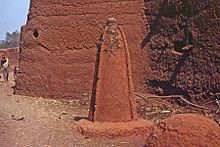
SYNTHESIS AND CONCLUSIONS RESULTING FROM RESEARCH ON TARTARIA TABLETS

February 3, 2019

Careful/ Attention !                                                                                                                                             This post is not a decipherment or reading of any actual written content of Tartaria tablets. Given that the signs do not belong to a single writing system but to several, the page has a purely didactic character. It has the role of trying and testing different writings, in the idea that the tablets would have used one of them. The signs on the tablets belong to several writing systems over a long period of time and which have been used in different geographical areas. In none of the trials did the signs fall into a single type of writing, there always remained signs that came from other writings (or as coming from the unknown). Most of the signs come from the Sumerian proto-cuneiform -shaped ones. The signs in the upper half of the round tablet seem to come from archaic Greek writing. This “collection” of signs seems to be the fruit of one’s rich imagination. As A. Falkenstein and A. A. Vaiman found, (this is also my firm opinion) the author was not a scribe, he had only vague notions about writing in general, and it is not known what he intended  or he was after. There are many elements of inconsistency as well as others that take the tablets out of the usual patterns and norms of  logics, writing and honest intentions. ====

SYNTHESIS AND CONCLUSIONS RESULTING FROM RESEARCH ON TARTARIA TABLETS                            Homage to: Mrs. Szofia Torma and Nicolae Vlassa who were much inspired and science-oriented than our-day scientists to detect and asert the type of writing and tablet’s age.

zsofia_torma_01vlassatartaria

  • This is the result of allmost 11 years of throughly research. Was an fantastic, fantabulous endeavour to wich became addicted, and also only at the finish realising that was exhausting.
  • SOME (ONLY) OF MY CONLUSIONS ARE QUITE SHOCKING, BECAUSE ARE BY LITTLE ASIDE OF THE UP TO NOW COMMON COURSE OF OPINIONS.Documenting from scientific sources is time-consuming and people are excited when told misteryous stories. Such of a tribe wich burned their ruller when become old !? Or of an wich, diformed shaman-priestess in better case, wich made rituals using psichedelic/psychotropic potions.
  • WHAT SHOWED UP IN MY RESEARCH ARE NOT MATCHING ESPECIALLY THAT ONES ADVANCED BY ARCHAELOGS, BUT CANNOT SAY THE SAME WITH THAT OF TOP-LEVEL ASSYROLOGISTS/EPIGRAPHERS.
  • FOR EVERY STATEMENT OR ASSERTION MADE HERE, I AM AT THE DISPOSAL OF INTERESSED PEOPLE AND SHOW THE EVIDENCES WITH WICH I CAN SUSTAIN, ADING SIMILAR OPINIONS OF OTHER 3 SCIENTISTS.
  • If I realised that cannot rely on archaeology dispersed data, my arguments are based on a profound and throughly analysis of the signs and “writing” from wich one could easy deduce my personal contribution. I renounce to order the conclusions upon a subjective criteria (such as “importance” could be).                      Note:                                                                                                                                                Every personal conclusion wich was partly advanced by others will be marked with *, and wich was not advanced by others before, will be marked with ***                        ——————————————————————————
  1. THE AGE OF THE TABLETS ARE AWAY OF THOSE FIGURES ALLREADY ADVANCED  (ARE NEWER). IN THE ARCHAELOGICAL SITE, ON THE VERY SPOT, SOMETHING TERRIBLE WRONG OCCURRED; (KIND OF “ARCHAEOLOGICAL/SCIENCE ACCIDENT HAPPENED AT THE SITE).*                           ————————————————————————————————————————
  2. THE AGE SPAN BETWEEN THAT OF SUPPOSED “PRIESTESS”(wich bone’s are true 5.300 B.C.) AND THAT OF THE TABLETS COULD BE AS MUCH AS 2.500 YEARS, (5500-3000=2500)OR EVEN 3.500(5.500-2.000=3.500)!***                                                  ————————————————————————–
  3. NEVER-ENDING-STORIES(LADY VINCA!?) ARE GOOD FOR MOOVIE-PICTURES BUT NOT PUSHING SCIENCE FORWARD, BUT ON CONTRARY .                               THERE IS NO CHANCE FOR THE DECEASED WOMAN TO HAVE THE TABLETS IN HANDS ! ***                                                                                                                                        ——————————————————————————————-                                
  4. THE TABLETS WERE NOT SCRATCHED BY A NATIVE SUMERIAN.                                HALF OF THE SIGNS HAS EXACT SUMERIAN SHAPE AN ANOTHER HALF ARE ROUGH COPIES OF THAT SUMERIAN-ONES *                                                                      —————————————————————————————
  5. THE SIGNS ARE NOT SUMERIAN PROPER BUT SUMERIAN-INFLUENCED.         ONE SIGN HAS NO MOUTH TO SPEAK: THE VERY SHAPE OF PROTO-CANAANITE(PROTO_SINAITIC),PHOENICIAN AND PALEO-HEBREW EXACT SHAPE OF SIGN CHET-HETH.THIS SHAPE WAS NOT USED BEFORE 2.000 B.C.*                  —————————————————————————————————–
  6. THE TABLETS WERE NOT SCRATCHED BY AN TARTARIA OR TURDAS NATIVE *             ——————————————————————————————
  7. THE TABLETS SEEM TO BE “WRITTEN” BROUGHT BY AN TRADER OR CRAFTSMEN SETTLED IN AREA OR BROUGHT BY ONE  RATHER COMING FROM AEGEAN AREA (Cyclades,CRETE; (see alabaster cup, “faceless”-type idol and Spondylus-shell bracelet, items characteristic to Cyclades !)* —————————————————————————————-
  8. THE TABLETS/SIGNS”WRITING” SHOW AN DIRECT STRONG INFLUENCE FROM NEAR EAST IF NOT EXACTLY FROM SUMER*                                                                    ———————————————————————–
  9. EVIDENCES ON THE TABLETS OF SIMILARITIES WITH AEGEAN WRITINGS ( Cretan Hierogliphic, Linear A ,Linear B and Eteocretan)*                                                                ——————————————————————————–
  10. SIMILARITIES WITH ANATOLIAN WRITINGS (ESP. CARIAN)***                                          ————————————————————————————
  11. THE TABLETS ARE CONTAINING A BUNDLE OF 3 DIFFERENT CATEGORIES/TYPES OF SIGNS, WICH SEEM NOT TO BE DIRECT-INTERNALY RELATED ALL ONE WITH ANOTHER, WITH THE CONSEQUENCE THAT WE CANOT EXTRACT AN CONTINOUS SEMANTHIC UNITY AS WE ARE READING NOWDAY AN MASSAGE WICH IS CONTINOUS (NOT DISRUPTED).***                                                  ——————————————————————————————
  12. I FOUND WRONG IDENTIFICATIONS, MISSED SIGNS(SIGNS NOT FOUND),etc. IN OTHER SCIENTISTS INTERPRETATIONS, SO I AM PRETENDING THAT MY INTERPRETATION IS ONE OF TOP-LEVEL.*                                                                                                                  —————————————————————————–
  13. MY CONCLUSIONS (NUMBERED) SUPERPOZE IN GREAT MEASURE THAT OF OTHER SCIENTISTS CONCLUSIONS, (IN GREAT MEASURE WITH THAT OF ASSYROLOGISTS A.A.VAIMAN and RUMEN KOLEV)*                                                                                           ———————————————————————
  14. THE TABLETS AS A WHOLE, ARE NOT CONTAINING AN TRUE WRITING, AS PUBLIC IS ACCUSTOMED WITH, WICH IS ABLE TO TRANSMIT AN COHERENT MESSAGE..ARE CONTAINING IDEOGRAMS, LOGOGRAMS & ICONS WICH COULD BE INTERPRETED AND NOT READ BECAUSE IS PROTO-WRITING.*                                                                                     ————————————————————–
  15. THERE ARE PRESENT ON THEM SOME ICONS OF TREMENDOUS AND PARAMOUNT CULTURAL IMPORTANCE WICH WERE USED IN ANCIENT TIME ON EXTENDED AREA. THEIR ORIGIN IS FAR DEEP IN TIME***                                   ———————————————————————–
  16. EVEN SO, THERE ARE STRONG EVIDENCES AND CLUES THAT UPPER HALF OF THE ROUND TABLETIS CONTAINING TRUE WRITING (Archaic greek).                 BY CHANCE (OR NOT) THIS IS THE SAME AREA WICH WAS HIDDEN (COVERED BY THE OTHER SQUARED TABLET).MAYBE NOT WITHOUT PURPOSE. THE WORDS REFFERED  MAYBE TO SOMETHING SACRED,HOLY FOR THEM, AND THE TABLETS COULD BE USED IN MISTERY-RELIGIOUS RITUALS .***                                  ————————————————————————————