HOW COULD ABIOGENESIS HAPPEN ? IS THERE A POSSIBLE SCENARIO ?
Well, in a nutshell, we know that life is made from non-life, the elements on the periodic table, the way a house is made of non-houses, such as bricks and lumber, etc…. not smaller houses, etc. :DMost of what you associate with “life” exists in non-life… and, some of that is because the definition of “life” is a bit outdated.This is a bit like “death”… another outdated term.As we discover more and more about life and how it works, our old definitions start to not apply as cleanly.For example, if you go back far enough, if you stopped breathing you were “dead”.If you started breathing again, you had “come back to life”.Later, if your heart stopped beating, you were “dead”.If your heart started beating again, you had “come back to life”.The discovered that the brain is still working, even if a bit wonky/hallucinating, etc… when the heart is stopped, so, you were not “really” dead yet… just dying.When restarting breathing, and then restarting the heart, became commonplace enough, if your brain stopped electrical activity, you were “dead”. So far, no one who was confirmed to be without brainwaves has ever “come back to life”… but it is not impossible.If we find a way to re-start brains, than that too will become an obsolete way to determine “death”.The definitions of life have always precluded viruses and prions for example.A possible scenario?Well, in nature, without life, even in outer space, self replicating molecules, and organic molecules can form.We can find protein and amino acids forming with no living source for example.Amino acids can assemble and disassemble proteins, and proteins can assemble and disassemble amino acids.Proteins can assemble and disassemble RNA. RNA can assemble and disassemble proteins.RNA can assemble and disassemble DNA. DNA can assemble and disassemble RNA.A prion can move, by folding and unfolding, and can make copies of itself from things around it.A prion has no RNA, or DNA… it is a protein.A virus is a protein with a genome. Viruses have RNA, and/or DNA genomes.They too can make copies of themselves from things around them… and the copies can inherit their genomes.Some viruses have outer lipid membranes, like simple bacterial cells.Some viruses infect other viruses, so they do not need living things to infect.Some viruses are larger than some bacteria.Some viruses have remnant traces of their genomes that regulate metabolic functions, like simple bacteria have.If you get these non-living things inside of you, it is considered an infection, not being poisoned by a chemical… because they are so close to be ing what we call “alive”.So, before “life”, we see things that have genomes that can be inherited, outer membranes like cells, traces of metabolic regulation, and so forth.If they made the copies inside their membrane, instead of outside of it, basically, that would be a simple bacteria.A MAN does not make progeny inside of himself… he has a genome that he sends OUTSIDE of himself, to “infect” another cell, and trigger that cell to make copies of his genome…using parts from the OTHER cell’s genome. IE: The man sends his genome (in a sperm) into another cell (an egg), and, triggers that cell to start making copies.It is analogous to how a virus replicates.It sends it’s genome into a cell, and triggers that cell to make copies. :DSo, we have a connect the dots sort of picture of how it all works….. and are working on the spaces between the dots. 😀
Vedeți un gen de cerc în jurul Reșiței, mai precis Dognecea
Din WordPress.comhttps://banatulmontan.wordpress.com › … Schiţă despre masivul bănăţean (de Alfred Ginzkey, Oraviţa)
<<<Formaţiunea geologică – anume cea plutonică – ne dovedeşte, cum că o bună parte a munţilor, mai ales la Oraviţa şi Moldova – sunt de origină vulcanică. Un şir întreg de vulcani se pare a fi fost aici în funcţiune, cari apoi prin erosiune şi denudaţiune au fost treptat reduşi la o zonă ce în present formează enorme mase de piatră eruptivă ca granit, symit, diorit etc. Exploatări miniere par a fi fost început de timpuriu în această regiune muntoasă a Banatului, aşa că se găsesc urme încă de pe timpul românilor între Ocna şi Dognecea la „Cracu de aur”, la Oraviţa în „Königsegg” etc. şi de pe timpul turcilor în minele de aramă la Ciclova. Se pot exploata aici cărbuni de piatră, fer, aramă, aur şi argint. Regiunea minieră începe la nord de Ocna de Fer întinzându-se spre sud peste Dognecea, Oraviţa, Ciclova, Sasca până la Moldova. La Dognecea şi Ocna de fer se găseşte magnetit şi hematit excelent, care este prelucrat în cuptoarele (furnalele) dela Reşiţa; se mai găseşte aici: zinc (blendă), aramă şi bismut. Oraviţa era odată renumită prin bogăţia zăcămintelor ei în aur şi argint, din cari s’au retras pe timpuri cantităţi considerabile. … După datele din „Metalurgia” lui Dr. Karsten Berlin, a furnisat argint … o producţiune de 2572.55 kg. Prin procedura greoaie şi neraţională a estragerei de pe timpurile acelea, o bună parte de argint a rămas neetras din minereuri. Cu mijloacele de estragere perfecţionate de azi desigur că s’ar fi putut ajunge la o producţiune cu mult mai mare. Afară de aur şi argint, să mai găseşte în ţinutul Orăviţei fer şi aramă.>>>
Mintea omeneasca nu este un aparat. Aparține regnului animal, care continuu, milioane de ani a facut eforturi să supraviețuiască și să se adapteze la mediu. Creează modele și tipare le aplică, compară și încearcă. Are stări, emoții, nehotărîri și îndoieli. În plus este foarte subiectiv, INFLUENȚABIL și înclinat spre puternică polarizare.
Așa încât dacă cineva sau ceva modifică realitatea mai precis baza sa informațională sau îl influențează este pierdut. Cu atât mai mult se pierde dacă este purtat între mai multe medii și realități, (aceasta reală și altele virtuale). Dacă unii nu vor avea capacitatea de întelegere sau adaptare vor începe să aibă senzația și sentimentul de înstrăinare.Că ei nu sunt luați în seamă serios și că nu fac parte din această lume.Aceastacîn termeni științifici se numește alienare.Dar și comportament schizoid când parțile componente ale personalității nu mai fac parte dintr-un tot. Sau nu funcționează ca un tot unitar funcțional și coordonat.Deci nu este de mare interes să avem o IA care cunoaște in amanunt structura și funcționare ființei omenești, dar și pe fiecare din indivizi in parte (în mod particular). Pentru că sigur va folosi acestea pentru realizarea obiectivelor. Ale sale sau oricui sau oricare or fi ele.
1.Încurcături pornite de la definiții ce conduc la percepții blurate 2.Stadiul actual al AI este încă departe de inteligența naturală. 3.Conștiința de sine este mai mult decât IP.Necesitatea unui test Touring upgradat 4.AI nu este o specie în competiție directă cu specia noastră, dar are potențial să ne cauzeze extincția.Două feluri de inteligențe 5.Trebuie să înțeleagă comunitatea AI ce este o personalitate non-umană .Limitele conștiinței naturale:senzorial îngustă ,multiplu subiectivă 6.Conștiința artificială nu este o gaură neagră.Avantajele potențiale au pondere majoritară 7.A trăi în două universuri simultan, cel real și virtual.Alienarea ca posibil rezultat. 8.Ne îndreptăm înapoi spre animism? Peturi, cyber sexdoll 9.Pericole, AI potential distrugător mai mare decat cea umană, însă mai posibilă alinierea obiectivelor și a controlul prin soft. ===============
I wondered why allmost 11 scientist struggled & consumed their precious time for only one 3-letter word from inscription, the word “per“.Taking for granted that Decebalus and Scorilo would be for dacian ruller’s names or pot’s owner and maker.I am not for these hipothesis, at least not at all for the latter. First could be, because smart dacians realised that stamp words are matching perfectly their kings names, so on own initiative put them one after another on the large krater-type jar…..and started a river-wine-flowing monster party. Please tell me why one spended a lot of skillful art-work effort and time in order to make those stamps, for what practical purpose, which is the practical benefit? Some years before I thought of roman transportation-logistics stamps, e.g. labeling bales fast transportation. per-scori-lo=for-run-it. / for-travel over-it Last month I added other interpretations, beginning from same flow,run meaning of the word scori. So obtaining again “travel,run” but adding -scroll,roll over “get through tech/kraft steps” and “flow=wash” some gold sand ? and/or “drain it” e.g. gold-sand or cheese. But regarding to gold-sand gold-dust, I found that the word scorilo is related to north-eastern italian dialect (friulian) word scori “flow,run,travel over”and latin word scoria: “slag”. Note that is attested that a lot of workers gathered around gold places and others were brought especially by romans from Dalmatia and Iberia because of their gold mining skills. That area are traditional celtic and italoceltic areas ! What do you think? Further I found that related to latin scoria (slag) there is a close-related process “scorification” wich has the purpose to separate gold and silver from other metals and unwanted minerals and substances. Gold <separation>SLAG So that stamps have perfect use labeling matter intended to go through this processing. And I propose the meaning :
DECE BALUS : (ten bales) but better: DACIAN GOLD DUST (balus old spanish name for gold-dust, nuggets, from wich come latin balux) PER SCORILO : FOR SLAG/SCORIFICATION
D O C U M E N T A T I O N gr. σκωρία (SKORIA):”slug”
“VOL. XIII Page 671- Da PLICATO a PLINTO (1 risultato) di tori, di orbiculo overo scoria overo scorilo e plinto constava. cesariano, 1-57″ From PLICATO to PLINTO (1 result) of bulls, of orbiculo or slag or slag and plinth consisted. Caesarian, 1-57″
“VOL. XVIII Page 229 -Da SCORIACEO a SCORNARE (3 risultati). scoriàceo, agg. miner. che presenta nell’interno piccoli incavi forma ‘aspetto’. scorillo, sm. miner. disus. scorlo (in partic., sciòrlo, sèrio), sm. miner. disus. denominazione usata inizialmente per
From SCORIACEO to SCORNARE (2 results) -formis, from forma ‘appearance’. scorillo , sm. miner. disus. I scroll he won the test, black scorillo . tommaseo [sv”
books.google.pn https://books.google.pn › books Panlessico Italiano, ossia Dizionario Universale della lingua … Marco Bognolo — 1839 … Scorification , [ Sco- rification ] . In chim . Riduzione del metallo in isco … SCORILLO , sm . Minerale che si cristallizza per la maggior par- te si cristallizzano non di rado in prismi o in cilindri , che nelle facce …
pdfcoffee.com https://pdfcoffee.com › al-rosetti-ist… Al. Rosetti – Istoria Limbii Romane scoare s.f. (M-ţii Apuseni) „scorie de fer”: scoria „sordes metallorum, scuria quod de ferro cădit”= “the dirt of metals, the ax that falls from iron”(CGL, IV, 168, 30; 569, 36, V, 243
Tehnologia obţinerii aurului se deosebeşte de cea a altor metale întrucât el apare în stare nativă sub forma unor filoane sau pepite. Diodor din Sicilia redă procedeul zdrobirii minereului, alegerea sterilului cu mâna, transportarea masei semiprelucrate la locurile de măcinare. Aici se executa pisarea în mojare, cu ajutorul unor răngi de fier, apoi măcinarea în râşniţe prevăzute cu mânere, până când minereul ajunge la mărimea unui bob de linte. Spălarea se făcea în canale săpate în pământ, firele de aur colectându-se cu ajutorul unor tufe de rosmarin. Apoi tufele se uscau şi se ardeau pentru a recupera aurul. Produsul obţinut prin spălare era topit în recipiente de lut, executate dintr-un material refractar (creuzete) care se introduceau într-un cuptor.
Datorită faptului că aurul conţinea şi anumite cantităţi de argint (în Munţii Apuseni în procentaj ridicat), era supus unui proces de rafinare (numit cementatio) pentru eliminarea impurităţilor. În acest scop se adăugau cantităţi de plumb şi tărâţe de orz sau alte metale indicate de autorii antici (cositor etc.). Creuzetele descoperite în Dacia la Lupşa şi Baia de Arieş nu poartă urmele unui foc puternic, deci retopirea avea loc la o temperatură moderată şi constantă. Aurul exploatat din depozitele aluvionare, conţinând mai puţini compuşi mineralogici, nu era supus unei topiri repetate. ENGLISH: The technology of obtaining gold differs from that of other metals because it appears in its native state in the form of veins or nuggets. Diodorus of Sicily reproduces the process of crushing the ore, selecting the tailings by hand, transporting the semi-processed mass to the grinding places. Here, crushing is carried out in mortars, with the help of iron teeth, then grinding in grinders equipped with handles, until the ore reaches the size of a lentil grain. The washing was done in channels dug in the ground, the gold threads being collected with the help of rosemary bushes. Then the bushes were dried and burned to recover the gold. The product obtained by washing was melted in clay containers, made of a refractory material (crucibles) that were inserted into a furnace. Due to the fact that the gold also contained certain amounts of silver (in the Apuseni Mountains in a high percentage), it was subjected to a refining process (called cementatio) to remove impurities. For this purpose, quantities of lead and barley bran or other metals indicated by the ancient authors (tin, etc.) were added. The crucibles discovered in Dacia at Lupşa and Baia de Aries do not bear the traces of a strong fire, so remelting took place at a moderate and constant temperature. Gold mined from alluvial deposits, containing fewer mineralogical compounds, was not subjected to repeated melting.
FINALLY IT SEEMS THAT NO MATTER IF IT IS ABOUT SCORI LO: “FLOW/WASH IT”OR SCORILO, “SLAG,SCORIFICATION” (SEPARATION) BOTH ARE MAIN PROCEDURES TO SEPARATE OBTAIN GOLD
….also SCORILO is the name ofthe king and is related to ruller < scroll,roll rom. “a derula”(the power) and not scum but to raw,rugged (face,behaviour?) DECEBALUS=dacian(s) forehead alb. Bale=forehead cretan,old gr. belos “threshold:
After some years Florin Croitoru had come with close opinion talking of scorere<>flowing, in fact suggesting cheese draining.
When discussion comes to serious things, inscriptions were made in an unusual way , namely were made by stamp imprinting. Even so it is possible that there were used even more than two stamps. The writing in one is mirror reversed.
<<< “But my opinion is that we are dealing with two stamps, one made better, the one with “DECE” and the other, with “BALVS” made by someone else, a man who, just like we did when we were children, made stamps from eraser, I carved it and when I stamped I found that the writing came out backwards. I don’t think there is any other logical explanation for that text being written in two ways. And if we have two stamps it means we have two words. And if we look even more closely, we notice that between DECE and BALVS written backwards there is a larger space than between the other letters. And the second inscription, is written in reverse.>>> From https://groups.google.com/g/andradanoua/c/due8c7pa7WM#:~:text=%C5%9Etampilacu%20PERSCORILO, with%20%C5%9Ftampila%20DECEBALUS. “Stamp with PERSCORILO is placed in reverse in relation to the stamp with DECEBALUS, so it cannot be an expression “decebalus per scorilo”. The fact that the writing is in relief and in the cartridge shows that they were used stamps, so several such vessels were made with the stamp per scorilo as well as with the DECEBALUS stamp” ———————— Now, the container is of KRATEROS type; the name comes from greek “mixing wine” and for this was used in all places icluding symposia=meetings or by etruscans for funerrary rituals. From Fonduri Patrimoniu https://www.fonduri-patrimoniu.ro › …PDF << când viaţa cotidiană antică devine patrimoniu unesco. Kraters were used possibly for storing but also for mixing liquids, just like wine>> This size “extra large” is very rare in the World. If we think of a big meeting for comemoration of a dead ruller as could be SCORILLO then the thext is fitting allmost perfectly. But what puzzled other scientists that there is not a proper way of honoring somebody using stamps and letters tens/hundreds times smaller than container, when they had at disposal square meters of working surface. So others sought (as me either) that roman stamps are involved (by no way made by dacians). Romans had a such a high degree of organising all practical aspects, eg constructions and transportation. But out of all, especially logistics high level was never riched by any country hundreds if not thousends of years after. My country Romania even nowday has not such a level of organised administration. ————————- R EA D I N G / MEANING —————–
v. percorrere=v. run across v. andare in calore, andare in estro=v. go into heat ———————————— I was on the verge of renouncing to all variants in favor of the one most used and accepted, because: – there are prezent on inscription out of 3 words, two king names – For word scorilo existed or exist hfound not hard evidence and if was, not sure of its real meaning. Found scori but that final LO of Scorilo was a big truble for me
Usage notes. Appended to present active infinitive verb forms to derive accusative forms when the object is third singular masculine person. Also appended to second singular person imperative forms. The final –e of the original infinitive is removed :
Suffix -Lo is present in serbocratian ,italian and latin. (So could be explained is somehow prezent in north-eastern Italy Veneto area friulian dialect.)
Friulian-English https://glosbe.com/fur/en per scorrilo: “to pass through” / rom.”(pentru) a trece prin” ==================== Now things suddenly took an unexpected turn. So much as to clarify in a manner almost impossible to be contested: A. Whose purpose were the stamps intended for, B. how and why the Dacians used stamps with Latin writing, and C. the meaning of the text. A- These stamps were used by the romans in the field of transport and logistics. B. The Dacians used them because the texts had a different meaning in their language, a profound one related to dacian kings/rullers. Was perfect suitable when gathered at one banquet (gr. symposio) on occasion of honoring/aniversary/funerary ritual for SCORILO, when the crater was full of drink It seems that we had and encounter here, no literary latin but late vulgar latin, close to italian and romanian. C.1. The meaning for the Romans: dece(m)balus: “ten/dacian bale, batch, installment” perscorilo: “forflow,run (lat.curre it.scori), flowing-residue,drain,,crossing” C.2. The meaning of Dacians: Decebalvs: “Decebal” perscorilo: “fordraining, creaming, Scorilo” DECE-BALUS PERSCORI-LO TEN-BALES FORTRAVEL OVER ………………………SCROLL THROUGH …………………………RUN ACROSS Dacian: …………………. .DRAINING, CREAMING, SCORILO Decebal forPassed, Last, SCORILO Rom.: 1o boluri PAR–CURSUL …………………….PENTRUSCURSUL=SCORILO Do not ask me who made who took from where the stamps, which day who werethere and so on. I am telling you only what is written there and the meaning. ============================== These explanations are scattered, so I conclude: – the text (late Latin) on the stamps has to do with flowing and running. Because these are the main meanings of the verb involved here, scorere. It refers to movement or something that flows, not necessarily liquid. And we will have either course or draining, but also exactlythe name Scorilo.
The naturalistic representations of the photographic type, of the things that surround us are very familiar to us and do not require any effort of understanding. Whether it’s the image of the mother, a tree or whatever. But when it comes to representing abstract notions, then things are not as simple. Because ideally the image should be both suggestive and represent that concept as synthetically as possible. The difficulty becomes obvious and only if we go back to the example we had before, mother. I don’t think that when the Sumerians needed a sign to represent the divine powers then, they immediately imagined one. I think they had a choice, from the infinity of pre-existing signs in nature. I noticed that the Sumerian pictographic signs (ie proto-cuneiform) do not always faithfully reflect the shape of the described object. Then maybe the Sumerians took the sign from previous civilizations or maybe not. But surely the hunter-gatherers also faced a similar dilemma: what sign to use to express a sense of admiration, piety, and deification? We will never know if the choice of sign was partially random or long thought out. We are now approaching the bull’s skull and the human figure. Somehow an irony of fate, of the headless human figure! Of course, the human figure and the bull inspire strength and power, but I think there are many other symbols that could just as well suggest strength and power. But let’s not forget that we interpret from the perspective of modern man who has a completely different vision the world. The beginnings of religion in the world as well as the population of pre-ceramic Neolithic culture (PPN / pre-pottery neolithic) did not begin with the deification of anthropomorphic entities. As I argue, the first T-shaped monuments may have represented the spirit of life. Possibly with the ancestors. The Russian scientist Emelianov claims that the original meaning of the Sumerian notion “Me”, which has the shape of your letter, was “the will to live”. You are probably wondering what the connection may be between two civilizations 5,000 years apart. I was also surprised to notice some connections. It is possible that there is a kind of continuity in space and time of some local inhabitants. Fortunately, there are other researchers who have noted such similarities: From the Treasures of Syria – NINO Leiden https: //www.nino-leiden.nl ›publication› from-the-tre … << they were practical, modest, and devoid of anthropocentric pride enough not to find and rely on deities like them. The evolution starting from the deification of some spirit entities can be observed in that of the appearance of the pillars from layer III from Gobekli Tepe, then moving to the T-pillars from Adiyaman / Kilisik. >>
and ending with the man from Urfa. Although I would have liked to find traces and the last springs of the T sign in the pre-ceramic phase or before, I did not find it. I found something on the territory of Armenia, but the signs do not seem to be old enough (ie before 9,600 BCE) and their interpretation deviates from that of the Sumerian experts. https://www.academia.edu ›The_La … Web Results (PDF) The Land of the Celestial Gates | Hamlet Martirosyan … In future writings we will try to show that it is necessary to use the “passage, fissure, aperture, door, gate, way” meaning of the ME cuneiform. This https://en.wikipedia.org/wiki/Adyghe_Xabze
The Adyghe “hammer cross” representing Xabze
See also the indigenous religions of the indigenous peoples of the Caucasus: https://www.wikiwand.com/en/Caucasian_neopaganism << An important element is the belief in the souls of the ancestors, who have the ability to observe and evaluate the affairs of their descendants. The concept of physical pain or pleasure in (the life of) then is absent …. >> I did not find T signs older than those of Gobekli Tepe in art and cave signs or those of the Stone Age. And even if I found it, it would be rather impossible to extract any clear meaning from them. My opinion is that the sign being in the category of crosses is related to the impact, the intersection and the crossing, the crossing. It may represent the connection of earthlings with heaven and divinity, since the T sign in ancient Chinese writing represents the notion of DOWN. Somehow it is naturalistic, because the sky was imagined by the ancients as a sphere that surrounds the Earth, so somewhat tangible. is represented by the top of the T.
Two adjacent T’s: “H” Universe ?? If the meaning of the sign T = Me has become so rich and complex, I think it has an old origin in a simpler society and over time, as it has developed and has gained new and new meanings. The society and population of the Sanliurfa area from IEN 9,600 was at least as advanced and complex for its time as the subsequent society that followed it after thousands of years, the Sumerian one!
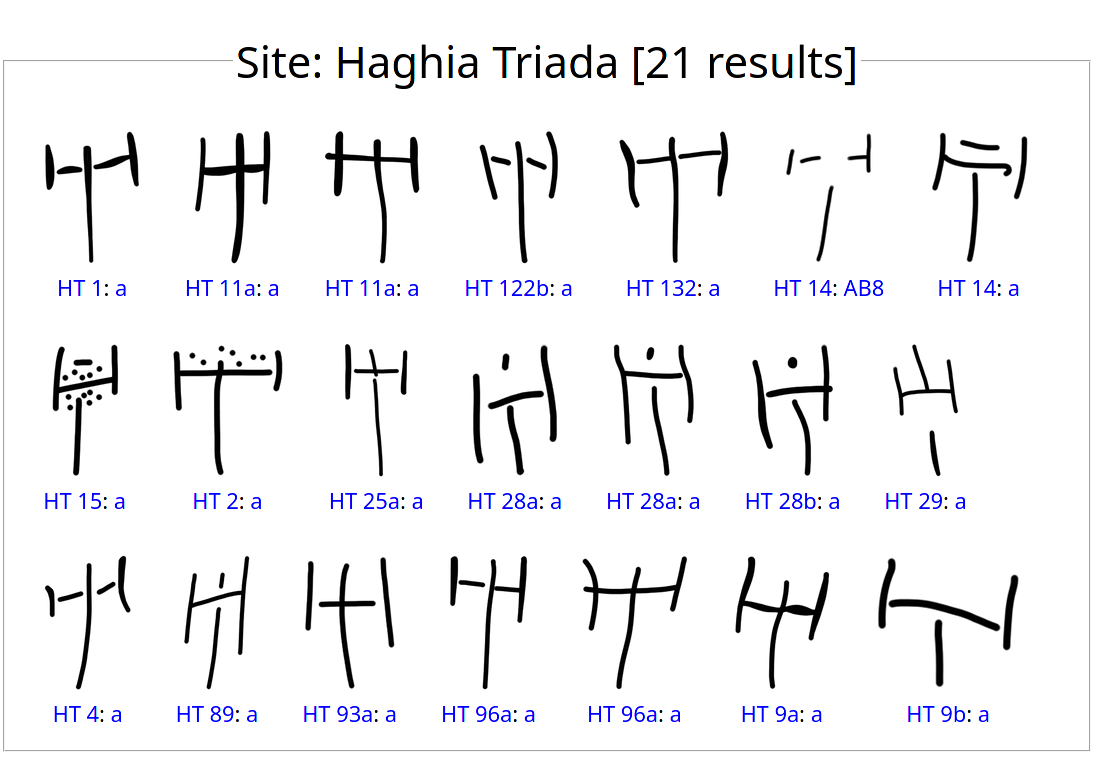
PDFby JA Halloran · Cited by 115 — Sumerian Lexicon, Version 3.0. 31 adj., big, large; mighty; great (chamber + abundant, numerous) [GAL archaic frequency: 1004 An example of such chart for sign AB 08 (phonetic value /a/) is displayed in fig. 2
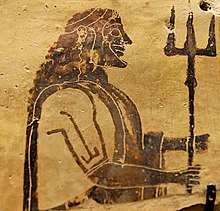
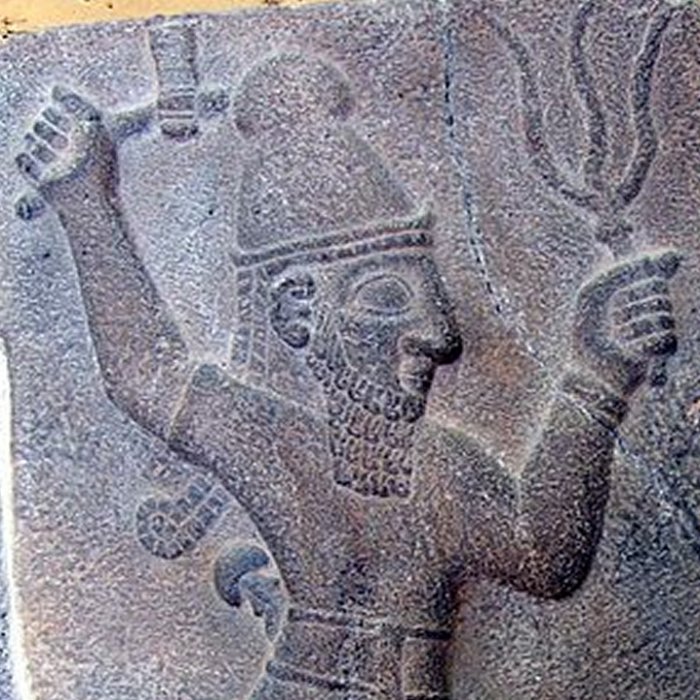
THIS IS THE POSEID TRIDENT. IF TRIDENT, DOUBLE-HEADED AXE WAS A SIGN OF POWER AS AGYPTIAN MACE. THAT’S WHY THE DOUBLE AXE SIGN WAS FOUND IN CAVE WHERE RITUALS WERE PERFORMED BECAUSE WAS THE SIGN OF ALLMIGHTY !
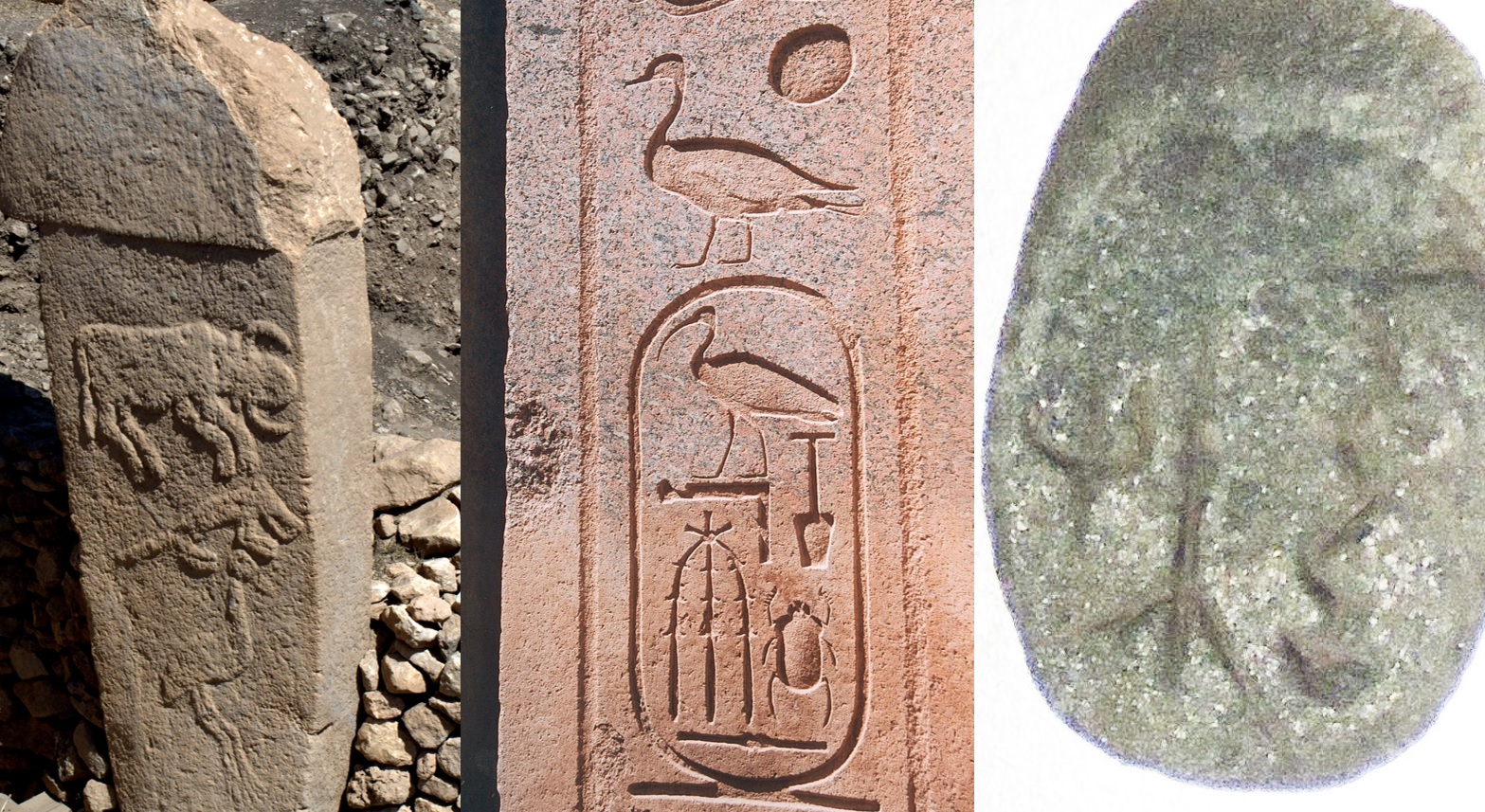
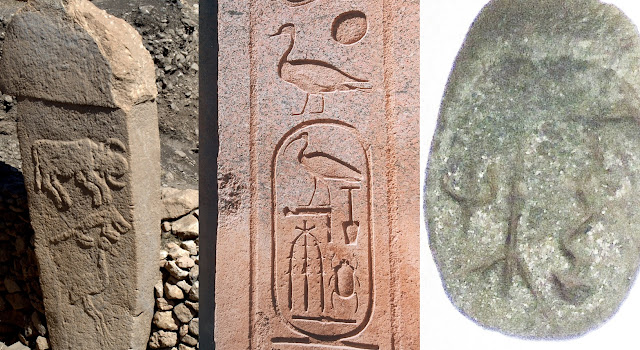
Most striking in this regard is a small plaquette from Göbekli Tepe. From the left to the right, it shows a snake moving upwards, a stylized human figure (?) with raised arms, and a bird. What makes this small find so interesting, is that the combination of depictions reappears not only in similar (e.g. in Jerf el Ahmar with a fox in place of the human-shape?), but also in completely and nearly identical form twice on another site, Tell Abr´3 in northern Syria (Köksal-Schmidt & Schmidt 2007; Yartah 2013, with images [external link]). Vie quotidienne, vie communautaire et symbolique a Tell ‘Abr 3 – Syrie du nord par YARTAH ThaÉr – 2013 – Université Lumière Lyon 2 http://theses.univ-lyon2.fr/documents/lyon2/2013/yartah_t/info





 In Sumer, din simbolul DARA3~c:

In this shape sumerian used to express numbers. Were found in economic transactions.Signs are not imprinted in sumerian (cuneus cuneiform) technique with the opposite edge of sharpened-one edge of stylus, so I wonder if the writer was a native sumerian.But in proto-cuneiform the signs were scratched as ours. https://encrypted-tbn0.gstatic.com/images?q=tbn:ANd9GcTkTxNNvRvYU4tmRRDwQ-TkhP-DH2FMo7WiO6prZW7bH6UCyaTL See A Comparative Linguistic Study about the Sumerian Influence on the ...https://www.researchgate.net/.../273885539_A_Comparative_Linguistic_Study_about_t...Nov 12, 2017 - A Comparative Linguistic Study about the Sumerian Influence on the Creation of the Aegean Scripts. Minoan Sumerian | Giannhs Kenanidhs - Academia.eduwww.academia.edu/11423494/Minoan_SumerianSee also image from:https://www.google.ro/imgres?imgurl=http%3A%2F%2Fslideplayer.com%2F3550914%2F12%2Fimages%2F8%2FBarley.jpg&imgrefurl=http%3A%2F%2Fslideplayer.com%2Fslide%2F3550914%2F&docid=sCshQbsbJ4AM8M&tbnid=7Cr6y-0Ujah3XM%3A&vet=10ahUKEwjx0qKWp7_ZAhWPJVAKHbxYD_kQMwiOAShHMEc..i&w=960&h=720&bih=662&biw=1366&q=proto%20writing%20%20writing%20grain%20barley&ved=0ahUKEwjx0qKWp7_ZAhWPJVAKHbxYD_kQMwiOAShHMEc&iact=mrc&uact=8 Also in linear B were used units of volume measurements, but de D-like signs were orienteded there 90 deg.rotated, in horizontal pozition: https://linearbknossosmycenae.files.wordpress.com/2015/02/units-of-mesurement-in-mycenaean-linear-b.jpg Close to these signs,we have : Usually associated with agriculural products as barley:https://linearbknossosmycenae.files.wordpress.com/2017/08/comparison-of-cretan-te-with-symbol-for-wheat-or-barley-in-various-ancient-scripts.jpg In linear B, https://i.pinimg.com/736x/95/40/78/9540781c6c839aa87a385ac46823b990.jpg Linear B, Cretan“TE” “Wheat“ https://encrypted-tbn0.gstatic.com/images?q=tbn:ANd9GcRykURVevP7C91htJQXSWtUoIKlv_VE7Zk8RacOILleQApR07vw Exemple of proto-elamite: http://www.cais-soas.com/CAIS/Images2/Misc/prot1.gif So could be interpreted as “3 /volume measures of some sort of grain”(gr.sitos) Note that this sign rather pertain to proto-writing. Cause in linear B we have signs for specific kind of grains (wheat visa barley): https://encrypted-tbn0.gstatic.com/images?q=tbn:ANd9GcRHPdQSYyE8qr4n115PLPH_UBTyeNB9XKrQDADDWG3bdzC2-UEQZQ: Next downward,this Y-shaped sign (! drawn separately in a box !)will see what could be. Y-sign= linear B= “SA” http://www.ancientscripts.com/images/lineara_ladle.gif http://www.ancientscripts.com/lineara.html“Once again applying Linear B reading to the previous Linear A texts, we see the sign sequence ja-sa-sa-ra-me. This sequence is very interesting because it appears very often in many other such votive inscriptions in slightly different variants. Next, ! vertical separation line ! In upper part 1-2 little “V-like signs !? Maybe 1/2?http://people.ku.edu/~jyounger/Hiero/ Next,downward, folow a sign wich ressemble violin,labrys?/ 2 merged lozenges ?; https://i.pinimg.com/736x/b4/dd/67/b4dd6746fe84b265e714daef471f2b89.jpgArt des Cyclades et apparenté aux Cyclades - Les Musées Barbier-Mueller Note:the sign wich is repeated as the last sign on the tablet https://linearbknossosmycenae.wordpress.com/tag/syllabic-scripts/page/19/?iframe=true&preview=true%2Ffeed%2F https://enijote.wordpress.com/2017/11/25/double-axes-and-the-limits-of-knowledge/Not much to see. But here’s its Linear A counterpart:https://enijote.files.wordpress.com/2017/11/la-a.png The sine qua non is the interpretation of labyrinth as “Place of the Double Axes,The Cretan Hieroglyphic evidence is even more explicit:https://enijote.files.wordpress.com/2017/11/ch-a.png?w=656 See https://www.pinterest.com/pin/464222674072955464/ They are saying that the sign is at the origin of)
 Tartaria tablets