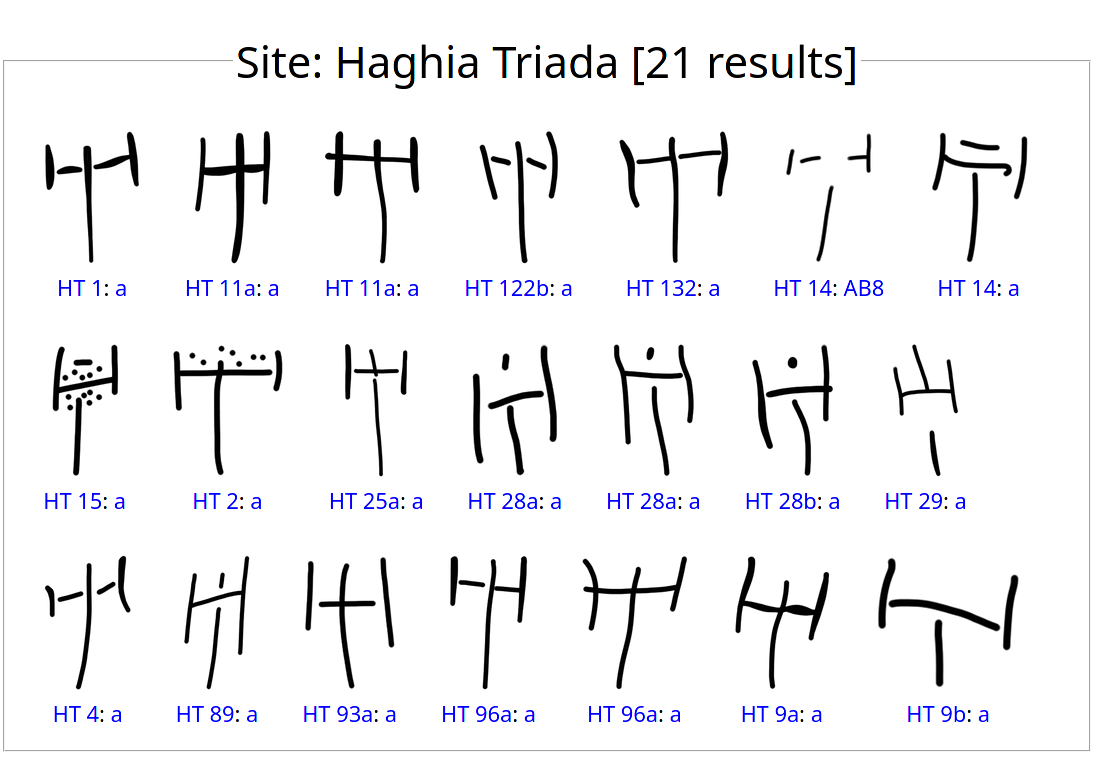
PDFby JA Halloran · Cited by 115 — Sumerian Lexicon, Version 3.0. 31 adj., big, large; mighty; great (chamber + abundant, numerous) [GAL archaic frequency: 1004 An example of such chart for sign AB 08 (phonetic value /a/) is displayed in fig. 2
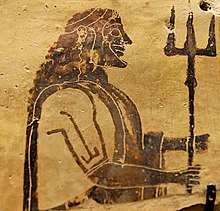
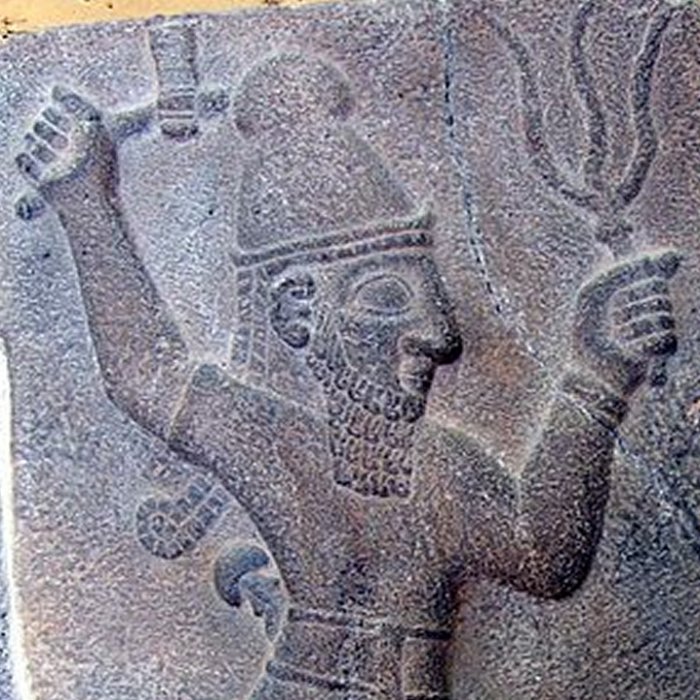
THIS IS THE POSEID TRIDENT. IF TRIDENT, DOUBLE-HEADED AXE WAS A SIGN OF POWER AS AGYPTIAN MACE. THAT’S WHY THE DOUBLE AXE SIGN WAS FOUND IN CAVE WHERE RITUALS WERE PERFORMED BECAUSE WAS THE SIGN OF ALLMIGHTY !
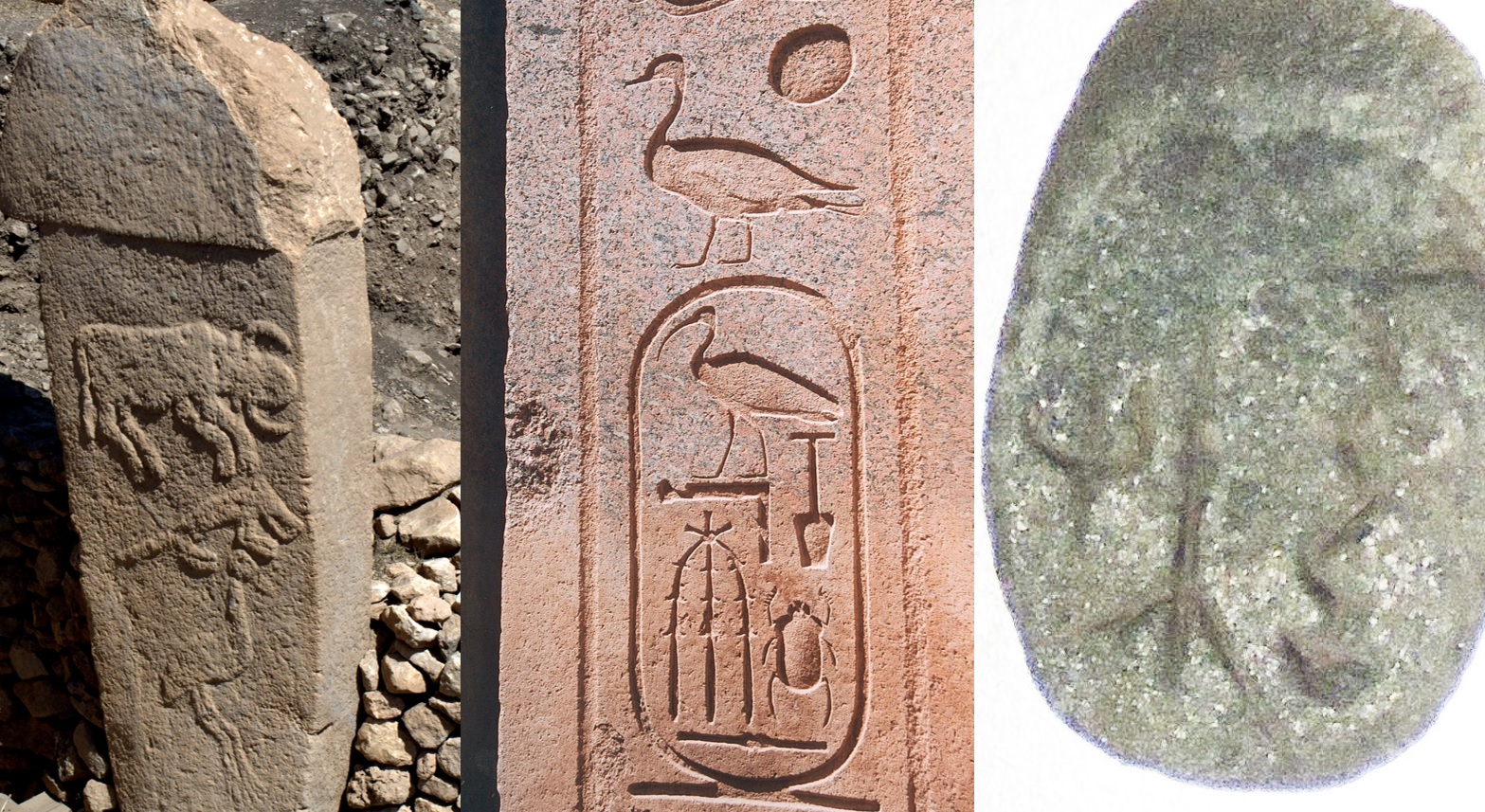
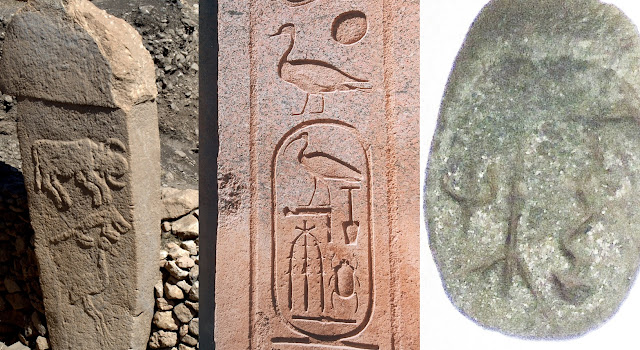
Most striking in this regard is a small plaquette from Göbekli Tepe. From the left to the right, it shows a snake moving upwards, a stylized human figure (?) with raised arms, and a bird. What makes this small find so interesting, is that the combination of depictions reappears not only in similar (e.g. in Jerf el Ahmar with a fox in place of the human-shape?), but also in completely and nearly identical form twice on another site, Tell Abr´3 in northern Syria (Köksal-Schmidt & Schmidt 2007; Yartah 2013, with images [external link]). Vie quotidienne, vie communautaire et symbolique a Tell ‘Abr 3 – Syrie du nord par YARTAH ThaÉr – 2013 – Université Lumière Lyon 2 http://theses.univ-lyon2.fr/documents/lyon2/2013/yartah_t/info
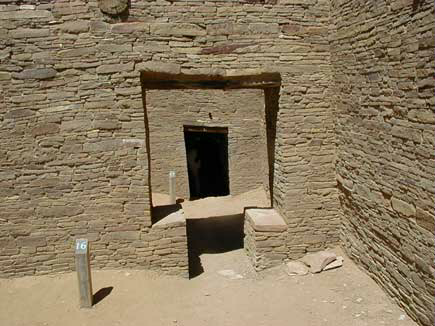
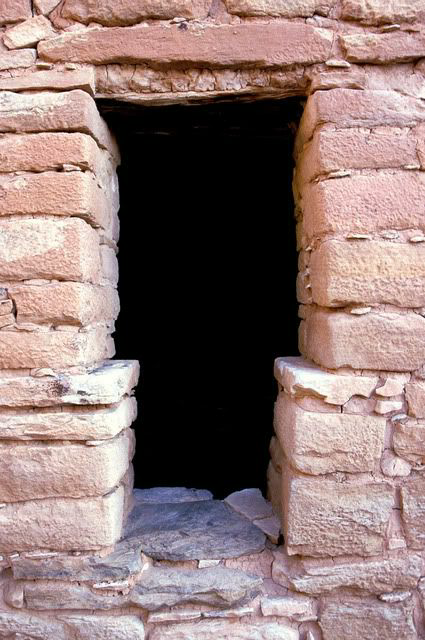
I found two papers in wich are discussed T-glyphs/symbols and T-doors in America: America’s T-doors. Between the Sumerians, Egyptians, Mayans and ancient Japanese – deciphering the IK glyph Matthias Ifejika https://www.academia.edu/resource/work/19045742 and: Ik’ WAY: The Mayan Origin of T-Shaped Doors in the North American Southwest Mark Callis https://www.academia.edu/resource/work/44957771
Interesting enough despite the scientists are sure that T-symbol is “Iku“, also sure that is related to wind,soul,life. If there are hundred of T-doors, the authors not made any connection of the soul with the door. Nor with the afterlife. Only tangential with death. “As for Mesoamerican, all I know is that in the Maya case it may have something to do with the written representation of the word ” ik’ ” which means wind, breath, or life.”
https://www.jstor.org › stableSome Observations on T585 (Quincunx) of the Maya Script – jstor 《 Abstract .The Maya glyph IK (ik’) is found in structurally similar positions to the Maya quincunx glyph, which is known to have a phonetic value bi or be. Since ik’ is life, spirit, breath, wind in Mayan languages, it is noteworthy that bi/be means life, breath, spirit in Zapotecan languages, possible descendents of the language of Monte Alban in the Valley of Oaxaca, where the quincunx glyph is found quite early. Thus, it is conceivable that the Maya quincunx glyph with its sound value be was borrowed in both form and sound value from Zapotecans, suggesting that be is also the sound value of that glyph in the “Zapotec” script. It is further suggested that in Zapotec the quincunx was a logogram representing be life, breath, wind whose meaning carried over into at least the quincunx part of a “death” expression in the Maya inscriptions, and perhaps elsewhere in the Maya script. Additional connections of the quincunx and IK glyphs are pursued.》
In fact that doors were made and intended for exit (in the case of houses), passing the souls through them. Wikipedia/ soul hole :<<…an “entrance and exit opening for the soul of the deceased”. … the opening made in the locking stones of so many megalithic graves .” …. megalithic graves were “heavy spell housings against the demonic power of the living corpse and at the same time seats of the separated souls, for which a small opening – the so-called soul hole – was left in the stone structure, where the anima could secretly slip in and out. ” The term was used in archeology and ethnology , but is considered out of date. The German word “Seelenloch” is also used in English-language publications. >>
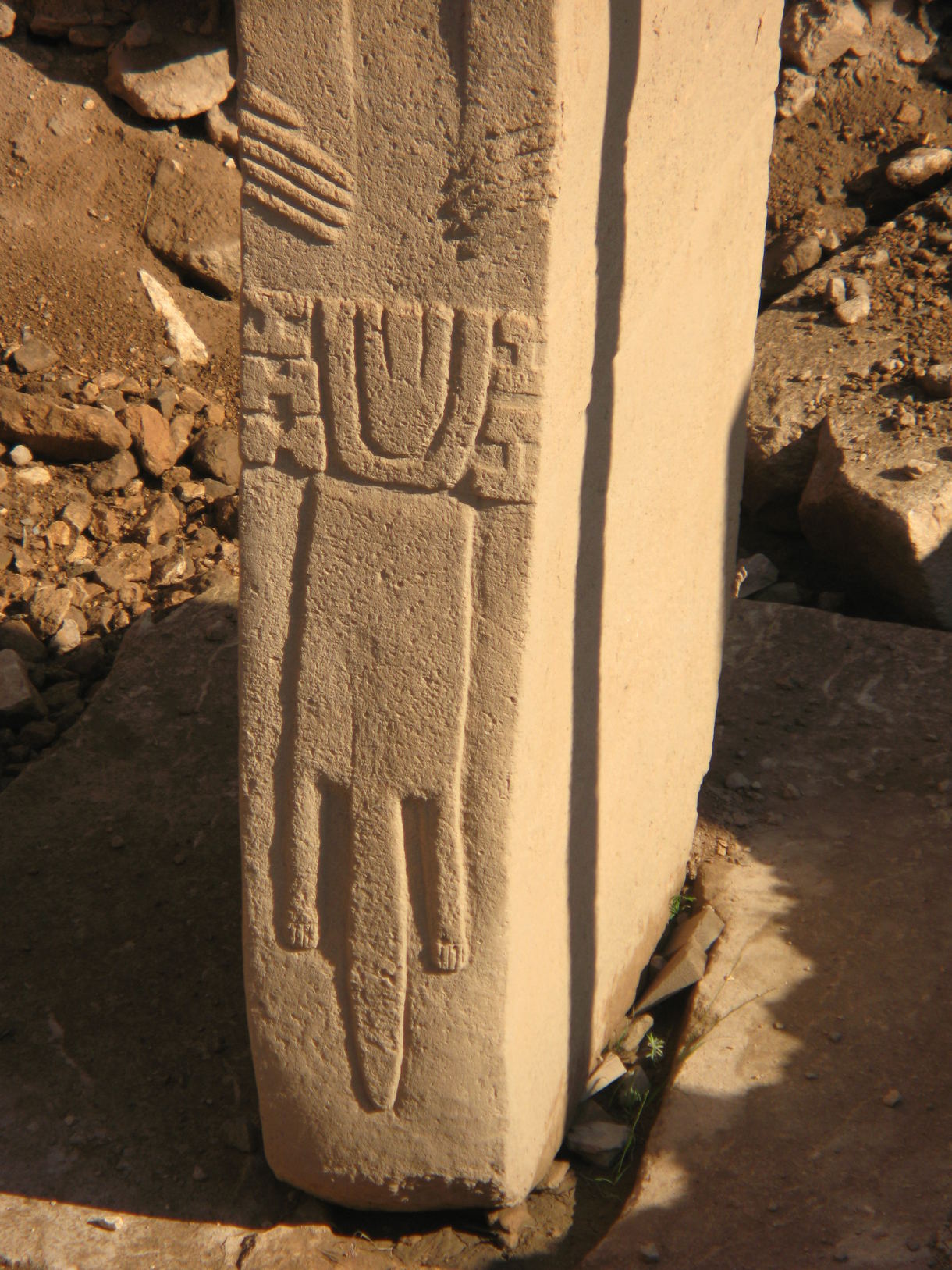
The shape is an abstraction of human torso because the hole must to acomodate the passing of something close to human body.Probably the spirit of the dead was amorphe, only by far ressembling the shape of human body. Very interesting, Gobekli Tepe T-pillars (upon scientists are abstract reflections of human body. As a result of my extensive study are related to sumerian proto-cuneiform sign Me:”to be,being”. Pillars were inhabiting life spirits, (as if they had souls).
I must explain that nowdays the spirit is equated with soul.I propose to consider spirit more as an essence, the abstract aspect. Soul, close to our senses and physiology, everyday life, breath. As animists consider that everything (living or objects) has its spirit but only animated,living beings has souls. I sustain that the American T-doors have the function of seelenloch=soul holes, present in many megalithic constructions throughout the World. Doors were thought as for exit, passage of the souls to the othe World. ====== From angelfire.com zThe breath of life symbol of the Maya I’K zthe T shaped symbol
“T” Shaped Window at Palenque
<< In the Mayan tradition, “I’q” is the Breath, the Air, the Spirit.The symbol of “I’q” is drawn as a T, representing a doorway into the spirit world and other dimensions. The T forms half of a cross (the World Tree) and the other half lies in the spirit world.Many of the Mayan temples have windows and doorways in the shape of a T. They are not only physical doorways but are also spiritual doorways (a portal into the spirit world).
Just as air is exchanged in the lungs, so our consciousness exchanges thoughts, ideas and experiences with the spirits by going through the zero point. Through the breath, we can gain a clearer perspective of reality, create a state of serenity and peace and journey through the corridor of our consciousness.>>
Pipette, Cochise County, Arizona. Photograph from Arizona Memory Project.
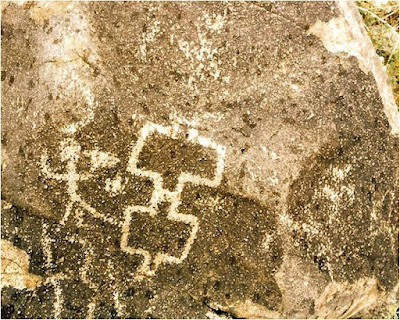
Symbols H and I are the same basic shape, one is another turned 90deg. In America’s the above author name them “ballcourts” and “pipettes”.From above paper: << Wright and Russell (2011) illustrate approximately 60 pipettes from rock art sites in their paper (incidentally they also include five T-shapes, supposedly as half pipettes, … We submit that the compartmentalization of the cosmos into containers was a conceptual metaphor of the tiered cosmos. This metaphor was embedded in the Uto-Aztecan language shared across Mesoamerica and the Greater Southwest and materialized in pipette symbolism. … In other words Wright and Russell are suggesting that the pipette symbol represents tiers of the cosmos with a passage up through them (for the entry of humans). >> So the author, Faris connects pipettes wth cosmos. In my before posts I showed that H is a double T(sumerian Me) and could mean the connexion of below with above, or whole below and above, then Cosmos. Maybe Faris chain-pipettes are the symbol of soul passing stages=rungs, up to the sky.For the ballcourt he said: “One of the iconic features of Mesoamerican urban sites is the ballcourt. Many of these were formed in the shape of the capital letter “I”. … While these are named Ballcourts, and we certainly believe that the Mesoamerican ball games were conducted in them, they are also believed to have served a number of other functions, ritual and otherwise. ” And finaly no definite conclusion: “So is the T-shape half of an I-shaped ballcourt? Is a two-lobed pipette a I-shaped ballcourt, or two T-shapes together end to end? Is a three-lobed pipette a ballcourt and a T-shaped doorway connected? I really cannot say, although I do believe that those more conversant with Hohokam than I should take a detailed look at it ” Good enough, despite he knows that T symbol is for ik, “spirit,soul” and realised that pipettes and ballcourts shapes are connected T’s(Ik’s) at least he realise and become aware that of a relation of humans with cosmos and soul rising to sky.(“tiers of the cosmos with a passage up through them (for the entry of humans“)
Some questions remain, e.g. why a nail, hammer symbol for breath,soul ? But if we are seeing from the perspective of divine power of life the World is not longer upside-down..
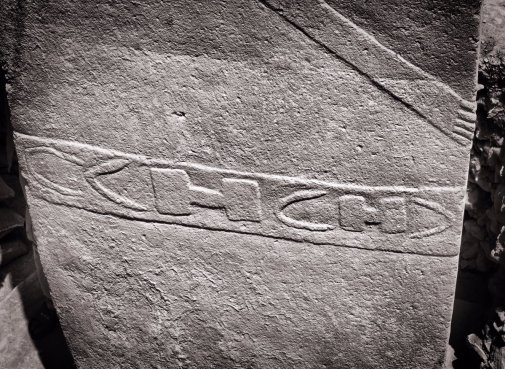
Alles begann beim Lesen: https://www.ancient-origins.net › co…Kosmische Kraft des Schamanen und Symbole im Göbekli Tepe – Teil II .Özgür Baris Etli < Das H-Symbol Ray Urbaniak interpretiert das „H“-Symbol als Doppel-T-Form. Zwei zusammengefügte T-Formen bilden ein Doppel-T. Er sagt auch, dass Tau die Hälfte davon in der spirituellen Welt repräsentiert. Wir können uns also vorstellen, dass das „H“-Symbol aus zwei Tau-Symbolen besteht. Das I-Symbol Das „I“-Symbol der alten mexikanischen Mythologie zeigt nicht nur ein einzelnes Tau in zwei Formen, sondern in unterschiedlichen Positionen, sowie zwei doppelköpfige Figuren, die in einer vereint sind, was die Dualität oben und unten oder den Himmel illustriert und Erde. … …….. In der prototürkischen Kultur wurde das „I“-Symbol als „ON: Cosmos“ bezeichnet. Interessanterweise repräsentiert das „I“-Symbol in der chinesischen Kultur den Schamanen oder Geistervermittler, das sogenannte Wu. Die weit verbreitete Verwendung der umgekehrten und aufrechten Tau-Form bei den indigenen amerikanischen Völkern als Embleme des Oben und Unten ist reichlich belegt und ist zweifellos so selbstverständlich entstanden wie die chinesischen Schriftzeichen „Shang: Above“, die als Symbol für den Himmel verwendet werden, und „Lea: Unten oder Unten“, verwendet als Symbol für die Erde. Die Verbindung zwischen Himmel und Erde stellt die Erschaffung der Unschuld dar und dies wird durch die zentrale Linie widergespiegelt. … Ich kann also vermuten, dass es sich bei dem mysteriösen „Me“-Symbol um eine „Himmel (Himmel) – Erde-Verbindung: damit das Leben existieren könnte“ handelt. Im schamanischen Glauben nimmt die Erde ihre Lebenskraft über die Nabelschnur aus dem Himmel. Göbekli Tepe ist aus diesem Grund als wichtiger Standort anzusehen. (Interessanterweise bedeutet „Göbek“ auf Türkisch „Der Nabel“). Darin vereinen sich schöpferische Kräfte zur Geburt oder Wiedergeburt. Daher sind bestimmte Tage entscheidend, um Lebensenergie vom Himmel oder Himmel zu holen. Es wird angenommen, dass die Lebenskraft immer da ist, aber nicht immer sichtbar. Es wird angenommen, dass es an bestimmten Tagen des Jahres sichtbar ist.Diese Tage sind die Tagundnachtgleiche und die Sonnenwende. Andererseits kann das „H“- oder schräge „I“-Symbol für Ost-West-, Frau-Mann- oder Gott-Göttin-Verbindungen stehen.> Herr Özgür!: H-Charakter ist nicht Wu, sondern Gong-„Arbeit“ ! ========= H UND ICH SIND VARIANTEN DER GLEICHEN GRUNDFORM! Die Argumentation von Herrn Urbaniak und Özgür stimmt mit meinen Erkenntnissen überein: protosumerisches Zeichen “T”=”Me” bedeutet meiner Meinung nach protosumerisch/euphratischer “Lebensgeist”, sumerisch “göttliche Kraft, Wesen, Vorfahre”.
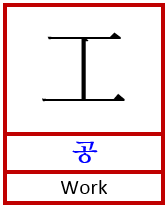
H besteht aus zwei T, also könnte Meme verwandt werden mit: – “alle göttlichen Kräfte = Kosmos”, (2×Me, Plural Meme) … oder – sumerische Heilgöttin (Schamane?) Ur-Meme, Meme = Gula =========== Es wird vermutet, dass in Göbekli Tepe heidnische, schamanische Rituale praktiziert wurden. In Bezug auf H/I-Symbole enthält das chinesische Schriftzeichen für Schamanen interessanterweise ein H-Zeichen. https://en.m.wikipedia.org/wiki/Wu_(shaman) Das zeitgenössische chinesische Schriftzeichen 巫 für wu kombiniert die grafischen Radikale gong 工 „Arbeit“ und ren 人 „Person“ verdoppelt (vgl. cong 从). Dieser 巫-Charakter entwickelte sich aus Siegelschriftzeichen, die tanzende Schamanen darstellten, die von Bronzeware-Schriftzeichen und Oracle-Knochenschriftzeichen abstammen, die einem mächtigen Kreuz ähnelten.>
Ihr seht, wir begegnen uns in H/I-Form, zweimal “Schamane” (1.als sumerisches Meme, Gula und 2.mit chinesischem Schriftzeichen Wu=Schamane) ! – und auch zweimal “Leben” : (1.Özgür “Lebenskraft” und 2. zweimal Me, me+me, zweimal “Lebensgeist, Sein”) Sehe Wkipedia Wu(shaman) ————— Interessant auch die Bullaugenform
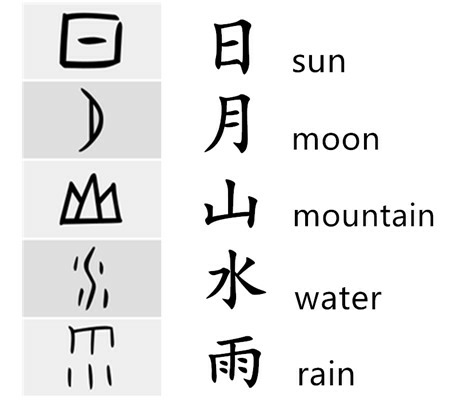
ist identisch mit alten chinesischen Schriftzeichen für Sonne “ri” (und Mond “yue”)
All begun when reading: https://www.ancient-origins.net › co…Cosmic Power of the Shaman and Symbols at Göbekli Tepe – Part II < The H Symbol Ray Urbaniak interprets the “H” symbol to mean double T shapes. Two T shapes butted together form a double T. He also says that Tau represents half of which is in the spiritual world. So, we can imagine that the “H” symbol consists of two Tau symbols The I Symbol The “I” symbol of ancient Mexican mythology not only exhibits a single Tau of two forms, but in different positions, as well as two double-headed figures joined in one, which illustrates the duality, above and below, or heaven and earth. … ….. In Proto-Turkish culture the “I” symbol was called as the “ON: Cosmos”. Interestingly, In Chinese culture “I” symbol represents the shaman or spirit intermediary, so-called Wu. The widespread usage amongst indigenous American peoples of the inverted and upright Tau shape as emblems of the above and below is abundantly proven and doubtlessly arose as naturally as the Chinese characters “Shang: Above”, employed as a symbol for heaven, and “Lea: Below or Beneath”, employed as a symbol for earth. The connection between Heaven and Earth represents the creation of innocence and this is reflected by the central line. … So, I can suggest that the mysterious “I” symbol is about a “Heaven (Sky) – Earth connection: so the life could exist”. In shamanic belief, Earth takes its life force from the sky via the navel cord. Göbekli Tepe should be seen as an important site for this reason. (Interestingly, In Turkish “Göbek” means “The Navel”). In this, creative powers unite for birth or rebirth. Therefore, some specific days are vital for taking life energy from the sky or heaven. Life force is believed to be always there, but not always visible. It is believed to be visible on specific days of year. These days are the equinox and solstice days. On the other hand, the “H” or slanted “I” symbol may be about East-West, Woman-Man or God-Goddess connections.> Mr. Özgür!: H character is not Wu but Gong “work” ! ========= H AND I ARE VARIATIONS OF THE SAME BASIC SHAPE ! Mr. Urbaniak and Özgür reasonings are consistent with my findings: proto-sumerian sign “T”=”Me” in my opinion means Proto-Sumerian/Euphratic “life spirit”, sumerian “divine power, being, ancestor”.
H is composed of two T, so Meme could be related to: – “all divine powers=cosmos” , (2×Me,plural Meme)…or – sumerian healing goddess (shaman?) Ur-Meme, Meme=Gula ===========
It is supposed that at Gobekli Tepe practiced paganist, shamanic rituals. Related to H/I symbols, interesting enough the chinese character for shaman is containing an H character. https://en.m.wikipedia.org/wiki/Wu_(shaman) The contemporary Chinese character 巫 for wu combines the graphic radicals gong 工 “work” and ren 人 “person” doubled (cf. cong 从). This 巫 character developed from Seal script characters that depicted dancing shamans, which descend from Bronzeware script and Oracle bone script characters that resembled a cross potent.>
Yousee we are encountering in H/I shape, twice “shaman” (1.as sumerian Meme,Gula and 2.with chinese character Wu=shaman) ! – and also Twice “Life” : (1.Özgür “Life force” and 2. twice Me, Me+Me, twice “life spirit, being“) See Wikipedia Wu(shaman) Work Ethics and Work Valuations in a Period of Commercialization: Ming China, 1500–1644*
Published online by Cambridge University Press
“Labour” is expressed by the term lao
, which has the connotation of “toil”, “pain”, and “exhaustion”, or qin
, which implies diligent or industrious work. Both refer mainly to physical work, especially in agriculture. Another designation for work is gong
Since this character is derived from a tool-like object, probably a carpenter’s square, it is predominantly associated with craft or proto-industrial production. …..Wu: female shamans in ancient China <Ancient oracle bone inscriptions use wu most frequently in relation to spirit sacrifices and for calls to “bring the wu.”….The oldest Chinese dictionary, Shuowen Jiezi, equates wu with zhu, a ritual invocator, and with ling, “spiritual, divine.” It underlines the female signification of wu: “wu is a zhu (invoker or priest), a woman who is able to render [herself] invisible, and with dance to invoke gods to come down.. Anciently, men and spirits did not intermingle. At that time there were certain persons who were so perspicacious, single-minded, and reverential that their understanding enabled them to make meaningful collation of what lies above and below, and their insight to illumine what is distant and profound. Therefore the spirits would descend upon them. The possessors of such powers were, if men, called xi (shamans), and, if women, wu (shamanesses). It is they who supervised the positions of the spirits at the ceremonies, sacrificed to them, and otherwise handled religious matters. As a consequence, the spheres of the divine and the profane were kept distinct. The spirits sent down blessings on the people, and accepted from them their offerings. There were no natural calamities. [Bodde, 390-1] >
÷÷÷÷÷÷÷÷÷÷÷÷÷
Also interesting, the porthole shape is identical with old chinese characters for sun “ri” (and moon “yue”)
https://en.wikipedia.org › wiki › Metavirus Metavirüs, Metaviridae ailesindeki bir virüs cinsidir. Bunlar, bir ökaryotik konak genomunu istila eden retrotranspozonlardır ve ancak virüs konakçıya bulaştıktan sonra çoğalabilirler. Bu genetik elementler, konak genomlarında bulaşmak ve çoğalmak için mevcuttur ve konakçılarıyla ilgisi olmayan atalara ait elementlerden türetilir.
https://assuefazione.wordpress.com/2007/04/22/sumerian-me-memes-and-neurolinguistics/ Sümerler, hayatın, inancın, teknolojinin, davranışın ve insan koşullarının her yönünü kapsayan benim adı verilen bir dizi kural ve düzenleme geliştirmiştir. Onlar erken dönem kodlardı, insanların okuması ve kendilerini aktarmaları için kodlanmış memlerdi. Bütün bir popülasyonu nörolinguistik olarak programlama girişimiydi. ====================
“Sümer kültürü — bana dayalı toplum — başka bir şeydi.Metavirüsün tezahürü. Bunun dışında, bu durumda, bir DNA’dan ziyade dilsel form.” “Affedersiniz,” diyor Bay Lee. “Medeniyetin bir varlık olarak başladığını söylüyorsunuz. enfeksiyon?
“İlkel haliyle medeniyet, evet. Her ben bir tür virüstü, tekmelendi metavirüs ilkesine göre. Bana ekmek pişirme örneğini alın. Bir kere Benim topluma dahil olmam, kendi kendine yeten bir bilgi parçasıydı. Bu bir doğal seçilimin basit sorusu: ekmek yapmayı bilen insanlar nasıl olduğunu bilmeyen insanlardan daha iyi yaşa ve üremeye daha yatkın ol. Doğal olarak, bu kendini kopyalama için ev sahibi olarak hareket ederek beni yayacaklar. bilgi parçası. Bu onu bir virüs yapar. Sümer kültürü — benimle dolu tapınaklar — sadece başarılı virüslerin bir koleksiyonuydu. bin yılda birikmiştir. Bir franchise operasyonuydu, bunun dışında altın kemerler yerine zigguratlar ve üç halka yerine kil tabletler bağlayıcılar. “‘Akıl’ veya ‘bilgelik’ anlamına gelen Sümerce sözcük, ‘kulak’ sözcüğüyle aynıdır.Tüm bu insanlar şunlardı: bedenleri bağlı kulaklar. Pasif alıcılar bilgi. Ama Enki farklıydı. Enki daha yeni olan bir tr’di özellikle işinde iyi. Yeni ben yazma konusunda alışılmadık bir yeteneği vardı — o bir bilgisayar korsanıydı. Aslında ilk modern insandı, tam bilinçli bir insandı. olmak, tıpkı bizim gibi. “Bir noktada Enki, Sümer’in bir çıkmaza saplandığını fark etti. hep aynı eski beni yaşatmak, yenilerini bulamamak, kendileri için düşünmek. Birkaç kişiden biri olduğu için yalnız olduğundan şüpheleniyorum — belki de dünyadaki tek bilinçli insan. içinde olduğunu anladı insan ırkının ilerlemesi için, onların pençesinden kurtulmaları gerekiyordu. bu viral medeniyet. “Böylece aynı yerde yayılan bir karşı virüs olan Enki’nin nam-shub’ını yarattı. ben ve metavirüs olarak yollar. Derin yapıların içine girdi. beyin ve onları yeniden programladı. Bundan böyle Sümer dilini kimse anlayamadı. dil veya başka herhangi bir derin yapı tabanlı dil. Ortaklığımızdan kes derin yapılar, ortak hiçbir yanı olmayan yeni diller geliştirmeye başladık birbirleriyle. Ben artık çalışmıyordu ve yeni yazmak mümkün değildi ben mi. Metavirüsün daha fazla bulaşması engellendi.” “Neden ekmek yapma işini kaybeden herkes ekmek kıtlığından açlıktan ölmedi? ben mi?” dedi Enzo Amca.
“Muhtemelen bazıları yaptı. Diğer herkes yüksek beyinlerini kullanmak ve anlamaya çalışmak zorundaydı. dışarı. Yani Enki’nin nam-shub’ının insanlığın başlangıcı olduğunu söyleyebilirsiniz. bilinç — ilk önce kendimiz için düşünmemiz gerektiğinde. bu başlangıçtı akılcı dinin de, insanların ilk kez düşünmeye başladıkları Tanrı, İyi ve Kötü gibi soyut konular. Babel adı buradan gelir. itibaren. Kelimenin tam anlamıyla ‘Tanrı’nın Kapısı’ anlamına gelir. Tanrı’nın izin verdiği kapıydı insan ırkına ulaşmak. Babil, zihnimizde bir kapıdır, bir kapıdır. bizi metavirüsten kurtaran ve bize veren Enki’nin nam-shub’ı tarafından açıldı düşünme yeteneği — bizi materyalist bir dünyadan dualist bir dünyaya taşıdı — ikili bir dünya — hem fiziksel hem de ruhsal bir bileşene sahip.” ====== Not: Sümer proto-çivi yazısı işareti “ben” aynı şekle sahiptir
Göbekli Tepe’nin T sütunları olarakas Göbekli Tepe T sütunları olarak
===== ELEŞTİRİ, YORUMLAR =======
Kabul edelim ki bende virüslerin özellikleri var. Ama şu ifadelere katılmıyorum: – “Bu insanların hepsi bu kadardı: bedenleri bağlı kulaklar. Pasif bilgi alıcıları.” Pasif alıcılardan uzaktılar. Çalışkan bir nüfustular ve entelektüel olarak çok yetenekli ve yaratıcıydılar. Ne de bununla: “Ama Enki farklıydı. Enki işinde özellikle iyi olan bir adamdı. Yeni bir ben yazma konusunda alışılmadık bir yeteneği vardı – o bir bilgisayar korsanıydı. Aslında, ilk modern insandı. , tam bilinçli bir insan, tıpkı bizim gibi. Bir noktada, Enki Sümer’in bir rutine sıkışıp kaldığını fark etti. İnsanlar her zaman aynı eski meleri yapıyorlardı, yenilerini değil. Kendileri için düşünmediler.” Hayır!: Enki bir tanrıydı ya da Stephenson gerçekten insanların melerini paylaşan akıllı bir lider istiyorsa. Bunlar ilahi bir kökene sahip olacaktı ama bunun bir efsane olduğunu biliyoruz, Sümerler (çalışkan ve yetenekli bir halk) me’leri yarattılar ve sürekli olarak yenilerini yaratma yeteneğine sahiptiler. Ve şiddetle söylüyorum: kendileri için düşünüyorlar! “Yalnız olduğundan şüpheleniyorum, dünyadaki birkaç – belki de tek – bilinçli insandan biri olarak. İnsan ırkının ilerlemesi için bu viral uygarlığın pençesinden kurtulması gerektiğini fark etti.” Bu yüzden benimle ve metavirüsle aynı yollara yayılan ve beynin derin yapılarına girip onları yeniden programlayan bir antivirüs olan Enki’nin Nam-Shub’ını yarattı.” “Belki de dünyadaki tek bilinçli insan!” Yazık olsun. Viral bir uygarlığın pençesi değildi. Nam-shub: “parlayan”, Enki tarafından yaratılmadı ve şuydu:
Wikipedia Asaruludu 《Sümer ve Akad mitolojisinde Asaruludu, Anunnakilerden biridir. Adı da Asarludu olarak yazılmıştır, Asarluhi ve Namshub. Adının etimolojisi ve anlamı belirsizdir. Asaruludu, Sümer dini ritüellerinde şeytan kovucu olarak görev yaptı. Namshub (parlayan) olarak koruyucu bir tanrı, “yolumuzu aydınlatan parlayan tanrı” olarak kabul edilir…. Asaruludu Kuara’nın koruyucu tanrısı olarak, Eridu (Enki’nin şehri) panteonuna dahil edilmiş ve böylece sihir tanrısı rolünü kazanmış olabilir. hastayı Enki / Ea ile tanıştıran bir ara rol. Daha sonraki metinler Asaruludu’yu Enki/Ea’nın zeka, tavsiye ve “geniş akıl” niteliklerini ve ayrıca büyülerdeki uzmanlığı paylaşan Enki/Ea’nın oğlu olarak tanımlar.>>
me’leri de insanlara dağıttı ve bana karşı hiçbir şey (“metavirüs” gibi) yaratmadı; bu son nokta olurdu! Bu nedenle, beynin derin yapılarını yeniden programlamak için hiçbir şey yoktu! “Bundan böyle ne Sümer dilini ne de derin bir yapıya sahip başka bir dili kimse anlayamadı.” Kalk, Sümer dili derin bir yapıya dayanmaz, aksine dil yapısı son derece basit ve mantıklıdır.
John Halloran Proto-Sümer dili icat sürecini görün. <<Diakonoff 1983’te şöyle yazmıştı: “Sözcüksel düzeyde, soyut fikirleri ifade etmek için hiç ya da çok az gelişmiş araçlara sahip olmayan ve dilbilgisi düzeyinde, ‘eylem-karşıtlık’ karşıtlığına dayanan herhangi bir dili ‘arkaik’ olarak tanımlayacağım. . durum’.” “Arkaik bir dilde, ‘zaman’, ‘mekân’, ‘özne’, ‘nesne’, ‘neden’, ‘güzellik’, ‘özgürlük’, “icat”, “çarpma”, “bölme” ve bazıları bize temel görünen, örneğin “karanlık”, “felaket”, “hastalık” ve “acı” vb. arasındaki ayrım gibi, diğerleri, veya ‘iyi’, ‘keyifli’, ‘nazik’, ‘mutlu’, ‘yararlı’, ‘şanslı’ vb. arasında. Ancak, tümevarımsal düşünme, yani belirli olgulardan bir genellemeye ilerleyen düşünce olmadan insan düşüncesi imkansızdır. ” … Diakonoff devam ediyor, “Sümerce, soyut fikirlerin oluştuğu arkaik bir dildir: bu yüzden hem Sümer dili hem de Sümer mitolojisi çok ilginçtir.Özne-nesne ilişkisini ifade etmek için hiçbir aracı yoktur ve zaman fikrini vb. ifade etmek için çok yetersiz araçlardır.” >> “Derin ortak yapılarımızdan kopup, birbirimizle hiçbir ortak yanı olmayan yeni diller geliştirmeye başladık. Ben artık çalışmıyor ve yeni benler yazmak mümkün değildi.”
Eugenrau: ?????? Yeni diller ve diller, Bay Neal Stephenson’dan hiç bilmediği daha fazla ortak noktaya sahiptir. Açıkça bir bağlantı ve ebeveynlik var. “Yani Enki’nin Nam-Shub’ının insan bilincinin başlangıcı olduğunu söyleyebilirsiniz – kendi başımıza düşünmemiz gerektiğinde. Aynı zamanda rasyonel dinin de başlangıcıydı, insanların ilk kez soyut konular hakkında düşünmeye başladıkları zamandı. Tanrı, İyi ve Kötü gibi. , bu nedenle, kelimenin tam anlamıyla “Tanrı’nın Kapısı” anlamına gelen Babil adı. Tanrı’nın insan ırkına ulaşmasına izin veren kapıydı. Babil, zihnimizdeki bir kapıdır, Enki’nin nam-shub’ı tarafından açılan, bizi metavirüsten kurtaran ve düşünme yeteneği veren – bizi materyalistlikten uzaklaştıran bir kapıdır. dünyadan dualist bir dünyaya – ikili bir dünyaya. hem fiziksel hem de ruhsal bir bileşen.”” Hayır !: Bay Stephenson’ın bunu tarihlendirmeye ve onaylamaya istekli olduğu zaman insan bilincinin başlangıcı !? “Rasyonel din” ?? sorunlar” https://bc805.medium.com/abstract-thinkt-how-is-it-significant-and-how-does-it-define-the-basis-for-modern-humanity-a98a5b92fb9f << Soyut düşüncenin geliştirdiği Paleolitik arkeolojik kayıtların alet keşiflerinde bazı ipuçları var.>> Soyut semboller, Göbekli Tepe 9.600 M.Ö.
Her şeyden önce, yazarın antropoloji, psikoloji, arkeoloji, dilbilim ve bilgisayar bilimleri alanlarındaki yüzeysel bilgileri karıştırarak, yazarın zihninde şekillenen bir halüsinasyona yol açtığı izlenimini edindim. Yazık ki, hâlâ kısmen yabancılaşmış bir dünyada yaşayan bizler, tarihsel ve kültürel bir gerçekliğin tecavüzüne ve saptırılmasına tanık oluyoruz. İnsanlığın ilk büyük medeniyeti, bu kadar kolay ve yüzeysel bir yaklaşımı ve böyle bir muameleyi kesinlikle hak etmiyor.
Note: sumerian proto-cuneiform sign “me” has the same shape as Gobekli Tepe’s T-pillars
CRITICISM, COMMENTS
Let’s admit that me’s had the characteristics of viruses. But I do not agree with the statements: – “That’s all those people were: ears with bodies attached. Passive receivers of information.” They were far from passive receivers. They were an industrious population and very intellectually gifted and inventive. Nor with this: “But Enki was different. Enki was a guy who happened to be particularly good at his job. He had an unusual ability to write a new me – he was a hacker. He was, in fact, the first modern man, a fully conscious human being, just like us. At one point, Enki realized that the Sumer was stuck in a routine. People were always doing the same old mees, not new ones. they didn’t think for themselves.” No!: Enki was a deity, or if Stephenson really wanted a smart leader who shared people’s mees. These would have had a divine origin but we know that this is a myth, the Sumerians (a hardworking and gifted people) created the me’s and continuously had the ability to create new ones. And I say strongly : they think for themselves ! “I suspect he was alone, being one of the few – perhaps the only – conscious human being in the world. He realized that in order for the human race to advance, it had to be freed from the grip of this viral civilization.” So he created Enki’s Nam-Shub, an antivirus that spread on the same routes as me and the metavirus, and went into the deep structures of the brain and reprogrammed them.” “perhaps the only conscious human being in the world!” Shame on you ! It was no grip of a viral civilization. Nam-shub: “shining”, was not created by Enki and was: Wikipedia Asaruludu 《In Sumerian and Akkadian mythology, Asaruludu is one of the Anunnaki. His name is also written Asarludu, Asarluhi and Namshub. The etymology and meaning of his name are unclear. Asaruludu served as an exorcist in Sumerian religious rituals. As Namshub (shining), he is considered a protective deity, “the shining god who lights our way.” …. Asaruludu, as the patron deity of Kuara, may have been incorporated into the pantheon of Eridu (Enki’s city) and thus acquired the role of god of incantations. Asalluhi sometimes plays an intermediate role, introducing the patient to Enki / Ea. Subsequent texts describe Asaruludu as the son of Enki / Ea, who shares Enki / Ea’s qualities of intelligence, advice and “broad reason”, as well as expertise in incantations.>> Enki was a god not an inhabitant of Sumer and the depositor of me’s, he also distributed them to the people and did not create anything (like “metavirus”) against me’s; that would have been the culmination! As such, there was nothing to reprogram the deep structures of the brain! “From now on, no one could understand the Sumerian language, or any other language based on a deep structure.” Get up, the Sumerian language is not based on a deep structure, on the contrary language structure is extremely simple and logical. See John Halloran Proto-Sumerian language invention process. <<Diakonoff wrote in 1983, “I shall define as ‘archaic’ any language which, on the lexical level, has no or only poorly developed means of expressing abstract ideas, and on the grammatical level, is based on the opposition ‘action vs. state’.” “In an archaic language there are no adequate means, either lexical or grammatical, to express such abstract ideas as ‘time’, ‘space’, ‘subject’, ‘object’, ’cause’, ‘beauty’, ‘liberty’, ‘invention’, ‘multiplication’, ‘division’ and many others, some of which appear to us elemental, as, e.g., the distinction between ‘darkness’, ‘calamity’, ‘illness’, and ‘pain’, etc., or between ‘good’, ‘enjoyable’, ‘kind’, ‘happy’, ‘useful’, ‘lucky’, etc. However, human thought is impossible without inductive thinking, i.e., thought which proceeds from particular facts to a generalization.” … Diakonoff continues, “Sumerian is an archaic language in which abstract ideas were in the making: this is why both Sumerian language and Sumerian mythology are so interesting. It has no means to express a subject-object relation, and very inadequate means to express the idea of time etc.“ >> “Cut off from our deep common structures, we began to develop new languages that had nothing in common with each other. The me no longer worked and it was not possible to write new me’s. ” Eugenrau: ?????? The new languages and languages have more in common than Mr. Neal Stephenson that he has no knowledge of. There is clearly a connection and parentage. “So you could say that Enki’s Nam-Shub was the beginning of human consciousness – when we had to think for ourselves. It was also the beginning of rational religion, the first time people started thinking about abstract issues. like God and Good and Evil, hence the name Babel, literally meaning “Gate of God.” It was the gate that allowed God to reach the human race.Babel is a gate in our minds, a gate that was opened by Enki’s nam-shub that freed us from the metavirus and gave us the ability to think – moved us from a materialistic world to a dualistic world – a binary world. a physical as well as a spiritual component.” “No !: The beginning of human consciousness when Mr. Stephenson was willing to date and certify it !? “Rational religion” ?? https://en.wikipedia.org/wiki/Faith_and_rationality ” the first time people started thinking about abstract issues” https://bc805.medium.com/abstract-thought-how-is-it-significant-and-how-does-it-define-the-basis-for-modern-humanity-a98a5b92fb9f <<There are some clues in the tool discoveries of the Palaeolithic archaeological record that abstract thought is developing.>> Abstract symbols at Gobekli Tepe 9,600B.C.
First of all, I have the impression that the author mixes superficial knowledge from the fields of anthropology, psychology, archeology, linguistics and computer science, resulting in a hallucination that took shape in the author’s mind. It is a pity that we are witnessing the rape and perversion of a historical and cultural reality, we who still live in a partially alienated world. Certainly the first greatest civilization of mankind does not deserve such an easy and superficial approach and no such treatment.
Wikipedia: Metavirusul este un gen de virusuri din familia Metaviridae. Acestea sunt retrotranspozonii care invadează un genom gazdă eucariotă și se pot reproduce numai după ce virusul a infectat gazda.
Cultura sumeriană — societatea bazată pe me — a fost o altă manifestare a metavirusului. Cu excepția faptului că, în acest caz, a fost mai degrabă într-o formă lingvistică decât în ADN.” – „Scuzați-mă”, spune domnul Lee. „Spuneți că civilizația a început ca o infecție?” – „Civilizația în forma ei primitivă, da. Fiecare me era un fel de virus, dat afară de principiul metavirusului. Luați exemplul me-ului pentru coptul pâinii. Odată ce a intrat în societate, a fost o informație care se autosusținea. Este o chestiune simplă de selecție naturală: oamenii care știu să coacă pâine vor trăi mai bine și vor fi mai predispuși să se reproducă decât cei care nu știu cum. Desigur, ei vor răspândi me-ul, acționând ca gazde pentru această informație care se auto-replicheaza. Asta îl face să fie un virus. Cultura sumeriană — cu templele pline de me-uri — era doar o colecție de viruși de succes care se acumulaseră de-a lungul mileniilor. Era o operațiune de franciză, cu excepția faptului că avea zigurate în loc de arcade de aur și tăblițe de lut în loc de lianți cu trei inele. „Cuvântul sumerian pentru „minte” sau „înțelepciune” este identic cu cuvântul pentru „ureche”. Atât erau acei oameni: urechi cu corpuri atașate. Receptori pasivi de informații. Dar Enki era diferit. Enki era un tip care se întâmplase să fie deosebit de bun in meseria lui. Avea abilitatea neobișnuită de a scrie un me nou — era un hacker. El a fost, de fapt, primul om modern, o ființă umană pe deplin conștientă, la fel ca noi. „La un moment dat, Enki și-a dat seama că Sumerul era blocat într-o rutină. Oamenii înfăptuiau tot timpul același me-uri vechi, nu veneau cu altele noi, nu gândeau singuri. Bănuiesc că era singur, fiind una dintre puținele — poate singura – dintre ființe umane conștiente din lume. Și-a dat seama că, pentru ca rasa umană să avanseze, trebuia să fie eliberată din strânsoarea acestei civilizații virale. „Așa că a creat Nam-Shub-ul lui Enki, un contravirus care s-a răspândit pe aceleași rute ca me și metavirusul. A intrat în structurile profunde ale creierului și le-a reprogramat. De acum înainte, nimeni nu a putut înțelege limba sumeriană, sau orice alt limbaj bazat pe o structură profundă. Despărțiți de structurile noastre profunde comune, am început să dezvoltăm noi limbaje care nu aveau nimic în comun unul cu celălalt. Me-ul nu mai funcționa și nu a fost posibil să scriem noi me-uri. Transmiterea ulterioară a metavirusul a fost blocată. – „De ce nu au murit toată lumea din cauza lipsei de pâine, pierzându-mă pe mine care făceam pâine?” spune unchiul Enzo. – “Unii probabil că au făcut-o. Toți ceilalți au trebuit să-și folosească creierul in mod superior și să-și dea seama. Așa că ați putea spune că Nam-Shub-ul lui Enki a fost începutul conștiinței umane — atunci când a trebuit să gândim pentru noi înșine. A fost și începutul religiei raționale, prima dată când oamenii au început să se gândească la probleme abstracte precum Dumnezeu și Bine și Rău. De aici provine numele Babel. Literal înseamnă „Poarta lui Dumnezeu”. A fost poarta care a permis lui Dumnezeu să ajungă în rasa umană. Babel este o poartă în mintea noastră, o poartă care a fost deschisă de nam-shub-ul lui Enki care ne-a eliberat de metavirus și ne-a dat capacitatea de a gândi — ne-a mutat dintr-o lume materialistă într-o lume dualistă — o lume binară. Lume — atât cu o componentă fizică, cât și una spirituală
C R I T I C I
Sa admitem ca me-urile au avut caracteristicile virusilor. Insa nu sunt de acord cu afirmatiile: “Atât erau acei oameni: urechi cu corpuri atașate. Receptori pasivi de informații.” Nu erau nici pe departe receptori pasivi. Erau o populatie harnica si deosebit de dotata intelectual si inventiva. Nici cu aceasta: “Dar Enki era diferit.Enki era un tip care se întâmplase să fie deosebit de bun in meseria lui. Avea abilitatea neobișnuită de a scrie un me nou — era un hacker. El a fost, de fapt, primul om modern, o ființă umană pe deplin conștientă, la fel ca noi. La un moment dat, Enki și-a dat seama că Sumerul era blocat într-o rutină. Oamenii înfăptuiau tot timpul același me-uri vechi, nu veneau cu altele noi, nu gândeau singuri.” Enki era o zeitate, sau daca vrea neaparat Stephenson un conducator destept care impartea me-urile oamenilor. Acestea ar fi avut origine divina insa stim ca acesta e un mit, sumerienii (un popor harnic si dotat) au creat me-urile si au avut incontinuu capacitatea de a crea unele noi. Nu !: “Bănuiesc că era singur, fiind una dintre puținele — poate singura – dintre ființe umane conștiente din lume. Și-a dat seama că, pentru ca rasa umană să avanseze, trebuia să fie eliberată din strânsoarea acestei civilizații virale. „Așa că a creat nam-shub-ul lui Enki, un contravirus care s-a răspândit pe aceleași rute ca me și metavirusul. A intrat în structurile profunde ale creierului și le-a reprogramat. “Poate singura-dintre fiintele umane constiente din lume”!? Să vă fie rușine ! Nu a fost nici-o stransoare a unei civilizatii virale.Nam-shub:”stralucitor”, nu a fost creat de Enki și era :
Wikipedia Asaruludu《În mitologia sumeriană și akkadiană, Asaruludu este unul dintre anunnaki. Numele său este scris și Asarludu, Asarluhi și Namshub. Etimologia și semnificația numelui său sunt neclare.Asaruludu a servit ca exorcist în ritualurile religioase sumeriene. Ca Namshub (strălucitor), el este considerat o zeitate protectoare, „zeul strălucitor care ne luminează calea”. …. Asaruludu, ca zeitate patroană a lui Kuara, este posibil să fi fost înglobat în panteonul Eridu (orașul lui Enki) și astfel și-a dobândit rolul de zeu al incantațiilor. Uneori, Asalluhi joacă un rol intermediar, prezentând pacientul la Enki/Ea.Textele ulterioare îl descriu pe Asaruludu ca fiind fiul lui Enki/Ea, care împărtășește calitățile lui Enki/Ea de inteligență, sfat și „rațiune largă”, precum și expertiza în incantații.》
Enki era zeu nu locuitor si depozitarul me-urilor, tot el le și distribuia si nu a creat nimic (gen “metavirus”)contra me-urilor asta ar fi fost culmea ! Ca atare nu a existat nici ceva sa reprogrameze structurile profunde ale creierului! “De acum înainte, nimeni nu a putut înțelege limba sumeriană, sau orice alt limbaj bazat pe o structură profundă.” Limba sumeriana nu se bazeaza pe o structura profundă, dimpotrivă structurs este extrem de simpla si logica.Vezi John Halloran Proto-sumerian language invention process. << Diakonoff scria în 1983: „Voi defini ca „arhaica” orice limbă care, la nivel lexical, nu are mijloace de exprimare, sau doar slab dezvoltate a ideilor abstracte, iar la nivel gramatical, se bazează pe opoziția „acțiune vs. stare.” „Într-o limbă arhaică nu există mijloace adecvate, fie lexicale, fie gramaticale, pentru a exprima idei abstracte precum „timp”, „spațiu”, „subiect”, „obiect”, „cauză”, „frumusețe”, „libertate”, „invenție”, „înmulțire”, „împărțire” și multe altele, dintre care unele ni se par elementare, cum ar fi, de exemplu, distincția dintre „întuneric”, „calamitate”, „boală” și „durere” etc., sau între „bun”, „plăcut”, „bună”, „fericit”, „util”, „norocos” etc. Cu toate acestea, gândirea umană este imposibilă fără gândirea inductivă, adică gândirea care trece de la fapte particulare la o generalizare. ” … Diakonoff continuă: „Sumerianul este o limbă arhaică în care ideile abstracte se dezvoltau: de aceea atât limba sumeriană, cât și mitologia sumeriană sunt atât de interesante. Nu are mijloace de a exprima o relație subiect-obiect și mijloace foarte inadecvate. pentru a exprima ideea de timp etc.”>>
“Despărțiți de structurile noastre profunde comune, am început să dezvoltăm noi limbaje care nu aveau nimic în comun unul cu celălalt. Me-ul nu mai funcționa și nu a fost posibil să scriem noi me-uri. ” Eugenrau: ?????? Noile limbi si limbaje au mai multe in comun decat se face Dl. Neal Stephenson că nu are cunoștința. Exista in mod clar o legatura si filiație. “Așa că ați putea spune că Nam-Shub-ul lui Enki a fost începutul conștiinței umane — atunci când a trebuit să gândim pentru noi înșine. A fost și începutul religiei raționale, prima dată când oamenii au început să se gândească la probleme abstracte precum Dumnezeu și Bine și Rău. De aici provine numele Babel. Literal înseamnă „Poarta lui Dumnezeu”. A fost poarta care a permis lui Dumnezeu să ajungă în rasa umană. Babel este o poartă în mintea noastră, o poartă care a fost deschisă de nam-shub-ul lui Enki care ne-a eliberat de metavirus și ne-a dat capacitatea de a gândi — ne-a mutat dintr-o lume materialistă într-o lume dualistă — o lume binară. Lume — atât cu o componentă fizică, cât și una spirituală. ” Nu!: Inceputul constiintei umane atunci cand a binevoit Dl.Stephenson să-l dateze si certifice !? “Religie raționala“?? https://en.wikipedia.org/wiki/Faith_and_rationality “Au inceput să se gândeasca la probleme abstracte”
…Apoi de la poarta lui Dumnezeu deraiază complet.Cum ar fi : – o poartă care a fost deschisă de nam-shub-ul lui Enki care ne-a eliberat de metavirus și ne-a dat capacitatea de a gândi ?? Si inainte nu exista capacitatea de a gandi ?? – la sumerieni la un moment dat (și deloc inainte) “au inceput să existe simultan componentele fizică si cea spirituală“.
In primul rand am impresia ca se amesteca cunostinte superficiale din domeniile antropologiei, psihologiei, arheologiei, lingvisticii si informaticii, rezultand o nalucire care a prins contur in mintea autorului. Este pacat ca asistam la siluirea si pervertirea unei realitati istorice si culturale, noi cei cei care si asa traim intr-o lume partial alienata. Cu siguranta prima cea mai mare civilizatie a omenirii nu merita o asemenea abordare facila si nici un asemenea tratament.
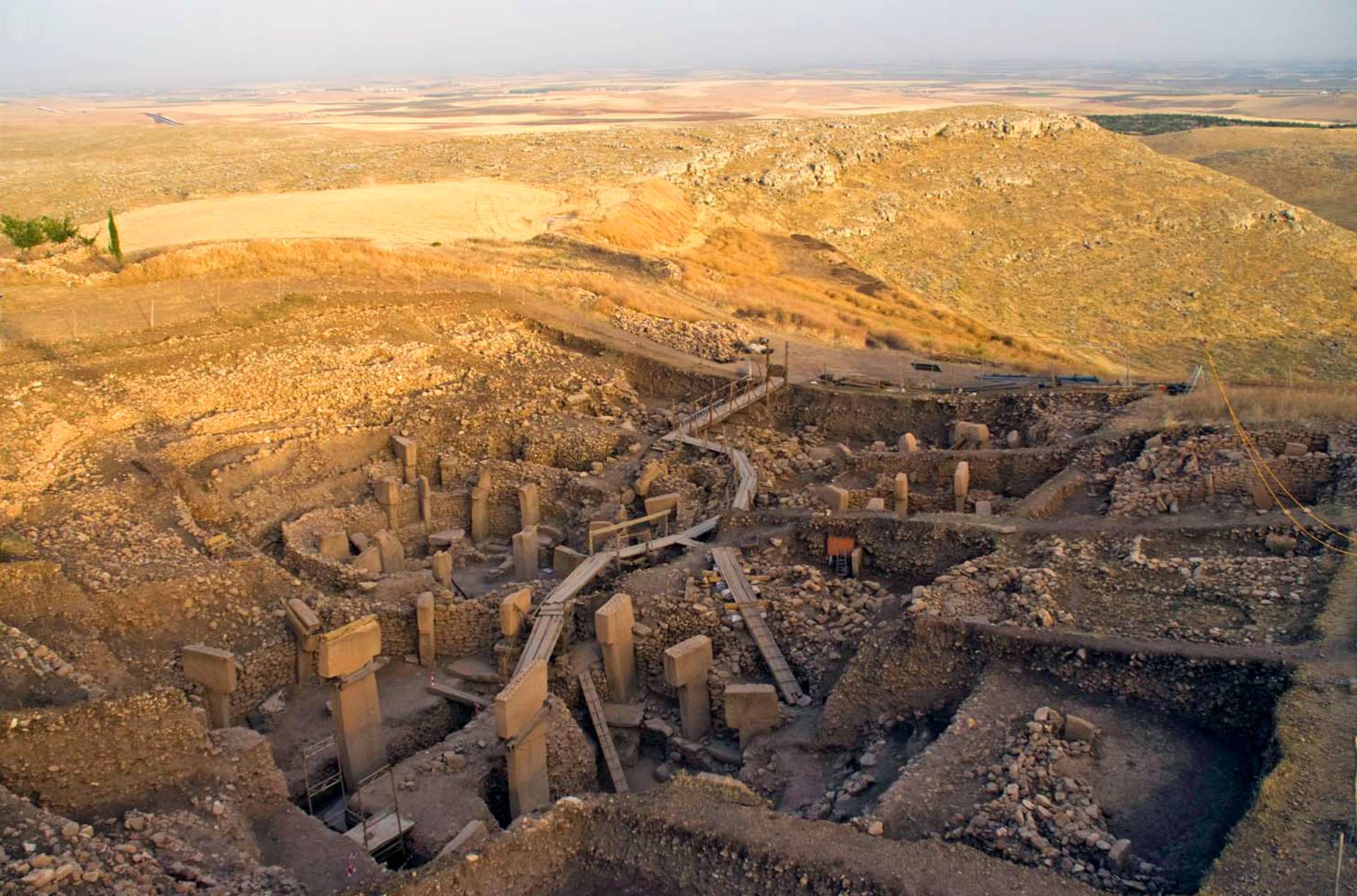
Arkeolojik açıdan, yaşı ne olursa olsun, kendine has özellikleri olan her arkeolojik yer bir medeniyettir, örn. Natufian, Vinca. Bir gönderiden: Tanrı ve Güneş: Göbekli Tepe’deki Yazı Robert M. Schoch, Catherine Ulissey ile.
<< Geleneksel tarihçiler ve arkeologlar, kişinin gerçek uygarlığı tanımlayabileceği üç ana ayırt edici özelliğe sıklıkla dikkat çekmiştir: 1) Anıtsal taş mimarisi, 2) Yerleşik kentsel (şehir) yaşamı ve 3) Yazı. Tarihöncesi genellikle bir toplumun okuryazar olmasıyla eşitlenir; herhangi bir yazılı kitabeleri veya kayıtları yoksa, o zaman gerçek bir kayıtlı tarihleri yoktur ve hem tarih öncesi hem de uygarlık öncesidirler. Ayrıca, geleneksel statüko düşüncesine göre, yazı ilk olarak MÖ 3000’den hemen önce Sümer ve Mısır’da icat edildi; bu nedenle, gerçek uygarlığın başlangıcını bu zamana kadar tarihlendirebiliriz. Ancak, 6000 yıldan fazla bir süre önce Kuzey Mezopotamya’da inanılmaz derecede sofistike Göbekli Tepe sitesini bulduk. Pek çok ana akım tarihçi, Göbekli Tepe’nin inşaatçılarına gerçek uygarlık etiketini uygulama konusunda tereddüt ediyor, ama neden? Anıtsal mimariye ve olası kentsel yerleşimlere rağmen, Göbekli Tepe’nin yaratıcılarına gerçek medeniyet unvanını inkar edecek olan araştırmacılar için en iyi argüman, görünüşe göre herhangi bir yazı biçimine sahip olmadıklarıdır (ya da öyleydi). Bununla birlikte, en son kanıtlar bu görüşü tamamen değiştirdi ve şüphecilerin bile medeniyetin kökenlerinin ne zaman ve nerede olduğunu yeniden düşünmesini talep ediyor.>>
Bu kriterle benim görüşüm Bay Schoch’unkiyle çelişiyor,
1) Anıtsal taş mimari, EVET 2) Yerleşik kent (şehir) yaşamı ve HAYIR (sadece hafif izler) 3) Yazı. HAYIR (yalnızca ilkel bir senaryo+işaret koleksiyonu, ilk yazma aşamasına ulaşmamış) Doğru değil Bay Schoch’un ifadesinin herhangi bir yazı biçimi yokmuş.
GENEL SONUÇ = Gerçek bir medeniyet değil. …..
Ancak çok ilginç bir şey buldum: << Şimdi, meslektaşım Dr. Manu Seyfzadeh’in öngörüsü sayesinde, Göbekli Tepe’de bulunan sembolik gösterim için potansiyel bir bağlam ve karşılaştırmaya sahibiz. Seyfzadeh’in belirttiği gibi, Göbekli Tepe’deki bazı semboller, bin yıl sonra aynı genel bölgede (modern Türkiye) kullanılan Anadolu Hiyerogliflerine (Luwian ve/veya Hitit Hiyeroglifleri olarak da anılır) oldukça benzerdir. Bu tamamen tesadüf mü? olmadığını düşünüyoruz. Gerçekten de Anadolu Hiyeroglifleri ile Göbekli Tepe sütunlarından bazılarına oyulmuş semboller arasındaki bazı önemli benzerliklere işaret eden teknik bir makale yayınladık (Manu Seyfzadeh ve Robert Schoch, Arkeolojik Keşif, Şubat 2019, cilt 7, sayfa 31-53). … Anadolu Hiyeroglif yazıtları genellikle MÖ ikinci ve erken birinci bin yıllara tarihlenir (çoğu MÖ 1300-900 arası döneme aittir). Bu, Göbekli Tepe’nin inşasından 8000 yıl veya daha fazla bir süre sonra, ancak Göbekli Tepe halkı tarafından kullanılan bir yazı sisteminin en azından parçalarının hayatta kaldığını ve bazı durumlarda çeşitli değişikliklerle Anadolu Hiyeroglifleri sistemine dahil edildiğini gösteren dikkate değer korelasyonlar var. – ki bu oldukça anlaşılır ve hatta bu kadar uzun bir zaman diliminde beklenen bir durumdur. >>
Onlar (Schoch, Seyfzadeh) bilmiyorlar, daha çok bilmiyormuş gibi yapıyorlar ve Göbekli Tepe’den nispeten fazla sayıda işaret (12-20?) gösterdiğim son araştırmamdan haberdar değiller, onları çok daha yakın buldum o döneme (2500 yıl daha yakın) Sümer proto-çivi yazısı işaretleri arasında.
Ve sütunların “T” işaretini, “Ben” proto-çiviyazısı işaretinin eşdeğerine sahip olarak tanımlamaktan gurur duyuyorum. İnsan, toplum hayatı, ilahi ilişki alanında karmaşık bir anlamı vardır.
….Ama sanırım önemli bir düzeltmeyle geri dönmem gerekiyor. Anladığım kadarıyla, (aslında başkaları da) toplumu, Göbekli Tepe toplulukları eşi görülmemiş düzeyde bir sistem ve organizasyona sahipti, sadece mevcut Çinli ve Almanlarla karşılaştırılabilir (ama çok ötesinde). : Mevcut işaretler göz önüne alındığında, yeryüzünde yok olana kadar insan türünün, ister “uygarlık” desek, ister “medeniyet” olarak tanımlasak da, ne derseniz deyin, böyle bir düzeye gelemeyecek gibi görünüyor.




 In Sumer, din simbolul DARA3~c:

In this shape sumerian used to express numbers. Were found in economic transactions.Signs are not imprinted in sumerian (cuneus cuneiform) technique with the opposite edge of sharpened-one edge of stylus, so I wonder if the writer was a native sumerian.But in proto-cuneiform the signs were scratched as ours. https://encrypted-tbn0.gstatic.com/images?q=tbn:ANd9GcTkTxNNvRvYU4tmRRDwQ-TkhP-DH2FMo7WiO6prZW7bH6UCyaTL See A Comparative Linguistic Study about the Sumerian Influence on the ...https://www.researchgate.net/.../273885539_A_Comparative_Linguistic_Study_about_t...Nov 12, 2017 - A Comparative Linguistic Study about the Sumerian Influence on the Creation of the Aegean Scripts. Minoan Sumerian | Giannhs Kenanidhs - Academia.eduwww.academia.edu/11423494/Minoan_SumerianSee also image from:https://www.google.ro/imgres?imgurl=http%3A%2F%2Fslideplayer.com%2F3550914%2F12%2Fimages%2F8%2FBarley.jpg&imgrefurl=http%3A%2F%2Fslideplayer.com%2Fslide%2F3550914%2F&docid=sCshQbsbJ4AM8M&tbnid=7Cr6y-0Ujah3XM%3A&vet=10ahUKEwjx0qKWp7_ZAhWPJVAKHbxYD_kQMwiOAShHMEc..i&w=960&h=720&bih=662&biw=1366&q=proto%20writing%20%20writing%20grain%20barley&ved=0ahUKEwjx0qKWp7_ZAhWPJVAKHbxYD_kQMwiOAShHMEc&iact=mrc&uact=8 Also in linear B were used units of volume measurements, but de D-like signs were orienteded there 90 deg.rotated, in horizontal pozition: https://linearbknossosmycenae.files.wordpress.com/2015/02/units-of-mesurement-in-mycenaean-linear-b.jpg Close to these signs,we have : Usually associated with agriculural products as barley:https://linearbknossosmycenae.files.wordpress.com/2017/08/comparison-of-cretan-te-with-symbol-for-wheat-or-barley-in-various-ancient-scripts.jpg In linear B, https://i.pinimg.com/736x/95/40/78/9540781c6c839aa87a385ac46823b990.jpg Linear B, Cretan“TE” “Wheat“ https://encrypted-tbn0.gstatic.com/images?q=tbn:ANd9GcRykURVevP7C91htJQXSWtUoIKlv_VE7Zk8RacOILleQApR07vw Exemple of proto-elamite: http://www.cais-soas.com/CAIS/Images2/Misc/prot1.gif So could be interpreted as “3 /volume measures of some sort of grain”(gr.sitos) Note that this sign rather pertain to proto-writing. Cause in linear B we have signs for specific kind of grains (wheat visa barley): https://encrypted-tbn0.gstatic.com/images?q=tbn:ANd9GcRHPdQSYyE8qr4n115PLPH_UBTyeNB9XKrQDADDWG3bdzC2-UEQZQ: Next downward,this Y-shaped sign (! drawn separately in a box !)will see what could be. Y-sign= linear B= “SA” http://www.ancientscripts.com/images/lineara_ladle.gif http://www.ancientscripts.com/lineara.html“Once again applying Linear B reading to the previous Linear A texts, we see the sign sequence ja-sa-sa-ra-me. This sequence is very interesting because it appears very often in many other such votive inscriptions in slightly different variants. Next, ! vertical separation line ! In upper part 1-2 little “V-like signs !? Maybe 1/2?http://people.ku.edu/~jyounger/Hiero/ Next,downward, folow a sign wich ressemble violin,labrys?/ 2 merged lozenges ?; https://i.pinimg.com/736x/b4/dd/67/b4dd6746fe84b265e714daef471f2b89.jpgArt des Cyclades et apparenté aux Cyclades - Les Musées Barbier-Mueller Note:the sign wich is repeated as the last sign on the tablet https://linearbknossosmycenae.wordpress.com/tag/syllabic-scripts/page/19/?iframe=true&preview=true%2Ffeed%2F https://enijote.wordpress.com/2017/11/25/double-axes-and-the-limits-of-knowledge/Not much to see. But here’s its Linear A counterpart:https://enijote.files.wordpress.com/2017/11/la-a.png The sine qua non is the interpretation of labyrinth as “Place of the Double Axes,The Cretan Hieroglyphic evidence is even more explicit:https://enijote.files.wordpress.com/2017/11/ch-a.png?w=656 See https://www.pinterest.com/pin/464222674072955464/ They are saying that the sign is at the origin of)

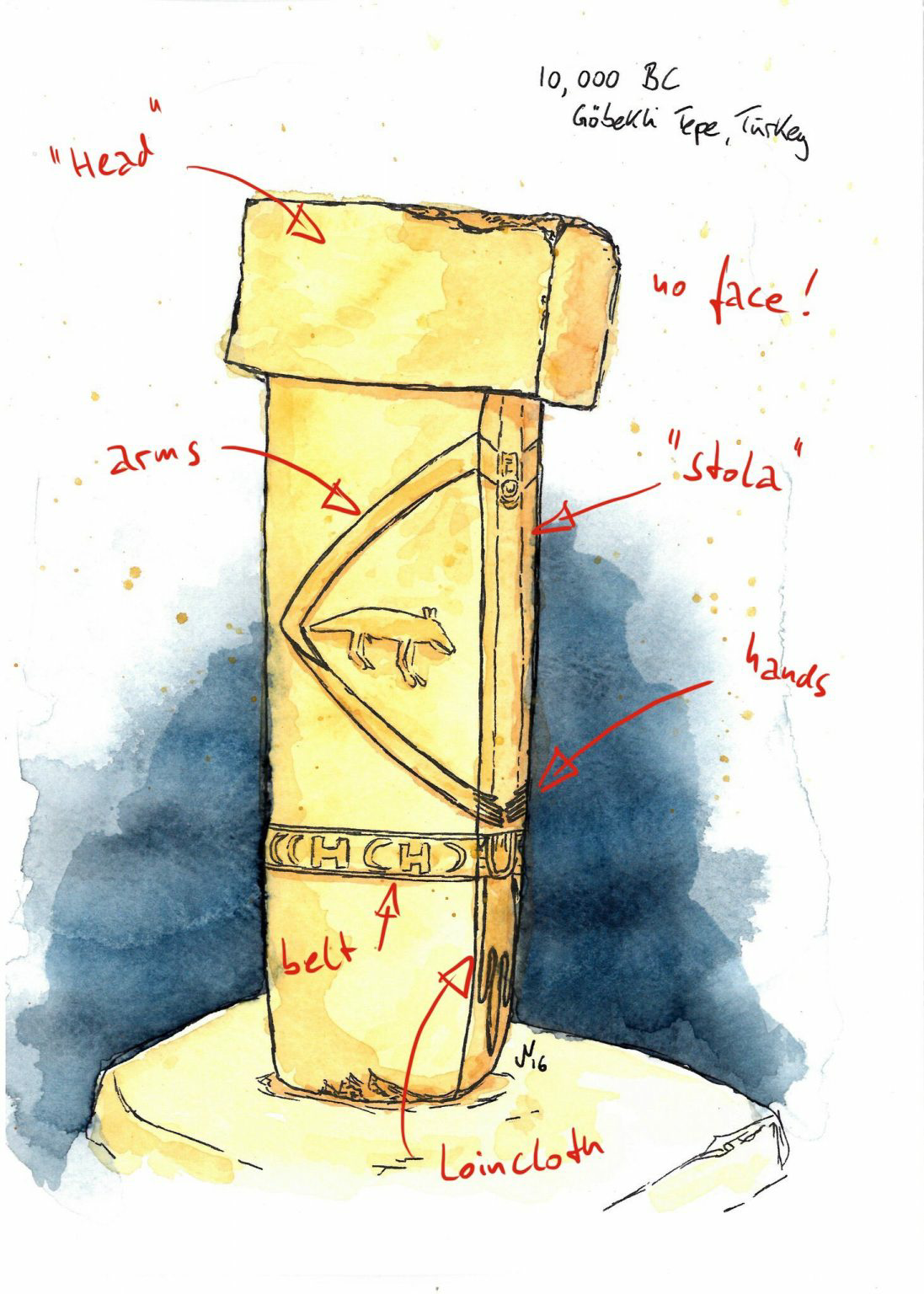 As a result of my extensive study are related to sumerian proto-cuneiform sign Me:”to be,being”. Pillars were inhabiting life spirits, (as if they had souls).
 Alles begann beim Lesen: