De zeci și zeci de ani oamenii se învârt în jurul acestui subiect numit “conștiință”, de fapt din antichitate. Au reușit să realizeze că conștiința este ceva foarte complex, unii spun că este cel mai complex lucru de care avem cunoștință din tot Universul. Este greu de definit dar și mai greu de înțeles și insușită acea complexitate nemaivorbind de mecanismul de funcționare. În acest subiect a intrat un filosof care are mai puține cunoștinte în domeniul neuroștiințelor, informaticii, biologiei sau neurologiei. Se numește David Chalmers, el apărând ca o somitate în domeniu și fiind citat de sute de ori. El a împărțit neștiința în ceea ce este conștiința în două calupuri: unul mai mic și mai ușor de înțeles și altul mai mare și mai greu de înțeles. Și cam atât a reușit să realizeze, a umplut lumea cu “problema grea a conștiinței” pe care desigur a reușit doar să o enunțe și nicidecum să o explice sau să o rezolve. Se întreabă dânsul :
– “cum este să fii tu, ce simte altcineva, cum poți să experimentezi qualia cuiva. Ori cum este să fii liliac sau caracatiță ?” Dacă pornea și făcea un raționament de genul celui care urmează posibil se apropia de un răspuns satisfăcător.Explicația mea: – Conștiința este ceea ce simte, cunoaște și experimentează individul despre sine dar și despre lumea exterioară. Conștiința are o caracteristică (accentuez eu e “puternic”) subiectivă. Adică experiențele și cunoașterea unui individ este diferită de aceea a oricărui altuia de pe planetă. Asta nu înseamnă că unele aspecte, elemente constituente nu pot fi asemănătoare.Asta nu atât pentru că senzorii sunt diferiți ci pentru că experiențele sunt sintetizate în creier și acolo apare diferența în mai mare măsură. Fiecărei senzații, experiențe, amintiri sau gând îi sunt asociate multe caracteristici și elemete particulare. Respectiv fiecare experiență sau cunoștință are culoarea, parfumul și o serie de amintiri conexe asociate, în acest fel devenind unice și desigur subiective pentru că aparțin acelui individ=subiect concret. Nu stim sigur dacă roșul pe care-l văd eu este exact, identic cu roșul pe care-l vezi tu deși ne uităm amandoi la un singur obiect roșu. De aceea este ușor de înțeles că nu poți simți ceea ce simte cineva de exemplu cand îi moare un părinte. Înțelegi, parțial rezonezi dar nu poți avea trăirea lui.Un alt exemplu: mirosul meu de cozonac este în principal acela întipărit bine cand am fost mic in vizită la cineva iar al tău este acela din casa bunicii de la țară cand aveai 6 ani. La fel, nu poți simți ce simte un liliac sau caracatiță, poți face un efort de gândire dar nu și pe planul simțirii, al trăirii efective. Animalul are acele organe simțuri și senzații complexe=trăiri formate în milioane de ani ! Din păcate aceste lucruri simple nu le-a înțeles sau cunoscut Dl. Chalmers.
Inteligența artificială generalizată presupune că poate face absolut tot ceea ce face mintea omenească. Deci are ca referință și face concurs direct cu omul. Dar vă întreb eu, de ce facem un concurs între inteligența omenească și ce artificială ? Dintr-o supraevaluare a noastră, orgoliu nemărginit, suntem constienți și siguri pe noi că sunem vârful inteligenței în Univers ? Pentru că altfel știm că mintea omenească este astfel construită ca în principal să se adapteze optim la traiul pe această planetă. Ea creează tipare și face aproximări. Altfel mintea omeneasca are o serie de chestiuni pe care le numesc slăbiciuni.Din această concurență pornită mai mult din ambiție si din mintea cercetătorilor rezultă că IA trebuie să aibă o conștiință, desigur artificială. Dacă copiază modelul omenesc progresul nu este mare întrucât conștiința omenească este subiectivă. Poate totuși folosi acest fapt pentru că dacă dorim să ne fie partener și să interacționeze cu oamenii, trebuie să aibă clar modelul și tiparele atât ale psihologiei umane cât și a universului său ideatic. Precum și a tuturor particularităților inclusiv acele legate de comportamentului său social. Dar, așa cum am mai atenționat, trebuie evitată suprapunerea realității virtuale a IA cu cea a oamenilor. Pentru că oamenii au un gen de naivitate și empatie care pornește de la faptul ca sunt ființe sociale. Astfel că atașează atribute ale personalității umane animalelor și chiar obiectelor.Afectivitatea partea emoțională și sentimentală ar putea zice cineva că este de vină și partea cea mai slabă.De aici și până la dezastru nu mai este nici-un pas.Pentru că individul poate începe să trăiască în douăvrealutăți sau lumi (sau mai multe?) și apare o destrămare a personalității, înstrăinare denumită științific și medical alienare. Dacă IA are atributele sau începe să coaguleze spre ceea ce s-ar putea numi conștiință, este și bine și rău, dar cred mai mult bine. – Rău în cazul pierderii controlului, vezi scenariul apocaliptic in care o entitate zombi face distrugeri parțiale sau totale din varii cauze și motive. – Bine întrucât se pot “educa” atât inginerii software cat și IA respectiv deca se aluniază obiectivele IA cu cele ale oamenilor. – Bine pentru că teoretic conștiința artificială poate avea scopuri și etaloane de înalt nivel etic și moral.
Interesant este că de operații în plan mintal sau de calculator nu s-a prea speriat nimeni. Începând de la sumerieni 3.500 Î.E.N. și până azi la primele experimente cu computere cuantice.Părerea mea este că nu de IA în sine ar trebui să fim îngrijorați ci de oamenii care o folosesc și mai ales cum o folosesc. Atâta timp cât este artificială nu numai ca material dar și ca software (care va fi creat și acesta de IA) nu avem motive de îngrijorare. În fapt este un computer care rezolvă problemele oamenilor.Dacă în schimb îi dăm sarcini din domeniul societății umane lucrurile încep să se schimbe.Când începem să-i facem cunoscute particularitățile și caracteristicile proprii ființelor vii, comportamentului și gândirii omenești, aici putem începe să avem probleme reale.Pentru că totdeauna trebuie să fim atenți că IA este artificială din materie inertă.Oamenii în schimb sunt alcătuiți dintr-un material friabil, carne supusă degradării, îmbătrânirii, durerii deci suferinței fizice și psihice. Vorbesc deci de momentul in care uităm că o IA chiar dacă va ajunge să aibă atributele unui gen de persoană va rămâne o entitate din material inert, o personalitate non-umană și nu o ființă vie și personalitate umană. Este foarte periculos să creem iluzia că un robot este o persoană sau să fie luat ca atate, drept o persoană. În momentul în care cele două entități au o zonă de suprapunere în conștiința umană, poate apărea o stare de confuzie gravă, un fel de suprapunere sau amestecare a două realități, una din ele sigur virtuală.Asta poate duce la o înstrăinare a individului iar tehnic vorbind in termeni medicali se poate numi alienare. Personalitate schizoidă atunci când componentele personalitații nu mai sunt integrate într-un tot unitar și funcțional.
1.Încurcături pornite de la definiții ce conduc la percepții blurate 2.Stadiul actual al AI este încă departe de inteligența naturală. 3.Conștiința de sine este mai mult decât IP.Necesitatea unui test Touring upgradat 4.AI nu este o specie în competiție directă cu specia noastră, dar are potențial să ne cauzeze extincția.Două feluri de inteligențe 5.Trebuie să înțeleagă comunitatea AI ce este o personalitate non-umană .Limitele conștiinței naturale:senzorial îngustă ,multiplu subiectivă 6.Conștiința artificială nu este o gaură neagră.Avantajele potențiale au pondere majoritară 7.A trăi în două universuri simultan, cel real și virtual.Alienarea ca posibil rezultat. 8.Ne îndreptăm înapoi spre animism? Peturi, cyber sexdoll 9.Pericole, AI potential distrugător mai mare decat cea umană, însă mai posibilă alinierea obiectivelor și a controlul prin soft. ===============
I wondered why allmost 11 scientist struggled & consumed their precious time for only one 3-letter word from inscription, the word “per“.Taking for granted that Decebalus and Scorilo would be for dacian ruller’s names or pot’s owner and maker.I am not for these hipothesis, at least not at all for the latter. First could be, because smart dacians realised that stamp words are matching perfectly their kings names, so on own initiative put them one after another on the large krater-type jar…..and started a river-wine-flowing monster party. Please tell me why one spended a lot of skillful art-work effort and time in order to make those stamps, for what practical purpose, which is the practical benefit? Some years before I thought of roman transportation-logistics stamps, e.g. labeling bales fast transportation. per-scori-lo=for-run-it. / for-travel over-it Last month I added other interpretations, beginning from same flow,run meaning of the word scori. So obtaining again “travel,run” but adding -scroll,roll over “get through tech/kraft steps” and “flow=wash” some gold sand ? and/or “drain it” e.g. gold-sand or cheese. But regarding to gold-sand gold-dust, I found that the word scorilo is related to north-eastern italian dialect (friulian) word scori “flow,run,travel over”and latin word scoria: “slag”. Note that is attested that a lot of workers gathered around gold places and others were brought especially by romans from Dalmatia and Iberia because of their gold mining skills. That area are traditional celtic and italoceltic areas ! What do you think? Further I found that related to latin scoria (slag) there is a close-related process “scorification” wich has the purpose to separate gold and silver from other metals and unwanted minerals and substances. Gold <separation>SLAG So that stamps have perfect use labeling matter intended to go through this processing. And I propose the meaning :
DECE BALUS : (ten bales) but better: DACIAN GOLD DUST (balus old spanish name for gold-dust, nuggets, from wich come latin balux) PER SCORILO : FOR SLAG/SCORIFICATION
D O C U M E N T A T I O N gr. σκωρία (SKORIA):”slug”
“VOL. XIII Page 671- Da PLICATO a PLINTO (1 risultato) di tori, di orbiculo overo scoria overo scorilo e plinto constava. cesariano, 1-57″ From PLICATO to PLINTO (1 result) of bulls, of orbiculo or slag or slag and plinth consisted. Caesarian, 1-57″
“VOL. XVIII Page 229 -Da SCORIACEO a SCORNARE (3 risultati). scoriàceo, agg. miner. che presenta nell’interno piccoli incavi forma ‘aspetto’. scorillo, sm. miner. disus. scorlo (in partic., sciòrlo, sèrio), sm. miner. disus. denominazione usata inizialmente per
From SCORIACEO to SCORNARE (2 results) -formis, from forma ‘appearance’. scorillo , sm. miner. disus. I scroll he won the test, black scorillo . tommaseo [sv”
books.google.pn https://books.google.pn › books Panlessico Italiano, ossia Dizionario Universale della lingua … Marco Bognolo — 1839 … Scorification , [ Sco- rification ] . In chim . Riduzione del metallo in isco … SCORILLO , sm . Minerale che si cristallizza per la maggior par- te si cristallizzano non di rado in prismi o in cilindri , che nelle facce …
pdfcoffee.com https://pdfcoffee.com › al-rosetti-ist… Al. Rosetti – Istoria Limbii Romane scoare s.f. (M-ţii Apuseni) „scorie de fer”: scoria „sordes metallorum, scuria quod de ferro cădit”= “the dirt of metals, the ax that falls from iron”(CGL, IV, 168, 30; 569, 36, V, 243
Tehnologia obţinerii aurului se deosebeşte de cea a altor metale întrucât el apare în stare nativă sub forma unor filoane sau pepite. Diodor din Sicilia redă procedeul zdrobirii minereului, alegerea sterilului cu mâna, transportarea masei semiprelucrate la locurile de măcinare. Aici se executa pisarea în mojare, cu ajutorul unor răngi de fier, apoi măcinarea în râşniţe prevăzute cu mânere, până când minereul ajunge la mărimea unui bob de linte. Spălarea se făcea în canale săpate în pământ, firele de aur colectându-se cu ajutorul unor tufe de rosmarin. Apoi tufele se uscau şi se ardeau pentru a recupera aurul. Produsul obţinut prin spălare era topit în recipiente de lut, executate dintr-un material refractar (creuzete) care se introduceau într-un cuptor.
Datorită faptului că aurul conţinea şi anumite cantităţi de argint (în Munţii Apuseni în procentaj ridicat), era supus unui proces de rafinare (numit cementatio) pentru eliminarea impurităţilor. În acest scop se adăugau cantităţi de plumb şi tărâţe de orz sau alte metale indicate de autorii antici (cositor etc.). Creuzetele descoperite în Dacia la Lupşa şi Baia de Arieş nu poartă urmele unui foc puternic, deci retopirea avea loc la o temperatură moderată şi constantă. Aurul exploatat din depozitele aluvionare, conţinând mai puţini compuşi mineralogici, nu era supus unei topiri repetate. ENGLISH: The technology of obtaining gold differs from that of other metals because it appears in its native state in the form of veins or nuggets. Diodorus of Sicily reproduces the process of crushing the ore, selecting the tailings by hand, transporting the semi-processed mass to the grinding places. Here, crushing is carried out in mortars, with the help of iron teeth, then grinding in grinders equipped with handles, until the ore reaches the size of a lentil grain. The washing was done in channels dug in the ground, the gold threads being collected with the help of rosemary bushes. Then the bushes were dried and burned to recover the gold. The product obtained by washing was melted in clay containers, made of a refractory material (crucibles) that were inserted into a furnace. Due to the fact that the gold also contained certain amounts of silver (in the Apuseni Mountains in a high percentage), it was subjected to a refining process (called cementatio) to remove impurities. For this purpose, quantities of lead and barley bran or other metals indicated by the ancient authors (tin, etc.) were added. The crucibles discovered in Dacia at Lupşa and Baia de Aries do not bear the traces of a strong fire, so remelting took place at a moderate and constant temperature. Gold mined from alluvial deposits, containing fewer mineralogical compounds, was not subjected to repeated melting.
FINALLY IT SEEMS THAT NO MATTER IF IT IS ABOUT SCORI LO: “FLOW/WASH IT”OR SCORILO, “SLAG,SCORIFICATION” (SEPARATION) BOTH ARE MAIN PROCEDURES TO SEPARATE OBTAIN GOLD
….also SCORILO is the name ofthe king and is related to ruller < scroll,roll rom. “a derula”(the power) and not scum but to raw,rugged (face,behaviour?) DECEBALUS=dacian(s) forehead alb. Bale=forehead cretan,old gr. belos “threshold:
After some years Florin Croitoru had come with close opinion talking of scorere<>flowing, in fact suggesting cheese draining.
When discussion comes to serious things, inscriptions were made in an unusual way , namely were made by stamp imprinting. Even so it is possible that there were used even more than two stamps. The writing in one is mirror reversed.
<<< “But my opinion is that we are dealing with two stamps, one made better, the one with “DECE” and the other, with “BALVS” made by someone else, a man who, just like we did when we were children, made stamps from eraser, I carved it and when I stamped I found that the writing came out backwards. I don’t think there is any other logical explanation for that text being written in two ways. And if we have two stamps it means we have two words. And if we look even more closely, we notice that between DECE and BALVS written backwards there is a larger space than between the other letters. And the second inscription, is written in reverse.>>> From https://groups.google.com/g/andradanoua/c/due8c7pa7WM#:~:text=%C5%9Etampilacu%20PERSCORILO, with%20%C5%9Ftampila%20DECEBALUS. “Stamp with PERSCORILO is placed in reverse in relation to the stamp with DECEBALUS, so it cannot be an expression “decebalus per scorilo”. The fact that the writing is in relief and in the cartridge shows that they were used stamps, so several such vessels were made with the stamp per scorilo as well as with the DECEBALUS stamp” ———————— Now, the container is of KRATEROS type; the name comes from greek “mixing wine” and for this was used in all places icluding symposia=meetings or by etruscans for funerrary rituals. From Fonduri Patrimoniu https://www.fonduri-patrimoniu.ro › …PDF << când viaţa cotidiană antică devine patrimoniu unesco. Kraters were used possibly for storing but also for mixing liquids, just like wine>> This size “extra large” is very rare in the World. If we think of a big meeting for comemoration of a dead ruller as could be SCORILLO then the thext is fitting allmost perfectly. But what puzzled other scientists that there is not a proper way of honoring somebody using stamps and letters tens/hundreds times smaller than container, when they had at disposal square meters of working surface. So others sought (as me either) that roman stamps are involved (by no way made by dacians). Romans had a such a high degree of organising all practical aspects, eg constructions and transportation. But out of all, especially logistics high level was never riched by any country hundreds if not thousends of years after. My country Romania even nowday has not such a level of organised administration. ————————- R EA D I N G / MEANING —————–
v. percorrere=v. run across v. andare in calore, andare in estro=v. go into heat ———————————— I was on the verge of renouncing to all variants in favor of the one most used and accepted, because: – there are prezent on inscription out of 3 words, two king names – For word scorilo existed or exist hfound not hard evidence and if was, not sure of its real meaning. Found scori but that final LO of Scorilo was a big truble for me
Usage notes. Appended to present active infinitive verb forms to derive accusative forms when the object is third singular masculine person. Also appended to second singular person imperative forms. The final –e of the original infinitive is removed :
Suffix -Lo is present in serbocratian ,italian and latin. (So could be explained is somehow prezent in north-eastern Italy Veneto area friulian dialect.)
Friulian-English https://glosbe.com/fur/en per scorrilo: “to pass through” / rom.”(pentru) a trece prin” ==================== Now things suddenly took an unexpected turn. So much as to clarify in a manner almost impossible to be contested: A. Whose purpose were the stamps intended for, B. how and why the Dacians used stamps with Latin writing, and C. the meaning of the text. A- These stamps were used by the romans in the field of transport and logistics. B. The Dacians used them because the texts had a different meaning in their language, a profound one related to dacian kings/rullers. Was perfect suitable when gathered at one banquet (gr. symposio) on occasion of honoring/aniversary/funerary ritual for SCORILO, when the crater was full of drink It seems that we had and encounter here, no literary latin but late vulgar latin, close to italian and romanian. C.1. The meaning for the Romans: dece(m)balus: “ten/dacian bale, batch, installment” perscorilo: “forflow,run (lat.curre it.scori), flowing-residue,drain,,crossing” C.2. The meaning of Dacians: Decebalvs: “Decebal” perscorilo: “fordraining, creaming, Scorilo” DECE-BALUS PERSCORI-LO TEN-BALES FORTRAVEL OVER ………………………SCROLL THROUGH …………………………RUN ACROSS Dacian: …………………. .DRAINING, CREAMING, SCORILO Decebal forPassed, Last, SCORILO Rom.: 1o boluri PAR–CURSUL …………………….PENTRUSCURSUL=SCORILO Do not ask me who made who took from where the stamps, which day who werethere and so on. I am telling you only what is written there and the meaning. ============================== These explanations are scattered, so I conclude: – the text (late Latin) on the stamps has to do with flowing and running. Because these are the main meanings of the verb involved here, scorere. It refers to movement or something that flows, not necessarily liquid. And we will have either course or draining, but also exactlythe name Scorilo.
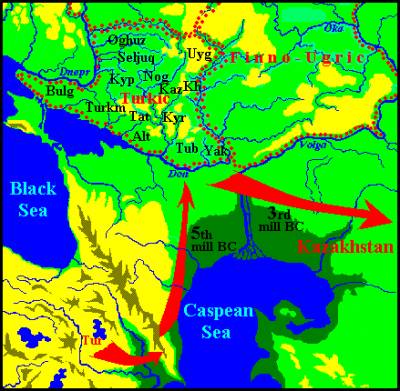
Earlier, using the graphical-analytical method, we found the Turkic Urheimat in the South Caucasus (see The Nostratic languages. ) and then localized the habitats of Turkic tribes speaking particular dialects, originated from the common parent Turkic language, in East Europe (see The uprising of the Turkic Languages) . content://com.android.chrome.FileProvider/images/screenshot/16411219832048302626540330989691.jpg
From The Relationship of the Altaic and Turkic languages.http://alterling.ucoz.de/index/the_relationship_of_the_altaic_and_turkic_languages/0-19 << Earlier, using the graphical-analytical method, we found the Turkic Urheimat in the South Caucasus (see The Nostratic languages. ) and then localized the habitats of Turkic tribes speaking particular dialects, originated from the common parent Turkic language, in East Europe (see The uprising of the Turkic Languages) . Only to the end of the 3rd mill BC the most part of Turkic tribes crossed the Don and dispersed in the Volga river basin, the Northern Caucasus, and further in the steppes of Kazakhstan. In such way they arrived to Altai. Such assertion contradicts Altaic theory of the origin Turkic languages based upon the fact of common features between the Turkic and Mongolic languages. But these common features can have other explanation as genetic relationship. >>
For the place of origin of Altaic and Turkic languages, further searching must be made; from the above paper: “The Proto-Turkic language quite well fit to the general model of relationship of the Altaic languages what can say about their common genetic origin. For the final clarification of the issue, it is needed to find the territory of arising of the Altaic languages. As the graph has only five knots, it can be placed on different places in Europe or Asia. To facilitate the search for the exact location, we have to construct the separate models of relationship of the Mongolic and Manchu-Tungus languages, which number is enough for the confident placing them on assumed places of Ethno-generating areas . Having received such survey, it will be easier to establish the place of formation of the other Altaic languages”
Another relation of altaic family with the folowing people on the area, sumerians:
Close or on the same area followed sumerians: From https://dokument.pub/gbekli-tepe-genesis-of-the-gods-the-temple-of-the-watchers-and-the-discovery-of-eden-by-andrew-collins-graham-hancoc-flipbook-pdf.htmlhttps://dokument.pub>gbdkl…PDFgobegli_tepe-genesis_of_the_gods-DOKUMENT.PUBABODE OF THE GODS 《The mythologies of these great civilizations speak clearly of wisdom bringers and creator gods responsible for the formation of the earliest towns, cities, canals, walled enclosures, and irrigation channels—and even of humankind. Named as the Anunnaki, these anthropomorphic, or humanlike, gods are said to have emerged from a primeval mound called Duku, situated on a cosmic mountain named Kharsag, beneath which was the world of mortal human beings. Klaus Schmidt believes that Göbekli Tepe had a direct impact on the myths and legends regarding the Anunnaki, and that the site could be the role model for the original Duku mound. Indeed, he goes further, as Andrew points out in this book, by hinting at a connection between Göbekli Tepe and biblical traditions concerning the Garden of Eden, and perhaps even the very human angels of Hebrew mythological tradition known as the Watchers. CULT OF THE VULTURE A deep look at the description of the Watchers and their offspring, the Nephilim, in ancient Jewish texts such as the book of Enoch makes it clear that these mythical creatures were not incorporeal angels, but flesh and blood human beings with very distinct shamanistic qualities. They are occasionally said to wear dark, iridescent cloaks, or feather coats, and on occasion they take flight like birds, echoing the presence among the earliest proto-Neolithic communities of the Near East of a cult of death and rebirth focused on scavenger birds such as the vulture. As Andrew points out, at Göbekli Tepe, as well as at the nine-thousandyear-old Neolithic city of Çatal Höyük in southern-central Turkey, there are abstract representations of vultures with articulated legs. Either they are shamans 》
” the Fertile Crescent was a linguistic mosaic with higher population densities than its surroundings and a long history of ancient cultural innovations, including agriculture. Languages expanded from it, not into it. It is pointless to look for the origins of Indo-European in the first farmers of Anatolia, who spoke Hattic before the Hittites arrived. Neither could the Neolithic peoples of the Levant have spoken Afro-Asiatic, the only Eurasian branch of which (Semitic) having reached the area in relatively recent times. We will never know the language of PPNA, and there might have been many. Perhaps the dwellers of Çatal Höyuk and worshippers at Göbekli Tepe spoke an ancestor of Hattic, or perhaps it was yet another language that contributed to the huge diversity of this ancient cultural mosaic.” https://images.app.goo.gl/uviPnB2J8JZj5mFT9
It is not inappropriate to say “inhabitants” because although it is not known how stable the dwelling was, it is known that they frequented this area. My humble premises, assumptions, opinions, hypotheses and observations would be: – Many hypotheses have been launched regarding the connection of the population and cult sites with the sky and the stars, in my opinion possibly exaggerated, inducing the idea of a population with intense concerns and good training in the area. astronomy, and resulting less than for hunting. – The sky did not look the same for non-Western European populations. (see for example the ancient Chinese cosmological concept) If the origin of the Indo-Europeans was in Anatolia then we can assume precursors, beginnings and concepts in the same direction. – the stage of spiritual-religious development was the animist-totemist-shamanist one. Among the shaman populations, the axis of the world and the North Star were of the greatest importance. Because they were related to the afterlife but also to the spiritual journeys of the shamans. Then the correspondent of the polar star on the earth was the intersection of the polar axis with the earth, the “navel of the earth”. At 9,600 B.C. the north celestial pole was near the constellation Hercules (the star EtaHerculis) – the existence of an Axis Mundis does not depend on the existence of a bright star in that place in the sky – Of course the existence of asterisms / surrounding constellations was noticed and inscribed – I do not fight the claims that on the pillars there are stars and constellations (like some maps) – the T-shape which is the symbol of the complex Sumerian concept “Me” which at its turn had a total involvement in the physical and spiritual life of the Sumerians. This symbol and conception is definitely rooted in Tas Tepeler. – This symbol and concept Me, for the Sumerians: “divine, vital force, life spirit” was closely related to the activities carried out by the Sumerians and the inhabitants of Tas Tepeler in their holidays and festivals. – if ancestor worship was very much like worship of heroes, then why not a proto-hero-ancestor in pre-pottery neolithic. Similar to Ghilgames, as later was represented by Hercules Constellation >> – considering the period of time in which it existed, the Tas Tepeler hunter-gatherers society were one of the highest organizational knowledge and technological level achieved by humankind. ===== D O C U M E N T I N G ======
https://www.uh.edu › ~cldue › hero… Hero Cults <<The worship of heroes was very much like ancestor worship>> GÖBEKLI TEPE’S PILLAR 43: AN ASTRONOMICAL INTERPRETATIONAndrew Collins and Rodney Hale http://www.andrewcollins.com/page/news/P43.htm <<During the epoch of 9600 BCE the northern celestial pole was located in the constellation of Hercules, although no bright star was close enough to act as pole star.
Figure 3. Schematic overlay of key features of Pillar 43 overlaid on a snapshot of the sky taken from the Stellarium sky program for the latitude of Göbekli Tepe for a date of 9600 BCE, its approximate date of manufacture based on radiocarbon dating evidence.Schematic overlay of key features of Pillar 43 overlaid on a snapshot of the sky taken from the Stellarium sky program for the latitude of Göbekli Tepe for a date of 9600 BCE, its approximate date of manufacture based on radiocarbon dating evidence.
Hole in the Sky Identifying the ball as the turning point of the northern night sky makes sense of its role as the disembodied head and soul of the headless figure seen at the bottom of Pillar 43. In the shamanic-based beliefs and practices of tribal cultures in Siberia, such as the Chukchee and Altaians, the northern celestial pole is seen as a hole through which the soul passes to gain entry to the afterlife. Indeed, this “hole in the sky” was compared with the round smoke hole of a yurt or tent, through which the soul of the shaman, and presumably those who have died inside the yurt, navigate to reach the Upper World (Eliade, 1987: 17, 19, 30). Indeed, in shamanic tradition all three worlds – the Below World, Middle World and Upper World – are linked via similar such holes.>> I found a work that refers to Chinese civilization, although it refers to a later period than the pre-ceramic Neolithic. I think it is a very good source of inspiration: The Ancient Eurasian World and the Celestial Pivot In and Outside the Square:The Sky and the Power of Belief in Ancient China and the World, c. 4500 BC – AD 200 by John C. Didier http://sino-platonic.org/complete/spp192_vol1.pdf <<Chapter 2: The Power of the Celestial Pole in the Ancient World Sources recording early celestial observations undertaken in many world civilizations support the proposition that for ancient peoples the sky, and particularly the celestial pole and its circumpolar stars, constituted the point of center and/or origin of things, and also the ultimate guide and source of solace for humans when they were astray, alone, or otherwise insecure in the world. Essentially, people looked to the sky to establish their own context and thus gain a sense of security.Part of such security seems to have been achieved when ancient observers across many civilizations imposed their wish for escape from the natural earthly cycles of life and death, that is, for immortality, on the one natural phenomenon that never rested, and thus never died, the northern celestial pole. Such an immortality often involved the apotheosizing of human leaders on earth such that they came to form part of a given civilization’s godhead. In other cases the celestial polar godhead, while anthropomorphized, did not as far as we understand embrace the spirits of deceased ancestral kings. In both cases, however, the northern celestial pole seems to have served as either the font or seat of the perceived and projected universal high power. …… In the literature treating the history of the ancient development of astronomical science it is often pondered whether the human impulse to observe, mark, and thus understand the formulaic shifting of the celestial canopy originated in a need for either calendrical and navigational or psycho-spiritual guidance. That is, we wonder, which came first, a celestially based calendar or a celestially oriented projection of protective and guiding deities? …..As we have seen, such Lithic constellations would have marked the seasons and years, but they might also have been simply practical measures to enhance identification of the particular heliacally rising star that was significant to the observers. …. earlier people with even fewer clues to the workings of the universe that surrounded them also would have projected onto the stars a causal, effective influence over themselves and their earthly environs. As mentioned in the first pages of this book, likely this originated as not only a simplistic response to patterns observed in the environment but also a root psychological impulse to manage the feared unknown. In that such a process to a degree rationalized the universe, the causal relationship established psychologically between stellar phenomena and earth events lessened the extent and intensity of the unknown and thus reduced people’s fear of it. ….. p.200 Taiyi is the name of the god at the northern celestial pole. Residing in its station, it is called Taiyi. Since it constantly traverses the eight trigrams between the sun and the pole (i.e., between the solar ecliptic and the NCP, or throughout the heavens), it is called either Tianyi or Taiyi. ….p.203 In other words, “there was thus a tendency for kingdoms, capitals, temples, shrines, and so forth, to be constructed as replicas of the cosmos. …. The Ancient Eurasian World and the Celestial Pivot In and Outside the Square:The Sky and the Power of Belief in Ancient China and the World, c. 4500 BC – AD 200 by John C. Didier http://sino-platonic.org/complete/spp192_vol1.pdf <<Chapter 2: The Power of the Celestial Pole in the Ancient World Sources recording early celestial observations undertaken in many world civilizations support the proposition that for ancient peoples the sky, and particularly the celestial pole and its circumpolar stars, constituted the point of center and/or origin of things, and also the ultimate guide and source of solace for humans when they were astray, alone, or otherwise insecure in the world. Essentially, people looked to the sky to establish their own context and thus gain a sense of security.Part of such security seems to have been achieved when ancient observers across many civilizations imposed their wish for escape from the natural earthly cycles of life and death, that is, for immortality, on the one natural phenomenon that never rested, and thus never died, the northern celestial pole. Such an immortality often involved the apotheosizing of human leaders on earth such that they came to form part of a given civilization’s godhead. In other cases the celestial polar godhead, while anthropomorphized, did not as far as we understand embrace the spirits of deceased ancestral kings. In both cases, however, the northern celestial pole seems to have served as either the font or seat of the perceived and projected universal high power. …… In the literature treating the history of the ancient development of astronomical science it is often pondered whether the human impulse to observe, mark, and thus understand the formulaic shifting of the celestial canopy originated in a need for either calendrical and navigational or psycho-spiritual guidance. That is, we wonder, which came first, a celestially based calendar or a celestially oriented projection of protective and guiding deities? …..As we have seen, such Lithic constellations would have marked the seasons and years, but they might also have been simply practical measures to enhance identification of the particular heliacally rising star that was significant to the observers. ….. earlier people with even fewer clues to the workings of the universe that surrounded them also would have projected onto the stars a causal, effective influence over themselves and their earthly environs. As mentioned in the first pages of this book, likely this originated as not only a simplistic response to patterns observed in the environment but also a root psychological impulse to manage the feared unknown. In that such a process to a degree rationalized the universe, the causal relationship established psychologically between stellar phenomena and earth events lessened the extent and intensity of the unknown and thus reduced people’s fear of it. ….. p.200 Taiyi is the name of the god at the northern celestial pole. Residing in its station, it is called Taiyi. Since it constantly traverses the eight trigrams between the sun and the pole (i.e., between the solar ecliptic and the NCP, or throughout the heavens), it is called either Tianyi or Taiyi. ….p.203 In other words, “there was thus a tendency for kingdoms, capitals, temples, shrines, and so forth, to be constructed as replicas of the cosmos. …. p.204. Elsewhere Eliade even indicated in passing the object that he believed was the absolute center of the cosmos to which the Sacred Mountain pointed and which every temple or palace recreated: the pole star. … p.209 “The Polar Rectangle” ….. p.210 The palace of the Chinese emperor… [and] the heart of the South Indian templecity… each symbolized an axis mundi, an omphalos, about which their respective kingdoms revolved. Similarly, whereas in these cultures cardinal orientation involved the positioning of the sides of a square or rectangle so as to face the cardinal points of the compass, in ancient Mesopotamia it was normally the corners of the enceinte which were directed in this manner. But in both instances the principle of cardinal orientation was strongly developed, the four compass directions were the reference points by which the sacred enceinte of the city was located in the continuum of profane space. >> Observations in Eddic Astronomy Niddhöggr, Yggdrassils Askr, and the Swan Song of Cyngus by Dr. Christopher E. Johnsenhttp://www.germanicmythology.com/ASTRONOMY3/Nidhoggr.html << As we know it is extremely likely that the Milky Way was seen as a road or river where the dead crossed over or traveled upon to reach the land of the dead. Cygnus is located at the northern-most reaches of the Milky Way, reflecting how migrating swans were seen to journey each spring over the earth. Worldwide in many mythologies, Cygnus was seen as the entrance and exit to the sky-world and perhaps the original location of heaven. The extreme north was where the dead went in the afterlife and they reached it by going to the Pole Star along the north-south meridian line, which splits the heavens in two along its longitudinal zenith. This cosmic axis of the Northern Hemisphere was seen as linked with the axis mundi of the terrestrial world, via a sky-pole, which has featured extensively in shamanic practices across Europe and Asia.>> The Polar Star and Human Migrations in Prehistoric Europe http://www.pienisalaliittotutkimus.com/2018/01/15/the-polar-star-and-human-migrations-in-prehistoric-europe/?fbclid=IwAR13326gRZRQvcA_phSaYCBm25mIYCjzH7tOyHf65Vz3rmXwoSqGAUk4uUk << The star constellation Hercules, which is seen up side down, can be conceptualized as a female goddess, not up side down, especially this relief:
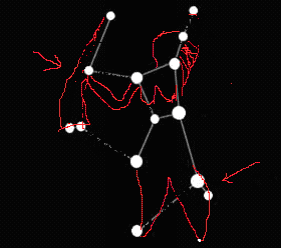
Comparing it to the Hercules constellation shows certain similarity, as an easy application of the common observation that in the stars you can see what you want to see. The arrows point out something that is not obvious. The right tight in the relief is bulged, which can be explained by the stars of Hercules, and the drinking horn is there, though in another position.
Hercules was the constellation closest to the celestial North Pole until the polar star moved to Draco, so we should find two constellations, Hercules and Draco. A Gravettian statue known as Balzi Rossi Beuty and the Beast shows a woman and a snake. The figures are connected from the head and legs. Draco is close to Tau Herculis, which is a star in the woman’s head. Draco does not connect to the woman’s feet, but there is another snake shaped constellation close to the feet, Serpent’s Caput. While it may not be so obvious from the drawing, there is no mistake in identifying one figure as the woman by the breasts, navel and buttocks and the snake by the snake head and scales in the body.
….. After Gravettian there were the Solutrean and Magdalenian cultures which were already discussed. Let us jump to the new migration around 12,000 BC. It is the time when Vega was the polar star. >> Tau Herculis https://en.wikipedia.org/wiki/Tau_Herculis << Tau Herculis is located within 1° of the precessional path traced across the celestial sphere by the Earth’s North pole. It could have served the northern pole star around the year 7400 BCE >>
https://en.wikipedia.org/wiki/Vega << Vega was the northern pole star around 12,000 BCE >> ME’s and the Spring Festivals (Summary of Habilitation and Russian book). St.-Petersburg, Orientalia, 2009
Here we will review the basic properties or attributes of the prephilosophical categories of Ancient Near Eastern culture, and the most perspective approaches to their studying. It is impossible to study suchfundamental categories as Egyptian kа,bа, Sumerian me,nam, Elamic kiten, Chinese dao,de, applying philosophical or logical methods. …… The МЕ category is one of the most complex and multidimensional problems in cuneiform studies. Its translation, etymology, unity of theabstract and concrete sense in one concept, the semiotic space of thecategory and its probable dynamics within the borders of Mesopotamianculture contain one big problem for Sumerology. МЕ is connected to allinstitutions of civilization in Mesopotamia – the government, the court,military activity, crafts, rituals, literacy, and also to some human actionsand character traits. The whole “shape” of the civilization depends on MEas well as the prenatural laws and principles of cosmic life. ….. Then, let’s examine J. Klein’s hypothesis about МЕ as a special object which, in the reseacher’s opinion, should be “a two-dimensional symbol or an image cut or drawn on a banner or standard and designating abstractconcept hidden in it”. ….. Chapter V GODS AS HEROES OF SUMERIAN SPRING RITUALS All Sumerian texts results in the following consecutive actions:1. Preliminary reception of МЕ’s (from the senior god, or the senior brother, or an ancestor).2. Fight for МЕ’s with a certain villain living in the highlands.3. Victory over the villain and capture of trophies.4. Solemn delivery of the trophies into a temple of the senior god (anancestor or the entity the ME had been received from).5. The need for authority and reception of signs of power.
The naturalistic representations of the photographic type, of the things that surround us are very familiar to us and do not require any effort of understanding. Whether it’s the image of the mother, a tree or whatever. But when it comes to representing abstract notions, then things are not as simple. Because ideally the image should be both suggestive and represent that concept as synthetically as possible. The difficulty becomes obvious and only if we go back to the example we had before, mother. I don’t think that when the Sumerians needed a sign to represent the divine powers then, they immediately imagined one. I think they had a choice, from the infinity of pre-existing signs in nature. I noticed that the Sumerian pictographic signs (ie proto-cuneiform) do not always faithfully reflect the shape of the described object. Then maybe the Sumerians took the sign from previous civilizations or maybe not. But surely the hunter-gatherers also faced a similar dilemma: what sign to use to express a sense of admiration, piety, and deification? We will never know if the choice of sign was partially random or long thought out. We are now approaching the bull’s skull and the human figure. Somehow an irony of fate, of the headless human figure! Of course, the human figure and the bull inspire strength and power, but I think there are many other symbols that could just as well suggest strength and power. But let’s not forget that we interpret from the perspective of modern man who has a completely different vision the world. The beginnings of religion in the world as well as the population of pre-ceramic Neolithic culture (PPN / pre-pottery neolithic) did not begin with the deification of anthropomorphic entities. As I argue, the first T-shaped monuments may have represented the spirit of life. Possibly with the ancestors. The Russian scientist Emelianov claims that the original meaning of the Sumerian notion “Me”, which has the shape of your letter, was “the will to live”. You are probably wondering what the connection may be between two civilizations 5,000 years apart. I was also surprised to notice some connections. It is possible that there is a kind of continuity in space and time of some local inhabitants. Fortunately, there are other researchers who have noted such similarities: From the Treasures of Syria – NINO Leiden https: //www.nino-leiden.nl ›publication› from-the-tre … << they were practical, modest, and devoid of anthropocentric pride enough not to find and rely on deities like them. The evolution starting from the deification of some spirit entities can be observed in that of the appearance of the pillars from layer III from Gobekli Tepe, then moving to the T-pillars from Adiyaman / Kilisik. >>
and ending with the man from Urfa. Although I would have liked to find traces and the last springs of the T sign in the pre-ceramic phase or before, I did not find it. I found something on the territory of Armenia, but the signs do not seem to be old enough (ie before 9,600 BCE) and their interpretation deviates from that of the Sumerian experts. https://www.academia.edu ›The_La … Web Results (PDF) The Land of the Celestial Gates | Hamlet Martirosyan … In future writings we will try to show that it is necessary to use the “passage, fissure, aperture, door, gate, way” meaning of the ME cuneiform. This https://en.wikipedia.org/wiki/Adyghe_Xabze
The Adyghe “hammer cross” representing Xabze
See also the indigenous religions of the indigenous peoples of the Caucasus: https://www.wikiwand.com/en/Caucasian_neopaganism << An important element is the belief in the souls of the ancestors, who have the ability to observe and evaluate the affairs of their descendants. The concept of physical pain or pleasure in (the life of) then is absent …. >> I did not find T signs older than those of Gobekli Tepe in art and cave signs or those of the Stone Age. And even if I found it, it would be rather impossible to extract any clear meaning from them. My opinion is that the sign being in the category of crosses is related to the impact, the intersection and the crossing, the crossing. It may represent the connection of earthlings with heaven and divinity, since the T sign in ancient Chinese writing represents the notion of DOWN. Somehow it is naturalistic, because the sky was imagined by the ancients as a sphere that surrounds the Earth, so somewhat tangible. is represented by the top of the T.
Two adjacent T’s: “H” Universe ?? If the meaning of the sign T = Me has become so rich and complex, I think it has an old origin in a simpler society and over time, as it has developed and has gained new and new meanings. The society and population of the Sanliurfa area from IEN 9,600 was at least as advanced and complex for its time as the subsequent society that followed it after thousands of years, the Sumerian one!
Nu este impropriu spus “locuitori” pentru ca desi nu se stie cat de stabila era locuirea, se stie ca frecventau aceasta zona. Umilele mele premize, supozitii, pareri, ipoteze si observatii ar fi: – Au fost lansate multe ipoteze privind legatura populatiei si a siturilor cultice cu cerul si astrele, dupa mine posibil exagerat, inducand ideea unei populatii cu intense preocupari si o buna pregatire in zona astronomiei, si rezultand mai putin decat pentru vanatoare. – Cerul nu a aratat la fel pentru populatiile care nu au fost Vest Europene. (a se vedea spre exemplu concetia cosmologica antica chinezeasca) Daca originea Indo-Europenilor a fost in Anatolia atunci putem presupune precursori, inceputuri si conceptii in aceeasi in aceasta directie. – stadiul de dezvoltare spiritual-religioasa era acela animist-totemist-samanist. La populatiile cu samani, axul lumii si steaua polara aveau cea mai mare importanta. Pentru ca erau legate de viata de apoi dar si de calatoriile spirituale ale samanilor. Apoi corespondentul stelei polare pe pamant era intersectia axei polare cu pamantul, “buricul pamantului”. – La 9.600 B.C. polul nord celest, a fost in dreptul Constelatiei Hercules (steaua EtaHerculis) – existenta unui Axis Mundis nu depinde de existenta unei stele stralucitoare in acel loc pe cer – Desigur existenta asterismelor/constelatiilor inconjuratoare a fost remarcata si au fost inscriptionate – nu sustin dar nici nu combat sustinerile ca pe piloni sunt figurate stele si constelatii (in genul unor harti) – Forma T care este simbolul conceptului sumerian complex “Me” care la radul lui a avut o implicare totala in viata fizica si spirituala a sumerienilor. Acest simbol si conceptie isi are radacina categoric la Tas Tepeler. – Acest simbol si concept Me, pentru sumerieni:”divin, forta vitala,spiritul vietii” a fost strans legat de activitatile desfasurate de sumerieni si locuitorii Tas Tepeler in sarbatorile si festivalurile lor.
GÖBEKLI TEPE’S PILLAR 43: AN ASTRONOMICAL INTERPRETATIONAndrew Collins and Rodney Hale http://www.andrewcollins.com/page/news/P43.htm Lb.Rom.: << În timpul epocii anului 9600 î.Hr., polul ceresc nordic era situat în constelația lui Hercule, deși nicio stea strălucitoare nu era suficient de aproape pentru a acționa ca stea polară. Gaura in Cer. Identificarea mingii ca punct de cotitură al cerului nopții de nord dă sens rolului său de cap și suflet neîncarnat al figurii fără cap văzută în partea de jos a stâlpului 43. În credințele și practicile bazate pe șaman ale culturilor tribale din Siberia, precum ca Chukchee și Altaieni, polul ceresc nordic este văzut ca o gaură prin care trece sufletul pentru a obține intrarea în viața de apoi. Într-adevăr, această „găură din cer” a fost comparată cu gaura rotundă de fum a unei iurte sau a unui cort, prin care sufletul șamanului și, probabil, cei care au murit în interiorul iurtei, navighează pentru a ajunge în Lumea Superioară (Eliade, 1987). : 17, 19, 30). Într-adevăr, în tradiția șamanică, toate cele trei lumi – Lumea de dedesubt, Lumea de Mijloc și Lumea de Sus – sunt legate prin astfel de găuri similare.>>
Figure 3. Suprapunerea schematică a caracteristicilor cheie ale stâlpului 43 suprapuse pe un instantaneu al cerului luat din programul de cer Stellarium pentru latitudinea de Göbekli Tepe pentru o dată de 9600 î.Hr., data aproximativă de fabricație bazată pe dovezi de datare cu radiocarbon.
Am gasit o lucrare care se refera la civilizatia chineza cu toate ca se refera, la o perioada mai tarzie de cat neoliticul pre-ceramic. Cred ca este o foarte buna sursa de inspiratie:
The Ancient Eurasian World and the Celestial Pivot In and Outside the Square:The Sky and the Power of Belief in Ancient China and the World, c. 4500 BC – AD 200 by John C. Didier http://sino-platonic.org/complete/spp192_vol1.pdf <<Chapter 2: The Power of the Celestial Pole in the Ancient World l Lb.Rom.: << Surse care înregistrează observațiile cerești timpurii efectuate în multe civilizații ale lumii susțin propunerea că, pentru popoarele antice, cerul și, în special, polul ceresc și a acestuia stelele circumpolare, au constituit punctul de centru și/sau originea lucrurilor și, de asemenea, ultimul ghid și sursă de alinare pentru oameni atunci când erau rătăciți, singuri sau nesiguri în alt mod în lume. În esență, oamenii s-au uitat la cer pentru a-și stabili propriul context și, astfel, să capete sens de securitate.O parte din această securitate pare să fi fost atinsă atunci când observatorii antici din mulți civilizațiile și-au impus dorința de evadare din ciclurile naturale pământești ale vieții și morții, pentru nemurire, pe singurul fenomen natural care nu s-a odihnit niciodată și, prin urmare, nu a murit niciodată, polul ceresc nordic. …. În literatura care tratează istoria dezvoltării antice a științei astronomice adesea s-a gândit dacă impulsul uman de a observa, de a marca și, astfel, de a înțelege formula deplasarii baldachinului ceresc a provenit dintr-o nevoie fie de calendaristică și de navigație sau dintr-una de îndrumare psiho-spirituală. Adică, ne întrebăm, care a fost primul, un calendar bazat pe cel ceresc sau o proiecție orientată spre cer a zeităților protectoare și călăuzitoare? …..După cum am văzut, astfel de constelații litice ar fi marcat anotimpurile și anii, dar ar fi putut fi, de asemenea, pur și simplu măsuri practice pentru a îmbunătăți identificarea unei stele speciale în creștere heliacala care a fost semnificativă pentru observatori. ….. oamenii de demult, cu și mai puține indicii despre funcționarea universului care îi înconjura, de asemenea, ar fi proiectat asupra stelelor un efect cauzal, eficient influența asupra lor înșiși și asupra mediului lor pământesc. După cum se menționează în primele pagini ale acestui articol din carte, probabil că aceasta a apărut nu doar ca un răspuns simplist la tiparele observate în mediu dar și un impuls psihologic bazal de a gestiona necunoscutul temut. În că astfel de proces într-o măsură a raționalizat universul, relația cauzală stabilită psihologic între fenomenele stelare și evenimentele pământești au diminuat amploarea și intensitatea necunoscutului și astfel a redus teama oamenilor de asta.
….. p.200 Taiyi este numele zeului de la polul ceresc nordic. Locuind în stația sa, se numește Taiyi. Deoarece traversează în mod constant cele opt trigrame dintre soare și pol (adică între ecliptica solară și NCP, sau prin ceruri), se numește fie Tianyi, fie Taiyi. ….p.203 Cu alte cuvinte, „a existat astfel o tendință pentru regate, capitale, temple, altare și așa mai departe, să fie construite ca replici ale cosmosului. …. str.204. În altă parte, Eliade chiar a indicat în treacăt obiectul despre care credea că este centrul absolut al cosmosul spre care îndrepta Muntele Sacru și pe care fiecare templu sau palat l-a recreat: steaua polară.… p.209 „Dreptunghiul polar” ….. p.210 Palatul împăratului chinez… [și] inima orașului templu din India de Sud… fiecare simbolizează un axis mundi, un omphalos, în jurul căruia se învârteau regatele lor respective. În mod similar, în timp ce în aceste culturi orientarea cardinală presupunea poziționarea laturilor unui pătrat sau dreptunghi astfel încât să fie în fața punctelor cardinale ale busolei, în Mesopotamia antică era în mod normal colţuri ale enceintei care erau îndreptate în acest fel. Dar în ambele cazuri principiul orientării cardinale a fost puternic dezvoltat, cele patru direcții ale busolei au fost punctele de referință prin care enceinte sacru a orașului a fost situat în continuum-ul spațiului profan. >>
Din Observations in Eddic Astronomy Niddhöggr, Yggdrassils Askr, and the Swan Song of Cyngus by Dr. Christopher E. Johnsenhttp://www.germanicmythology.com/ASTRONOMY3/Nidhoggr.html Lb.Rom. <<După cum știm, este extrem de probabil ca Calea Lactee să fi fost văzută ca un drum sau un râu pe care morții au traversat sau au călătorit pentru a ajunge în țara morților. Cygnus este situat în partea cea mai nordică a Căii Lactee, reflectând modul în care lebedele migratoare au fost văzute călătorind în fiecare primăvară peste pământ. La nivel mondial, în multe mitologii, Cygnus a fost văzut ca intrarea și ieșirea în lumea cerului și poate locația originală a raiului. Nordul extrem a fost locul unde morții au mers în viața de apoi și au ajuns la el mergând la Steaua Polară de-a lungul liniei meridiane nord-sud, care împarte cerurile în două de-a lungul zenitului său longitudinal. Această axă cosmică a emisferei nordice a fost văzută ca fiind legată de axis mundi a lumii terestre, printr-un stalp ceresc, care a apărut pe scară largă în practicile șamanice din Europa și Asia.
Compararea acesteia cu constelația Hercule arată o anumită similitudine, ca o aplicare ușoară a observației comune că în stele poți vedea ceea ce vrei să vezi. Săgețile indică ceva care nu este evident. Strecul drept din relief este bombat, ceea ce poate fi explicat prin stelele lui Hercule, iar cornul de băut este acolo, deși într-o altă poziție.
Hercule a fost constelația cea mai apropiată de Polul Nord ceresc până când steaua polară s-a mutat la Draco, așa că ar trebui să găsim două constelații, Hercule și Draco. O statuie gravettiană cunoscută sub numele de Balzi Rossi Beuty and the Beast arată o femeie și un șarpe. Figurile sunt conectate de la cap și picioare. Draco este aproape de Tau Herculis, care este o stea în capul femeii. Draco nu se conectează la picioarele femeii, dar există o altă constelație în formă de șarpe aproape de picioare, Caput al șarpelui. Deși s-ar putea să nu fie atât de evident din desen, nu există nicio greșeală în identificarea unei figuri ca fiind femeia după sâni, buric și fese și șarpele de capul și solzii de șarpe în corp.
….. După Gravettian au existat culturile solutreană și magdaleniană despre care s-a discutat deja. Să trecem la noua migrație în jurul anului 12.000 î.Hr. Este timpul când Vega era steaua polară. >> Tau Herculis https://en.wikipedia.org/wiki/Tau_Herculis << Tau Herculis este situat la 1° de calea precesională trasată peste sfera cerească de polul nord al Pământului. Ar fi putut deservi steaua polului nordic în jurul anului 7400 î.Hr. >>