Tartaria tablets dating leaves much to be desired; (this is the most modest appreciation) Only after a couple of hours after discovery, the tablets exact dating became a matter of past (because wanting hardeningg (improvement of poor consistency) they were fired in an owen at an unknown temperature, maybe 800 Celsius degrees. So C14 age determination it is not possible anymore. The alternate, second-degree method, is requiring to know the acurate, precise strata position and the same for the exact position of every artefact, so resulting the relative position of the artefacts, one to another, including the bones. It could be a real fact that the tablets could had fallen from upper strata * We have no hard evidence of any kind, (exact mapping/drawing, pictures or testimony of somebody present there at the very moment of discovery regarding the place and relative position of every artefact) !. No comment that the chief-in charge archaeologist of the site was not present there and could not be found only after one or two days. ** There is no one common opinion regarding stratigraphy nor of the exact location of the artefacts (especially relative position one to another: bones, faceless-type idol, cup, spondylus bracelet etc.) Even more, folowing the opinion of other archaeologists, the artefacts are pointing to other geographical origin (Spondylus bracelet, faceless-type idol to Aegean,Cyclades) and other later related cultures ** *(anchor-type item possible related to Cotofeni Culture). ****
Regarding the signs, most of World top-level scholars in the paleography/proto-writing/assyrology fields asserts an maximum-maximorum age for tablets at 3.200 BC (age of early sumerian writing, proto-writing phase, proto-cuneifoerm signs Late Uruk/Uruk III) /A.FALKENSTEIN, A.A.VAIMAN*****
Why I wonder myself if some kind of unknown-yet kind of specific scientist-disease afected some of them, having as derived consequence a partially blindness ? In romanian: ” a avea orbul gainilor”
Because otherwise is completely out of my understanding how out of very few of them ( A.Finkelstein, A.A.Vaiman ) did not realised that the very shape of signs are offering paramount importance clues and evidence regarding the place of origin and the time/age. Because in the writing developement course, the concrete shape of signs suffered changes.Especially two signs are offering top-value clues and those shapes could be either place and time-markers. Kind of smoking-gun. No getting in details for the moment, but i will disclose them: – sign “capital D-shaped” sign was not use anywhere scratched-made till Aegean and archaic greek writings. Shapes P/D were used in Crete for letter “R” An Archaic Greek Inscription from Crete Author(s): Lilian H. Jeffery and Anna Morpurgo-Davies https://www.ling-phil.ox.ac.uk/files/jeffery-amd_archaic_greek_inscription_from_crete_british_museum_quarterly_36_1971.pdf – sign ” H-like wth 3 horiz. bars” was used for the first time in Canaanite and later in Aegean, Indus, phoenician and old hebrew writings.
The signs on the upper half of the round tablet are evidencing themselves, as showing as an group of signs “of different opinion” to the rest of the tablets signs, pointing to be newest signs, so possible we have there an proper-true writing, of archaic greek type. ====================================
THE TABLETS COULD BE USED IN AN OFFERING RITUAL TO SOME GOD (see the pictographic tablet with a silhuette with extended hands, vegetal motif and goats). Religious ritual performed by a animal husbandri and agricultural population. More, the shape of the round tablet show that was not made only for a written clay tablet but has the shape of a loaf of bread.
 http://oldeuropeanculture.blogspot.com/2016/12/can-you-see-me.html This is small Vinča votive clay bread:
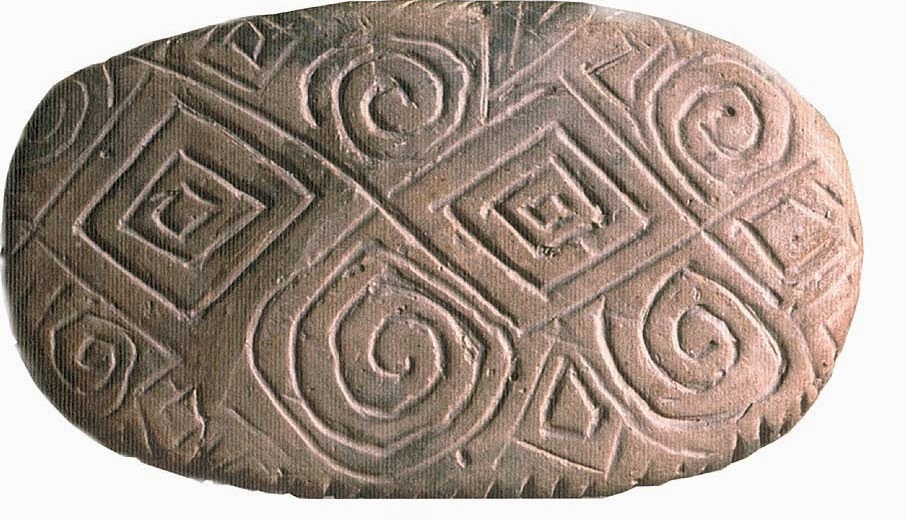 https://www.spurlock.illinois.edu/collections/notable-collections/profiles/mesopotamian-tablet.html
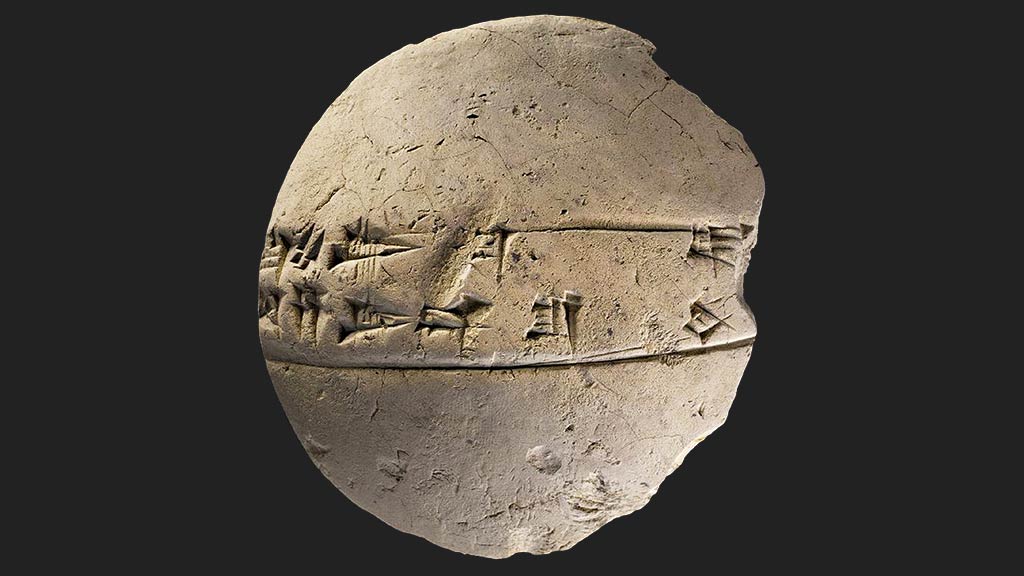 School Text on a Clay DiscBabylonia, modern Iraq2nd millenium BCE1913.14.1741 ————————————————————————–

http://www.ancientpages.com/2018/02/17/7000-year-old-inscription-undeciphered-vinca-script-one-worlds-earliest-writing-systems-discovered/ 7,000-year-old ceramic tile covered with Vinca symbols was discovered in Bulgaria. Credit: Twitter The Vinca symbols carry non-verbal information about calendar and ritual events.
The Vinca culture carved their symbols on wet clay using a sharp object. ===============================================
ON TWO SIGNS WICH OFFER CLUES ON PLECE OF ORIGIN, TYPE OF WRITING AND AGE.
“CAPITAL D-shaped” SIGN
Oldest (rather presumed than found) using of this sign is in the utmost earlier stage of sumwerian writing developement, on outer surface of economical clay tokens, as a jar/volumetric measure (Denise Schmand Besserat);time 3.500-3.300B.C. Two early sumerian signs are “like” capital D-s, but at the close distance are little different:
-one with a paralel stroke inside https://cdli.ucla.edu/tools/signlists/protocuneiform/archsigns.html sign Gar to be read “ninda” :” cereal,bread ration” and – sign for number 1:”DIS”
 .jpg) ( and same shape but bigger for number 60)
( and same shape but bigger for number 60)
But attention, only see from distance are D-like, because in realety the sign were made by imprinting and not by scratching ! From https://sites.utexas.edu/dsb/tokens/the-evolution-of-writing/ The Evolution of Writing DENISE SCMAND BESSERAT
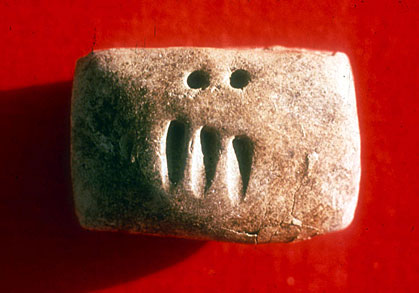
(Fig. 2) Impressed tablet featuring an account of grain, from Godin Tepe, Iran (Courtesy Dr. T. Cuyler Young, Royal Ontario Museum, Toronto) me : upper row 10 10, down 1,1,1=number 23
The sign D in scratched way was used after one thousend years in Egypt(~2.300B.C.?) as sign for “loaf of bread” Was used in Aegean writings Linear A si Linear B, but not as a logogram/syllabogram, but to represent fraction of weight unit mina or volume unit. (2.000 BC). After another time was used in archaic greek writing (800-500 B.C.) —————————————————————————- The sign  with 3 horiz. bars was used by sumerians as proto-cuneiform sign KU but not this shape but “boxed shape”
  (from3.200 B.C.) Was used later in Cretan hieroglyphic writing, (from 2.200 BC), Linear A (from 2.100 B.C.), Linear B (from 1.500 B.C.), later in Proto-Canaanite/Phoenician (1.500/1.100 B.C.) and Paleo-hebrew
  (from 900 B.C.) writings,, Anatolian and archaic Greek (800-500 BC)
See No.45, From https://www.researchgate.net/figure/The-Cretan-Hieroglyphic-table-of-signs-by-Evans-1909-232-3_fig1_273096050

The particular shape with slanted vertical bars as we have on the round tablet was used wide-used, only in phoenician, old hebrew, Crete and some places in Mediteranean Sea. From https://thegolfclub.info/70686f656e696369616e/phoenician-alphabet.html
The signs shape evidence is imposing to select a time window when those shapes were simultaneous used anywhere in the world. It is true that this could happen even in Aegean writings, but the presence in 2 places left side and right side (one doubled DD!) of the round tablet of measurement units is allmost impossible to have an coherent interpretation or reading, beeing rathe uninteligible.
Could not be phoenician or old hebrew writing despite the perfect exact shape of H het sign used by them, for the simple reason that the D-shaped sign was not used by them. ================================================================
THE EXPECTED TIME-WINDOW COULD BE RATHER AFTER 800 B.C.,USING ARCHAIC GREEK LETTERS (and of course especially in Crete)
=========================================================
Pity, due of early alphabets using in Greece, before come to be unified/standardised there was an epichoric phase (epichoros=local). So the sign D represented for some the sound/letter Rand in other place, for others letter/sound D !
From https://ro.pinterest.com/pin/431149364302140497/?lp=true
 So one must take both variants for the sign D wich are conducting to increasing the number of possible readings
- H D Di D o o sau 2. HD Di b o c
pentru 1 : *h₁ed/ EDe DiDOU :”give eat !”
Ancient Greek Etymology From Proto-Indo-European *h₁ed–. Cognates include Sanskrit अत्ति (atti), Latin edō, Old Armenian ուտեմ (utem), Hittite 𒂊𒀉𒈪, Old Church Slavonic ꙗсти (jasti), and Old Englishetan (English eat).
or : “give now !“
Ede – New Testament Greek Lexicon – New … – Bible Study Toolshttps://www.biblestudytools.com/lexicons/greek/nas/ede.html . … already 42, as soon as , now , soon* , this time …
possible also “ede DeDOU” :”give (goat)kid!”
for number 2: HERA/ HEROS (“lady/lord,defender“) in left and DiBOS,divos Deibos (“GODS“) on the right side. Note Included also an dorian/albanian(?) writing:
HeRa,Here Su RROC rroc=rrok TIME boundary, TERM ===============================================
Note
- all 3 tablets are containing an hodge-podge of signs, wich not all, only part of them could be found in a single writing sistem
- the closest writing to all signs is sumerian from the proto-cuneiform phase. The fact that most/all of the signs could be found in exact or liittle distant shape in proto-cuneifor could be explained if the sumerian signs are at the origin (mother af all) signs, in different world writings.Otherwise only half of the Tartaria tablets signs has exact sumerian-signs shape.
- Yet cannot explain myself how the “writer” knew so many signs, some old-ones, maybe from Anatolia and Levant (eg. Syria). Capable to scratch signs, but not sure at all that had knowledge of their meaning or phonemic eqivalence.
- so as other scientists advanced possible some/most of the signs mimics other signs******
- the place of origin if not for the tablets but sure for the scribe wich made for his living trading, isAegean/Cyclades area or Crete. An minoan or greek read CRETAN trader wich – could be of sumerian ancestry or – had extended commercial ( metallurgy?) contacts with far distanced areas, (as Anatolia, Suria, even Sumer!?).
- Possible the very sustainers of the sumerian origin of early minoans, I am naming here Misters G.PAPAKITSOS and I.KENANIDIS missed by close the discovery of their life: << the very physical, material evidence of sumerian presence and cultural influence in Aegean area, this evidence beeing Tartaria tablets ! >>******* ==============================================================
-
* The Position of the Tărtăria Tablets within the Southeast … – Jstor
See also S. Hood, “The Tartaria Tablets,” Scientific American. 230.5 (May 1968) …. theupper strata, most likely connected with the Baden-. Kostalac presence on … -
The Tartaria Tablets: a Chronological Issue | Antiquity | Cambridge Coreby E Neustupný –
“In this article Dr Evžzen Neustupný, of the Archaeological Institute of the Czechoslovak Academy of Sciences, emphasizes the problematical nature of the find. Vlassa had already shown that some layers of the Tartaria tell were mixed—and discusses the chronological issues involved. The attention of readers is also drawn to the note by Dr D. Berciu in his Romania (London, 1967, 161), and to Dr Quitta’s comments (antiquity, 1967, 266).”
-
https://www.academia.edu/…/Chapter_3_Existence_of_an_archaic_script_in_Southeas…Chapter 3 “Existence of an archaic script in Southeastern Europe: A … In a subsequent paper he dated the artifacts around 2600–2400 BC (Vlassa 1970: 30).
- ****
О КВАЗИШУМЕРСКИХ ТАБЛИЧКАХ ТЭРТЭРИИ ВАЙМАН А.А. Археологические вести. Спб, 1994. Вып. 3. Содержание. – ИИМК РАН http://www.archeo.ru › … › Археологические вести › Contents of issues “Two other tablets (figs.2,3) carry signs, many of which, according to Vlassa, are either identical with, or very similar to, those inscribed on the tablets from Uruk IV (early Proto-Sumerian script). The sensational find has gained a wide publicity. The most significant paper that has appeared so far is that by А.Falkenstein who has basically supported Vlassa’s conclusions. Falkenstein has compared the Tàrtâria tablets with those from layer III in Uruk and Jemdet-nasr (late proto-Sumerian script) using a number of criteria, such as clay, format, stylus, structure of the text, signs. He has proved beyond doubt that the script of the Tàrtâria tablets had been directly influenced by the proto-Sumerian script. “
- *****Untitled arheologie.ulbsibiu.ro/publicatii/ats/ats8/merlini.pdf The Tărtăria tablets as problematic archaeological artifacts ….. “the date of Uruk-Warka IV and Jemdet Nasr… seems lately to be the general … 1974/5: 27) and more precisely between 2900 and 2800 BC (Makkay 1973: 1).
Acta Terrae Septemcastrensis https://books.google.ro/books?id=q-pjwVI1Vz0C For a number of scholars the dating of the tablet to, a late period was … history and the Tartaria tablets as Cotofeni finds (G.I. Georgiev and V.I. Georgiev 1969).
Iuliu Adrian PAUL ENIGMA TĂBLIŢELOR DE LA TĂRTĂRIA SCHIŢĂ PRELIMINARĂ* http://bjastrasibiu.ro/wp-content/uploads/2015/08/130-iuliu.paul_.pdf
“Astfel, E. Neustupny (E. Neustupny, 1968, p. 32-35), referindu-se la
tăbliţele de la Tărtăria, subliniază că, după părerea sa, nu există decât două
posibilităţi: ori datele C14 sunt fundamental greşite, ori tăbliţele nu aparţin
contextului arheologic de care au fost legate de descoperitor, adică stratului
Vinča-Turdaş de la Tărtăria. În argumentaţia sa, el înclină spre cea de-a doua
posibilitate, bazată, printre altele, pe faptul că la Simpozionul Internaţional
privind cultura Lengyel, ţinut la Nitra (Slovacia) în 1967, s-a precizat că, la
nivelul tăbliţelor, s-a descoperit şi o ancoră de lut de tip caracteristic culturii
Coţofeni şi bronzului egeean timpuriu.“
******The Lost Civilizations of the Stone Age https://books.google.ro/books?isbn=0684862700 Richard Rudgley – But the string-holes on two of the Tartaria tablets appear to be a feature without … that the tablets represented a garbled and ‘senseless’ mimicry of Near Eastern ...
of the Tărtăria tablets – Dacia. Revue d’archéologie et d’histoire ancienne http://www.daciajournal.ro/pdf/dacia2016/18.pdf Thoughts about a “reconsideration” of the Tărtăria tablets . …… an object as faithfully similar as possible to the Mesopotamian model which he wanted to imitate,.
the tartaria tablets – jstor https://www.jstor.org/stable/pdf/24926226.pdf by MSF Hood –SUMERIAN WRITING of the period around 3000 B.C. covers a clay tablet found at Jemdet. NasI’ in Mesopotamia. … on tablets found at Tartaria in Romania (see illustration on opposite page). ….. prehendingimitation of more civilized peoples‘ …
Attention, the folowing article is referring to Vinca-Turdas culture; the tablets are much newer ! M. Masson. Interaction of cultures and cultural integration http://www.archeo.ru/izdaniya-1/archaeological-news/annotations-of-issues/arheologicheskie-vesti.-spb-1994.-vyp.-3.-annotacii
- “An appreciable shift occurred in the early agricultural period, when societies which had attained similar levels of cultural and intellectual development displayed considerable receptivity to integrational processes. Yet here as well the “rejection” is evident. If the decoding of the famous tablets from the early agricultural site of Tartaria, Romania, proposed by A. A. Weiman, one of the world’s most authoritative experts in Proto-Sumerian texts (see this issue), is correct, a highly peculiar picture emerges. In the depth of the early agricultural Balkan area with its remarkable achievements in the artistic and intellectual domains a stable complex is found which is related to the temple structures of the Sumerian civilization. No matter whether the kulturtrager from Uruk had actually built their temple somewhere in the vicinity or whether we have before us a unique case of import having no pragmatic value, it is absolutely clear that these hallmarks of urban civilization had in no way been integrated into the system of early agricultural communities, which, in my opinion, had achieved the initial stage of the early complex society. Numerous and diverse signs found on the artefacts from the early agricultural Balkan sites are doubtless related to some symbolic and magic system, but do not represent a system of writing, which is a phenomenon different, in quality. So the Proto-Sumerian prototype did not in any way affect the local society, which was probably content with the available systems of storage and transmission of information (probably the oral and the artistic ones).”
- TARTARIA AND THE SACRED TABLETS.pdf | Pottery | Archaeology https://www.scribd.com/document/…/TARTARIA-AND-THE-SACRED-TABLETS-pdf
The tablets of Tǎrtǎria. An enigma ? A reconsideration and further …
… between the Orient and southeast Europe or Transylvania in prehistory. … influx of Near Eastern elements into the Aegean around 3000 B.C. (Charvát 1975).
******* Minoan Sumerian | Giannhs Kenanidhs – Academia.edu http://www.academia.edu/11423494/Minoan_Sumerian
(PDF) A Comparative Linguistic Study about the Sumerian Influence on the Creation of the Aegean Scripts. … https://www.researchgate.net/…/273885539_A_Comparative_Linguistic_Study_about_t…Additional Palaeographic Evidence for the Relationship of the Aegean Scripts to the Sumerian Pictography
Additional Palaeographic Evidence for the Relationship of the Aegean Scripts to the Sumerian Pictography Evangelos Papakitsos Ioannis Kenanidis https://www.researchgate.net/…/279940914_Additional_Palaeographic_Evidence_for_th…
 Tartaria tablets
Leave a comment